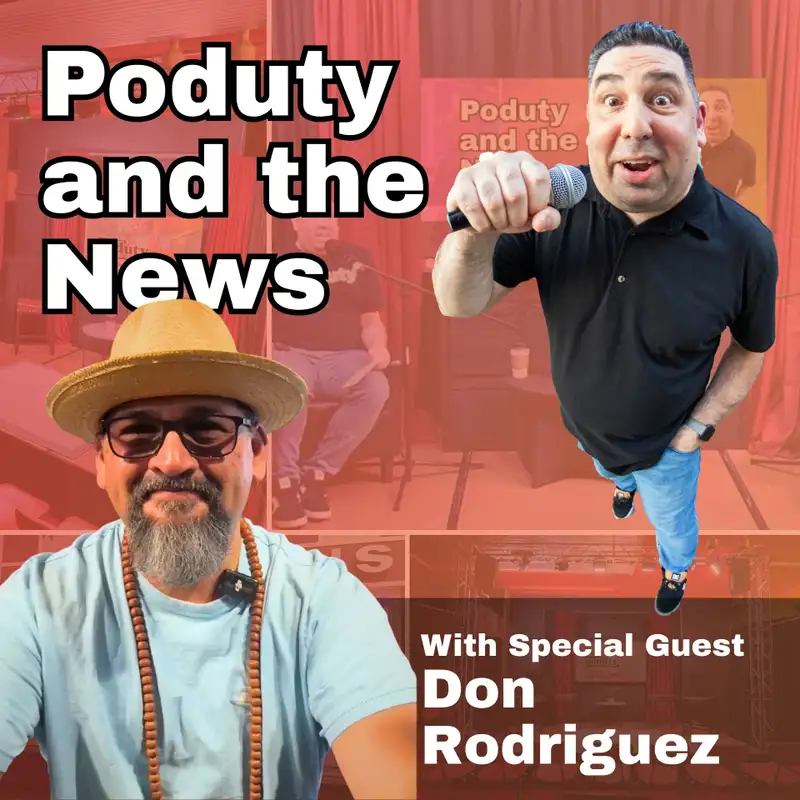
Oh, we are live. Hey, everybody. Welcome to Paduti in the News for
Tuesday, May 5, 2026. I've got a great guest joining me
today. Don Rodriguez, INI Studios record
label. Don, do you know what time it is,
man? It is Poduty and the News time. What time is it?
What time?
Poduty and the News.
Poduty and the News.
The only live news podcast about
podcasting from the st.
The only live news podcast about
podcasting from the ST
Stage. Oh, the only live
news podcast about podcasting from the stage. Don, welcome to
the show. Hey, thanks for having me, Jeff. And. And tell me who that artist
is. I'm ready to sign her. She's hot, man. She's got it. She's got everything
I'm looking for. Oh, man. Some people don't want to know who the artist is.
You. This is a one man show. I'm trying to do a lot. I do
a lot of research. As you mentioned before, I need help and sometimes,
you know, I rely on certain tools and certain things to. To get the job
done. And that's something I created about
six months ago and I just been using it. People love the song. Yeah, so
do I, man. Yeah. No, I'm just messing with you. I figured it's something like
that. I create content all the time for the same purpose, you
know, podcasts and other stuff like that. So. Great. Yeah, thank you.
Thanks for having me on. It's a pleasure. Yeah. I'm so excited to have you
here. I love. I was looking at your studio pictures before we went live
today, and the way that you structured the studio and the way
that you approach recording artists, I'm in love with it.
You saw a little bit about the theater space here. So, you know, I'm a
big diy, you know, independent production guy. But what
you're building is incredible. Tell us a little bit about INI Studios.
So it's a recording studio, record label, and
a music publisher for independent artists. We represent independent
artists solely. And the reason behind that is just because I like to
put in my efforts, energy and resources
to where they're best needed. They can best be suited for people who are trying
to emerge into the music industry, which is harder than
ever these days. So, yeah, this studio, it started
as a rehearsal studio where me and my friends would jam out. And then I
converted it to a recording studio where we can record
masters and built a bunch of sound baffles. And it's a
great space. And the idea that
I got for its layout was really the
one time I was doing the sound check. And I felt that the best I
had ever sounded was on an empty stage doing
soundcheck. And so I thought, okay, I'm going to build this studio
that really looks like a stage and a performance. And instead of the
audience, I put mirrors against the wall so that you could
see yourself perform. And that's probably the biggest thing that I would get compliments on
is like, wow, I can see myself perform. And I didn't
know that I was doing that. And artists immediately start fixing things because they
can see themselves. But it is. It does very much emulate a live
performance venue with no audience. And so you
get that, you know, eyes closed, live sound. You can hear me in here
now. It has a lot of natural reverb to it. I took a lot
of time creating that. It's not. It's not an accident. I try to
stay humble, but anyone who's in the business will know creating good
sound is not an accident. Yeah,
I love it. It's almost like these little pods or like little mini TV
studios where people can go in and perform. And it
just feels like next level. Like, you feel that
professional treatment. You feel like this is your space,
this is a place for you to perform. And it's just built so
naturally, especially probably yourself as a musician.
Like you said, you catered that towards being able to perform,
solo, perform like you do during soundcheck in an
open theater. You're recreating that and giving that
back back to the community. So that that idea of how
to create, you're at your highest level. You're sharing that with.
With musicians all around you. That is the idea.
And thank you for recognizing it. I mean,
you know, it's. It's a working thing to record
masters. It's not easy to get up in front of people and
sing and go through warm ups. Even now, most artists who use
the studio will warm up on their way. Because warming up is kind of an
embarrassing series of cackles and screams and
yelps. That's not pleasant. And so one of the things here at
this studio, when during our recording sessions, during the week,
unless we're on soundstage, we really don't allow. I don't allow guests
inside. It's really just the artist. Because making
music is a personal thing. And even me being the producer
and the sound engineer standing here working with you, it's a
difficult thing to put all your inhibitions down and
sing and warm up and hit bad notes and start
over. It takes a lot of patience and a lot of Guts. So yeah, it's
not for everyone. And I've had artists who have come in
for a week or two and just decided it's not for me. I'm going to
go back to my home studio. That's fine too. I get it. I understand.
It is next level stuff. Yeah. Get a chance. And what's the website?
The best way to check it out and see the space and see everything that
you're building over there? Www.I and
imusic.studio. that's I a N D I
M U S I C studio.
Yeah, check it out. Just poke around on the site and just look at the
different ways to record, the different setups, the different sound
stages. It's incredible. I was really immersed in it,
going through all the content on the site. Thanks. Now I built this
studio for me and then like I said, I opened it to other independent
artists and I'm a 20 year entrepreneur in my previous
life was a contractor. So I'm very familiar with contracts
and I built a record contract that I would want one where
the artist owns 100% of their masters and their compositions
and there's no options in my record contract. So we just do one record at
a time and it comes with a three year publishing deal because I opened
up a publishing company as well and registered as a publisher with
BMI and ascap. So I kind of put all the layers together
when I built the studio, when I built the concept so that independent artists
could come here and it could really be a one stop shop. So when you
visit our Instagram page or the website, you're going to see the different rooms, the
different studios. We have a photography studio and choreography studio
or dance studio I should say, where artists work on their choreography. Or if
we have a photo shoot, we'll do photo shoots in there. And then we have
a podcast booth where we'll do interviews of our artists and put that out there,
do snippets of interview pieces. So we try and hit everything that we
can because it's really, really, really difficult to be a music artist these
days. My number one thing, and we're going to get into this as we talk
about these news topics. But the number one thing I
emphasize to artists right now is that it is easy to make music. Everyone
has a home studio. Your uncle, your brother, your cousin, someone you know has a
home studio. When I was young, getting into a studio seemed impossible.
But today that's not the issue. Today the issue is being heard.
Right now there is 100,000, over 100,000 songs a
day are uploaded to the platforms, the streaming platforms.
That is 3 million songs a month. So if you are an
independent artist and you are aggressively, and this is aggressive,
Jeff. If you are aggressively releasing a song once a month,
you are one among 3 million singles.
If you are more realistic and still aggressive, and anyone who's
independent, an independent artist will know this. Still more
realistic and yet still aggressive. One every two months.
We are one single among 6 million singles.
So really, today's music industry, the challenge
is not making music nowadays. The challenge is being heard.
And so when we get into these topics, you're going to hear me talk about
that. I have four pillars to, to,
to, you know, my business or what we talk about here, always
here, that is being heard. It should be our goal. Owning our
music should be our goal. Music should be human
and we should collaborate as far as, as much as possible. I don't think
that's the fourth pillar. It's probably slipping my mind. But we're going to get to
it because I have a bunch of notes. Yeah, and your story and
what you built is very parallel to what we're trying to build here for
podcasters. And you're kind of that one stop shop if you want to record.
And there's the distribution and the publishing and all that.
You're helping the local musicians
put something together that's bigger than themselves. You're kind of
amplifying what they're building. And what we're building here is a
live podcast venue where we'll build event landing
pages, we'll help them sell their tickets, we'll record
their podcasts for them, we give them back the recording. We don't take any
ownership. It's very important for us to bring people in without
risk. We'll Split the door 50, 50 in ticket sales.
But that content creator isn't on the hook. Or there's no. Like
if you were to book an event at a hotel and use their ballroom,
all those little line item hidden fees, the cleaning fees, the, the move
in fee, the move out fee, we're trying to get rid of that so that
people can perform their shows without fear. They're on the
hook for $2,000 at the end of the night if they didn't sell enough tickets.
And your story is very parallel to that with
really focusing on the independent artists, really focusing
on lifting them up, giving them a voice, helping them get
heard. That's one of your big pillars and that's what you're doing. And I think
that's why your Opinions tonight and your
expertise is going to lend so much to these six stories. I
appreciate it. Let's dive in. I'm ready when you're ready. Let's go. We'll go
to story number one. This one's a big guy. The
Google. The Android show controls the rollout, and
Google's not waiting for IO to tell their story. They are starting
early with their own show, setting the tone before anyone
else gets a say. This is about control, control of the message,
the timing, and the audience expectations. In music
and podcasting, in any creative business, the people who win are the
ones who own their rollout. They do not wait for the platform
or a moment they created. And this was an example
of they have their own stage when they present their updates and their
releases. They have a space to record that content
and distribute it from out from all over the place. But they're doing it a
little bit early. They're doing the Android show before this
year's event, and that's an added experience for people who
are fans of Android operating systems, cell phones. And they're going
to do a live podcast recording before they do their big
event. I think that's huge. These experiential
ways to bring the audience together, this is what we're seeing
more and more across conferences, events and
other industries. And I'm sure you're seeing a lot of this in the music
industry. You. Absolutely. Actually, you
mentioned that you're bringing artisan and doing podcasts. So you're
already ahead of the curve. Well, because as an artist these days,
again, the. The objective is to be heard right among all the
music that is being uploaded to all these streaming platforms
and. Yeah, absolutely. I think the most important thing here,
Jeff, what I'm emphasizing to my artists and my friends, is
that you have to decide what you want to be. Do you want to be
an artist, then you're going to need to go down an artist path. You want
to be a producer, then you need to be a producer. A lot of,
you know, young people these days who are making music, they want
to be everything, because, I don't know, there's a few superstars
that are everything. I dabble a lot in
Buddhism. And one of the things they say in Buddhism is if you. If along
the path to enlightenment, Enlightenment, you run into the Buddha, kill him.
That's because that saying means, is that your path is
individual. It's not this specific path that you might
have read about or that you're trying to emulate. And as soon as you
start to Try and grab the universe by the neck and say,
I've got to do it this way. The universe is much bigger than you and
it kicks against you and you generally will lose. I am
probably in the minority on this story. As a music producer
and a studio owner, I am letting Google do what Google
does. On this one I get stings a little bit.
It feels like you're taking control from me. But
at the same time, as a 20 year entrepreneur, I can tell you
an Armenian customer gave me some great advice a long time ago. He said
the best way to save money is to hire the expensive guy. And what
I meant by that is the people who do things well, pay them,
let them do what they do. And in this case, Google does a
better job distributing. And if they have multiple platforms
that they're going to distribute our art to, then I'm all for it.
What I would rather focus on, if it's me as an artist,
what I would rather focus on is getting on the platform.
You know what I would, what I would say to this and this is a
big one and, and that's why I want to explain it well to the artist.
Because I know there's artists I know in my stable right here, they're going to
be like this is, you know, I want to release this when this and that
and that. I totally get it. But in this one, I'm going
with Google. I'm going with Google because I believe they do a better job.
And the analogy that I'm, that I'd like to give on this one is, is
you got to think of Google as a music festival and
as an artist. I want to perform at the festival. But Google is
the music festival. They have the grounds, they have the parking,
they have the shuttle, they have the stage, the sound system, they're
selling the tickets. And most importantly, they control the gate.
They control the gate, they have all the people, right? The
audience is what we're trying to get and the audience goes to
Google just like they go to a music festival. So
let's focus less on, you know, trying to
control the music festival and focus more on trying
to get on the stage at the music festival because
Google has the people and that's really what we want. And if you're a smart
artist, what you're really doing is getting on the stage. And once they're
capitalizing on your, on your 10 minutes on that
stage and making that audience that Google has start
to follow you, right? I mean that's really what you want to do. We want
to get on these big stages and pick off audience members
as crossover fans. You came to the music festival
and you left as a fan of mine as well. And that's what I
really want as an artist. So I'm not bucking Google here. I'm letting
Google be Google. I read this headline and honestly my interpretation
of this headline was Internet giant takes
a little bit more control of the Internet. I mean, you know, that's
okay. Google's going to do what Google's going to do.
Amazon's going to do something next. Right. So
choose what you want to be right now. If you want to fight the system
or do you want to be part of the system and gain from the system?
That's what I would say here. Yeah, we're seeing a lot of
podcasters reach out to events, reach out to
different conferences and we're seeing conferences,
select podcasters as part of the entertainment. So here we have the
Android show as part of this event. There are conferences
where whatever you're talking about, whatever you're passionate about, there's probably
a space for you to do something, whether it's be part of a panel
or run your podcast live. But you can get in front of that
community, that audience and share your expertise with them
in a way. You couldn't just kind of like me sitting in my silo
here recording my own show over and over again if I was
recording this at a conference where people knew Padooti News, it's time
for Padui news. They're all dancing in their chairs. I'm going to make a different
type of connection performing this show in front of a live audience.
So what Don's talking about here, this is something you should think about at
a very small DIY level. Where can you position
yourself to be in front of the audience that cares about what you're talking about?
Yeah, and I really like your conference level. A few weeks ago we had the
Las Vegas drum show here in town and Roland, the,
the company everyone knows and loves, music production and
video production tools. Roland had a
podcast in the corner set up there and, and yes, this is exactly
what you should be thinking. You know what, I'm glad you mentioned that to me
because I was just at a, you know, one of
those pop up tent festivals over the weekend and I had my own tent
out there and I'm handing out my own flyers for, for this studio,
trying to get followers and subscribers like anybody else. In
other words, nobody, nobody is outside of this system.
And anybody who's like, oh, you got to do this and that and, you know,
wake up in the morning and you'll have this many. You know,
anyone who's going to tell you that there's not work involved is
probably lying to you. Right? There's work involved. So,
yeah, I like it. I like the conference idea. I would get there, I would
get to conferences, see if you can get a space. You call them up and
say, hey, I want to do a space, I want to do some interviews. Don't
ever try to hide what you're doing. That's how you get in trouble. Because,
because sometimes if you're like, I don't think they're going to let me do a
pod, my own podcast while I'm at that conference and I don't want to say
anything. I would rather say something, be told no
rather than try and hide it because a lot of times you'll find that they
would have told you yes, but, but you didn't say anything. So they put you
over in a spot where that's not conducive. There's a lot of noise and
stuff. So always be up front. And I really like that idea. Get
to these and if you're an independent artist, listen to this. Do the same
thing. Get to these pop up festivals in your town. I know
there's a ton of them. There's, they're everywhere. It's springtime,
summertime is coming up and get yourself out there, make yourself
a thousand flyers. Then that doesn't have to be fancy right
now. We all need to be heard again. You're going to hear me say this
objective all the time. There's lots of, of noise out there and
we're trying to be heard amongst the noise as independent artists. So
we got to go back to grassroots, especially since if I can just add
this one thing, we're finding out now that you get this blue check
mark on, on meta. And a lot of those
followers and likes are just feel good bots that you're paying
for, you know, and they're not real people, so that's not
cool. You know, I, I would rather have real organic people. I mean,
the likes and the follows feel good, but, you know, at the end of the
day, I'm trying to reach real human beings.
Yeah. Speaking of real human beings, our second story, this is, this is
as live as live can get. We're talking about, you know, going live at
conferences, but Graham Norton is taking his
podcast to the fringe. And this is what building an audience
over time looks like when it pays off. This isn't just content
anymore. This is a room full of people who chose to show up
in music. That's the goal. Not just streams, but fans
who will buy a ticket, show up and be part of experience.
That is where the real value is. And this one comes from us, from the
Edinburgh reporter, and it's Graham Norton is bringing his.
It's called Wang it On, which is caught my. I love, love that
title. And he's doing a live performance and this is exactly
what Don's talking about. When you see an event like this and
you see people showing up, you know, what does that bring to your mind, Don?
It brings to mind my hero, Larry King. You know,
it brings to mind what, really what we're doing
is opening to live audience things that, that
used to be a very small audience or
no audience, right? And, and this reminds me of
Larry King because Larry King for me was just
one of the best live interviewers in, in, in the history of the,
the country. And I know he credits people himself, but I really
think a lot of Larry King. But he would go live and he would do
these similar conversational style interviews.
And now what we're doing is opening it up to a big audience
that people can come and have these. Now that kind of sounds like,
I don't know how old you are, Jeff, but I mean that kind of sounds
like Donahue or Geraldo when we were kids that are babysitter, you
know, watching tv. But this is great. I don't
think it's, I don't, I don't think it's new, but
that's fine. It doesn't have to be new. You know, there's, there's
plenty of great coaches that, that'll tell you. Take something that, that
someone has done and put your spin on it, put your style on it.
Apply a strategy from another industry to
your industry. You know, these things are great. And, and I love what he's doing
and I love the wanging on form, long form conversational
podcasts. I think they're smart. People feel like they're part of the
conversation. You know, again, I'm gonna say
be heard. It's, it's our mantra here at the studio. But
it really is the mantra of a generation. Right?
They want to be heard and you just hear this all the time. And
it's the thing that makes politics so difficult
is because people want to be heard and they want to feel like their
opinions were expressed and that they were listened
to and that they were considered. Right. Whether they were or weren't
is A different thing, but they want to feel like it. And so when you
have a wanging on type of experience and you let people
become involved, it reminds me of, of the
original Twitter years ago. This is at least
15, 16 years ago, I would go on and
watch my football team and I would go on to
Twitter. My wife would be like, why do you watch the game? And you get
on to Twitter. And it was because if you follow the
certain hashtags for the, for the game that the NFL set up,
you could interact with fans
and opponents if you wanted. I never got in the opponents one because that stuff
got really. But you could interact with fans during the game about
what was going on live. And now, I mean, he's just, again,
he's applied all this live Larry King interview,
conversational thing, NFL hashtag,
conversational things going on and letting this audience both live
and online participate. And I think it's genius. And
I'm all for it. I love it. I think this is, we should do more
of this. This is what people want. They want to be involved and they want
to be heard and they want to think. They want to believe that their, their
opinions have been heard and considered. I
think podcasters, too, are waking up to this reality
of churning out content for algorithms, right? They're making
these video shorts. And if you were a good podcaster and
you were starting to get some ad revenue coming, you'd find out that
the amount that you make per download is about 2 cents. If you
got a thousand downloads, you can make $20. And for
most podcasters, getting to a thousand downloads an episode is very difficult.
It's a high bar. It's the only. The top 5% get over a
thousand downloads. But when we start talking about these live events,
what they're building here, what Graham's doing here. Graham
Norton, four to five tickets. If you
can profit $5 from four to five tickets, an
in person audience is making you the same amount of money
as 1000 downloads of a podcast. So the value
of getting somebody to come out to see you sitting down in front of you,
it's 250 times greater than a digital
download. And I think when podcasters start to realize, okay,
maybe a thousand downloads and episodes out of my reach, but 15,
20 people in my local town are able to come in,
you're already right out the gate making a kind of money that
people who get 5,000 downloads are making. So really think
of the value of in person versus digital.
And why am I surveying these algorithms that I'm just hoping to get
likes and clicks and shares that don't really have any
retention. Nobody really remembers the 200 TikToks they watched
last night before they went to bed. But if you met 10 people sitting in
front of you, those are 10 really good connections that you can build off
of. That's a tangible asset. Those are fans who like what
you're building. They came out to see you. They're giving you money to
perform what you're doing. Keep those things in mind when you see these types
of stories, that there's a whole, whole network growing. And
we're seeing it a lot from some of the gurus.
Gary Vee has been very bullish lately on
the future is analog. And it's something I believe, and I know dawn
probably is going to really like this concept of getting
away from digital and being with people, being
around people, sharing your passions. And this came to us
from the TPBN YouTube channel. And Gary Vee is saying what a
lot of creators are starting to feel. Digital is easier
than ever, but that also means it's more crowded than ever.
And that's what don saying, like, 6 million new songs in two months.
The real opportunity is in the balance. Use
digital to get attention, but build something real that people can
connect to in music. That means owning your work, building your
audience, and creating experiences that go beyond the
stream. Yeah, I agree with Gary on
everything here. And I feel like what Gary is saying is what he's
always said, which is at the end of the day, what
we're really selling is trust. And that's what we're getting back
to. And I feel it in the music industry big time, you know,
trust in a human being. Trust. I mean, think about it now, how many times
we call up customer service for a product and
all we want to do is get to a human. We used to
hate how long it took to get a human. Now
we'll wait three days if it means we'll just get a human, because
the AI options really aren't that great yet, you know,
so we're gonna get back to that. I feel like the music industry
specifically is feeling what Gary is talking about.
Not that we're gonna go from digital back to recording on
tape. That would petrify me. But.
But we're gonna get. We're gonna go from.
From clean digital back to humanity.
Right. And it's a shift. And I've seen this before.
It. It feels very much like the late 80s when
we were. We had a lot of synth music. It was so
popular. We Were inundated with all kinds of
beats. Beats and synth music, sounds and
tones and all the music was great and I loved
every second of it. But then we reach like this end
where we're like, oh, we're just kind of done with all this clean,
you know, technology. Techno music. It was called techno.
And so then that was the birth of grunge after that.
And you saw the music industry shift, pardon my hand,
shift from that clean, you
know, era of. Of synth music back
to real instruments, real vocals,
real people singing about real human experiences,
not about la di da di da. I was at the club again this
past weekend. I mean, that's fine composition, don't get me wrong. I'm not
knocking anybody's content. But you saw a shift.
And I think that's what we're gonna see again. That's what I'm saying. And I
think Gary's onto that. Gary's like, you know what? We're kind of
reaching the end of digital clean, blah,
blah, blah. We want to be reminded that life
on earth is difficult and it's not, you know,
hunky dory at the club doing this. Yeah. You know,
drinking, smoking, whatever, whatever they talk about. So
I think that's what we're seeing. And I'm all for it. Again, that's what
I'm telling my artists. You know what? If you want to have
a sustainable career right now, learn an instrument,
become an artist that. That can perform
with live instruments, you know, and don't worry about
your voice so much. I would say, you know, stop working on your
voice and start working on playing a piano or a
guitar or. Or something like that. That is going to make
you feel more human and let your voice, you know,
not be great. And I just had an artist this morning who was in
the studio working and he was working on recording vocals and he was doing
some engineering work. And I told him, leave your breath in there. You know, there
was a part where he takes a breath just like that. Leave it in
there because that's telling people that this is a human behind that
microphone. AI doesn't have a breath.
Yeah, keeping it real. Keeping those little, those little nuggets in there that
later on people come back to as behind the scenes facts or
did you know that during this song they did this? And those become
the things that people really connect to. That makes you human. You
make mistakes. Even on this show. I'll stutter a couple times
and I'll trip over my words and I have to remember to slow
down so that I'm not talking like a Pittsburgher, but those things
are. That's who I am. That's who I am as a host. And those are
things people connect to. And I get feedback. Like, people like my
voice. They like hearing the way I sound. They say it's soothing. I don't know
why, but those are. That's me, and that's who I am
on stage. And you're going to have your own way to perform
on stage, your own way to do things that's completely different than anybody
else. And nobody has ever done it the way that you're going to do it.
And so really embrace those things and. And lean
into them. I agree. I agree. And what
Gary is saying is that is what the new audience is
looking for. They want. They want to know what is
real. I mean, and I'm facing this all the time. My wife and
I. I just turned 50 last year, and my wife and I are always like,
we can't. We can't decide what's real or not. We'll ask our kids,
hey, is this video. This bear on a trail? Is this one real?
No, that one's not real. Okay, about this cougar on the trails. This one real?
Yeah, that one's real. Well, how am I supposed to know? So I think
that's what people are going to want. I think that's what the audience is going
to be clamoring for soon. They're going to want real humans. They're going
to want humanity. They're going to want to be reminded
that we're not alone on this big floating rock in the universe.
Yeah. And, you know, coming from two creative entrepreneurs,
our next story really leans into that of your. Of creating.
Right. And if you have an idea, here's an. Here's a chance for
you. This comes to us from wnyt so New York, that
somebody's offering a year of studio time. I don't know if
it's one session a month for 12 months, which is still a great
opportunity. And if you pitch your podcast, you could
win the launch of your podcast. And this story is about giving people a
shot. A simple pitch contest. But behind it is
something bigger. Structure, guidance, and a chance to be
seen. That is what turns ideas into reality. In
music, talent is everywhere, but without support and direction,
it never gets heard. This is about building a system that
helps creators take that first step.
Yeah, I can totally resonate with this contest. As a matter of fact, I'm going
to steal this idea because I'm always looking for ideas. You know,
one of the, one of the things that I explain it this way.
If you're a vocalist, then your instrument is your voice,
right? This is what you do. The problem is
you need something to sing, right? All the time you're always running
up against this challenge that you don't have anything to sing. And I'm always
talking to vocalists, especially the really, really good ones.
They'll say, just give me something to sing, right? Not another cover
song. Give me something original to sing. I feel the
same way as a producer all the time. I feel like that vocalist does. When
I opened the studio, the first thing was like, okay, I mean, I've got my
own music and that's great and I'm producing it. But the first thing
I thought as a producer, give me something to produce. And I immediately
went out there looking for stuff to produce. I was all the things that were
important to me. You know, I'm into Kundalini Yoga. So I
approached my Kundalini Yoga instructor and I said, let's make this YouTube series
about Kundalini into yoga. And she's like, okay, sounds good. Because
I needed something to produce. I have the studio. I'm a producer,
a retired contractor. I want to produce things. So I kind of, that's what I
read into this story was like, yeah, I'm going to hold a contest too.
Not because it's not great to help and support other people.
Because sometimes if you're doing a thing, you need to do something, right? You need
to sing. If you're a vocalist, if you're a producer, you need something to create.
So I'm all on board with that. And I love helping
people get, you know, get off of their feet. There's a lot of great
ideas out there. And what I like most about this story is that they
recognize that it's a new world, right? There's Roku, there's
YouTube, there's. There's a bunch of new, to
be a bunch of new streaming services. So
you're not limited to just like some late night
TV show producing, you know, your weird gadget show
like I used to watch when I was kids. Nowadays you can produce a
real high quality show series and, and put
it out to YouTube and then get it registered on Roku, which is what we
do here as well. And, and to be in other places, try and
get as, as many places as you can to get your
content out there. In fact, Jeff, what you're doing right now, this is content.
And a lot of people ask me, dawn, how is it that you give your
artists master or ownership of their masters and their
publishing. We haven't even talked, we haven't got to publishing yet. The whole world is
talking about masters. You're already jumping to giving them compositions too.
Well, that's because I'm not going to ride the coattails of their music. I'm going
to produce my own video content. The label is, and we're going
to, and we're going to use that as content driven
revenue. Right. You know what I mean? So right now, the old label has always
been, you have this artist and the artist makes music and
everybody makes every dollar off of that one
song. Sorry, pardon. I get passionate. See,
And I just want to change that. Like why, why make it that way?
So when you see people producing new things, it's for that reason.
So I'm here in the studio, but I'm not just producing my own music,
I'm producing other people's music. And then content. As well as
Kundalini show, I'm launching another, another show called
Ali Jazz Sessions that's going to premiere in October of
26 and run through June of 27. So it
takes that, it really just. If you're going to be heard, if you're going
to be seen, you've got to get out there and do it. So if you
have an idea, pitch it. And you're in the area of this contest, pitch it
to them. Don't think that your idea is silly, but I will
remind you, your idea is, is just
words and words are just sound waves moving through air. So
unless you call someone and you put something into action, your
idea is going nowhere. So I fully support this. If you have an idea and
you're in the Las Vegas area, call me. I, I love new ideas. Tell me
what you want to pitch. I have another one that's about reincarnation and
it's called the Silhouette. I'm going to produce that one this summer too.
So, yeah, listen, I love it. This is great. I love supporting people and their
ideas. I, I, I would love to see all the
ideas that would come through. The only thing that would make me upset, and what's
going to upset these people behind this contest is that they can't produce
everything because they're going to get some great ideas and they're gonna be like, well,
now we got to choose one or three, you know. Anyway, go ahead, Jeff.
I'm monopolizing the conversation. No, this is why I want you here, Don. I want
to hear your experiences, your perspectives and, and getting it from the music industry.
There's already a lot of foundation there that. That's parallel to what
we're trying to build over here in the podcast industry. So you're giving us these
great perspectives and that idea of doing a scholarship or
really supporting your local community that like this studio is doing, Don's talking
about doing it. I've done things where I've done free training on how to
podcast. I working on. There's a summer camp for
girls empowerment. I have two daughters. And the
idea that I could fill this theater in the summer with 30
kids who want to learn about podcasting and content creating. And it's all done.
The whole space is donated. Those are the things that plant those little
seeds that sprout into something so much
more magical than your business idea. It's
bigger for the community. And those types of things come back and
you give, and the community gives back to you. And you
don't do it just for the reason to give, but you do it because it's
that that rising tide lifts all ship. If, if I can bring in 30
kids and two or three of them are inspired to do podcasts, well,
maybe two, three years from now, they're filling this place
up because they found a passion and they're.
They're just so grateful to have a place to perform. And. And that's why you
do these things. And that only happens in local businesses. You don't. You don't
see Google sponsoring the kids baseball teams or
the football team. You'll see their banner in the outfield.
But your local businesses, these local communities, these
studios, they're the ones that are out there doing the hard
work for the community and to help bring everybody together.
And this, this is a great podcast. The
Duh two to nine podcast. They're building a local
movement. I love this happened at a skating rink. And this comes
to us from the post Searchlight. This is what happens when a podcast
becomes more than just a show. A local event free
for families, built around connection and conversation. This is
how you build something real. And in music, it's the same idea. You're not
just putting out songs. You're building a community that believes in
what you're doing and shows up for it. And this was
like at a roller skating rink. There was food. They were feeding the community. There
were donations. It was just a great event. And they recorded a
podcast during the whole thing. So it's that full circle now that
all the things Don and I have been talking about, building something for the community,
supporting the community and they're showing up to support you in return
and listen to your podcast and hear about the things that you're doing.
This is huge. This is important. I mean,
I don't think that you can make a better move as an
independent artist if you're an independent artist listening to this or a
podcaster like you represent. Jeff,
There's a band that I've worked with here in town in Las Vegas, locally
called this side. They're, they're a punk, new age punk band.
And over the, the last holiday season I saw on their
Instagram they were getting their family and friends together
on a turkey drive and bringing it over to a place that was
going to be preparing meals for the homeless and that.
I mean, I'll tell you as a producer, as a studio owner
label, I mean, I'll sign you just based on
that because you got to understand from my point of
view, I need someone who's going to be out there working in the community
and getting their name out heard. If you want me to invest my money in
you, right, I need to know that A, you're prepared
to perform and B, that, that you're going to do things like this
because we're going to have to build this grassroots
fan base from zero to wherever it goes.
No one's building it for you and you can buy it. But I covered that
in the, in the beginning. Do your research, chat, GPT something,
look into it. A lot of that stuff is bots that you're paying
for the feel good bots, you know, and, and that's great.
I'm not down in anything. I'm just letting you know, just know what you're buying
and I'm a big proponent of that. So I really like what they're doing in
this, with, with this kind of stuff. And I like the post
Searchlight. I love the name, I love what they're doing. And you know,
when you think about this, searchlight is, is out there signaling,
gathering attention. And post Searchlight
means what do you do once you've got that attention,
right? So if we're out there, you know, with our Instagrams and our
Facebooks and our tick tocks and whatnots and we have all these
little video clips and we're trying to send them viral and we're
doing everything that we can to be noticed, seen and heard.
Okay, once we're noticing and heard, then what? You
know, I had this happen to me and not to too, not to too.
I just, I, I, I, I'm, I'm coming from you with real world experience,
I produced a show called the Boulder City Sports Network is the very first thing
I produced. When I opened the studio, I thought sports is an easy end
because I know sports and I had kids and this was going to be good.
And I had a video called Gabe's Touchdown and it got
2.4 million views and 100,000 likes.
You know how much money I made on that? Nothing. Zero.
Nobody made anything because I had no post
search like strategy, which means I had
nothing to for them to follow up with or to
do once they noticed me. I had 2.4
million people notice my page and
a hundred thousand people like that video. And I had no way to
convert them to followers, no way to
monetize all of that. I mean, I just wasn't ready. It was
accidental. I'm glad it happened to me early because it taught me you've got to
be ready. That's what. What I really like about that post searchlight concept is
that like, here's your searchlight grabbing your attention, but your post
searchlight is just as important as the searchlight itself. What are you doing
after you have their attention? And this strategy is
the best, in my opinion, which is I'm taking my fan base and
improving my community. You don't get better than that. I mean, you really
don't. I don't want to toot my own horn, but I was going to say
I have recitals in here for local piano and guitar
lesson givers. Right. To kids. Because
it's like you were saying, if I can spark that interest
in a young person, that I am passing on this talent to someone else and
letting them know at a young age, oh, wow. I could be in this studio
recording my own music someday. And that's the kind of thing you want to do.
It doesn't have to be big. Be small, you know, but do something. I
love this. Yeah. Giving back and not worrying about
the finances. But our last story is about
financing and you did talk a little bit about that. My original
segue was going to be from the 2.4 million views,
100,000 likes, no financial gain. But here's a
podcast from Bloomberg. It's the Odd Lots Podcast is hosting a
live show in New York City. This is a financial
podcast, not necessarily entertainment, not music, but they
are still filling a room in New York City that tells you something
important. You do not need a massive audience. You need
the right audience. People who care enough to show up. And in
music and podcasting, that is everything. A smaller
Dedicated fan base will always outperform a large
passive one.
Absolutely, man. I'm all over this. And if you're still tuned into
this podcast, you're smart, because this is a good one, because
you need to find a niche, and the tighter the niche, the better. The
smaller the corner, the better. I mean, think about it. If I like to go
boating out here in the west, and if you've ever been boating,
you. You get on the lake, and you want to find a little cove. You
want to find a small cove, right? So when someone comes by, they just pass
by. They're like, oh, someone's already in that cove. That's a bummer. They're in there.
So it's the same thing. This is the same concept behind the niche.
And. And that's the fourth pillar, by the way, which is find your
audience. That's what we're always saying here. Be heard, own your
music, protect your music, and find your audience. This is a big one.
Find. Finding your audience is what we picture because there's 8 billion people on
Earth, Jeff. Right. And I think that's what this
article is Speaking to. There's 8 billion people on Earth.
We can reach virtually all 8 billion of them,
minus a few countries that don't allow their. Their
population to see anything. But let's just say we can reach 7
billion of them. Okay, fine. All we need to do is find our million.
And I promise you, no matter what it is you're making, be it a
podcast, music, pottery, I can find a million
people in a 7 billion Earth population
that likes. Really, really likes your stuff. Right? And that's
really what the goal is here, is finding our audience. And
so get niche. This is the reason I took the cone. I went for the
Kundalini Yoga, because out on the market, if I search
out there, there's a ton of yoga out there, but there's not a whole lot
of Kundalini Yoga. And so you. You get niche and then
find another. Another niche. Right? One of the artists I
works with. I work with right now is working on an album of fantasy rock.
It's rock, okay? But the fantasy rock aspect
is real niche to a subculture in rock,
and it's real popular. And what's great about
niches is they're loyal. They're loyal.
You know, one of the movies that. That just sticks out in my mind that
I've always been loyal to, and I know every line is the Big Lebowski. It
was just a cult classic. It was not a big hit by
any measure of how Hollywood standards,
but it has a huge following because of what it meant
to people who saw it, what it represented, the, the sort
of comedy it was. And it has that kind of following. And that's really
what we want, to build a cult following of people who
like us, like Deadheads, you know,
get that, you know, Graham Norton, perfect
example. Get into a niche, find the people that like your
style, like what you're doing, and be loyal to them. Don't let them down.
And back to one of the earlier stories. Get out into the
community and meet them. I was just explaining this to another artist
for the same exact reason. Come out. We were at the Spring Jamboree this
past weekend introducing our studio to people, getting
followers, getting supporters, subscribers, and introducing the artists to them, to
the public as well. And so this was my point. Get out there, meet
the people. Because I know every artist
that I followed at a young age, every artist that,
that I happened to meet when I was young and they were young and they
were just starting out, I followed them now
till the day I'll die, I'll be following them, right? These are the kind of
followers you want when you meet people. Music is especially this
way. When you meet a music artist and then they blow up, you will
tell everyone. You know, I remember when I used
to message DM Stick Figure directly. This is my own
personal story, because I did. I remember when I used to be Stick
Figures, a band, I'm not sure out here on the west coast, there's a big
reggae band. They're pro. They're out there too. Everybody knows who they are. And I
remember when I used to DM stick figure on
Instagram about their music and about their old tracks and we talk about
stuff and they would reply, those days are gone now. Their
Instagram pages managed by a company,
so. But I'm going to tell everybody, right? And I'm going to be a
huge Stick Figure fan till the day I die. And I'm going to tell everyone
how I used to dm. I this is the kind of stuff that you want
to create organically on your own. Getting out there into
the community, helping people, getting to know your fans and
building that, that, that cult following
with your niche stuff. Get niche. I'm all about it.
Stay real, be authentic. What Gary Vee was talking about,
find a niche and be loyal to them. Yeah. Build
trust with your audience. I think we hit everything, right? That's right.
I niche down so much. I'm the only live news podcast recorded
live about live news Podcasting on Tuesday
nights, even in Tarentum, Pennsylvania. So I've really, I've
really honed in on my target market. But Don, this has
been amazing. Delivered so much value. There's so many
parallels between what you're creating in the music industry and
what we're trying to build here. And I love hearing that outside
perspective, hearing another way to approach this business model. And
the last thing I do before we say goodnight is I turn the
stage completely over to you one last time. You can
plug, promote, talk about anything you'd like. Don,
the floor is yours. Oh, man. Wow. Anything I'd
like? Well, I would say love one another.
That's going to be the thing I'd have to say when someone puts me on
the spot. I love the opportunities to plug my companies and
stuff, but. But what really always needs to be said is that
the everybody here, we're on the school of earth together and
we should love each other. So that's the first thing that I would say.
Second thing I would say is I have a music studio out in Las Vegas,
Nevada, just outside Las Vegas, Nevada, and I'm building a publishing
company that represents independent artists. So if you are an independent music
artist and you do not have a concierge publisher, I'm not talking about song
trust, I'm talking about a real music publishing company. And
you'd like to be a part of one. I am onboarding artists for free right
now. There are some fees. Let me just full disclosure. I say
free because I'm not charging anything. But if we have to fix some metadata or
if we have to fix, remaster your tracks, sometimes that can cost a little
bit. But otherwise onboarding into my publishing
company is free because I'm building a catalog of independent artists. And the reason
I'm doing that is because I feel like Hollywood is
under a ton of pressure to produce a lot of content and all of their
content always requires music. And if you don't notice,
every documentary, every series, there's a ton of music in it. And
so I believe the reason that AI is such a huge
source of this music right now is because we don't
have our legal paperwork in order to
transfer and sell and license our music. So one of those things
is, is getting all your metadata in order and getting your tracks
the copyrighted properly. So I help artists do that and then when we do that,
we onboard you into our publishing company and then we blast you out there
trying to get your music placed in documentaries and playlists
throughout the world. Again, our goal is to find your audience, find our
audience, and find our niche, and to be heard among the
noise. So if you're an independent artist and you need a publisher and you're
interested in onboarding with me, please reach out to me at Admin
Studio. That's a D M I N at I A N D I
M U S I C Studio. Admin
Studio. And I will talk to you about getting your music in our
catalog. Let's see, what else. If you're on the west coast and
you're looking for a studio, I have flat rates to produce singles and
flat for solo artists and flat rates to produce singles for
bands as well. If you want to build an album, it's pretty easy. We build
a budget and then we get to it. Artists own their masters and their
compositions a hundred percent of the time. If we collect something
at all, it's because we've invested in you and it's always a royalty. And
we collect 50, 50 on a royalty as soon as your music comes
out. So we don't collect 100% until we're fully paid. We go 50,
50 from day one. But that's only if your music's super
awesome. And I'm like, all right, I'll back you. It happens
more often than you. I really like supporting independent
artists. It's my passion. I've been very blessed in the
construction, real estate industry over the last 20 years. This
is my passion. This is what I would come home and do on on my
weekend time is be here in the studio making music
with my friends. And so the studio is open to make music
for all independent artists. I'd love to hear what you got and
yeah, I guess that's my spiel. Awesome, Don.
Thank you so much. I'll put all those links in the show notes. We also
have a crew page. Anybody who's ever been on the show gets their own
dedicated page on the podcast where you'll see all their links,
their social profiles, their website, and any future
episodes. So I'm 100% inviting dawn back on a future
episode. So when dawn appears again, all the shows that Don's been
on will be there on one page on Don's page. So check it out.
News.poduty.com. Don, do you remember what
time it was? It's Poduty and the News time. Thank you so
much, Jeff. I appreciate. I can't wait to come back on. What time is it?
Poduty and the News.
Poduty and the News.
The only live news podcast about
podcasting from the stage.
The only live news podcast about podcast.
We did it.