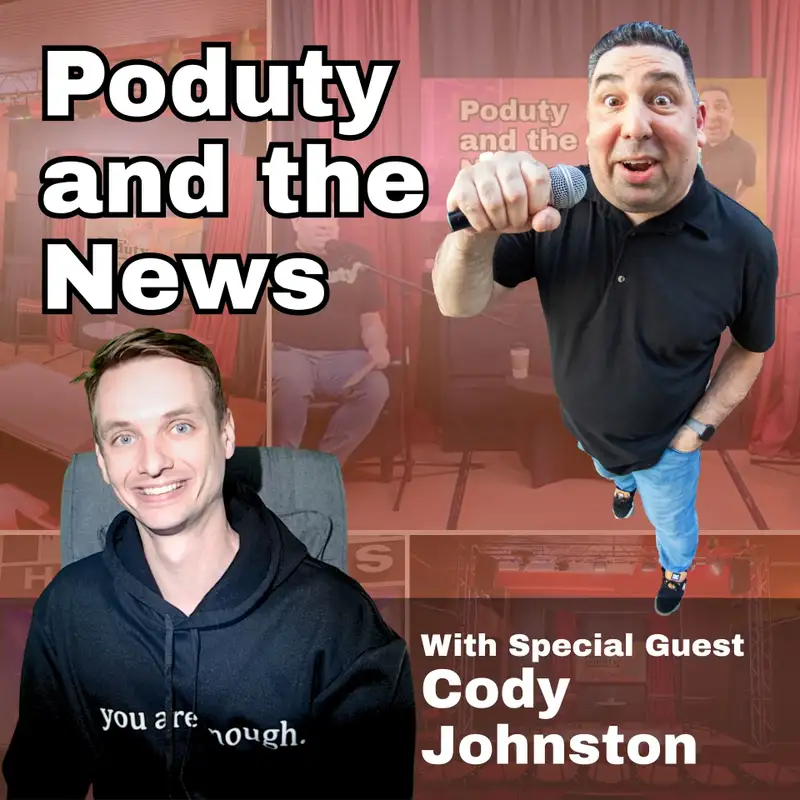
Hey, everybody. Welcome to the Poduty Live Podcast Theater. It is Saturday,
April 25, 2026. We've got six great
stories about live podcasting. We're recording it live.
We've got Cody Johnston. Cody, do you know what time it is?
It is time for my interview. What time is it?
What time is.
Poduty and the News.
Poduty and the News.
The only live news podcast about
podcasting from the st.
The only live news podcast about
podcasting from the stage.
Oh, the only live news podcast about podcasting from the stage.
Cody, welcome to the show. Thank you very much for having me. I'm
excited to join you. AKA the Weird Canadian.
I love the name. I love the backstory behind it. Tell us a little about
yourself. What are you working on up there, up north of the border?
So I'm Cody Johnston, AKA the Weird Canadian, currently
building out a media empire that is to
protect the creative. I'm really fascinated in TV
shows and movies, and I'm sick of Hollywood destroying the
content for whatever they think they want to make money off of.
So I've really decided to build this as a company to
protect that. I'm in the process of making that happen by
making myself a little bit more famous and getting myself out there and
showcasing who I am to the world so that I can bring in those. Those
great storytellers and be able to give them the TV shows and the
recognition they deserve. Aside from that, I am also a
software developer, so I am building applications left, right, and center across the board.
Awesome. I love that story. This idea of
independent media, I think it's such an important part going forward
because so many people have access to these tools. They
have the ability to go live. They have the ability to create an asset
that they own and that belongs to them, that nobody else can take it.
And you're really tapping into that. You're getting away from these
corporate conglomerates and you're really showing people how can
they build something that they own and control and
hopefully showcasing a lot of it while I'm doing this. Yeah, it's a great
way to do. And the website. If people want to reach out to you, connect
with you, what's the best way to find you? The WeirdCanadian CA
or literally anywhere you type. The Weird Canadian. I will pop up. I got
lucky and got that name early and have had it for a year now, so
I think I own it. There can be only one the
Weird Canadian. Check it out. Search for the Weird Canadian. Cody
Johnston, are you ready for our stories?
Very ready. Here we go. We got our first story coming tonight
from History Hits Different Live. This one is from
Marshall Partheon. A live episode of Us and Them
used Ken Burns, the American Revolution as a starting point.
But the real story was what happened next. Professors, students,
and the audience all stepped into the discussion, challenging ideas
about history, identity, and what the country stands for today.
This wasn't about finding the right answer. It was about creating a space for
different perspectives to exist at the same time. And that's where live
podcasting starts to separate itself. It's not just about telling
stories. It's about letting people step inside. And
I think this is a lot about what we talk about here at the theater,
what Cody's building. This is that idea of you can
build something, take it to an audience, take it live in front of
a group of people who have the same interests as you, who are interested in
the same topics you talk about, the ideas you share.
You can really position yourself as the expert and build
a small community around your passions, around your interest.
Yeah. And honestly, with the emergence of
podcasts, we're actually seeing a surge in people understanding a
lot more about what's going on, a lot more about history. There's
a lot in our understanding of what went on in the past that
we do not know because we've lost the context of those people who actually
said the words or did the things. Now is a great
time to be recording a lot of the information and. And having these
nuanced discussions because we don't get the chance to ask
both sides of the story and then come up with our own conclusions from that
anymore. We get told what the narrative is, and then we're just
told to go along with it. We can now start challenging
things, seeing things from different perspectives, and actually start
understanding people as themselves instead of the
collective that we see them as. Yeah. And live events
like this, you know, you can. It's one thing to read a post on social
media and, like, angrily type a comment to get
people going and, you know, and ruffled some feathers. But when you have
social discourse in an environment like this, in a community setting
where you're in front of people face to face, the level of
conversation is exponentially better than it is on social media. The
interaction with your neighbors is exponentially better
than it is on social media. And I really think people are hungry and
thirsty for. For events like this. They.
People are. We. The Internet
doesn't give us that sense of satisfaction to connect with people.
And I think a lot of people are starting to understand that as we're starting
to develop and understand social media and what we've done over the past 15
to 20 years with the Internet, we're really structuring
our understanding based on text. And that
really doesn't help because with text you can't understand tone,
you can't understand intonation, you can't understand intention. The.
The things that make us human, that make us connect to each other and see
past our differences. Text doesn't do that. Text makes
it harder for us to understand each other. The only way
you actually get to understand somebody is if you have a conversation with them
and be able to see where they come from and then also be able to
showcase where you come from. I think honestly, the
more we have people talking like this in real
life or even just recorded conversations, I think we're going
to be more empathetic and more
welcoming to challenges and things we've been afraid of
for a lot of our lives. Yeah, I really hope so.
I'm really believing in that path forward.
Life is just better in real life. Life is better when you're not
sitting at home after work, doom scrolling through a thousand
videos, but out in the public, out with your friends and neighbors, having
a night out, sharing conversation. I really
think we're coming back full circle to. In real life
again. Like. Like the 1970s, like, we would hang out at a park or,
you know, picnic table or pavilion and talk to people. You
actually hang out and socialize. And these types of events,
they're coming back and they're coming back with a vengeance. And
the other side to that too is they're also coming back and being
cost effective. Like they're. They're no longer like the.
When you have the 70s and 80s and stuff, the ticket prices for concerts
and you're going out were so cheap, they wanted you to come.
Over the past several decades, we've just made things more and more
expensive to go out and hang out with people. And now we're just
coming back to everything becoming cheaper because people want more
inclusivity, want people to actually show up. I think
we're actually seeing the revolution take place of. We
are sick and tired of capitalists taking advantage of us. And we want to build
something that actually does something for us. I'm very
excited for the next 10 years in terms of who you get
to see, what experiences you'll get, because
they'll be either expedited in a way that
AI is going to help you understand it better, or it's going to be
cheap enough for you to be like, yeah, I can't not say no to. Can't
not say no to this opportunity. Yeah. And in regards
to some of the expenses that you've been talking about, it looks like we're starting
to see some fracturing of certain companies
buying the entire process of the ticket sales, to
owning the events, to owning the artists. We're starting to see that, hey,
maybe that's a monopoly and we should let more competition in here. You
can't have one company own the entire pillar
of that industry. So those things are starting to break apart. And hey,
with more competition, we may get back to those 70s and 80s
prices. It's funny that you mentioned that, because
when we have the laws to take these
guys down, we've had them for years. I think the discussion around
it and the people's frustration has really
driven the decision to actually use those laws for
a long time. We just been set with the status quo, and now we're actually
having the power to make those choices again. Well,
you mentioned the word driven. Our next story fits
perfectly into that. From stage to stream, this is Car
Dealer and magazine in the uk they hosted a live
event. And here's a move more events are starting to figure out.
Don't let the live moment end when the room clears out. Car
Dealer Live turned their event into a podcast by packaging up the best
moments and releasing them as a highlight episode. It gives people a
taste of what they missed while also creating a path to monetize
the full replay. This is live podcasting doing double
duty. First it serves the audience in the room. Then it becomes a
discovery engine for the next audience online. The real takeaway
here is simple. Your live event is not the finish line. It's
the starting point for more content, more reach, and
more revenue. People are very
afraid of the bots and the people
who hide themselves on the Internet. I understand. Sorry,
I'm getting a little bit too far back into the weeds of things. But I
understand a lot of where we came from as a society being like, we need
the anonymity. We need to be protected. The narrative around
the Internet in the early days of the Internet was protect yourself. The narrative when
I grew up was don't open the door to a stranger. Right. Those
narratives have just kind of enclosed on the Internet,
making us become two different people.
And I think the fear of showcasing
who you are is now going away, and it's becoming an engine
to drive change and monetary
gain.
When you're working with a live event, you are more
vulnerable than ever. And not just in terms of
who you're talking to, it's also on stage. Like, if you worry about
anything in the political space, you might not want to go outside because potential
for bad actors. But the more you do it, the more
people are going to resonate with it because they want that connection.
And then, yes, you get to use those reels, all of that stuff, to
showcase who you are in little bits. And those little bits get people
interested in what they think you are. And as they start to know
you, they start to generate an idea in their head of whether they like
you or not. The more you push out, the more people
are going to understand about you. And it's a fun fact because it kind of
goes to my own story, as I am 100% myself online
and offline. If you look up the weird Canadian and talk and showcase
how I speak and everything, I will do the exact same thing
in person. I am most likely to tell you an
insult online as I am in person now, because I'm done with the
line of not showcasing who we are, because I think
we need people to just be real again.
Yeah. The one thing you can't do in a live environment is
run it with AI. It's honest emotion, it's
honest conversation. And in events like this, where
you're having an audience come in, they're talking about automotive
business, they're talking about how to be better at your dealership, how to
sell more cars, but the audience that's in there that day,
there's also a whole group of people outside of that audience that
want to hear what happened at that event. They want to hear the replays.
And those replays then become sort of the marketing to set up the
next event. So when you create your own media, when
you're giving information as a human, not as letting some
bot write a blog post, you're building this thing
that other people will gravitate to. And as more people outside of
that event gravitate towards it, that's more ticket sales down the
road. You're really extending your advertising, your marketing.
You're finding ways to grow that event
for nine, ten months down the road to start selling the tickets for
the next event. And you don't even need to be big. I
cannot say this enough. You could literally have your live event in
a park that you have in your local area with no
cost to you, everything you already have resource. It used to
be that there was this big barrier to having these extra clips and things that
you could post on TV or social media. That
cost us next to nothing. Now, everybody with a phone
now has the same ability as anybody in a studio.
So don't think your live event needs to be on some
stage somewhere. You can just host an event with live people
in your neighborhood, at a park, or in your own home or wherever
you feel like it. And then you can just monetize from there. Like, you can
figure out how to get more people involved. Based off of that,
we're opening more ways to wealth to the individual.
Absolutely. And one of the things, the power of live events. Here's the secret
to the theater space. And a lot of people come to me and like, hey,
I want to do a live event, but I don't have a space in my
neighborhood. And just like Cody says, oh, yes, you do. You have
parks, you have coffee shops, you have restaurants that have
banquet rooms that go unused during the weekday. You have libraries
with media centers. There's places to do this. But the real
secret to live events is. I'm going to give you a little bit of podcast
math today. I know it's Saturday morning. We don't want to have a lot of
math. But the most podcasters, they put a show together, and
their goal is, I'm going to build an audience, and then I'm going to sell
ad space to advertisers. And the reality is, if you
can get a thousand downloads for your podcast, you can sell a
block of 1,000 ads for about $20. If you did a host red
ad, every thousand downloads you get, you could earn about
$20. But where the math breaks down is
90% of podcasters do not get to a thousand
downloads per episode. So there's this major hurdle that nobody
talks about. So if you could get a thousand downloads, you make
20 bucks. Great. You know, that's our starting point. That's our baseline. But if
you were to do a live event at a coffee shop at your library
and you sold 10 tickets or four tickets for
$5, right? Get your friends, your family, your cousins, your
neighbors, you say, hey, I just need to get four people to come watch
me live. Those four people at $5 will give
you $20 in ticket sales, which is
equal to the thousand people that would
download your digital download. So I asked people, what's more
realistic? Is it more realistic to get four people to show up for you
or to get 1,000 downloads on your next episode? And the math tells
us that it's more realistic to start building this asset that you
own. Don't rely on the algorithm to bring you an
audience. Rely on yourself to build community. Rely on
yourself to elevate your friends and neighbors. You know, entertain them.
Build something that's special in your Hometown, because those four people
quickly become 16. They become 32,
64. I'm using computer math here, but, you know, as
every doubles every 18 months, you're going to, you're going to build
something that has value and you're going to see returns right away
because you're entertaining a live audience. In real life, IRL
events have so much more potential than
digital downloads for 90% of podcasters.
And that's one of the reasons why I'm so gung ho on building a
media company that protects the creative, because there's so many more avenues to
monetize TV shows and movies than just
showcasing the actual show. One of the biggest
takeaways for me is I think most of the content, most of the
storytelling should be free. Anything extra. That's where you get
into the charging. If you want to go into more backstory and you want
to understand more of the character, that takes time out of my
day, so I'm going to charge for that. But I just want to showcase my
story. I just want to showcase what idea I have in my head
that should be free. Ideas should be out there for everybody to use and
have. It's, it's the, the content or
the, the branded content that you then start selling.
There's so many monetization ways and pathways to even be
successful. You don't even have to follow the standard route
anymore. And I just, I appreciate that
we have the opportunity now. We haven't for
most of our existence, exactly the last 20 years
have really been controlled and taken over by, you know, certain
tech companies that control the whole flow of information. But
there is this, hey, let's maybe reset. The people are kind of
sick of this, that, you know, why am I working for you for free? To
give content to your system that you're not going to share with the people who
are subscribed to me. You're going to suppress me until I either
pay to boost it in the algorithm or I'm just done with
it. You know, people are done with it and they want to, they want something
more tangible. They want to have a night out. They want to.
Sometimes we have, we've had shows here. I would say half of our shows
bring in full catering. Like they make it an event where they're
feeding their guests, they're. They're having drinks, and then they do a show and they're
having A good time together. And that's a complete different
experience than we've been building for the last 20 years online.
If you really break it down, the only thing that
is actually tangible in your life is is life experiences.
That's just the simple fact of life. If you don't experience new and
different things, you're going to be the same person, not go anywhere and not
do anything. Getting out there, meeting people is
and connecting is the only way to grow.
Like, what's the value of a Like and subscribe compared to the value
of a handshake and eye contact? It's you. They're not
even on the same game. I've gotten to talk to
CEOs of big companies just because I asked them
and have a connection with somebody else. Like these are opportunities that you miss
out on when you don't connect. Well, speaking of
connection, I connected to this next story because one of my favorite movies
is Back to the Future. And this podcast is called Bake to the
Future. It's in the baking industry. It comes to us from the commercial baking.
I think it was a conference when industries have real problems. Live
podcasts are starting to become the place where those problems get talked
through in public. At a baking conference in Chicago, a
live episode of Bake to the Future focused on one
issue that keeps coming up. Workforce
hiring, retention. That seems like four issues on some of
the issues that keep coming up. Workforce, hiring, retention, and the
future pipeline. Instead of another closed door panel, they
opened the conversation up on stage and turned it into content. That
shift matters because now the conversation doesn't just stay in the
room. It becomes something the entire industry can learn from,
share and respond to. Live podcasting isn't just
entertainment. It's becoming a tool for industries
to think out loud. We hire people
to companies to solve problems. That's your job. You go in to solve
a problem that they have. We understand
that when we have an issue and we don't understand it, we need to
bring in expertise. What happens when you don't know what
expertise you need? What happens when you don't know
what the actual problem is? You need to bring in insight
from everywhere. Governments really
should take heed to this because if you put out what
actual issues there are, you could have a public discussion where
facts come out, experts come out, and just
general ideas that nobody would have thought of.
The reason software is software developers love open
source is because we don't. We don't think we know
everything, but we know that if we ask
others, they're going to be able to help us work through things.
You have an experience set that you've
developed over your lifetime. That experience set does not work
in every scenario. And if you
just open up your world to saying, okay, I don't understand this, let
me find somebody who does. We
solve everything. We solve world hunger, we solve diabetes, we solve
medical breakthroughs. This is why I'm so
gung ho on AI is because we are actually allowing
intelligence to be sourced by anybody. Which means if you
have some sort of experience in a field and you want to learn more in
another field, it doesn't take much to learn that other field
because it can break it down in a way you understand. I think
every problem we have is going to be solved by the public. We just need
to let the public actually have access to it. Yeah. And
events like this, where there used to be these closed door
conversations where the event would pick four people, usually
four people who were sponsors of the event. They got to send their CEOs
or CMOs, and you would just listen to a panel of four people
regurgitate company mission statements. But now
by having podcasts replacing those panels
of four people, they're bringing in podcasts as a form of entertainment
as part of the show, as part of the schedule.
Isn't a four panel entertainment anymore. They're bringing in podcasts from within
the industry and they're having unstructured
dialogue. They're tackling problems like you hear here at
Baking Tech 2026, where the podcast is
talking and diving into issues that are actually interesting
to the audience. Whereas before it was talking points for
sponsors regurgitating to the audience, now we're opening
that dialogue, allowing the podcast to control the
conversation of the room, to talk about things that are going to impact
the industry in eight months, 16 months down the road.
This is, this is the real future of events, is having these industry
conversations happen live on stage. To be
honest with you, you don't even know what expertise you don't know until you start
investigating. I, I with AI
was a software developer. I really enjoyed code. Now I'm a musician,
an author, podcast host. I'm running a 3D printing company.
I'm doing tourism in my town.
These are all things that I just got empowered to do because I
was interested in something different. Podcasts give,
gives you a lot of insight into what you don't know and how to work
with it, and gives you a lot of questions to run with. I'm
very, very happy about, like searching the Internet and figuring out what I,
what I'm trying to figure out, and once I do, I'm so happy. I think
people enjoy solving problems and I think
giving everybody the same opportunity is as
equitable as you can be on a planet. You're giving everybody the
opportunity to solve the same problem.
Speaking of solving problems, so many problems get solved over beer.
We got beer. Business and the Buzz when you bring
podcasting directly into the middle of an industry event, you don't just
report on what's happening, you become part of it. At the
Craft Brewers Conference in Philadelphia, the brewbound
podcast set up for an on location studio to capture
energy in real time. From major acquisition news to
conversations about customer experience and industry trends, they
turned the conference into content as it
unfolded. You, you are essentially just
giving more will to people that
join, right? Like, you're showcasing how it's fun, you're showcasing that
it's a great environment. You're showcasing
everything. People worry about when they go into a live space.
They're worrying about who they know, they're worrying about who they can talk to,
they're worrying about what they don't know that they might be
embarrassed of. I think this is kind of something that I've been working on a
while ago. People are ashamed to ask questions,
and a lot of that shame gets alleviated
when there's some idiot like myself in there just
saying things that are enjoyable and making
it a little bit more of a
welcoming space. I don't know about you. The
last time I was at an an expert event, I didn't feel
like an expert at all. But I also
didn't fear questioning where I didn't know things. Like, I'm
okay with being wrong, because if I'm wrong, it means I have an
opportunity to figure out what's right. And
with that, I think you're getting more nuanced
conversations that people want. The lacking in
humanity that we have on the Internet, where it's like these quick clips
where you only get a snippet of information, you don't get much detail, you're actually
getting to understand the personality of a person. And I think
that's more welcoming to an event than just showcasing what
that event can be about. Like, I love beer,
but I know nothing of it and I don't know what I would talk about
aside from I want to go to each booth and drink a beer,
right? Like, who's going to. Who's going to actually, like, pull me aside and say,
hey, do you want to learn about brewing or do you want to learn how
we do our different processes. And sometimes you want to
know that information, but you don't want to ask. It's a great opportunity for people
to do that. It's almost like the sharing of information has
gone grassroots again, where in this conference
you're getting direct information from the people who are making it
happen, who own small breweries, who probably have small
restaurants alongside their brewery to figure out different ways to
monetize and keep customers entertained. You're getting all that
information from the people who are actually doing it.
Not just experts, but the experts who are actually doing it. And
I think these types of events really connect the people who are interested
in it with the people who are doing it. And it's really this new
one to one exchange of information. I like how you
phrased the experts question, because to
me, those experts that came on stage and said they were experts in things,
while they may be knowledgeable, they hadn't done the actual
work. To me, an expert is somebody who's actually doing the work,
actually in the process of developing something or making something.
They have more expertise on what they are doing than
your higher up does. They may have been involved in the process
at some point, but they are no longer involved, which means they have a
little bit of lacking of information in key areas that
a lot of people are. So as a software developer, I'm more likely to
connect with another software developer who's speaking my language
than a senior expert who can't
speak the same language as me. Yeah, a lot of
quote unquote experts. They did have success at one point, maybe 10,
15 years ago, and really made waves throughout the industry. And then they just
relied that for 10 to 15 years. But I'd
rather talk shop with the people getting their hands dirty who are doing it
right now, who are moving the needle on a grassroots
level and becoming, yes, they'll probably be the next experts
in 10, 15 years because of what they're doing now. And that's fine. That's
a great career path to take and not taking away anything from that. But
most of the time you're gonna get your best information from, from the people who
are actively doing it right now, today. And
with the level of technology we have, it's becoming
harder and harder to stay an expert on anything unless you're doing it
full time. And when I
want to portray myself as an expert and write down some notes, I always
use, I put all my notes in crayons. And this is where we're going to
the next one. The Crayola's second act. This comes to us
from Adweek on YouTube. You would think a brand like Crayola has
already done everything it can do. But in a live podcast
at Brand Week, their former cmo, Victoria
Lozano made it clear that growth never really
stops. The conversation focused on how Crayola is
expanding beyond kids, tapping into adult audiences,
and building an entire ecosystem around creativity.
This is bigger than marketing. It's about rethinking what your business
actually is. And it's where live podcasting shines. Instead
of a polished campaign, you get a strategy behind it. You
get to see why. Because sharing, because
staying relevant isn't about protecting what you've built. It's about being
willing to redline it in real time. This
is kind of an interesting story because I actually had an interview with
the chief creative direct, I can't
remember her title of Lego. And she was
showcasing how she brings LEGO into high
profile executive boardrooms to showcase how
it isn't just a toy, it's something that you can work with and people
understand as a general medium. I think a lot
of things we used to do as children are vibing with
us now because when we were playing with those things, they were
real to us. They had imagination beyond
belief. For us, we've gone into a
system where we're told exactly how things are supposed to
be. And then we grew up into that system to find out that
none of that is true. Everybody just making it up as we go
and people are really just wanting to see the,
where people are coming, like where the businesses are coming from. Why are, why are
you marketing this to me? Why do you think I should have these things?
And the more businesses are open about their processes,
who they're doing it for, what they're doing, the more likely you
are to buy. This is one of the
revolutions I think we're going to go through is a lot of these giant companies
are going to fail because instead of being transparent, they're going to
hide and try and showcase only what they want to show.
We no longer live in a, in a high trust world.
People want, want accountability and they just want to understand
and if you don't have those two things as a business nowadays, you're
not going to make it. We're seeing that with AI right now.
People aren't trusting the models and smaller models are coming up because
they're just saying, hey, we did this this way. We're going this way
because we believe this. It's going to happen
everywhere. And I hope, my only hope is that
People like the bigger companies start embracing those changes.
I think they're going to benefit from it mostly. But I
also think that they're afraid.
Yeah, the AI revolt is just around the corner. You
see people getting angry now. People are
straight up not even talking to you. If they even
suspect you're using AI. There was just
a radio station in Cleveland that was promoting their
podcast, and they were using, like, they were using the voice, but they were
using AI imagery as the part of the voiceover.
And people rejected and revolted the. This whole
campaign in droves. And we. We don't want to see that. We want to see
that connection. And I think that's something Crayola is really tapping into here. I'm
thinking of. Of myself. You know, I'm turning 50 this year,
and I hadn't thought about crayon since I was five. You know, 45 years
ago, I was in the market for Crayola, but I wasn't the purchaser. My
parents were. But then I had children, and I had another
reconnection with Crayola by coloring, you know, with my daughters and, you know,
you know, having those sessions on the floor where you're coloring Princess
Belle images from Disney, all you doing all the coloring.
But as an adult, we're fine. We see a lot of
coloring, adult coloring books. It's very therapeutic. It's very
relaxing. And this is a company that's kind of tapping into
real experiences, real life things, real moments that you share with
family, real connection. And if you can do that with your podcast,
show the real side of it, show how do you connect with
real people in real time. That's. That's what they're building.
That's a great lesson for you to take from for your podcast
with the. The also resurgence of
childhood, like nostalgia and stuff like that. For a
long time, we have always been a society that
teaches our children that you need to be adults as fast as possible.
We are now learning that the more you make a child
do that, the more mental harm you cause to them.
The best way you could raise a child right now is let them be a
child. Stop putting them in political narratives. Stop putting them in what you
think they are. Let them just play, have fun, figure things out,
and they'll have a better upbringing.
The kids. We have an opportunity to.
For our next generations to raise kids, allowing
them to be children and understanding that fact. And
now, like when I say Criola's working on a
nostalgia now is all of the adults now who wanted that childhood that
they never got. They didn't get to play because they were told they had to
be adult. They had to do this, they had to do that. They're going back
to those things because they feel like they missed out on something.
And and honestly, I grew up thinking
I needed to be an adult. It was only when I realized that being
childish makes your life fun. I can still do
things as an adult, I can still take on responsibility, but I'm going to be
a child for the most part. When I want to, I'm going to play, I'm
going to have fun. When you strip that out, you don't really
enjoy much. And speaking of having
fun and doing things as an adult, you could go to the New
Heights Podcast I saw this. This was all over social media, this
is all over press releases. But I'll give POD News credit. I was the
first place I saw it was on POD News. And this is what it looks
like when a podcast becomes something bigger than a podcast.
New Heights with Jason and Travis Kelsey is heading to Los Angeles
for a live show at the Orpheum Theater. And it's not just a
recording, it's a full scale experience. Thousands of
fans, brand sponsors, celebrity guests, and a distribution
plan that stretches across YouTube, Prime Video and podcast
platforms. This is the evolution. Content turns into
community, community turns into events, and
live events turn into a full business ecosystem that
includes commerce, partnerships and cultural moments. Live
podcasting is no longer a side project for some creators,
it's the business model. It really is.
I've actually talked to a lot of marketing experts as of late and
they are saying if you don't have a presence online in
2026, you are probably not going to make it in the future.
We are getting to the point where there's so many avenues of learning
about things. You have to be on everything. You have to be
everywhere if you want to actually make something of
yourself. But you also can size
that. If you only want to stay on one community, you can stay on one
community. You don't have to go further. It's just a
matter of what you want to do in terms of why
people start podcasting. It's all preferential choice. I started it
because I wanted to showcase a different type of narrative than
we're being seen. But my ultimate goal isn't
that it's understanding who I want to be and who I
understand I am, but also taking
steps to guarantee I can do certain things in life.
You got to understand that everything's a stepping stone into everything.
The more you're Willing to throw yourself out there and try new things. The
more connections, the more opportunities, the more understanding you're going
to have about yourself. And I think ultimately
it comes down to understanding who you are, to understanding what you want.
And everybody just likes to showcase who they are and what
they want, and people connect to that. People just want to
be real, showcase who they are, and connect with others.
My biggest qualm throughout my entire life is I didn't know how to connect
with people. I didn't understand how to have friendships. I didn't know what people
wanted from me. And then I realized that doesn't matter. I
needed to figure out what I wanted for me. You use the term stepping
stone, which is a great way to describe this evolution that
we're seeing in podcasting. Whereas this started as a
YouTube show, and then I think one of them started
dating the largest pop star in the world, and it
became something bigger than what it is. And
they have done live events in the past, and that's kind of like this
evolution. Yes, they can sit at home, record an episode,
read sponsorship ads, and they probably make a very good
chunk of change doing that. But live events, filling
theaters, filling arenas, that is a
whole nother game of making a profit off of
a single episode. So think about these steps and that
stepping stone that Cody's mentioning. Right now, you're recording in your home
studio, just like the New Heights podcast was five, 10 years ago.
How do you get out of that? How do you get to the next level?
How do you play those small clubs, those parks, those coffee
shops? How do you get out of your home studio environment
into the real life? So that when these large events
come to town and they start looking for opening acts, they're going to start to
pull from people who are doing the work, who are putting in the
time, who are doing live shows already in front of an audience and have experience.
You'll be ripe for that selection. In terms of how you
get there, this is a hard process. Even I'm still learning. I'm
not at that point. I do understand how to get there. I'm still
fuzzy on some of the details, but I'm kind of just going on
autopilot. One of the biggest things you could do as a podcaster,
if you want to be recognized, is just consistently upload.
That consistency schedule is something that really resonates with people.
If you're willing to show up day in, day out for your
audience, they're gonna. They're gonna take that, they're gonna understand that
you only grow by keeping at it. I started this a year ago,
and the majority of podcasts that I started with, like, because I started on
podmatch, which is where we met, I started
when they first started up, and all of those podcasts that came up with me,
most of them are gone. It's because you couldn't. They didn't
have the consistency. They couldn't see past their,
oh, if I post this, people will come. And when they don't
come, I am now I've done something wrong.
It comes over time. Everything is a rolling stone. The
more time and energy and consistency you put into something, the
more expert you get, the more understanding you get, the more tweaks you
can put in, the better you're going to resonate with your audience. In
terms of how I'm going to this next year, I have plans to
scale, so I'm looking at bringing in, creating a community
space, bringing in people who actually resonate with my content to help
me generate even more content. The
stepping stone is just engaging. It really is
figuring out what your audience wants from you and then just giving it
to them and also being happy about
it. I don't care if my content
doesn't do well. I'm just happy that my content's out there.
And that's kind of the mentality you need to have when you come into
the entertainment space. You need to stop worrying about the ifs, ands, or
what's, and just be like, I'm happy with what I've done
because it means something personally to myself.
Yeah. Think about the types of communities that you build or the types of communities
that you're a part of. You can. You can join a group online, a Facebook
group, or a LinkedIn group and kind of talk to people or
bounce ideas off of people. But the communities that you form
in real life, around content creation, around things that
you love to do, you can't replace that online. And
let's say you meet people in your community that like what you talk
about, and you just schedule a meetup once a month, you
could think of how far you could grow your ideas and concepts and
Show Ideas in six months or 12 months, if you start
laying that groundwork now. And that's what Cody's building, building these
communities, connecting with people. You can do that in your
hometown. You can do that with people around you who love doing the same thing.
And why not start building that community? Who wants to
come out and see live events? Even before I started this, like, I
connected with streamers online, I ended up in a community. That
community found me a few friends that I was talking to. We set up our
own community and became our own little friend group. We no longer
associated with the streamer anymore, but now I have friends all over the world that
I've connected with in different ways because we just had a shared
community to begin with. It's all about
connecting. I'm really starting to understand that the human experience
is all about connecting with people. That's it. It's so simple.
I'm 50 years old and I'm just figuring it out now.
Cody, this has been a blast. The six stories, they go by
so fast and I really appreciate you being here today. I love the
way you're building things, the perspective of what you're bringing to the
content creating community. You are doing something that I believe is
the most important part of the future of podcasting, of the
future of content creating, bringing these communities together,
really building the asset that belongs to the individual and
letting them control the narrative. Cody, one last time, I'm
going to turn the floor over to you. Plug, promote, talk about anything
you want. Cody, the floor is yours.
My name is Cody Johnston, AKA the Weird Canadian. You can find me
at theweirdcanadian CA or anywhere you can type in the Weird
Canadian. In terms of what I want to talk about
for my last little bit here, the world
is changing at a significant pace
and I understand a lot of people are afraid of what's
going on and how it's happening. I just press
everybody to look a little bit deeper than the headlines, kind of try
and understand what's right and what's wrong,
come up with your own set of moral values that you do not want to
compromise and stick with it. I think becoming
who you want to be is easier than ever in this day and age
and it just takes a little bit of understanding of yourself.
And I'll be writing a book about this to give you some strategies. It's called
Bleeding Digital. I have no representation yet. It will be out soon
or hopefully soon. But yeah, if you need
any information or just want to connect with me, anything at all, like I
am an open resource. My email is open. My
if you reach out to me, I'm going to have an engaging conversation with you.
As long as you're not a troll. No trolls.
The weird. That's your tagline with the weird Canadian.
No trolls. It's because I used to be a troll.
It gets me going into the problem. I do.
Deep down inside, I think we're all we're all trolls that enjoy pushing
buttons and ruffling feathers. But Cody, this has been so
much fun. I'll put all the links into the show. Notes we also have the
crew page on Poduty in the News, where every guest that's ever been on the
show gets a page. The crew page with all the
links to their whatever they're building to their websites,
and all the links of all the podcasts they've ever been on. I'd love to
have you back on the show on a future episode. You'll see all that on
Poduty and the Crew. Cody, do you remember
what time it was? I guess it was my interview
time. What time is it?
Poduty and the News the only live
news podcast about podcasting from the
stage.
The only live news podcast about
podcasting from the staaaaaaaage.