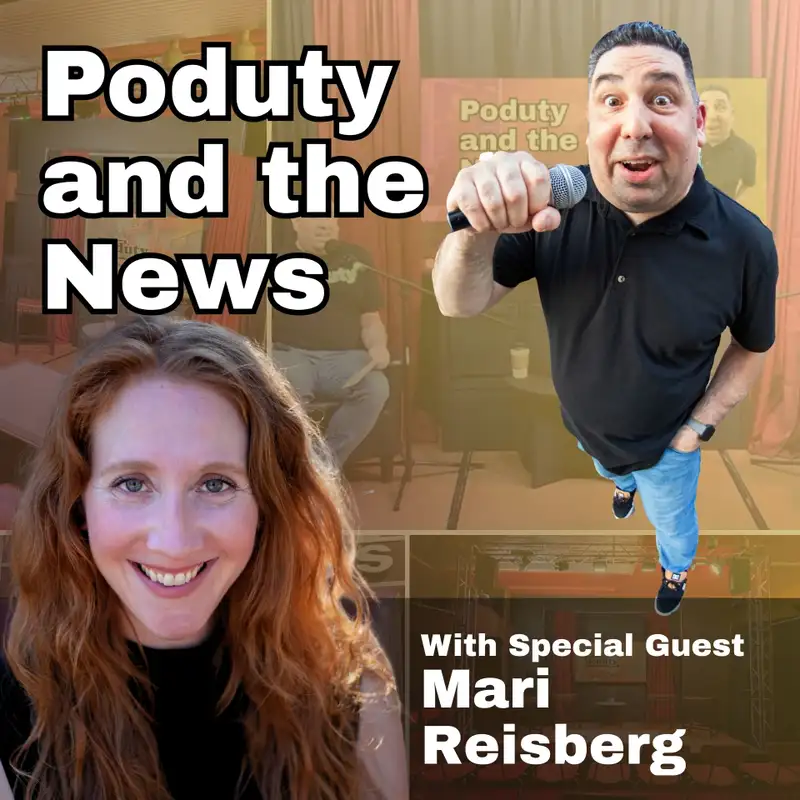
Hey, everybody. Welcome to Poduty in the news for Tuesday, June 9,
2026. I'm Jeff Revilla. We're live at the Poduty Live Podcast theater in
downtown Tarentum. We've got a great guest joining me.
Mari Reisberg is going to join us today.
Sustaining Creativity podcast and the platform. We're going
to get into all of that right after the theme song. But Mari,
do you know what time it is? Oh, it's the
best time. What time is it?
What time is it?
The only live news podcast about
podcasting from the stage
Day.
The only live news podcast about
podcasting from the stage.
Oh, the only live news podcast about podcasting from the stage.
It's Poduty and the News with Mari Reisberg. Mari, welcome to the show.
Thank you so much. I'm so excited to join you
live and chat about the news and other things.
I can't wait. It's Poduty and the News, the only live news podcast
about podcasts and from the stage. I'm on the stage. Mari, where are you joining
me from? I am joining you from Colorado. I'm just outside of
Denver and we had you were a guest on
another podcast today and a great story, a great background.
If you want to hear all the details, it's over at My Guest tonight. I'll
put a link to that in the show notes. But, but Mari has
gone on well beyond a trapeze artist
into sustaining creativity, the podcast, the
platform, and really showing people how do I keep
coming up with new things, how do I avoid burnout, how do I stay creative
and have fun? And that's really a lot about what the podcast is about. Tell
us a little bit about everything about sustaining creativity. Well,
thank you so much for asking. Sustaining creativity, it
is a huge passion of mine, living a creative life
and creativity. Creativity, I think, looks different for everyone. It's not
only the performing arts. You can find creativity
in putting food on a plate, getting dressed in the morning, how you walk your
dog, how you drive to work. Creativity is
everywhere and we can find it doing anything.
And that is the beauty of creativity and
creative opportunities in creative spaces. So
the work that I do is about supporting individuals to
continue finding creativity in their life so that they can
continue to experience joy and
more wonder and curiosity in
every facet of their life. My podcast,
I interview people from around the world on creativity, what it means to them, how
it shows up in their life, the tips and tools and ideas they have
to share with all the listeners. It is such a huge passion
of mine and I can't wait to keep sharing it with everyone and all
the listeners here today and anyone who
listens after the live show. And the
thing I love about it, it's not just like content creators or
video. It's creativity in all walks of life and
all aspects of life. It's, you know, everybody goes through these
ebbs and flows of creativity. And, you know, sometimes you're rolling
and rolling, and then all of a sudden, maybe you hit a dip. And a
lot of what you talk about really helps maybe level that out or
keep processes in place to. To keep the creativity going.
Absolutely. The beautiful thing about creativity is it
actually needs pauses. It needs rest. We
need moments of doing nothing, which allows
that subconscious space, our mind, subconscious mind, which is
where creativity comes from, to act, be activated even more.
So that's why people have their most creative thoughts.
While showering. We're doing a mundane task,
thinking, not having to think too much. And all of a sudden we
have those moments of, oh, I know, this is the
greatest thing that I want to share with other people. So we have these creative
thoughts come up while we're doing mundane tasks,
but it's also this opportunity of
giving our mind a break, because we all need
to take a break, go daydream, go sit outside, read
a book, take a nap. It's so important
that we find time to pause in the midst of
our busy, bustling days that we all have.
I tend to have my Most creative inspirations
10 seconds before I wake up. And then as soon as I wake up, I'm
like, oh, it was really good. What was it
exactly? That's why, like, have a notebook by your
bedside so you can immediately write it down before you say anything to
anyone else in the room. No talking to pets
or partners. We're just writing down our most
amazing thoughts. Yeah, I wake up, there's the cats. I'm like,
hey, buddies. And I'm like, oh, I forgot what I was going to. Was going
to write down in my journal. I got to go right to the journal. It'll
skip the cats. They'll be there when I'm done writing.
Exactly, exactly. They always try to eat the tip of the pen when I'm
writing. Like, hey, like, calm down.
Well, Mario, the best way to find the podcast and to learn more about the
platform. So I am at Sustaining Creativity
on all platforms. And then the podcast, Sustaining Creativity
Podcast, you can find it wherever you listen to podcasts. And
yeah, that's. Those are the best places. I'm quite active on
Instagram, so Shoot me a message like
comment. I am Sustaining Creativity. So it
will be me responding. And I'll have all those
links in the show notes. And over on the podcast page we have what's called
the Crew. So after this episode, when it goes live, Mario will be
part of Poduty and the crew. And, and it's all the guests who have ever
been there. And Mari's page will be there along with all the links to connect
with her, all the podcasts that she'll be on because I'd love to have
you back on future episodes as well. And all that will get added to her
page and kind of index as, as Mari's professionalism
and knowledge on podcasting, Creativity, live
podcasting. And you'll be able to see that over on the podcast page. But go
to the show notes, check out all of Mari's links, check out Sustaining
Creativity, check out the podcast. Does it come out more than once a week?
It looks like your pattern was more than just weekly.
Yes. So actually this month I just started releasing
two episodes a week on Tuesdays and Fridays. So
I'm growing. It's great. So
Tuesdays and Fridays listen to Sustaining Creativity and then on Thursdays
this podcast comes out. So we just booked 60% of your week.
I love it. Amazing. Are you ready to get into
our first story? Let's do it. I'm ready.
This is a great one. And a lot of what I do with these stories,
I try to pair them with Mari's expertise or knowledge, experience.
And a lot of the stories center around being creative,
finding these new outlets, finding new ways to push limits and
push boundaries. And also how do you sustain that? How do you
do that? And I love this first story because this is a 24 hour
live podcast. A thon. This comes to us from Lancashire,
Lucy Baxter. She's hosting a 24 hour live podcast to
support cystic fibrosis. Baxter, who hosts from
Lancashire Lass and the Trust official podcast,
began the livestream at 10am on June 5 and continued through the
night until 10:10am June 6. The event
streamed on YouTube and featured celebrity guests including Jenny
Augutter, James Dunmore and Strictly Come Dancing
professional Joita Pristal, along with
guests living with or affected by cystic fibrosis. The
fundraiser was held ahead of CF Week, a national
awareness fundraising campaign in the United
Kingdom. And you know, this is something if you're planning to do,
whether it's locally for, you know, some local charities, maybe
a library or a small business, this is a 24 hour
commitment. You hit go and you say you're going to go 24
hours, you're locked in until 10am the next morning.
And just a great way to raise awareness, I thought, and a great way
to really be all in for the cause. Like, they, they had
to do a lot of planning to fill 24 hours, but they got through
it and they did it.
Absolutely. The piece that
speaks to me the most, well, first of all, I haven't pulled an all nighter
in a very long time. So even thinking about
what goes into the preparation,
knowing that that is what you're going to be doing. So how are you not
only mentally preparing, but physically preparing your body?
And I think that's where creativity gets to show up.
Because what are those, those things you're
telling yourself when you feel like
you've reached your max and you don't have anything else
to say? I mean, it's a podcast. I can't even imagine talking for 24
hours on a podcast. I mean, don't get me wrong, I enjoy talking.
However, I don't know that I could do it for 24 hours straight.
But it sounds like having
some prep time to figure out all the things
that you want to say and want to share. But I can only imagine, what
if something goes sideways? How are you going to, you
know, pivot and use your own creativity?
But if the thing that goes sideways happens at hour
22 of 24,
that you're going to be pulling from deep
creativity to get through those moments and try
and, and figure out, okay, how do I get us back
on track? Or how do I go with this
new idea in and figure out what I want
to say or how I want to, you know, share this platform
for this particular podcast, Cystic Fibrosis.
And I, I mean, I think
that when we are
given some structure,
creativity loves boundaries.
Once we have some boundaries, we then get to play within those
boundaries. And so I can only imagine how
the host was able to really bring her
authentic self to a cause that
sounds like is very important to her and the other people who
were there speaking on it, but
that we get to really find that flow.
I don't know if you've ever experienced, like,
if you play music or you
run or you're, you paint or you do something and
you feel like you're in what they call flow
that I guess I have a curiosity of
how was she feeling her flow over
24 hours? And at what point did it
disappear? At what point did it show back up? But
those are all my curiosities and my Questions? Yeah, you
mentioned like pulling an all nighter. I mentioned I'm turning 50 coming up
and it would be quite a feat if you could make it
all through the night and you're out there with the sunrise. But now that I'm
turning 50, instead of waiting for the sun to
rise and then going to bed and sleeping until 8pm, I tend to go to
bed now at 8pm and I'm waking up with the sunrise. So
some things do change over time. And the time it
takes to cover 24 hours, I'm sure there's a lot of prep goes into it.
You don't just go live and hope for the best for the next 24 hours.
And if you're planning on doing something like this, think of the contingencies
like, okay, what happens if like Mari says, you get to that hour 22
and something goes completely haywire? A sideways, you know, do
you have a pre recorded video you can throw up on the screen to get
your composure back? Do you have a guest in the audience you can pull up?
Can you take Q and A? You know, so as good as to
think of these things, that structure that Mari is talking about, where I think where
you lay out the 24 hours, there should also be some
contingencies to that, that structure as well. So what if it
does go wrong? What if these things that I planned out don't go according to
plan? I got a spoiler alert. They won't. You
know, you're trying to budget for the next 24 hours. It's, it's
really rare to pull that off without, you know, some little
hiccup, something going wrong, audio cutting out, microphones
dying, power failures. Right. All these things are out of your
control. But how do you get around that? How do you plan
for that? You're planning for that creativity, right. If you have
to fill an extra half an hour because something went wrong, well, you already
built that structure and you know the rules of the game in order to play
within that, that 30 minute structure.
Absolutely. Well, let's keep it
moving. Let's go over to our next story
number two. We're going to. Journalist Annie Lowery and podcast
host Ezra Klein are scheduled to appear live as part of the City
Arts and Lecture Series. The event will focus on Lowry's new
book, the Time How Government Wastes Our Time and How to Fix
It. Lowery is known for her reporting on economics and
politics for publications including the Atlantic, the New York
Times and New York Magazine. Klein is the host of the
Ezra Klein show and a Writer for the New York Times. The
conversation will be recorded for the City and Arts Lectures podcast
and will also air on public radio. Attendees can purchase
tickets with some ticket packages including a copy of
Lowry's new book. My goodness,
this like I love
the podcast theme. That's so great. But the
idea behind, you know, the interview
being on a podcast. I think we're so used to having interviews
happen on talk shows on a television set
and not necessarily on a podcast or without a
video attached. And I don't know if they have a video attached. Most many
podcasts do these days. But the
just, you know, how do you, how does
one talk about an entire book in
bite size moments? That
is I think a skill first
but to, to share the most salient pieces without giving
away the whole, the whole package
so that you're still marketing something so that people will then
buy your book. So making, making it interesting enough to
draw in a listener to then
who would want to tune in and then
continue to buy it. I think there's so much creativity that goes
into that. How do you. I'm really
fascinated by people who can take a whole,
for example, take a book and turn it into bite sized
chunks that are
insightful, intriguing, make
you want more and, and yet
they. And then present it in,
you know, however long the podcast is along with many other
things that people are talking about. But and then to ask the
appropriate questions to elicit that information from
your guest with where and someone you may or may
not have a relationship with. I think that is such a skill in
creative listening and creative
relating. I think there's so much creativity that shows up in
relationships and how we talk and listen to other
people and how we just
relate to someone else that we're sharing space with whether it's a
virtual or literal space. So
yeah so many curiosities about this and how it,
how it shows up and the creativity behind that. I really think,
you know, there's like
knowing yourself I think is an important aspect
of creativity, an important piece that allows us
to really share that with other
people. It's when we, when we're kind of
putting identity together and not it hasn't fully
formed yet that, that we get a little stuck in our
creativity. So those are my thoughts
and I love it and I love that like this event has this multiplier
effect. There's many things happening. One, it's a book tour.
Whereas we talked about authors would go
on morning radio or morning TV shows or
do interviews in newspapers or magazines. But here's an Event.
It's a live event with the author where they're selling tickets. So one,
they're still promoting their book, but they're getting people to pay
them. They're. They're selling tickets to this event. And that because
it's being recorded and distributed. This is the multiplier I think,
that I like about this is they're going to this third party. The. The
City Arts and Lecture series is recording the event for their
own channel, for their own members, that they're going to broadcast
that. So the thing that you created one time, it's getting
multiplied many, many times over through that network of
the City Arts and Lectures. So you're getting like a double whammy here. You're
promoting the book, you're selling tickets. And in some cases, some
of those people who come to see that author may have already bought the
book, and now they're going to pay another 20, $25 to see the
author. You just sold that book twice. So, you know, from a business
perspective, for me, I'm looking at this, I'm like, oh, wait a second. This is
a great. This is a great strategy for creators.
You know, if you can. If you've created something one time, the book, now you
have a live event, and now you're recording it for a TV and
radio show, for the station. This is
like hitting a home run, I think, is the best way to compare it.
Absolutely. You're on
it for sure. The business guy,
everything. We were going out for a steak dinner for my birthday, and I'm
already planning on breaking down the actual cost of every
item. This is pretty expensive
for what this is. I love it.
I love the. The business because that isn't where my brain
first goes to. Clearly. It goes to the creativity that goes
into it all. Yeah. And that's what makes conversations like this
so great, because we're getting two different perspectives. You're seeing or
you're saying about how can we put this together? What goes behind this?
Why? What would draw somebody to come see that? What's the individual like?
You're saying it's. It's the perspective from the author and the people are paying to
come see that. And I'm saying, hey, this is. If you love being creative,
this is also a sustainable way to live your
life. So, you know, you can blend that creativity with
having a great business model. That's. That's a great exchange.
You know, some people feel icky, like, oh, I'm selling my information or I'm selling
my book, or I'm you know, but that's a great
night of exchange between you and the audience. The audience likes what you're
creating, they want to come see you and they're supporting you. So they're
getting this one on one experience that's once in a lifetime that you
don't get that unless you're in that room. And that's the part of this that
I love is, you know, what is that business side to being creative?
How can we just do what we love and share our love with what
we do with other people? Yeah, let's do more of
that. Well, let's keep. Here's another book. One is,
you know, being creative, writing books. That's, that's a, that's a very long
process to do that. And this comes from the Former Survivor
contestant Christian Houbicki recently hosted a live interview with
podcast host and author Rob Cisternino
Sternino at a sold out Barnes and Noble event in
Los Angeles. The event celebrated the release of sir they're going
to get me on that. We'll call it Rob's New York Times best selling book
the Tribe has Spoken. During the conversation, the two discussed
the process of writing the book Rob's journey from Survivor
Contestant to full time Podcaster and the growth of
rhap community. Audience members also
participated in a question and answer session covering topics related
to Survivor podcasting and fan
communities. My goodness, that is a
jam packed event. So many, so much
going on with it. I mean
talk about entertaining and,
and you know, I think the piece of like creativity
that we often bypass
or don't view as being creative is
witnessing others creativity. And I
think we can find so much inspiration by
attending events such as this or reading someone's book
or watching their journey from contestant on
a reality show to podcaster
what that journey was for them and find inspiration
for your own life, for your own job or
career that you're engaged in. But the
idea that, in the idea
that witnessing someone else's creativity can
impact us in similar ways
to expressing our own
creativity, I think we often forget that piece.
So it's just as important to
go witness someone else's creativity as it is for us to
express our own. And I think that you really
see that in this article of like the people
not only attending the event but participating in the event and
experiencing bits and pieces of the
things that the host and the guest want to share
with someone. So I love that aspect of,
of creativity and being really inspired by other people
to kind of recharge your own creative spark.
Yeah, A lot of times that witnessing is the inspiration
for the next iteration of what you're passionate about. If
somebody's coming to see you and they walk out of there
feeling inspired. And as Tony Robbins would say, they're juiced,
right? They're juiced up, they're excited, they have new
inspiration, they're tingling, they're like, I'm gonna go do this thing. And it's almost
like that butterfly effect. Because you did this one little thing on
stage, it influences one person to do this one other thing that
inspired somebody else all from that one little event.
And you get that by being you, by being who you are,
finding in this case your tribe, like the survivor tribe,
and being the person that they came to see, just
being authentically you and sharing your stories, sharing your
passions and hopefully those little things
send out little sparks into the audience and inspire people to do more.
Absolutely. It's, it's a great, like
chain, Chain of sparks to create
more creative inspiration in the world. That's
a call. Episode or story number three is chain of sparks. I love it.
We're going to still stick with endurance. And I love this story.
This is, you know, this is about taking making a career out of something,
doing it for a long term and being one of the best at it. And
a live podcast was recently recorded at the Rad Race Shop in
Hamburg featuring Ironman world champion Laura
Philipp. Hosted by Ingo alongside Fritz and
Julie from Canyon Rad Pack, the event took place
two days before Ironman Hamburg. During the conversation,
Philip discussed her athletic career, training journey,
business ventures, race preparation and life outside
the competition. The live audience also heard stories about her
transition from learning to swim as an adult to becoming a world
champion triathlete, as well as discussions about
nutrition, entrepreneurship and the realities of
professional endurance sports.
My goodness, endurance sports. What an
intense world. But the piece of
that article and that story that really sparks me
is that they talked about life outside endurance
sports, life outside the triathlon,
triathlete that they are,
because I think that is such an important thing
for people who turn passions into career
and, and especially in the world of creativity. If
your creative juice or
passion becomes career, I think
for many people it starts to
lose a little bit of its luster for them when
you're getting a paycheck for it. Not for everyone. For some
people, they are so grateful and
so in, in
tune and in step with their creativity, but
still having something outside of what
career you are engaging in to
reignite or spark your own creative
life force to keep that
career, creativity Going. I mean, when we're
talking about elite performers in any
industry, there is so much
dedication, time spent,
choices made to do
the elite thing that you have worked
countless hours towards. It's,
how are we still giving some
time to be human and to
recharge? In any industry, it doesn't matter if you're an
athlete or performer or an executive, you're still
needing that recharge time for your nervous system
to reactivate into showing
up in your life and the career
path that you've chosen. So I'm really struck. I really
appreciate that they asked the athlete about
kind of life outside and what that looks like
and. And how, you know,
when we turn passion into a career, lots
of things can change and get in our way. So remembering
those pieces outside of that space that keep us
grounded, keep us in touch with our
humanness along the way is so important.
And she's not just great at one sport, she's excelling
in three as a triathlete. So to have that downtime
that break the. Let your brain reset,
because as you. When you become like a physical
athlete and don't, don't, just don't listen to me. Is talking about the,
you know, peak athletic, you know, prowess. But
there's muscle memory, there's things that you do, you repeat over and over again and
to be the best that you can. And sometimes, like Mari's saying, stepping
back from that lets all that sink in and settle down
and become more solid so that when you go back and do it, you can
repeat it a little bit better and your head's a little bit clearer, you're a
little more focused because you have that distance sometimes. Sometimes
it's like. Like I'm a different person on stage. People tell me, and then I
get off stage, I sit in the corner, and I don't talk to anybody. You
know, it's a skill that you learn. It's something that you build up over time,
and you do that so that you can do the thing you love. Like, I
love live podcasting. I love doing this on stage, but I don't want to talk
to people. Like, I want to go hide in the corner. You can see over
on the side there. I got a curtain over there, and that's where I
usually hide when I'm producing shows. And, you know, it's
okay to have that switch to go from professional
triathlete, you know, to having a life at home.
You know, a lot of people are into sourdough starters, right? So maybe. Maybe baking
is her thing. She likes to make, you know, sourdough bread or, you know,
something. You know, there's always something else that you can do that lets your
brain settle so that you can focus later on the thing that you love to
do. Absolutely, yeah.
And one of the things I love to do, it's go into the local pub.
And this is the Pub Crawlers podcast. They record inside
local pubs across the uk. And the Anfield Rap was
released the second episode of its new podcast, the Pub
Crawlers Podcast. The episode was recorded on location
inside a Liverpool pub and features host Rob
Gutman alongside guests Steve Graves and
Adam Malia. Rather than focusing on a specific
topic, the conversation covers a variety of subjects, including
pub culture, everyday observations, music and
personal stories. The series is filmed and recorded inside
pubs throughout the United Kingdom and Ireland, and the first season
visiting locations in Liverpool, Manchester, Sheffield,
Chester and Nottingham. Each episode combines discussions
about pub life with conversations that develop naturally
among friends around the table. And just to kind of
build on this, this is kind of that downtime we're talking about, like, how do
we pull back and do something else, you know, how do we
reset, how do we recenter refocus? And I think this story was great.
There's a lot of what Mari talks about. Absolutely. And I
love that it's in a pub and you
like, creativity gets to be found everywhere and anywhere
and that just the pub culture
in the UK and
that is such a fun experience
and, and it's so nuanced too. There's so many,
so many bits and pieces and corners to
uncover and experience and,
and I, I love the, just the kind of normal,
I guess, normal in air quotes, normal experience
of having a local pub to
go to where you're seeing people, you
know, people you don't know. And what
that brings to your
experience of pub culture and the,
the, the life it lives beyond.
I, I lived in England for a short amount of time
and we had our, our local pub that we would go to
called the Baron Staff in Birmingham and
was, it was a whole world
unto itself that you kind of walked into
and everything else ceased to exist.
Your worries, your problems. And you had a whole
kind of experience and culture and world that
you got to step into for however long you were
there. And that as you were saying, that kind of just having
that downtime to process and
shake off anything that needs shaking off.
Yeah, grab a pint, get some bangers and mash and let's listen to a podcast.
And you know, also, this is a local thing. This is something that's
happening in your neighborhood. And if you're sitting around like, oh, I
wonder what I could do for a night? Well, we've covered stories already where
authors are presenting their books, podcasters are going to
pubs. You know, we're doing fundraisers, you know, for
businesses, communities and charities. And these things are all happening in all of
our backyards. Even though I'm talking about this from the stage here in
Pittsburgh and Maurice in Colorado, these things that we're talking about
are happening all over the world. And we had Germany,
we had England, we had, I think one other place too as well.
You know, these are international stories. They're happening in the States and they're happening across
the globe. So how can you go out, support those creators who
are local to you, local to your town, they're supporting the things in your
town. You know, how do you find them? Go online and
try to find a thing to do. The night out might only cost you like
10 or 15 bucks. It's a pretty
sweet deal. And
our last story, I snuck a Pittsburgh one in, but this one also has a
lot of longevity and a ton of creativity. The Comedy
Bang Bang Podcast. They were here with their Ground Beefing tour in
Pittsburgh on June 4. Host Scott Aukerman and rotating
cast of comedians brought the long running podcast to a live audience.
Ahead of the performance, Aukerman spoke with local media about the tour,
explaining the name Ground Beefing, originating from an inside
joke that developed during podcast recordings with comedian
Paul F. Tompkins. Aukerman also discussed the show's
improvisational format, noting that performers typically enter
with only character names and basic descriptions while the
rest of the show is created live on stage. The tour adapts
the podcast talk show format into a live theatrical experience
for audiences across multiple cities.
Oh my gosh. Love, love, love this
concept and have it.
I love participating in it and I love viewing it and being an audience
member of these types of things because I think it, it
offers so many wonderful
ways to stay curious,
be entertained, be in awe
of. I don't know if viewers and
listeners have ever been to an improv show where
these people are making it up on
in the moment. That is awe inspiring to me
that they're given a brief description and a name
and then off they go. Whatever comes
out is it highly
entertaining and and I, I love the,
the like invitation to participate in this
in this way as a viewer or even
as a local participant or a tour
participant if they're I'm wondering, I
imagine they get new characters every show so it doesn't feel
old. And speaking of
old, I saw one with John Mulaney on this
on Comedy Bang Bang, where he was an old man, like hard of hearing
and just talking about like doctor's appointments and
scheduling early, doesn't want to be late in the day. And
from a creative standpoint, John Mulaney is very well
established comedian, very successful, has filled theaters and arenas,
and here he is on this podcast coming out in a character he
probably thought of one night, maybe off stage or ran
into somebody who inspired him to create this character. He gets to play
that out as that character on this podcast for the hour, hour
and a half. And it's, it's. I love the. How
creative this podcast was. And if you were the person that got to go on
in character and pretend to be somebody else,
that was just. That was probably the most creative story I found in this
batch of six. Yeah, to, to find
the, you know, the inner
character, whether it's someone you know or you're
basing them off of someone you saw or some
part of yourself that feels that way. You know, maybe John
Mulaney has that old part that feels like he only wants
to schedule appointments in the morning or afternoon.
Yeah, there's always a little bit of truth in every character. Exactly.
Exactly. Well, Mari, I warned you. This goes
by so fast. We've already done our six stories already.
And this is the part of the show I turn the entire floor
over to you for one last time. You can plug, promote,
talk about anything you'd like. Mari, the floor is yours.
Thank you so much for inviting me to join
you here tonight on Piduti and the News. It has been such
a treat getting to chat and share my thoughts and
creativity with everyone. If you want to listen to the podcast, you
can find me at Sustaining Creativity Podcast on all
platforms. I'm on Apple
Podcasts, Spotify, Stitcher,
Amazon, all of them. You can find me there. You can also
find me at Sustaining Creativity on all social media,
Facebook and Instagram and
TikTok and Mari Reisberg on LinkedIn, if
you would like to connect with me there. And those are all the places.
My podcast, as we talked about earlier, comes out Tuesdays and
Fridays now. So we have over 300 episodes
for you to go listen to. And each episode is me
interviewing a different person from around the world. So definitely go tune in
and let me know what your favorite episode is.
Awesome. Mari, thank you so much for joining me tonight.
Do you remember what time it was? Do
I remember what time it was? The best time. What time is it.
The only live news podcast about
podcasting from the stage?
The only live news podcast about
podcasting from the stage?