What time is it?
What time is it?
The only live news podcast about
podcasting from the stage.
The news.
The only live news podcast about
podcasting from the stage.
Well, I hope you know what time it is. It's time for Poduty and the
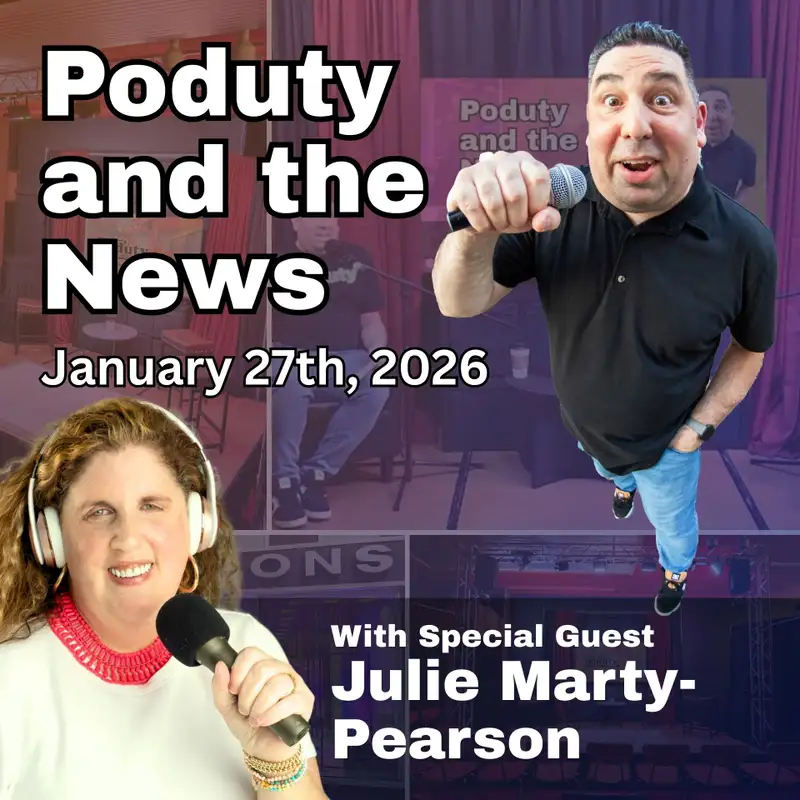
News. I've got a great guest joining me tonight. It's
Julie Marty-Pearson. How you doing tonight, Julie?
I'm good. How are you doing? Great. So it's
cold here in Pittsburgh. We had 20 inches of snow yesterday.
And the high for the. Until Sunday, the high
it's going to be is 16 degrees. I
honestly could not. I do. I do not even compute. I
am in California where It is currently 58, and I
was born and raised here, so I've never lived somewhere that cold. And I feel
for all of you right now. I was having a
conversation with somebody earlier today and they're saying something very similar like, how do you
do it? And I'm like, honestly, it's. It's really the best part
of living and climate where you have four distinct seasons. I
like, even though January and February are really tough and it's
still getting dark at 5pm there's just something about knowing
that by mid March it's going to be, you know, 60
degrees and it's going to be light until 7pm and you start to get
more and more of this, you know, daytime back and life back, and
you're. You can get outside more and you really get to appreciate, you know,
seven, eight months of the year with four kind of not
so great months. That sounds nice.
Yeah, we don't, we don't get four, I would say
seasons. It kind of depends. But where I live gets very hot in the summer.
We were over 100 for three or four months and I do
not enjoy that. So I, what you were talking about sounds good. I could deal
with a couple months of that to en. Enjoy the rest of the year.
Well, I know something else that you have because I was listening to your new
podcast, Still Becoming Woman Unmuted,
and you were kind of joking about you started with one podcast
and now you have three podcasts. And it was really entertaining
just to hear your perspective about you podcasters kind of collect these things
and we just start more podcasts. Tell us a little about your podcast
and the best way if we want to connect with you and how do we
listen to them. Yeah, you can find all of my information,
all of my podcasts and things on my website, which is easy. It's just.
juliemartypearson.com and like you said, I Just started
another last week. I. I've been messing around
with this idea for a while and I just thought I'd put it out there
and I've gotten a great response. So I'm really excited about still becoming women
unmuted. It's really going to focus on women's issues, women's
topics. Just a place for us to share and grow, kind of learn
together. And I have two other podcasts. My other
is podcast your story and that is related to my
business. And I share my tips and tricks there about
how to start a podcast, how to grow, and how to be a good guest,
which I get asked about a lot. And then my third is kind
of my passion project. It's where I started in podcasting.
It's called the story of my pets. And I interview people
all over the world talking about stories of pet rescue, you,
animal fostering, animal adoption, and why
everybody should help out the animals in their community
and, you know, and volunteer and foster for overcrowded shelters
and all sorts of different topics. So I really love that one. I've
always been a huge animal lover and they're a big part of my life.
And I keep that going because that's kind of the really fun part of
podcasting for me is getting to talk to people about their pets.
Yeah. I think I saw on one episode you had somebody who rescued, I think
over 2,000 pets or helped foster
2,000 pets. It was quite an impressive number.
Yeah, I've had some really amazing conversations
with people that I thought I knew a lot. I thought I've always been an
advocate. And then I started the podcast and I was like, wow, there's a lot
I need to learn. So no wonder we need to educate other people. But
yeah, I've met some really incredible people that have. Some people are
doing it on the side as a volunteer thing. But I've also interviewed a lot
of people who work full time and rescue and shelters and non
profits. And it's just really amazing what, what they're dedicating their
lives to. But we also talk about fun things and
how cute our pets are and the silly things they do and how we can't
imagine if we didn't have them in our lives. So I try to make it
a mix of the stories we tell. Awesome. And that
all those links will be in the show notes. There's the podcast.
The story of my pet was great. I was listening to some of the episodes,
doing some of my research, audio Julie. And just a great little
channel on YouTube. Check it out. The link will be in the show notes. Make
sure you support the guests and also all my guests who come on the show.
We're doing something a little special. It's called Poduty and the Crew.
And Julie will now be part of the crew. If you go to the website
where you can find this podcast, you're going to see Julie with all of her
links and any show that Julie
has ever appeared on. So we're building out this huge library so
Julie can be on this show and Julie could be on future episodes.
And we're going to have all those links there, all of it archived in
one place there. It's going to be pretty impressive. That
sounds very cool. I will be checking it out myself now that
I'm on it. You know, I think it's that I think I talk
about it all the time. But podcast guesting is such a great thing because it
is like expanding our community and our connections and
all of that. And I put all of my guest episodes on my website just
for that reason, because I want to share them too. Yeah, it's a great
way. So check out those links. News.poduty.com
p-o-d-u-t-y.com all the links, all the
show notes, all the episodes, audio and video in one
place, which means we know what time it is. Are
you ready for our first story? Let's
go. There are some interesting ones you may.
Not fully understand because this is going to be people in the path
of the snowstorm that just came through the east coast here. But
snow panic is real. And the Rizzuto show
podcast delivered another masterclass in live culture.
Reactive podcasting with an episode that turns a simple winter
forecast into into a full blown social experiment.
From grocery store panic and empty shelves to the absolute
horror of watching someone pay with a check. The show
captures how fast adults unravel once snow enters. The chat
layered with listener emails about awkward office behavior,
relationship limbo and workplace etiquette wars,
plus celebrity nonsense, sports updates and
sponsored studio cams. The episode shows why live
comedy podcasts thrive. They react instantly
to shared experiences and turn everyday chaos into
communal laughter. And one of the things that you said you've never
been in a winter environment. One of the things,
it's very Covid like the behavior of people. When there's a storm
coming, everybody has to go to the store and they buy
everything. There won't be milk or bread, paper
towels, toilet paper. You'll have to go hunting to find stuff. The
shelves literally get wiped empty when you're at the
worst Case scenario, the snow happened Sunday into Monday. We were
already driving Monday afternoon, yet there was this full
blown panic in the area. And a podcast like this, this is going to be
a live stream show. And this is an example of kind of pulling
on cultural moments, things that are happening in society,
and kind of piggyback on that for the content for your show. So this
is one of those shows where, you know, this is what the public's talking about.
They're going crazy trying to get all the groceries they can. And here
we. This podcast comes in and really capitalizes on that
moment. Yeah, and that makes so much sense because I
saw so much of this on social media. You know, people
go into the store talking about it. One of my friends who's a podcaster was
posting about like, she would say, why are there no
eggs, milk or bread anywhere? And she was like, how much
French toast are you guys making right now? Like, she said she couldn't
find those three things at any of the stores she went to. And it's just
so funny to think it's like, guys, you're not going to be cut off from
the world for a month.
It is full blown panic. And, and to be able to have a live stream
podcast, you know, something that's even in, in your industry,
you, your, your niche, you're going to find
things that capitalize on the current moments. And I really think that's what this
po. This episode did really well is they took this major
thing that had news coverage 247 for a week leading
up to it, and they had a little comedy about it. They were, you know,
teasing and jesting each other about what's going to happen.
Did you get your eggs? Did you get the milk? And, and I think
that's just a, a new way to think about podcasting in a way you may
not think about. You may be sitting there writing a script or getting,
preparing questions for an interview. But another perspective, if you're going to
live stream it, you might as well really get into the pop
culture, really get into the psyche of everybody who's out there running around
to get, get the milk and bread. Yeah. And I think it's
smart because, I mean, one of the benefits of live streaming is you don't have
to edit and then put up later and all of that. So you
can be at the immediate moment of what's happening
you, whether that's good or bad. But yeah, I think there's definitely
a niche there in podcasting that not a lot of us who record
and you know, edit, get to do because we're on a schedule or
we put it out certain days. But doing it live and just delving
into what's happening in the world is really. It sounds like they had a lot
of fun with it. Yeah. And this could be a special episode.
It doesn't have to be your normal format. These, they look like they do
it pretty regularly, maybe part of a radio station. But if you can have a
special event or kind of reward your fans with a special type
of episode, this might be one strategy to consider. It's take things from
your industry, take things that you're interested in and make them current and just
have a conversation about it. Yeah, you know, one of
that's one of the things I'm playing with with my newest podcast is doing some
of my episodes livestream, maybe even a panel so people can ask
questions in real time and we can respond. Because I've never
really done that with any of mine. And there's definitely a different
type of focus or content you can get that way.
Yeah. Let's keep it going. I have a second live stream. This podcast
mixes live stream podcasts, live podcasts that happen in
front of audiences, and even podcasts that happen at
as part of other events like conferences. We even see it with
concerts sometimes. The opening acts now are podcasts. So
let's keep it going with another live stream. The Brothers of the
Serpent Niche Nerdy and Live the snake Bros.
Poll 4700 views the snake Bros. Live
podcast proves once again that you don't need celebrity guests or
a massive stage to win with live podcasting. A
recent live streamed episode pulled over 4700 views.
Combining real time discussion, deep dive
analysis and long form debate on topics ranging
from fasting and extreme weather in Texas to
geomagnetic storms and a controversial academic paper on
ancient Egyptian stone vessels. The episode shows
how live podcasts can thrive by letting audiences watch the
thinking process unfold. Disagreements, critiques and
all, turning complex subject matter into compelling, binge
worthy content that rewards curiosity and keeps viewers
engaged far beyond a traditional audio
format. Julie, we're kind of building on the last story
there. There's a way to connect with people. It doesn't have to be
kind of like that morning show format. It could be something that you're
passionate about. It could be like the paper on Egyptian
stone vessels that made for interesting content.
Somehow they were able to pull it together. Maybe that's something they studied in
college or they're just obsessed with, but they
were able to take something abstract and really make a
content, make a show out of it. That was the part that stuck
out to me when I was reading about this before, I was like, egyptian stone
vessels. That's very specific. But,
you know, and I could say, you know, as a guest, one of the things
I love about being a guest is seeing what people are doing. I've been on
podcasts. One was for Bruce Springsteen, Superfans.
That's a very specific podcast. But we had this great long conversation
about lots of different things. So I think it is cool when
people really get specific, but they also allow it to evolve from that
point. Dive in, find the things you love, because you're going to find with
your podcast, you're going to find other people who love the same things. And
if you're passionate about it, you'll find your audience. Get in there,
figure it out, make it interesting, have fun with it. And this is just
a great example of doing that live and pulling your audience together.
4700 people also wanted to know about Egyptian stone
vessels. Wow. And I think
that's also why we see in mainstream media, all the
big shows, all the popular shows have podcasts,
buddies. They said, you know, after this episode, check out the, the podcast
about this show. They even have some new ones where they're having, you
know, famous people come in to host, to talk to the people that are
in the, the television show after each episode. So that
is because everything can be a cult following, whether it's a TV show or a
book or just Egyptian stone vessels, apparently.
And you see that a lot. Like you just mentioned, HBO does this
really well. Apple does it really well. They're combining this
extended content in podcast format. Yes, you're going to watch the show,
you're going to binge watch the series, but then there's this additional bonus
content that you can only get through the podcast. And Julie's spot on, like,
that's a way to keep that community growing, keep that community
engaged in between episodes. And I think that's also why so
many actors and sports people have created their own shows, because they've
realized they can do it for themselves without it actually being the, you
know, companies behind the shows it that are creating it, they can
create it for themselves. I've seen a lot there's. I know there's a couple ones
for the show, the Office that the people who used to be on it do
like re watches of all the episodes. So there's so many different approaches.
I know the Boy Meets World is a big one. That one was I forget
what they call it, but you know, those shows,
I think How I Met yout Mother has a podcast as well. Like these classic
TV shows now are revisiting where they have this cult following.
And they're right. They're just going into it and keeping that community
engaged. That makes me think I might have to create
a Clue podcast. Clue is my favorite
movie from back in the 80s. And I'm like, or there could already be some.
And I just haven't seen them yet. Like all the Easter eggs.
And Clue would be like, what's all the. There's just so much scenery in the
back. The set design was so elaborate in that movie. Yes. There's
probably a thousand stories in the background.
Oh, I love that. Oh, now I'm gonna have a fourth podcast.
Oh, well, let's. Let's see. Because maybe you could present that
podcast at this conference, which I just wanted to highlight. This is
the map for an event coming up in the communications industry.
And if you look at the highlighted section in the upper right corner, guess what
it says? If you really, really zoom in, it says Podcast
stage. So this is a conference and part of the
showroom floor, the event floor is going to be a stage
dedicated just to podcasting. So Connected America
2026 just unveiled its future focus agenda
for this April in Texas. And buried among the
keynotes, AI discussions and broadband policy panels
is a major signal for podcasters, a dedicated
live podcast lounge built into the conference experience
taking place April 14 at the Irving Convention Center. The
event isn't just hosting conversations about connectivity.
It's actively creating content in real time with live
interviews featuring senior industry leaders alongside startup
pitches and policy discussions. This is another
example of how conferences recognizing podcasts as a
primary storytelling and distribution channel, not just the post
event marketing. And it shows how live podcast stages are
becoming the standard feature for major industry
gatherings. And I heard on here it says a pitch fest that I know.
Jolie, you work on Pitch Fest. I saw on your YouTube channel.
That's so something that you're building. If you were part of the
communications industry, you know, that could be something that you could
possibly present on this stage. Yeah, this is
crazy. I mean, I've heard about people doing some live
recordings at conferences, but it's usually podcast conferences.
So to see them have a dedicated space for that, that's really
amazing. But that's also shows that that industry is keeping up with
what people want and how people communicate and how they get information.
It's like if an industry isn't tapping into Podcasting, then they really
are losing out. Yeah. And this is the communications industry, if
you think about what you're working in. Julie also has the story of my pet.
There's probably a thousand pet conferences or meetups
or adoption events going on across the country. You
could tie your show into those types of events. So whether or not
you're in broadband communications for Connected America,
find something in your industry you can probably piggyback on
and maybe get a free ticket, maybe get your ticket comped, maybe be
a volunteer or help make the event a better place.
You can do that because you have this asset of your podcast. And
I can say that that is very true, because I actually have done that this
past summer. I got to go to catcon, which is an
annual conference for cat lovers in Pasadena, California,
and I got to sign up as media with my podcast. And so
I got a media pass and got to walk around for two days interviewing people
and taking photos and participating, and it was
amazing. And then I covered it on my podcast. That's
100% what we're talking about. That's incredible that you're
thinking that far ahead and doing those types of things already to be
able to just leverage your way, like, hey, I got this thing where I talk
to other people who take care of pets, who care about their story.
Then they invite you into their conference to walk around, interview some of
the event booths, some of the speakers. You get this
inside, kind of quote, unquote, inside baseball. Look at the
cat convention, that there's no better way to tie
yourself to your audience than to just go where your audience is.
First of all, it was fun because I had gone to catcon many years ago,
so I was excited. But a couple of the booths that they had, hundreds of
booths, it was crazy. It was like 3,000 people. You wouldn't believe it, but it
was true. And a couple of the booths were actually being run by people I
have had on my podcast before as interviews. So I got to meet them in
person, and then I walked around and talked to everybody, and I have some.
Several newer guests that are coming on through, meeting there. And I also
handed out, you know, stickers that have my podcast name on it and little
paw prints. So there's a lot of different ways you could use an
experience like that. And it doesn't even have to be directly tied
to your podcast. It could just be loosely tied to it, too.
Yeah. A great way, you know, go where your audience is. There's
no better way to meet people that are like you than to go where
they like to go. I guess I tried to make a saying out of that.
It didn't quite work, but I think you got it. Yeah,
go where your people are 100%.
I love that story. I want now I kind of what? We just adopted three
cats over the summer. I tore my Achilles and I'm
resting and my family's like, hey, we want to get some cats. And
so while I can't walk around the house, we adopted three
Maine coons. We found we didn't know what they were. It turns out
that were Maine coons. So we don't know how big they
are, but they are six months old now and they are as
big as our 15 year old cat. So we'll see what
happens. I'll keep you. Those are big
cats. I don't know if they're
100% like, but they're already pretty big. Well,
let's keep it going at conferences. Here's another example of a conference. A smart
example of long tail live podcasting comes from
IAB Europe, which recorded an entire
Retail Media Roundtable podcast miniseries
live at the Retail Media Impact Summit in Amsterdam,
sponsored by media marked Saturn. The sessions
weren't just for attendees in the room. They were captured strategically
to be released throughout the year, extending the life of the conference
far beyond the single event. It's a strong reminder that live
podcasting isn't only about the moment on stage. It's
about creating a content engine that keeps delivering value,
visibility and relevance long after the
conference doors close. And this could be one for pidouty in the
news. You know, I could go to a podcast conference
to, you know, Radio Days Europe, I think, is a big one
coming up. I'd love to do the news from the stage.
That's so cool and so strategic. I mean,
they're, they were thinking ahead, they were thinking about all the content they could get
and how they could, you know, use it over time. Which also saves a
lot of time having to do more events throughout the year. I
mean, we talk about batching even for us who record and edit, but this
is such a interesting way to do it and to
really be like expanding the ways to connect with people
that, you know, are much broader than when you just do it on
Zoom or, you know, in a local studio.
Especially when people travel from all over to go to a conference. Right.
This is something that we're seeing with conferences happening. We're
talking about going to conferences as your podcast and maybe performing there or
like Julie did with the CAT conference, getting additional content.
But we're seeing conferences use us strategically
before, during and after the conference. Leading up to the conference, they're having
people release podcasts saying, hey, we're going to be there, come find us.
We'll be at this booth, we're visiting these people, we'll be on this stage.
Then during the conference, they're live streaming from the conference,
they're getting content from the conference. And then for the rest of the
year, after the conference, all these podcasters that they invited to the
conference, they are releasing content all year long
about the conference, only snowballing the effect for next
year's attendees. So, you know, con, this is an example of a
conference using that strategy to get people to
deliver content to people all year long. Well,
and what's smart about that is that it probably doesn't.
It saves them money too in marketing and promotion by having
a lot of podcasters do it for them both pre and post. And
if you have a great a podcast you love and you hear them talk about
it, you're much more likely to want to go to the conference next year. I've
had so many people say that about catcon because I talked about it on all
my socials and talked, you know, did live videos and
shared a lot of photos and so of course, you know, that was the whole
point of catcon, letting me have a media passes because then I'm probably convincing
some people to show up next year. I just love it. Great way to
promote, great way to connect with the community. It's a win win for the
podcasters. It's a win win for the conference. And you get this
multiplier effect by working together and we'll keep it going.
Let's go to San Diego.
We're going to the Voice of San Diego. One Sports leadership steps
onto the podcast stage. The VOSD podcast took their
microphones live to Soda Bar for a special episode
featuring J.D. wicker, athletic director at San Diego State
University. In front of a live audience, Wicker tackled tough
questions about ticket pricing at Snapdragon Stadium,
empty seats, and how SDSU is navigating the
rapidly shifting landscape of college athletics, including
nil and sports betting. The episode shows how
live podcasting creates a rare environment where public figures
can't hide behind press releases. Blending real
accountability with real time audience energy in a way
traditional interviews rarely match.
Hey, here's a great example of going into the public, right?
You could do an interview one on one in a private studio and
record it and then release it. Or you could take
that conversation out in the public, have a night out, sell some tickets,
maybe a fundraiser for a certain charity or a certain part of the athletic
club, and just have this intimate experience with your fans
and kind of answer all those questions that they are, hey, what's going? Why can't
we sell any tickets? No. Yeah. It's such an interesting
approach, and it's something they could be doing after every game.
And different, you know, different people on the team are interviewed.
There's so many ways you could play into it. But I do love this idea
that, you know, he was willing to show up and be there live and allow
whatever questions that may come to, you know, be asked of him.
It definitely is a great way to connect with the fans, but also connect
with fans who may not agree with the way things are going either.
Yeah, and I love this set. There's just this padded background.
It's almost all black. Black ceiling, black padding, black
tablecloth. You can see the fans in the front. These
podcasts don't have to be giant events filling theaters
or conference centers. You can do this in a coffee shop, in
the media center of a library. There's lots of places
where you can perform your podcast live and connect locally with
people in your community. Yeah. You know, it's so funny. I was just talking to
another fellow podcaster about that, and we were researching some of the places that
we might be able to create our own events for women in podcasting instead of
just doing it all virtual. Because no matter what, nothing beats in
person. It's a different vibe, It's a different kind of connection, and
that's just in conferences or meetings. But it's also with live
podcasting, I mean, you just. Stuff's gonna happen that wouldn't happen if
you're, you know, at recording it over zoom or, you know,
even live streaming. Yeah, people are gonna get tired of hearing me say this.
But what. The thing I found out that I love most about live
podcasting is whenever you go see a podcast live,
it's a once in a lifetime performance. It will never
happen again. It's different than comedy and music.
If a band comes to town and they play their 15 songs
as their set list, they go to the next town and they play the same
exact 15 songs for that town. And comedians work
on material, and by the time they have a routine, they play that
routine in town to town. But when you go see a podcast, a live
podcast like Julie and I can't do this show again tomorrow in
Cleveland. You've already seen it. It's been released and
edited. This show tonight is once in a lifetime. This
will never happen again in the history of the world. These six stories,
this moment, you can only get it by either being here in the
moment or listening to the archive, to the recording. And,
and that's something I'm finding out how special live
podcasting is. It's a, it's really, it's the ultimate
fomo, right? Oh, yeah, I've. There's
a couple that have toured, there's a couple in like the pop
culture space, like Lady Gang and the Giggly Squad. And
that's how they've become as big as they are, is by doing the, the
tours of the live shows because everybody wants to be there and, and
hear what they say or hear what questions are answered about some scandal that just
dropped or whatever it may be. And it is different than like a stand up
comedian doing their regular thing. It's them actually
talking and conversating versus doing, you know, something they have
structured and they do every time. Yeah.
Speaking of every time, could you win by betting every time?
Here's a, here's a sportsbook podcast about a gambler.
A lot of gambling going on in these last two stories. The Boulder City
Podcast hosted Roger Gross. Gross.
Gross. Okay, Roger Gross. It's, it's taking the show
live on February 16th with a special in person podcast and
book signing featuring legendary sportsbook executive
and author Art Manteris. Recorded live at
Skinny Bar, the episode brings audiences face to face with
one of the original architects of modern sports betting,
whose career spans the Stardust, Caesar's palace, and the
iconic Superbook in Las Vegas. The event blends
storytelling, audience Q and A and a book signing for
the bookie, showing how podcasts can turn local venues into
must attend experiences without ticket fees,
massive production, or celebrity hype.
And one of the things I've been seeing lately is people used
to do these book tours. They would go on morning radio, local
television, they talk about the book, they'd promote the book, say, hey,
you can get it at Barnes and Noble. But now what we're seeing is
people are wrapping their book release in a podcast tour.
And here's a place called the Skinny Bar. The Boulder
City podcast is inviting them on to do a live show, talk about
the book. Probably get some of those crazy stories from early
Vegas, you know, some of the sports, but, you know, how many friends did you
have that, you know, had their fingers broken for you from trying to, trying to
rob the casino? And you're going to hear all these little stories of the
grit and the dirt and in the seedy side, probably of Las Vegas. I'm
just imagining in my head what gambling would have been like whenever Art
was running the town. And this is. If you're
a gambler. I mean, gambling is running rampant in this country,
but if you like betting and sports betting, here's an. Here's
a way to sit down, hear a story like you would have listened to a
radio station 50, 60 years ago to hear the.
Like this inside information about what really happened and went
down well. And it's kind of a collision of a
lot of different things because, like, yeah, like you said, you know,
book tours, book signings are big, but you don't see them very much
anymore because they're obviously not doing what they used to do. Because there are other
platforms where people can get interest and get people to,
you know, buy their books. But the idea of instead of it just being a
boring signing, where you stand in line and get your. An autograph on your book,
it's a live thing where anybody can ask them questions and you get the
book. And, you know, I did something like this years ago. I want to say
it was at least 10 years ago. I love Bravo. I love reality
shows. I watch all Real Housewives, and I was working in LA
at the time, and Andy Cohen, who's one of the big producers, was there.
It was plugging his book, but it was him in
conversation with, oh, I can't think of her name
now, with a female comedian. So we all went there and sat in the theater
and heard the two of them speak. And then after, he let people stand in
line and get, you know, signatures on his book. So
it's the same idea. It's a. It's mixing the live podcast with a book
or something like that that people are trying to get people to buy or
even just, you know, share. It's really interesting.
I love it. I mean, you hear a couple stories from the book, you may
want to buy the book and the author's there. The subject
of the book is there. You can maybe get it personalized and really walk
away with a cool souvenir or a cool way to remember the
evening. And the tickets probably are 10, 15,
$20. These types of events aren't bank breakers. And
you get to have a night out. It's at a bar, you get a couple
of drinks, maybe some appetizers, hear some stories, you know,
maybe 30, $40 all in. It's just a
unique way to experience an evening with other people who also
like this type of entertainment, like sports betting, you're gonna be in a room, you're
gonna hear these stories and just have a very unique
and interesting night out. And I can see this happening even like we were
talking about with TV shows like Heated. Rivalry is huge right
now. And that's based on a book. So I could see that author doing
this live, you know, podcast interviews, pushing
her latest book, talking about the TV show version. I mean, there's
so many different ways that media companies and publishing companies could tap into
this. It's a great strategy all around. So, again, I like to go
back to think of your podcast. Think of, you know, where do
you operate and where does your community operate and where can you
find your fans and, and kind of plug yourself into that. Could you be a
guest on a podcast like that's happening here on the Boulder City Podcast?
Or is there some kind of event that you can tap into
and just take your podcast live? I promise you, it's a completely different
experience. Like Julie was saying, you have to experience it live.
You've got to do it live one time. You'll be hooked. And you end up
like me, sitting in a theater on a Tuesday night
doing something you love. Because there's just nothing like live
podcasting. It's a whole new game.
And I really believe that this is the future of where podcasting is going to
be going in the next two to three years. So get in early.
I didn't warn you before we started, but this does go
so fast. We've already gone through our six stories.
We're at the end of the show. I like to turn it over one last
time. Anything you'd like to plug, promote, talk about the floor is
yours. Well, thank you. I know. I can't believe how fast it went. I
thought we'd never get through all those stories. Well, I would just love
to say if there's anybody out there listening to this who's been thinking about starting
a podcast or wants to start being a guest, maybe they're an author and they
want to start plugging their book through podcasts. I have a community
where I support people. It's a low cost monthly community called
Podcast yout Story. And it's somewhere where people who are host,
guests, or both come and connect and network. But we also
do monthly workshops, and as you mentioned
earlier, I do a live pitch fest where everybody gets to come and they get
three minutes to pitch themselves as a guest and why people should, you know,
book them and then they get the clip of it after so they can share
it on social. So we do that. We do so many different things. And I
would love to have anybody interested in learning more or growing in
podcasting to come join our community. The podcast, your story,
community membership. And again, you can check it out on my website.
Julie Marty Pearson.com.
Awesome. Thank you. That sounds like so much fun. If you're ever in
Pittsburgh. I already invited Jolie to Pittsburgh. If you're ever in town, the
stage is for you. Whatever night you want, we're going to book it and
maybe we'll do a. We could do a little pitch fest Pittsburgh.
Oh, my God. That. I am writing it down right now and I was just
talking to somebody about this and I will be saying, we've got a spot in
Pittsburgh. Well, let me tell you about
why, because I have a theater space. You see it here. I'd love for you
to host your show on our theater. It holds 40 seats, but
we can live stream to thousands. This little space has the
same capacity of Madison Square Garden. And I really tease up the offer.
It's hard to say no. I do no contracts. I do no
minimum ticket sales. If you want to do your show here, I'll build you an
event landing page. I'll sell the tickets for you. I will produce
the event, I will record the event for you, and I will give you
back the recording without any ownership. It's your content
for you to use in perpetuity. And at the end of the night, we
sit down together, I show you the ticketing dashboard and we Split the door
50, 50. If you like it, let's do it again. If you don't, we
shake hands and walk away. We tried it and it was a good time. But
I really want people, I want you at home to experience live
podcasting. And I'm doing that by taking all the risk out of it.
So if you have a podcast in the Pittsburgh area, or Bakers,
California, or Bakersfield. Bakersfield, California. Come on
down. If you're ever in town, I will reserve the space for
you and we will put on a live podcast,
Poduty.com,
P-O-D-U-T-Y.com
and unfortunately, that's the end of the show.
And I know what time it is. I don't want to say because I hate
saying goodbye, but it is. Or it was. What
time is it?
Only live news podcast about podcasting
from the stage.
The only live news podcast about
podcasting from the stage.