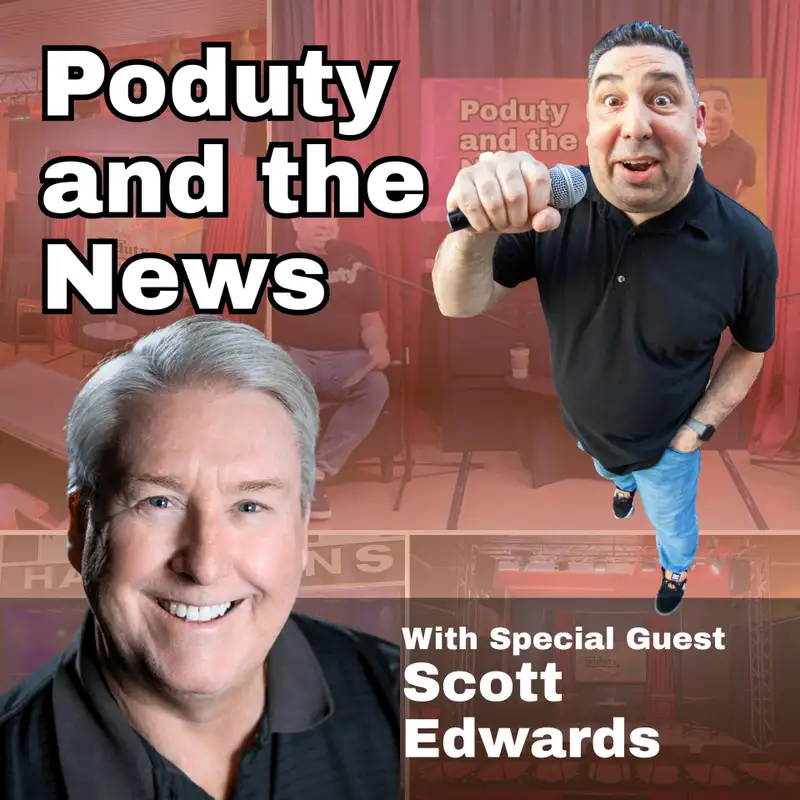
Hey everybody, welcome to Poduty in the News for Tuesday, March
17th. It's St. Patty's Day. I got a great guest joining me
today. We're talking 6 live news stories about live news
podcasting recorded live from the stage. It's Scott
Edwards. Scott, do you know what time it is? Ladies and
gentlemen, it's Poduty time.
Let's rock it. St. Patty's Day. I
got my cocktail.
What time is it? Oh,
oh, it's time for
Poduty and the News.
Poduty and
the News, the only live news podcast
about podcasting from the state.
Poduty and the News.
Poduty
and the News, the only live news
Podcast about podcasting from the
stage.
Oh, the only live news podcast about podcasting from the stage. It's
Scott Edwards. Scott, welcome to the show. What happened to the music, man? I
was just getting my dance on. Hey, good to be here, Jeff.
Great. Uh, what a wonderful setup. I wish I was there on stage with you.
It looks amazing. Well, we'll have to get you here someday. One of
the things I love the most is a guest that brings their own sound effects,
and so far you've knocked two out of the park. I love it. Well, you
know, you never know when something is, is gonna go the other way. Yeah.
All right, settle down, settle down. The dancing girls are off to the
side. Yeah, those people have seen this show, I'm guessing.
But Scott, looking back through your history, the website scottscomedystuff.com
your Verbal Ninja production. But the thing that really catches my attention
about your story is Laughs Unlimited comedy clubs in
California, when this was a time when comedy clubs
weren't all that well established across the country. And you're very
early to this. And the parallel that I'm seeing is you were
starting these comedy clubs, you, as it was becoming a thing, as
it was growing, as the public was starting to accept it as a, like, a
form of entertainment to go out for the night a night out, go see a
comedian. And here we are in 2026 trying to build a
theater very similar to the comedy club model for a
place for people to go perform podcasters, or
go perform their podcast and have a night out, enjoy it. And we're
showing the community that, hey, this is a form of entertainment. So
there's a lot of parallels between what you built in the early '80s
and what we're trying to do today. I'd love to hear some of those your
early comedy club stories about, you know, what were you
thinking when you're like, okay, there's got to be a place for people to, to
perform this type of art? Well, I, I'm so glad you asked,
Jeff. It's been really a lot of dumb luck. In fact, in the late
'70s, I was, uh, somebody
said, hey, we need some music for a wedding. And so I
formed a company called Sounds Good Music, and we were spinning records
in a thing called Disco. Long before the
movie Saturday Night Fever made it a big deal. And when we were spinning
records and doing weddings and bar mitzvahs and birthday parties in schools,
there really nobody understood what disco was. They just liked dancing
to the music, kind of like your opening. It's really fun and exciting and
anybody could dance to it, right? And then the movie
came out. Disco got really hot. And there was a
disco in every town in the country. It was pretty
incredible. So I kind of lucked into the timing on that. Well,
fast forward a few years and I'm on a short
vacation down in Los Angeles. And my dad, who had a great sense of humor,
says, you got to go by this little satellite club of The Comedy
Store. It's in Westwood, right by UCLA University, and
check it out. And I go in and I was with my
then-girlfriend, soon-to-be wife, soon-to-be ex-wife. Whoop! And
I had a great time. It was my first exposure to live
comedy. And people listening to Jeff's show, you got to know
this is in the late '70s where comedy, especially
stand-up comedy, was just kind of the entertainment break between
jazz bands or strippers at a strip club. I mean, it
wasn't considered mainstream entertainment. It was more of a filler.
Well, I loved it to death. I met Dave Coulier that night, George
Wallace, Sandra Bernhardt. And I said, man, I gotta get into
this. Much like disco, I just got the idea, really
somebody else's idea, stole it and made it my own. Jeff,
the rest is comedy history. You're right. A
lot of times you hear stories from that era and people were doing comedy at
bowling alleys and the backs of Chinese restaurants.
And they're just really good. No, I didn't mean to cut
you off. I, I I don't know how this Riverside works, but if we're
both talking, I'm the one that counts. I'm the guest. But no, Jeff, what were
you saying? The way that the comedy clubs were kind of established—
they weren't really established because back then people, you would hear stories about people
doing comedy in bowling alleys or the back of Chinese
restaurants, that there really wasn't a set place. But there was
this rising of talent, this rising of this new medium. That was
really catching on, and you saw the wave and kind of
caught that wave as that art form was really growing.
To be honest, Jeff, I was actually a little ahead of the curve. So
when I opened my chain of comedy clubs with the help of Dave Coulier, Bob
Saget, George Wallace, and Garry Shandling, I opened in
August of 1980, and that was the year
that I was the 12th. That's like you know, 10 plus 2, the
12th full-time comedy club in the entire U.S.
That's how new and unusual it was. It was the Improv in L.A. and New
York. There was the Comedy Store in L.A. There was a club up in Seattle,
one in Boston, but they were very rare. And I opened up
Laughs Unlimited, all comedy showroom,
in August 1980. My very first show, the opening act,
making $100 for the week. Gary Shanling. You may
remember him from a few shows, Larry Sanders Show and stuff. And my
feature act was a talented magician, and the headliner was the one and
only George Wallace, who went on to have his own theater show at the
Flamingo in Las Vegas for over a dozen years. Really
funny people. And what's great, and like you mentioned,
stand-up comedy wasn't really a known thing. In fact, I was
using the banquet room of a restaurant and I would have to set up every
night for my shows. And it was so new that
the only way I got going was these guys introduced me to
people. So Dave Coulier introduced me to Bob
Sagan. Bob Sagan introduced me to Shanling, and Shanling
introduced me to Paula Poundstone, and, and goes on and on.
And it was just an exciting time. It was kind of like the
Wild Wild West because There was no framework
for clubs at that time. It was very new and I
picked the way I wanted to go. Some clubs were different. I
was considered an A-room. A lot of the guys that worked for me went on
to sitcoms and movies and TV shows. But I did a lot of
open mic work and worked with some great people
long before they were famous. And it was, it was really an exciting
time. And I'm going to say one more thing. Much like disco, where it
went from being in every city. When I
opened up, I was the 12th club in the country. That's 1980. By
1985, they had taken over all those
discos, and now there was 1 or 2 in every major city. So
it went from 12 to maybe 200 in just a matter of a few
years. Yeah, I love that your first show, your—
it was— it's 2 of the greatest legends in comedy, and that's how you
started. Yeah, well, you know, nobody really knew
them at the time. It was much like Bob Saget. And I
got a great story for you. Do you have time, Jeff? I'd love— I'd love
to hear a Bob Saget story. Oh, Bob Saget was a
tremendous guy and a great friend. He really helped me out a lot in getting
started. In fact, he helped produce and star in my first
two TV commercials, and he didn't even charge me for it.
But the really exciting thing was we were such good friends and
comedy was still so new. He called me up and he goes, hey, I'm coming
up in a couple of weeks and I need to bring a friend with me
to open the show. And I said, Bob, hey, anything you want,
no problem. So a couple of weeks go by and this guy
comes up and he knows nothing about comedy. And Bob's there to teach him
how to do stand-up. So I'm showing the guy how to, you know, where to
look, how to interact with the audience, how the mic works and all the kind
of technical stuff. And Bob's writing material for him.
And that guy worked for a whole week for no money, and he was
practicing and practicing a set. And then the very next
week, he did a short version of that set on his
very first TV show called Bosom Buddies.
And the star was Tom Hanks. Yeah,
that, that's incredible. Great stories. And
just just to be there as this is developing and,
and really, you know, immersing yourself. And that's kind of what we talk about now
with podcasting. This is the time, like, immerse yourself in things that
are happening, the current events. These are those roots that are getting planted
right now in this industry, you know, similar to what
happened in comedy 40, 40, 50 years ago. It's pretty
incredible just to see it, kind of how things are cyclical and
new things are coming up and new things are developing. And those
great stories, those great legends that came from that time period are also going to
start to come from this time period too in the podcast arena.
Yeah. And ladies and gentlemen, for those actually listening, Jeff was just saying how fricking
old I am. So thank you very much, Jeff. But yes, I'm an old guy
and I had a lot of fun when I was young. But you're right. Podcasting
was very similar to disco and stand-up comedy for me. I first
got into it about 7 years ago. Podcasting was not
nearly as popular as it is now. And I started
a small audio podcast that
ended up doing very well and it still continues. And it's been
a real joy because the focus of my podcast, I'm
sure you could never guess, is stand-up comedy. So I got a
chance to showcase entertainment from back in the '80s and '90s,
but also new young comics. And then I interviewed a lot of the comedy
industry professionals, and that makes my little
podcast— I was doing it kind of for selfish fun, but now it's
kind of a history of the life of comedy as
an actual industry, entertainment industry, that's not only enjoyed
by millions but is respected and a big part of our
entertainment world. Not to keep coming back to podcasting,
but the way comedians have really infiltrated podcasting
over the last 10 to 15 years, the way they've adopted and
grown and really kept connecting with their audiences in new
ways. Podcasting has been that medium, and I listened to some episodes.
It is, it's like this history of comedy. You're hearing some of these stories, some
of the acts, you're hearing some of the behind-the-scenes things. It's over
at ScottsComedyStuff.com. We'll have the links in the show notes.
Go check out the site. Check out the content on there. Check out the history
on that podcast. It's really incredible. And the podcast is called
Stand-Up Comedy, your host and MC. And that was a selfish
plug. But if you get a chance, it is interesting. And if you like
stand-up comedy, you'll enjoy it. But you're absolutely right, Jeff. Stand-up comedy,
much like podcasting, is just building its
foundation. Foundational. Foundational.
We're fondling each other. I don't know. It doesn't feel right. But
it's a foundation for future
interaction with our audiences. And I think you're
totally on point that comedy has gone from
the stage to television to then social media,
and now it's into podcasting. And why?
Because you're reaching a new and extended audience
each and every time you're on. You know, when I started my podcast, I had
a pretty good following, but in Northern California, and then it was all of
California, then it was half the US, and then it was
all the US. Well, now, 6 and a half, 7 years later,
I'm number 2 in Haiti. I mean,
come on, you can't beat that. I'm the number 2 comedy show in Haiti.
Whoop whoop! The kids are excited.
Scott, thank you for sharing those stories with me. As I found out,
you know, through podcasting, that I enjoy comedians
more off the stage. I enjoy the backstories, how learning
how jokes came together, learning about those stories
about being on tour and the things that you don't hear on the stage.
Those have become so interesting to me, and it's given a whole new light
to what it takes to be a comedian, how difficult it is to be a
comedian, what it— what you have to actually grind through
to become an established comedian. And those stories all come to
life because comedians have adopted podcasting as a way
to share more with their audience. Exactly. In fact,
in the comedy club world with comics, what they do is they
get on stage each and every night and they're writing material, trying
material, moving words around, getting the timing just right
so that when it gets to be the perfect set at a comedy club,
then they can go on to TV or into a movie and they've got that
timing, they've got that material. Well, what's great about broadcasting
is not only are you getting that material, but a lot of people just
like you, Jeff, like the behind the scenes, what it took
to build the foundation of that joke, how many times or how
many different ways was it performed before it became the joke we all
know. You know, uh, waiter, there's a fly in my
soup. You know, I mean, who knows where that started, uh, but it, uh,
I heard in the beginning it was a penguin, not a fly. But you know,
you never know what's going to happen in comedy. And what's great about
podcasting is that not only can share the actual
entertainment, the jokes as they're, uh, you know, crushed in from
coal into a diamond and are really funny, but also
where they got that lump of coal and what made them, uh, get that
idea and what did they do to hone that over and over to make it
funny. And that is interesting to a lot of people, at
least the, the two on this stage. Yeah, I could hear those
stories all day and it it adds another level
that you don't expect. You do end up hearing the polished
routine, the one that's been crafted over a year or year and a
half to get to that perfect 7 minutes for a
Tonight Show or the perfect hour for a special.
But it didn't just happen. It's not magic that somebody can put
an hour together. It takes days or months,
month after month after month. Months and a year sometimes to get
to that level, to be able to have that hour. And you need
to— I like to know, you know, how's the sausage made? And that's really what
you get with podcasting. Exactly. A lot of bad sausage. But
anyway, what you want is that experience. I
think your concept of podcasting, Jeff, is so
fresh because if you had a
comic on your stage right now, what I would do if I was
producing it is I would introduce this comic, he'd come out and do
like his tight 5-10 minute set, shit he's been working on
for years and years, get a nice big applause, get the audience
engaged in it, and then sit him down and have a
podcast interview where you can dig deeper, get
information, learn about it. And trust me, that comic is still going
to be entertaining in the conversation. And that's what in
podcasting we're looking for. It's a sharing of information
while being entertained. There's a— you're not going to
believe this— there's a gentleman from Pittsburgh. He was a comic in the '90s, Loaf
Thomas. He's been coming out to some of my meetups and he's putting
together a show very similar to that. It's going to have— he's going to host
the night and bring out 3 comedians with him.
And they're each due 7, 10 minutes, just kind of work the crowd, you know,
be loose. And then after that, they're going to sit down and
just talk about stuff, talk about the set, talk about how some of the jokes
came together, and do like a little mock interview, a little panel for the
audience. And I think it's going to be a great concept. And hearing it from
you saying, hey, this is a direction we should go in, I feel a lot
better about this. I think it's coming up towards the end of April. We haven't
set a date yet, but— well, people, mark your calendars because Jeff is
on to a great idea, and don't want to miss that show because
not only will you see some great live comedy entertainment but you'll get a
chance to interact with the comics as Jeff asks them questions and
let them kind of share their experience. Because trust me,
stand-up comics are all a little goofy, right? And so the way they come up
with their material and work it out is never a straight line.
It's always tangents and things they try. And
it's an amazing artwork.
You know, comedy is part of the variety arts. And I think it's just so
creative, but that creativity in what
makes comedy unique compared to oil paintings
or even songs by musicians is that
stand-up comedy success is based directly on
audience interaction and audience response. And being
able to bring that into a podcast, not only the entertainment, but then
the behind-the-scenes conversation, I gotta tell you,
Genius. Whoop whoop. Any sound effects for
genius? I like the— I don't know if I have anything.
Let's see. Uh, all
right. Well, Scott, Scott's Comedy Stuff dot
com. All the links will be in the show notes. I could do this so
that we could just throw out the stories and I could keep talking about comedy,
but we do have 6 news stories to get to about live podcasting. We're going
to tie in all this history that we're talking about to some current
events, to how people are performing podcasts now, some of the
conferences, some of the live shows, and all this stuff Scott's going to
pull on all that history that he has for Laughs Unlimited, the comedy
shows, the tours, all those things that have built up
Scott's repertoire. I think that's— I'm learning to speak French.
Those are going to apply to these current events. Yeah, no, no,
it goes, uh, you know, we're taping this on St. Patty's Day, so it goes,
uh, right along with the green I'm wearing because I believe in
being a tribute to the
St. Patrick's Day people and the loving Irish and their drinking.
I think what you're talking about is incredible. And just to give
everybody in the audience a little bit more about me, what was
amazing about stand-up comedy is it opened up the world of
producing to me. And not only did I do live stage
shows, 6, 7 nights a week for over 21 years. But
I produced several live concerts up to
12,000, 15,000 people. I did 2
television series and 1 TV special for Fox. I
did a lot of radio, produced a couple of bands, took
them to records, and comedy really
opened the door for me. And it's just
so exciting that podcasting is the bridge to let me
relive and share not only those stories, but I'm still
interacting with comics today, which makes my retired
life much more fulfilled. Yeah, it's got to be great. Just, you sit
down and start telling these stories, go have coffee with some old friends that
you connected with over the years, and just reliving those moments
and what was built and what was accomplished in that time
is not to be You know, not under— not, it's not
underwhelming to hear these stories. Like, these are impressive stories of the
foundations of comedy and the beginnings of those humble
beginnings. But Jeff, how does it relate to today's news?
Well, would you like to find out? Let's jump into it. Ladies and
gentlemen, Poduty presents the news on podcasting on
Podcasting News. The news on the only live
news podcast recorded from the stage. This is, uh, this
first one is coming to us from Spotify out in Germany. They built this
club called the Legends Club, and it's, it was exclusively
for podcasters who have had 100 million streams. So, you know,
obviously these are bigger podcasters in Germany, but they're building these
small theater spaces, these intimate spaces for
people to come in and listen to these podcasts and be 3 or
4 rows away to get that feeling of when you're listening to
a podcast, you kind of feel like you're in the room. Well, in this case,
you're actually in the room, and you're only 4 or 5 rows away
from the, the main speakers. And this concept is very
similar to what, you know, I'm showing you and demonstrating here in this theater space.
It's about connecting with your audience, connecting in new ways.
And Spotify sees this, sees that this is a very impactful way
to connect with the podcasters. This Legends Club that they're calling it,
I think they've done a couple of these pop-ups like this, these small intimate
rooms where it's a VIP guest maybe, or they're
selling tickets to bring in the fans of the show, and
they're getting this immersive experience, something you can't just get from an
MP3 file. This is, you know, being in the room, being
there with the podcaster, and really getting that experience firsthand.
Scott, when you see a stage like this, a small room, a small club,
what does that— where do you go to in your
mind about what's possible with these types of venues and
these types of setups? Well, I think it's interesting, Jeff, that in
podcasting there has been a progression, and I think it's the
natural next step. And to give an example, as I
mentioned, my audio podcast Stand-up Comedy Host and MC has been on
about 7 years and has a pretty large audience and
always a lot of fun. And I've had many live interviews on that show,
but it also led me to just a year
ago starting my first— and I fought it for a while because
it's been going on for about 3 years, and that's video
podcasting, right, where people were showing the interviews
and showing entertainment through a video podcast. So I started
my video podcast about a year ago. But now,
a couple years into video, what we're doing is we're
making it, as you said, more interactive, more immersive,
because not only is there an audio podcast, not only can you watch it on
video if you have the time and the screen in front of you, but you
can actually personally attend the event,
be a part of it, be a part of the audience, and interact
with the host and the guest. Making it, you know,
as I said, the natural progression in the entertainment life of
podcasting. And I am not surprised they're doing it. I will
say I'm surprised they're doing it in Germany. There's not a lot of people with
a sense of humor there, but hey, there's some good podcasters.
Well, there's always this thing about when people design things in Germany,
it has to have more than one purpose. So everything they design, like a
bottle opener, is also like a switchblade or something like Everything has
to have multi-purposes. So I'm sure that they designed this room
as a podcast studio, but I'm sure if you turn the tables around, it's like
a poker room or something too. Yeah, I heard they're doing light porn,
but who knows? Das, das
gut. I speak German too. I don't know
if you know that. Idle. Turn into das
gut. Das gut. We're going to our second
story. Speaking of boulders, right? Where, uh, podcasters play a
visible role at the Boulder International Film Festival,
highlighting how podcasts are becoming part of major cultural and
literary events. Several live podcast recordings will take
place during the festival, including appearances from
broadcasters and creators discussing books, culture, and
current events. Notably, actor and podcast host Alec
Baldwin is connected to the festival's podcast programming
showing how podcasting is increasingly intersecting with
publishing, journalism, and live stage conversations.
One of the things we're seeing a lot anymore is
conferences, events, and festivals are choosing
podcasts as a form of entertainment during the event instead of
having just a Q&A panel with the audience
or a magician or even a comedian or a musician. They're using
podcasting to fill the time, to
entertain the audience. They're bringing podcasts up on stage as the main
events. Well, it goes back to what I said before. It's kind
of the progression of entertainment. You know, we talked about
stand-up comedy starting in strip clubs and between jazz bands. Now it's an
accepted form of pure entertainment. Well,
then you kind of got into the social media
stage where people were commenting on events
and they'd go to event and then they'd talk about it on social media. Well,
podcasting then took the place of that and went more,
and this is what's great about podcasting, it goes deeper. So instead of a
TikTok video or 3 minutes on an
event, now you can actually talk for half an hour, an hour,
on an event, about an event, from, with people from the
event as a podcast. Well, now,
as you mentioned, Jeff, just this recent last year or so,
people are realizing that the interaction of the
audience is so important to the experience, makes it more immersive,
makes that event more important. They're
now having the podcast with the guest
about the event at the event. So what they're
doing is they're bringing the audience into the
podcast. And that is, I already mentioned, I'm reiterating
myself a little bit. I'm sorry, I'm sorry, I'm sorry. But what it is, is
where the audience can now participate. They're not just
listening to a podcast or just watching a podcast. Now
they're a part of the experience. And the event
producers, the event planners love this because it makes
the event that much more immersive, informational, and
exciting for the audience. Easier to sell tickets. Lots of
fun. In fact, I'm a regular at Podfest, which is held
down in Florida where podcasters get together and talk about the
industry and live
interviews and interaction with Podfest as it's happening is
one of the biggest hits of the event. One of the things I like to
say is a nice benefit of podcasting at these
conferences, everything at that conference is already
about the subject that you're probably discussing. So if you're invited
to a conference, everybody at that conference already knows,
likes, and loves what you're talking about. That's completely different than walking into
a comedy room in Detroit or a comedy room in Utah.
You don't know what the audience is like or what they're expecting. But with
podcasting, if you go to a conference that's about, in this
case it was, you know, about TV shows and you're an actor, Alec Baldwin,
chances are pretty good that audience has already warmed up to entertainment
stories, to hearing about Alec Baldwin and being in that room and
hearing those stories. So going where your audience already is
and going where your audience has already warmed up is a great way to
think about how do you position your podcast? How do you How do you get
in front of the right people? Find the places they're already gathering and go there.
Well, and you're so right about that, Jeff. And again, I relate
everything to the stand-up comedy industry, but as you mentioned, uh,
it used to be done in the back of a Chinese restaurant. Well, guess what?
That wasn't where quote unquote the comedy audience was. You had to try
to create it, and it made it very difficult, but those difficulties
really helped the comics hone their material. Well, then you put
stand-up comedy in a stand-up comedy club, and
that audience is there for comedy. So they're much more receptive,
much more open to whatever the entertainer is going to say. And not
only was that beneficial to the entertainers that they had an audience that
was there for comedy, but it made it better for the audience
because they knew there was a symbiotic relationship between
the comics and the audience because they were having a shared
moment. That will never happen before, will never happen again.
That show, that moment, that joke is only going to
happen once in time, and they were a part of it. You move that into
event planning and doing podcasting interviews and event,
you've now taken something that was maybe up on a shelf as an
audio or a video file, and now you're in it.
You're a part of it, and you can engage with it, maybe
change what happens. You know, ask a question that takes the guest down a
different path. I mean, it's so much more fun, so much more
interactive. It really helps build the audience for
whatever topic. At Podfest, it's about podcasting. But like you said,
at a TV show event, and then you have a podcast about TV shows,
guess what? Everyone's engaged in that topic and now they're a
part of the excitement. It really builds
all that energy and excitement to the benefit of everybody.
Yeah, the thing that I didn't recognize when I started this, and you, you
hit on it, about somebody goes in to see that comedy show, that's
that performance, the way that it happened that night is the only time
it's going to happen like that in the history of the world. And same with
podcasting. You and I can't go to Cleveland tomorrow and do this
show. This show is happening once and one time only with these
6 stories, with you and I talking about these things.
Either you're there or you're not. And it's so unique and it's
so special to have that performance, to have that live show.
It's not going to happen again. It'll never repeat itself unless
you're there immersed in the moment or you catch the recording, but
you'll never see it performed again. We're not taking this show on the road.
Yeah, I mean, things you just never know are going to happen.
Boing! Well, let's go to Sydney and see what's going to happen
at the radio. Podcasters and writers are uniting
at the Sydney Writers Festival. Wait a minute, is this a
protest or are they uniting for fun? This one
is for fun, I think. Fun and profit. Ah, that's
always good. Profit is always good. Yes, I'm an entrepreneur.
We've got radio hosts, journalists, authors, and podcasters will record
conversations in front of live audiences throughout the event. This
approach treats podcast conversations the same way literary
festivals have traditionally treated author talks and panel
discussions, reinforcing the idea that podcasts are
becoming an accepted format for live cultural
dialogue. And kind of sounds like we've hit on this story already, but
again, going to the places where your audience is already
meeting is one of the best strategies for your podcast. If
you're thinking about what can I do beyond just recording at home in
my mom's basement, how can I take this on the road, or how can I
meet people who are like me? Start thinking about conferences, start thinking
about events and festivals. There's things in your industry
that are already supporting what you're trying to build, right?
And participating is so important because it, again, it
connects you to the industry, to the people in the industry, to
the topic. What's great about the writers event
is that everything we're talking about, whether it's podcasting,
comedy, even music, it all starts with the
written word. And you have to be able to sit down and
write down a thought to build on it. And I know
some people think that in stand-up comedy that the comics
use their acting skills to make it sound like they— ooh, I just came
up with this idea of driving down the street and something funny happens. Oh, there's
a cow. I'm going to go right over it. Right? No, no, no. He had
to sit down, write down the basics of that concept,
that joke, and build upon it,
doing it over and over and over again. Much like a writer writes
a poem or a short story or a novel. It doesn't just sit
down and flow out of the pen or out of the typewriter or out of
a computer. I'm sorry, it's 2026. It is
rewritten and rewritten and rewritten. And then you have your editor look at it
and the subeditor and the executive editor. And it is worked on
over and over. And I think what they're finding is
podcasting is a part of
that whole experience of writing. And I
think it's just great that in Australia they're bringing those people
together to not only write and talk about the topic of
writing, but by using podcasting, they can now
see it happen right before their eyes. How does that idea come
about and how did you build on that idea using your own experiences
or somebody else's? And a podcast, as I've mentioned a couple of times,
goes deeper than regular conversation. If you're having a good
interview, right? I mean, much like you, Jeff, because you're amazing,
you have to ask a great question and then shut up and
listen, right? That's the key to being a good
interviewer is that you have to be prepared. You
have to have written something yourself, ask the right questions,
and then let your guest bring their experiences and their
opinions and their ideas to the public. And in Sydney, Australia,
they're doing it in the right way through this writers event. It's exciting.
You mentioned 3 things in there: comedians, podcasters, public
speakers. And, you know, how do you get good at those things? And
it's through the repetition. It's through doing it. Over and over
again. And I've heard people describe it as it's like having like a muscle,
and if you want to strengthen that muscle, you got to do those repetitions. You
have to build up that muscle, and you only can do that
by repeating it over and over again. And when you mention the comedian
working out a joke, they may have it written down and
they may just try one word in a different place for one night, and
that's the only chance they get to see if that was the right move on
that joke, and then they got to do it again tomorrow. But those
repetitions over weeks, over months, really working out the
spacing, the timing, strengthening that muscle from the
stage, strengthening how do I present this to an audience— those
repetitions are what make you great. And that's— you can go
to these types of festivals, you can host your show because you've done all
those repetitions. All those previous episodes have taught you how to
get on a microphone how to entertain a crowd, it's
through doing it over and over and over again. It's not always the most
glamorous way to talk about how do you get better, but you got to do
it 100 times, 1,000 times, over and over and over.
Well, what's interesting is a lot of people don't think about all
entertainment this way, but whether you're a writer, a musical performer,
an actor, a dancer, or a stand-up comic, or even a
podcaster, what you gain from the
experience of doing it over and over is the wisdom to doing it right, but
you're also trying different things. You know, we always
tell people that want to get into podcasting, quit talking about it and just do
it, because until you do it over and over and see and hear
your own mistakes, you won't be able to fix them. And
it's such an important part of the experience, just like a
writer that has to write and then it's edited and rewritten and edited again
and rewritten again, or a joke is worked on over and over and over to
get the right patter down. Even a magician, when they're doing an
illusion, they have to talk. It's called the patter
of a trick, and they want to get that just right and the timing
just right because, you know, the audience is looking here while over here they're doing
the magic, right? And it all has to come together,
and it's done through practice over and over and over. And I know your audience
will find this shocking. I just started public speaking last week, and
I think I'm pretty good. Doing all right.
Yeah, yeah, of course I've been in sales and on
stage literally thousands of times, so I am a little
comfortable with a microphone. But, uh, it is, uh,
practiced, and, and much like you, Jeff, it, it is
the definition of being a professional. Well, you
know, somebody who's only done it once or twice, not that many
times on camera, is our second story. Mariska Hargitay, I don't
know if you ever heard of her, uh, you probably first time got lucky,
I think, on this one, but she's going to be at the Napa Valley Stream
Fest. The Emmy-winning actress Mariska Hargitay will
participate in a live taping of The Hollywood Reporter's Awards
Chatter podcast before receiving the festival's Icon
Award. The conversation will take place on stage at the
Upton Theater in Napa and will later be released as a podcast
episode. The event highlights how podcasts are increasingly becoming
the centerpiece of film and television festivals, allowing
audiences to experience celebrity interviews live.
And this is a great mix of doing a live show—
I only get 30 minutes of this voice— it's a great, a great
example of doing a live show, recording it in front of the audience,
but then having this asset that you can repurpose over and over
again as a podcast episode, as YouTube
Shorts or vertical videos. It's a great way to, to get
that recording in and have something to build off of for weeks to come.
Well, and it's so true that we're all creating content, and content is
the king in podcasting and any form of entertainment. But what's
exciting is that she won her Emmy because she was literally the
youngest person on Law Order. I mean, that show's been on for 50 freaking years.
So I mean, for her to get on the show, it's and, and Survive,
an episode, got her the Emmy. But I think the fact that her mom was
Jane Mansfield is even more impressive,
because when you're the daughter of a huge celebrity and movie
star like Jane Mansfield, it really gives you a
different view of the world. So she understood before she
got into acting the hard work, the dedication,
the, the so many nos you're going to get as you're trying get into fame.
It's never like they say, oh, you're, you're found,
you know, like Marilyn Monroe, and all of a sudden she's a star. And Jayne
Mansfield was just there and boom, she's a star. No, these were
actresses that worked, you know, really hard doing soap commercials
and in selling condoms, and all of a sudden, you know, they got fame and
fortune. She was able to pass that— Jayne
Mansfield, I'm saying— got to pass that on to her daughter. Who was able
to take that experience from her mom, turned it into
an acting career, and then win an Emmy on Law and
Order. And who knew? Let's hear it for her. Good job. Good
job. Good job. All right. That's enough. All right. It's just
proof if you stick with it long enough, you could get the awards.
Yeah. Or be the youngest person on the oldest show ever
recorded. The show's been on for 50 years, but she's only 45. So
that's pretty impressive. Yeah, yeah, you never know. Well, let's
go keep it moving. We're going to move right along here. We got Podcast Movement.
We were talking about different types of conferences. You mentioned a podcast
conference called Podfest. Well, Podcast Movement has announced that its
flagship 2026 conference will take place in New York City
for the first time, hosted at the iconic Terminal 5
venue. The multi-day event will include an executive-level
business summit industry networking events, and
creator-focused programming. The move signals that podcasting
has matured into a major media industry and is
increasingly intersecting with advertising, technology,
and entertainment. And they just had a smaller, uh, podcast
movement at South by Southwest this past, uh, couple weeks ago. And
this is another part of that conference, is, is
growing in New York City as their flagship event. At Terminal 5 coming
up. I believe it's in September. I don't have the— September
17th through 18th. So this is another way, if you're thinking about
podcasting, this is where the industry is meeting up. They're meeting at
Podfest in Orlando, they're meeting at Podcast Movement in
New York, and South by Southwest. There's— these events are happening.
These are where you want to be if you're interested in podcasting. Go to where
your audience is. Go to where people like you are at.
Well, Podcast Movement, for anybody in podcasting, is the mothership.
It is one of the biggest conventions of people in the podcast industry,
and they're helping connect the host to the guest, to the
advertisers, to the equipment suppliers. It really is a
catch-all for anything to do with podcasting. And for those who don't know, it
got started in Texas and has just grown nationally. And the fact that
they're announcing they're going to do a big event in New York is actually huge
news. Because— and Jeff, you just brought it to your audience. This is the
news. Podcast Movement in
New York City is going to be huge because it gets literally
thousands of people down to Texas. Imagine what it'll do in New York.
And much like Podfest— now, Podfest is like the
little brother of Podcast Movement. It's a little more intimate,
smaller event, but it's growing. But it's been
happening in Fort Lauderdale and in
Orlando for the last several years. I believe it just had the 12th annual
and it's doing very well. The guy that runs it, Chris, does an amazing
job. But Podfest is a little bit smaller, a
little bit more intimate. And as I said,
Podcast Movement is like the mothership for podcasting.
And what's great is if you can't make it to Texas or you can't make
it to New York, They have a live version that
goes out much like your show, Jeff, but then they also record a lot of
the talks and a lot of the courses and classes they teach.
And you could pick those up through their website,
podcastmovement.com. So if you get a chance and
you're interested in podcasting, check out either
Podfest or Podcast Movement and you'll find lots of
tutorials, lots of great talks, and a lot of people
that you can talk to about the podcast industry. And
this one coming up next fall in New York is gonna be massive.
And as Jeff said, if you want to get in on the ground floor and
learn and meet all the people in the industry, Podcast Movement is a great
place to go. It's crazy when you go to conferences for the
first time and all these people that you've been listening to for years,
they're just standing there having a conversation. You know, you're maybe 2 or
3 people away they're— everybody's very friendly at the conferences I've
been to. They want to be there to represent
themselves, their shows, talk about the things that they want to talk
about, talk about the experiences they've had. And most people, you'll
find, if you're courteous and give space, that they're very
approachable. And even though you've been listening to them for years and you
might know them, you can still say hi to these people. You can still shake
their hand. You can thank them for some of their episodes and You don't get
that kind of experience sending an email or making a social
comment, but in these events, there's mixers and there's
different events in the evening where they're just celebrating. They're celebrating their
love of podcasting, and you're in the same room with some of the biggest
movers and shakers in the industry. Yeah, Podfest throws some great
parties, and so does Podcast Movement, and you do get a chance. What's
interesting about podcasting, Jeff, is that it
still really is blue-collar entertainment. In other words, anybody and
everybody could be a podcaster if they want to. And even though there are some
famous podcasters out there, you know, Joe Rogan, for example,
everybody knows the name. But most, even the really popular
ones with hundreds of thousands of followers, there's not this
fandom or stardom that makes them untouchable or
unapproachable. You said it really well. You can meet and talk to
your podcast heroes at either of these events.
And not only will they be talking, but they're going to be out in the
crowds before and after their talks, but also in the
after parties. And as I said, they're very approachable.
And as long as you don't, you know, throw yourself at them naked, they're going
to sit and talk with you and you'll learn things,
even if it's to go up and say, hey, man, I've been listening to your
podcast. It inspired me. Now I have a podcast. And they're
going to congratulate you for taking that move, taking that
step in bringing your value to
podcasting. The secret of podcast events, Jeff,
is to grow more podcasters because there's all these people
that have a voice. Let's hear it.
Yeah, I don't want to diminish what they've
achieved, but micro-celebrities in this
micro-environment where they're not walking around with
10 bodyguards surrounding them, they're not being
bombarded by paparazzi, they're in the crowd, they're walking the same
hallways as you, they're wearing the same badges as you, the name badge,
and they're just approachable. And it's surreal, I think, the
first time you get to experience that, you know, you're just walking down the
hallway with Legends in Podcasting, and they're just
friendly people. They're just, they're just like you and I. Yeah. And
what's nice about Podfest and Podcast Movement is they're both known for
having breakout rooms or open discussions where
5 or 6 people will sit at a table and one of the people
might be a really experienced podcaster and you got 3 or 4 newbies
and they're all talking and sharing ideas and experiences. And
that kind of connection, as we talked about earlier,
when it comes to events, having that live interaction, that,
that connection to the industry and to the people in the industry can
only allow you to build your dream when it comes
to podcasting. It really is an exciting time to be a
podcaster. Yeah, I love it. If you get a chance, even if
there's smaller events in your neighborhood near you, check them out, go
support those local creators, support what people in your
area are building. And then when you can get out to the Podfest, get out
to the podcast movement and take it up to the next level.
Exactly. I agree. I mean, I tried to build myself up. I
drop in occasionally on an AA meeting and talk about myself and, you know,
it always makes for a great podcast addition.
Just start setting up your recording and say,
hey, I'm Scott. I know this is anonymous, but I want
to talk. Well, let's go. Our last
story in a venue with— this is the kind of place that I would love
to do a show. It's in New Orleans. It's in a small
bar. It's, uh, the Rights to Ricky Sanchez podcast recorded a live
episode at the historic Preservation Hall in New Orleans
after a Philadelphia 76ers game. Hosts
Spike Eskin and Mike Levin were joined by guests including
NBA insider Jake Fisher, musician Amos Lee,
and poet Maya Kang. The show blended sports
commentary, storytelling, humor, and live performance in front of a fan
audience, demonstrating how podcasts can transform
fan communities into a live entertainment experience.
And this is kind of like a variety show here. They're talking sports,
they have musicians, they have poets, and they're doing this whole
set in front of a live audience, just entertaining them. A night out
in New Orleans, having some, um, what's the, what's the,
uh, not a gimlet, the, the drink of New Orleans, like a,
uh, Sarsaparilla? Yeah, there's a few. The Hurricane's
the famous one. Yeah, you get those Hurricanes off the street and it's like, you
know, 3/4 alcohol and a little bit of mixer. Uh, but the Mint
Julep if you're into the South, you know, you have a couple things you get.
So I've been to Presentation Hall, and it's an amazing place for
music in New Orleans. That's what I went there for. But what's
nice about all the entertainment places and the bars and the
showrooms in New Orleans is they're very intimate. So even though
these guys were able to take the stage and do their podcast, it
wasn't like 1,000 people or 800 people. It was probably 200
maybe a few less. It's not too huge a hall. But what's great
is that intimacy and the interaction of a live audience. And
because they're doing it after— did you say a Sixers game?
Yes. Yeah. So then you got these celebrity sports
people coming in off the cuff, no prepared material, just
talking. And again, that's the beauty of podcasting.
You're having a real conversation with a real person in front of a
real audience. There's nothing more live and invigorating than
that. And these guys picked the perfect venue. In fact, I was a
little shocked they let them do it because this is a hot place to hear
some jazz music and other entertainment. And to have a
live podcast in front of that audience, it had to
be riveting and just feel the energy in the room.
Typically don't stop the music in New Orleans to be able to even have
the venue open for the night. Seemed like this had to be a very special
occasion. The owners must have taken it very seriously. They,
because it's music nonstop, doesn't matter when you're down there,
that, that stage is having a performance on it. And to have it
see a podcast is another, another testament to how
popular podcasting is becoming. If they not, if they're not having
music at Preservation Hall, they're going to have a podcast that tells you that
those bar owners, they're those venue owners are looking at
other streams of revenue and sometimes maybe slowing
down. Having a podcast still fills the club
and it's another way to keep, you know, keep people coming in.
Yeah, and you're saying it so well, Jeff, and I think you could see the
theme throughout this episode of your show is
that much like stand-up comedy and musical entertainment,
It's great to listen to, but when you're there, for example,
a band, if you go to see, if you listen to the Eagles on the
radio, you're going, yeah, man, that's pretty good. But you go to an Eagles
concert and you're seeing them live, you're immersed in that
entertainment situation. It means so much more for you. It's so much
more fun. And the same could be said for stand-up comedy.
You know, the analogy is that stand-up comedy in
1985, '86 kind of got popular because Evening at the
Improv and a couple of TV shows put stand-up comedy on TV,
and that kind of brought comedy into the forefront of entertainment.
Guess what, though? It's so much better when you're live
in the comedy club, live in the room, engaging with that
entertainer and being a part of the show. So the same for
podcasting. It's one thing to listen to a podcast or maybe
watch a video podcast, but if you're in an audience and
you're there with the host and the guest and you're part of the event,
whether you engage with it personally or just get to experience
it live, it's going to mean so much more to you and to the host
and to the guest than just a regular podcast.
I mean, that's why I think, Jeff, you're making the point the next
progression in podcasting is doing it live, because when you get
that live audience, the energy, the interactivity
just fills the room and everybody's a part of it.
There's no beating that adrenaline. Yeah, it's electric.
It's one of the most electric forms of entertainment. And we are going to
go from one of the most electric forms to one of the most
dangerous forms in podcasting. We're at the end of the
show. No, I've had so much fun. And the
most dangerous part is this is where I turn the floor completely
over to you. You can plug, promote, talk about anything you'd
like. Scott, the floor is yours.
Ladies and gentlemen, I'm R. Scott Edwards and I am a
podcaster. My audio podcast is Stand-Up Comedy, Your Host
and MC. Check it out for great interviews and live stand-up
comedy entertainment from the '80s and '90s. But if you like new stand-up comedy,
go to my new video podcast, The Tag Team Talent Podcast.
That's The Tag Team Talent Podcast, where me and a co-host introduce
3 fresh comedy videos each and every week, including our
classic rewind. It's always lots of fun. If you get a chance, check it out.
And my website, the Stand-Up Comedy Podcast Network,
showcases over 20 different comedy-based podcasts. It has
great videos and pictures and all kinds of great stuff. Be
sure to check it out. And it's been such an honor to be on the
air with Jeff. Thank you, Jeff.
Man, you're incredible. That was great. I had my own
moment. I'm just so excited. I can't
stand up because they might see too much. Yeah. Yeah.
It's an above the belt show, they say. I
don't know what that means. I'm sorry I
mentioned my green thong for St. Patrick's Day. Sorry, folks. Just take that image out
of your mind. So far you mentioned don't throw yourself naked at the green
thong. At the conventions. Don't— you don't want to throw yourself— you might get
slapped. And there was another good one in there. Oh, the
German room when they turn it over at the end of the night.
So those will be some two good clips coming up. But Scott, I really,
I truly appreciate this. This has been so much fun. I hope we can do
this again. Love to have you back on the show. We'll do 6 more stories
another night. Hey, it's been a real pleasure, sir. And ladies and
gentlemen, keep watching the Poduty podcast and learn about podcast news
each and every day from this man, Jeff. He is doing it. What
time is it?
Podcast about podcasting
from the stage. Poduty and
the News Surprise! Poduty
and the News Surprise! The only live news
podcast about
podcasting from the
stage.