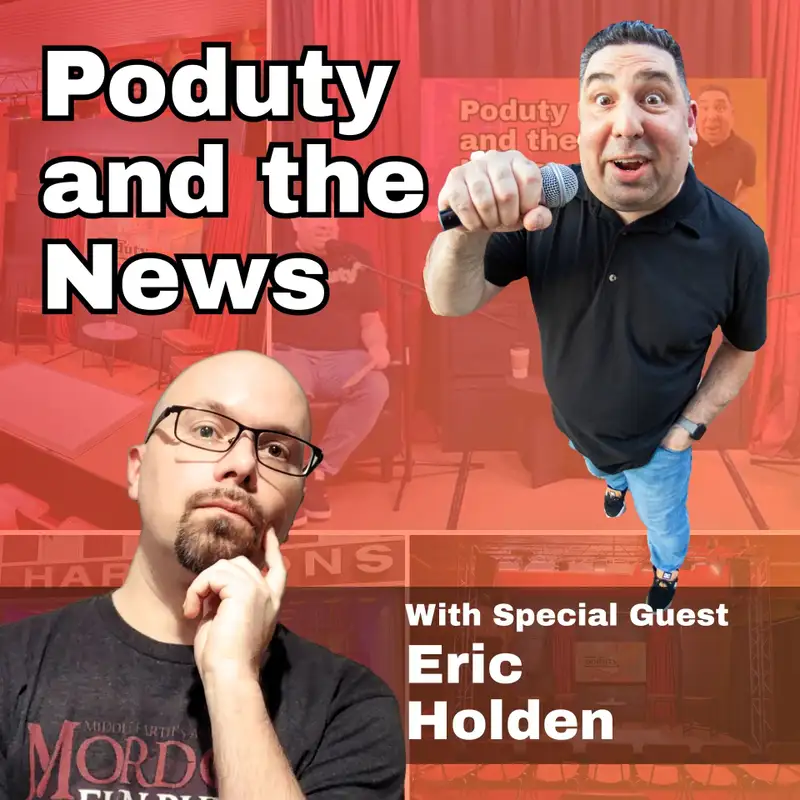
Good morning, everybody. It's Saturday, February 23rd,
2026. I'm at the Poduty Live Podcast Theater at Harrison's on Corbett
in downtown Tarentum for another episode of Poduty and the
News. We're bringing the crew Saturday mornings. Everybody get their coffee
ready. I've got Eric Holden joining me from the Goblin's
Corner. Eric, do you know what time it is? It's time for
an amazing intro song. What time
is it?
Oh, oh, oh, what, what, what, what, what time is it? [MUSIC] It's time for
Poduty and the News. Poduty and the News, the only live news podcast about
podcasting from the state.
Poduty
and the News. Poduty and the News, the
only live news podcast It's about podcasting
from the stage.
I love that, uh, you made me dance in the intro, Jeff. That's about as
much dancing as you'll see this white boy do, so, uh, thank you for that.
I love it. People are very amused by the theme song and really enjoy it.
Well, Eric, welcome to the show. Welcome to Poduty and the News. This is the
only live news podcast about podcasting from the stage. I'm your host, Jeff
Ravilla. Eric Holden from The Goblin's Corner is joining us.
Eric, officially, after all my blunders, welcome to
the show. Thanks so much. Uh, I'm pleased to be
here from not-so-sunny Atlanta currently. So as
you can see, my delightful studio in the back— hug a flump if you know
what those are. I do not. What are those? Flumps?
Uh, this actually my wife crocheted this for me, but it's— flumps are,
uh, they're like psionic floating, uh,
mushrooms essentially that gently fart as they fly through
the air. It's the most ridiculous monster in Dungeons and Dragons, which is
why I have one as a squeezable toy. So the farting— but does it— when
you squeeze it, does it make a noise? No, it doesn't, but that's, that's
definitely something we should put into it, like a little— like a dog
squeezy. I think those would go viral if people had farting mushrooms that they
could just It kind of looks like the Flying Spaghetti Monster, really.
Yeah. Well, Eric, tell us a little bit about,
uh, The Goblin's Corner. I want to hear about some of your experience running your
own podcast. You mentioned some of the improv experience. I think those things really
tie in to what we're trying to accomplish today, which is talking about live
events, live podcasting, storytelling. And, uh, tell us a little about the
show and, and a little bit about your background. Sure. So I come
from over 20 years of improv experience. Uh, I was, you know,
I did a lot of, you know, on-stage improv, some comedian
stuff. And yeah, I taught improv over the years, but I'm
also a huge nerd, as you can see from the background, various books
and media. And when, when
COVID happened several years ago, I was left with
nothing to do because we didn't have live events. No one wanted
to meet up in person. And my best friend Matt Staples, who's my co-host
of my show, we would sit out on the back porch years and years, uh,
ago and talk about just gaming and storytelling and what kind of thing we're
running and stuff like that. And at one point we were like, hey, why don't
we just do a show for this? Because we would, you know, post in
Discord or on Reddit about people who— hey, I have a hard time telling
the story, or I don't understand, you know, maybe not
necessarily the mechanics of the rules but how to get players involved, or I've got
a problem player you know, how can we make this an additive, engaging
experience? And so the Goblin's Corner was born from that— is how do you
get people using the experience that you have in improv
and worldbuilding and storytelling to make fun
stories? Because that's really what it's about. That's why people play tabletop
games. It's not just because of the rules or because I've got this really cool
character build, because they want to tell stories. It's the same feeling that you
get when you're a kid and you're playing make-believe. Just with some dice
rolls. So we've been doing that for several years now.
Uh, we've, you know, we've got an amazing set of followers. We've been doing,
uh, we do some live events as well. We stream some stuff. We've done a
rando roundtable occasionally where we get people from the industry in
to just kind of wax philosophical about events and
sometimes just, you know, talk smack, which is always fun.
And, and that's pretty much our show, right? Like How do you— do you
wanna make a great story? Great! Do you wanna know how to make a stupid
monster? We've got plenty of those, we'll show you how to make 'em too. So
check us out! Yeah, it's great that you have the livestream experience, the
improv experience. It's the Goblin's Corner, the podcast. Check it out, I'm sure available
everywhere. Do you have a dedicated website that you like to send people to?
goblinscorner.com and of course we're on YouTube and all
iTunes and all the other stuff as well. Awesome, I'll put all those links in
the show notes and as you know Anybody who becomes on the show is part
of the crew, and on the Peduti in the News website, you'll see all of
Eric's links, his bio, uh, and, uh, all the episodes that
Eric will be on today, and then any episode in the future we'll add to
that profile. So you can check Eric out, check out the show notes for the
links on, on his episode, and, uh, check out the crew page
to see everybody who's ever been on Peduti in the News. Eric,
are you ready for our first story? Let's dive in. I'm
trying something different. I've noticed that the weakest part of the show is me reading,
uh, about a minute-long version of these news stories.
It's not that exciting in hindsight when I, I read for about 60 minutes
and I, you know, stumble over all of my words. So I
thought I'm gonna start telling my guests about the stories instead of reading
verbatim from a script. So we're gonna try that out today. We're gonna
see how that goes. I think we'll be okay. I don't know, but that's
why we edit these things, and I can always insert me reading later on.
We'll impro— we'll improvise it. It's fine. Yeah, that's the way we'll do it.
As long as I don't tell you I'm messing up, you'll never know. So this
is a podcast called The Yogscast. It's on a YouTube channel, and they
went live. They had about 11,000 viewers on YouTube,
and they broke down Star Trek: Insurrection. It was It was
the energy of this live audience. It ended up turning what could have been just
a, a niche nerd rant into an entertaining communal experience
shared around fandom and frustration,
right? You know, Star Trek: Insurrection has pros and cons. It has its critics. It
has its fans. But they were able to take their community, tie
in together with, you know, what this one, uh, insur— Star Trek:
Insurrection was all about, and see what other people thought about it, see what the
reactions were from the fans. And it was just a great way to,
to bring fans together around a central topic. What were some of your takeaways, Eric?
So I watched it. Uh, I— what I liked a lot about it is it
makes podcasting kind of a mainstream media form
now, and it's a great way to just, as an
independent, you know, group of creatives,
or a theater in your case, or even just a show in ours, you know,
to get out more to the mainstream. Like one of the things I thought that
was really interesting as they were breaking stuff down is
it's adding that unexpectedness to,
you know, us— what it was essentially a scripted event, right? You know, they—
I'm sure they had notes as they were breaking stuff down, but instead they were
doing live. They were getting, you know, catches and takes from people who are commenting
during the show, which was kind of cool. And it made it kind of a
more fun and engaging experience. And you get really awesome creations
from that, right? There were some side jokes that they were establishing while they were,
they were chatting. It was a long and lengthy episode, but they, they
made it really interesting. Yeah, it's, it's events
like this, livestreams like this, that, that really bring the fans
together who really care. So whatever your industry is, whatever you're
talking about on your podcast, there are those little, you know, nooks and
crannies in your industry. There's those hidden topics, there's those not-so-mainstream
things that people can get together around and just geek out over, nerd
out over those little details and just have a good time. And
things like that, when you get that niche, really brings the community
together, really brings out the super fans. I think that's something we saw for
this stream is the super fans came out who knew all the
ins and outs of Star Trek: Insurrection. And nerds are opinionated
too. And you could give like— like they did a lot of, you know, they
did some good takes. You could see where they were like glazing certain people and
then they did some bad takes and you could just see the engagement spike.
Which I have opinions about because one of the things that,
you know, we do is we don't try to trash other people's love.
Be— just because I might not be interested in this particular game or this version,
you know, I, I make fun of 4th edition D&D, for example, in my show,
but it's not because I don't like it. It's just, it's not my bag. Right.
But you might have been brought up playing that edition of
gaming and that might be something that, you know, got you through a hard time.
Who am I to say that that's something bad? Now, in their case, they did
it in a way that uses humor, so it's not, you know, kind of a
malevolent way, but it's just enough to kind of,
you know, get that ire from the nerds who are very opinionated,
and they drove that engagement. They did it in a fun way.
You know, people laughed about it, and it gave that energy to the show as
well, which I really enjoyed. Um, there is one thing I wanted to
mention on what you said about niches. That is
a great example. They're not following the same script, particularly on
YouTube. You know, YouTube script, script is, I've got,
you know, 10 to 15 minutes. I've gotta nail these points. I've gotta
make it so that it can be chopped up into clips. This was like an
hour, 2 hours long, and it was a live format. They
were, you know, they were going back and forth. There were pauses in there.
They didn't care. They found their niche. They did something that was
unique, and as a result, they attracted
people to that show. And that says a lot. You don't have to be like
everybody else. Yes, I don't care about analytics. You know, the analytics may
say do this, but if you do something that's real, that's what's important.
Love keeping it real. And I like something else that you said about—
you don't have to tear down other people's loves and passions, but celebrating them
in a way. And you know, friends do joke around, they'll, they'll tease each other
a little bit. You can have fun with each other's likes and passions, but
they're also celebrating them at the same time. They're not tearing people down,
or at least that's one of the ways that you approach it. You're looking to
elevate and celebrate, and it might not be something that you love
about a series or a particular storyline, but you know that
your fans do, and there's reasons why. So you want to hear those
storylines, why they love it, why are they passionate about it, and you can
lift up that storyline. You can celebrate there with them. You can joke around, you
know, back and forth a little bit, but, you know, being there with each other
on a, on a subject matter that you're both passionate about, it's the best way
to, to glue that community together. Absolutely. And by the way, that
doesn't mean I'm not going to make fun of it. Yeah, it's just, it just
means that it's going to be an additive experience instead of a subtractive. Yeah. Speaking
of bringing people together for a cause, how about trying to
save Great Salt Lake? This happened live at Sundance. It was hosted at
the Impact Lounge and They asked one simple question: can
storytelling actually help save the Great Salt Lake? And what they
did is they brought up activists, they brought up podcasters, they were sharing the
stage. And Masei Gonzales, uh, podcast Stay
Salty: Lake-Facing Stories, passed the
mic around. And through the end of the episode, through the end of the show,
the, the governor Spencer Cox recommitted to filling the lake
by 2034. And the big idea here is, you know, how
does live storytelling— how do these live events where you're bringing the community together,
you know, how do they help create that civic influence? How do you build
something greater than just what you're talking about on the stage? How do you
create action? That is a great
example of getting the word out. You
know, we have a lot of heavily edited media these days,
and one of the things that I love about just the time we live
in now is if I've got an opinion, I can get online and say it,
you know, and it can get out to a million different places. And I don't
care how much it's, you know, regulated or whatever. If I have an opinion,
someone's going to see it. And that's great for people
trying— in this case, like trying to save the lake, right? And, you know,
politicians are starting to pay attention to that, which is awesome. It also
shows that live emotion, like people
are, you know, they were angry, they were passionate, they were, they were
concerned, and they had experts on there telling their points, right? And
there was back and forth, and that resonates a lot with
people. I'm amazed, like, just seeing the community come back out again. We always
talk about that post-COVID hangover where people kind of retracted
to their homes and they're just doom-scrolling on their phones all night. But here's something
that people were passionate about. People came out in droves to listen to these
stories, to hear what, what can be done. The politicians are
paying attention. This is where the, the direction of media is going.
This— the ability for you to create something that other people listen to that
isn't one of the three main networks. You have power now. And
these types of events where you're bringing your podcast, you're bringing the
community, you're bringing the politician together, that's going to move the needle a
lot faster than calling into your senator or or penning a
letter— I don't know if people still pen letters, but, you know, penning a letter
to your congressman. This method is
the media. This is how you distribute information. You record that
episode, you put it on social media, you distribute it through your podcast
feed, and now you have something to spread awareness,
to, to show people, hey, we better save this lake or we're going to be
in trouble. Yeah, you've got a voice, which is very important. Now, I
will say, like, this can also— this could have easily been a double-edged sword. Like,
it could have quickly, and I've seen plenty of videos of where, like,
a town hall that was streamed live just kind of goes into this
polarization moment where it's us against them and people are
fighting. And next thing you know, there's, you know, there's anarchy going on inside
the courthouse or wherever it was. But I think they did
it in a way where they found commonalities. And,
you know, that takeaway, I think if you're doing this for a live event,
if you're, if you're a podcaster, if you're anybody trying to do some kind of
live event, and you've got two groups of people that may not see
eye to eye, you know, take an improv rule, find
like and like, find things you can build on and then,
you know, elevate that. You know, I— you
both like cheese. Awesome. Let's start with cheese, right? You both like, I
don't know, rap music or the fact that you like money. Okay, cool.
I like money too, right? Go to— with idiocracy there. But there's something
that everybody can find in common. You find that common ground because if you
don't, you're going to get that polarized thing and then you're just going to be
battling each other and that's no fun. Nobody wants to see anybody argue on a
stage. Nobody wants to see anybody argue live. You know, we
get enough arguments in our daily, daily life and, you know, you want to see
people come together and build. Yeah, that's a
sign also of a well-moderated event. They really try to avoid that us versus
them language. They want to talk about here's where we're at, here's where the
problems are, here's some of the solutions. And they focused on an
outcome. And they were able by the end to get that commitment from the governor,
you know, less than 8 years away, can we get this thing filled back up?
And it's just a, a great way to see the community come together and get
some action on the table. Let's go. Speaking of action on the
table, I love this story. This one is— I wish I was in Fargo.
Uh, Fargo Moorhead Community Theater, they're building a $10
million, 40,000 square foot theater.
It's a 420-seat theater, and it's going to have
the most important thing besides the modern acoustics, flexible classrooms,
rehearsal space. It's going to have voice lessons
rooms and a dedicated podcast space.
Wow. That's a big deal. So they're building this theater and they're already incorporating
what's the future going to be like that's going to fill this theater. So
they're— they have rooms to develop the talent. They're thinking ahead. How
do we get people comfortable on stage, on microphones? And
when you start recording your own episode in spaces like this and you're
ready to go to that next level, the next level is already there. There's a
theater space for you to come in. Maybe there's special nights where
tenants or, uh, students who are taking classes in
the voice lesson room, the podcast studio, maybe there's like
a recital night, you know, where they can come in, they can bring their family
in. And they can get a taste of performing on stage. I just thought this
was a great way, uh, to build, you know, podcasting into the
foundation of this theater and get something moving, get
the arts flowing, get those ideas put out there, recorded and
distributed. And it starts right in the back rooms of this 420-seat
theater. Jeff, they're taking your idea, man. This is a great
way to put stuff together. You know what I— you know what this means though?
It really means that this is another form of just— you know, creative,
creative media. Like, it's— we've gone out of our infancy of,
you know, hello, I have an, you know, a show on this, and I'm
going to interview this guy about his business and what it means
about B2B marketing. And instead, it's, you know, here are
my ideas, let's build something creatively. This also adds a lot
of unexpectedness because, as you're aware, a live audience can change things
up, and it lets you kind of become more
creative overall too, which I love. Man, that's a huge theater as
well. So you could even have stuff
like a podcast moderating a live event and have people
on stage and have an MC be part of someone
who's streaming in. It also means maybe I can't get that guest
in because they live in a different country. Now it opens up the world
to guests from different places, people who are live and
local. And it just— it's, it's a really cool way to connect people.
Let's combine our last story with saving Great Salt Lake with this theater
space. Now you can have those types of community events, a
podcast being moderated by, you know, a panel of four. That's a great way. Some
of those panelists could be some of the students taking voice lessons, some of
the podcasters using the podcast space. In the back rooms. And
now you have this event that you're putting together. It's a social event.
Your guests, like you mentioned, could be anywhere in the world. It's
also, I think, an excellent business idea as a theater,
you know, just like hearing about like a lot of the business
decisions. Like, modern theaters— I'm— I know this is gonna probably come to a
surprise— don't make a lot of money, right? It's— it's no surprise to
me. Yeah, in fact, most theaters make more money off of like liquor
sales than anything else, than any show stuff. And so, you
know, having people who are trained in audio work or podcasting or
even just, you know, taking improv classes or acting classes or
whatnot, those type of things can help generate revenue to the theater. They can
sponsor more programs so that they can, you know, sustain the theater for years
to come. And that way you don't have to have like a patron that gives
you money and then you're kind of beholden to whatever you know, they
want you to tell, you know, you want an independent theater to tell its
own story, not be beholden to some, you know, billionaire that, you know,
wants you to basically use it for their own soapbox.
And so I think any way that they can, you know,
make revenue and also, again, train people in a creative craft
is an excellent business
idea. Absolutely. And you mentioned like, you know, if a theater doesn't have
a production that night, the theater isn't making any money that night. The,
the doors are closed, the lights are off, but they're— they still have their bills
to pay. And that's something I know with, you know, even though my theater is
only 40 seats, I have maybe 2, 3 events a
week. 4 nights a week, this theater is just burning cash. But what I
love about their business model, there's these office rooms, office
spaces, rehearsal rooms, podcast studios. They're building in these other
little streams of income that can help support the theater during those
down nights. Yeah, it's versatile. We'll keep going. We'll go back
to history. This story is about Will Rogers at the
Will Rogers Memorial Museum. This happened on February 12th, and
they did a story of bringing Will Rogers to life.
And for those of you who aren't fully familiar or weren't in attendance, you know,
he's part of the Cherokee Nation, born in 1879. He was the highest
paid Hollywood star of his time. Also a political humorist. He was
a national influence. But we're seeing more and more
of these types of history events as podcasts
performing live for audiences, and the audiences are coming out in droves
to— and in this case, they had free admission and refreshments. So, you know, lure
people in with food and drinks and then tell some stories, tell that
history and share that legacy with people and bring it to life in a way
that you wouldn't get just reading a book or or listening to maybe
a documentary that was produced before. And I just love when
museums and podcasts come together. We've seen this model a few times, and this
is just another example where, where it's just
that, that powerful connection of this is what we are, we're a museum, this
is what we talk about, and this is what people like listening to. Let's bring
all that together and have a night out. Yeah. And it's, it's a
nice sense of immersion and depth, much like this delightful,
uh, spa, uh, ad that's on your screenshot as well. I'm being targeted
with my ads. Absolutely. It was
like, oh man, you need to get a big immersive spa. You know, they use
humor and storytelling. They use facts and then weird
quirks to kind of engage the audience. It's not like a, just a history
lesson. I guarantee, you know, while I didn't see, you know,
anything in there, cause it was just a story that you posted, but like, you
know, this opens people up a little bit more to learning. And it takes that
absurdity of life and probably the really interesting facts about
the guy's life and distills it a bit,
you know, gives you something that you would then want to go, oh, here's
some tidbits. You know, we have like— we always say like leave the audience
wanting more in improv, right? You know, he always ended on a high note.
And I guarantee if they set this up right and they had the right audience
and stuff, they would give them just enough to intrigue others so that they would
go out and explore more information on their own. And that's the way
you do historical, you know, shows. I,
I kind of really enjoy historical podcasts or podcasts
that give like information and stuff. Like, I'll shout out to, you know, Stuff You
Should Know, which is a Georgia podcast, and
they always go into like really interesting tidbits or history behind, you know, whatever
it is, like behind, I don't know, the armadillo or just
random, you know, interesting, uh, facts and stuff. And it makes you want to go,
oh cool, I want to find out more about this. That's how you draw people
in. The thing I love about these types of podcasts at
museums is, you know, maybe they have a little bit of an agenda set. They
have their— they, they outline what they want the show to talk about, but they
have all the artifacts of Will Rogers laying around, and they have a
back room, things that aren't on display. You know, they could bring stuff
out and share things that the public can't see, and they're
sharing those unique artifacts those— the history, and they
actually have like maybe the jacket or the hat or, you know, something that he
wore on, on a movie set, and they have that here. They can bring it
out and people can see it, something they haven't seen maybe in 70 years when
they, they first saw it on the screen. Now that's the
actual thing, and having an event like that in the museum, you can get so
much more immersive in your storytelling. And it doesn't have to be
this giant expensive event where they list, you know, you know,
they see the, the setup and they've got the pop-up posters and
the live of, you know, static recreation of the statues and all stuff, and they're,
they're like, this is Will Rogers' gun. Well, that's cool, but,
you know, instead they could just be like, you want to see his gun? Check
it out, you know, look at this thing. Great. Here's the
shot glass that is right next to his gun. He used to take 5 shots
of whiskey before he made a show. I, I don't know anything about the guy,
so I don't know if that's actually true or not, but if I was, if
I was doing cowboy movies, I would definitely be drinking a lot of whiskey on
set. So, but it gives that realism to stuff and you don't have to make
a giant, you know, like a big
set or a huge event because maybe you don't have the money to do that.
Or maybe you just want to do something quick and you can round up— you've
got too many artifacts from a particular individual or a
particular setting. And so you can't get everything into your exhibit.
And so that stuff in the back room, you just break out. Here's some tidbits.
You want to learn a little bit more? Come to the museum and you can
learn a lot more. Yeah, you're filming all those cowboy movies in
the desert, you got to take shots to stay hydrated.
Also taking shots— photography shots— at the
Petapixel Photography Podcast. They recorded live at the Build Expo and they
were breaking down the latest camera releases like Canon,
Nikon, Sony, Fujifilm, and then they closed with an audience
Q&A. It's an example of how a niche podcast can turn a trade show
appearance into live content that extends beyond the room. And we
talk about, uh, podcasts like this all the time going to where their
audience already is, performing their show in
rooms where the people who love what they do already exist. So they brought their
podcast, the Pedipixel, and they brought it to a
conference. That conference gave you that multiplying effect. You know, people know
what you do, they probably are already fans, so those people are going to show
up. But other people in the room who are at that conference, now they're getting
introduced to you. Now they can hear your thoughts and, and figure out why are
all these other people interested in the show. And I just love the idea
of taking, taking your show to where your audience already
exists. Oh, absolutely. There are already experts, you know, sitting in
the audience. There are already people passionate about the subject. And I'm gonna— I'll
veer real quick, like, I do an improv show at Dragon Con every year. It's
a Star Trek-based improv show called Captain's Log. Guess
what? The audience of 800 people is full of Star Trek nerds
who love Star Trek. And when I do Star Trek, an improvised Star
Trek set on stage, they love
everything because even if I'm wrong, which I frequently
am, it's, it's because the community understands. They get the in-jokes, you know,
same thing with what Petapixel did, right? You've got a bunch of designers
and photographers. They're passionate about photography. They get up there, you want to see the
coolest new camera? Look what it does, you know, or this imports into, I
don't know, Photoshop or Affinity or whatever, you know, design program you happen
to be using, or it has all of these settings. They talk about stuff
with the experts and then the people in the audience, they get it. They can
get the technical jargon because they already are invested and involved
in that creative film. You know, go where your audience is. That's a
great idea. You're going to get a very engaged, happy
audience— well, not necessarily happy, they might be pissed off about it too— but at
least you're going to get some certain opinions about that subject
matter, which means you better be on point with your knowledge as
well too. So that makes you a better presenter because you have
to answer questions that maybe hit you from left field. Yeah, you
got to put the Canon people on the right side, the Nikon people on the
left side. Don't let them mix because they, they really stick to the camera that
they love. Yes. Lens manufacturers are just dead in the center trying to
like, no guys, we can sell it to everybody. We like you, but we
like everybody. But some people don't like everybody, and that's what happens
on The Worst Hookup Ever is sometimes two people meet and they don't
get along. And this is probably adult content, so don't go clicking the
link if you, you have kids in the car. But this is from The
Downside podcast, and they did this live audience segment called Worst Hookup Ever. It's
kind of like a game show and it was— had live
audience participation. They weren't allowing anything illegal, but that doesn't mean that the
content is PG-rated. And they let the crowd vote
by applause, and they gave away prizes at the end, t-shirts and stuff. And I
just love the way— I love structured chaos. I grew up in the '80s and
'90s, and I grew up with punk rock and skateboarding,
so chaos is something that I love to thrive in. So to see a
podcast really go off the rails, really try this type of format live
on the stage, letting the audience come up and be the show. That's
a big risk, but you can really thrive in that
type of chaos if you, if you really embrace it. Oh, 100%.
Hail Eris, man. Chaos is king. I will say a
couple of takeaways from this. A, failure is always funny. You know, if you're
going to crash the plane, crash it into the mountain. And crash
it hard. Like, if you're going to fail, fail deep. People love to see that
stuff and it's hilarious when it goes sideways. Sometimes that's part
of the magic. And again, this is also
a double-edged sword. You know, when sometimes things
go bad, they're going to go bad in a really bad way. And the audience
is going to be like, oh man, this is really a bad feeling. And that's
when, you know, someone who's skilled in stuff like this needs to make sure
that you steer that ship right. Have an MC. Prepared to take
it into either a positive direction or a funnier direction, or I
don't know, just press that button, make it go even worse, because you'll
kind of, kind of thread the needle and go through that awfulness into something hilarious.
And that's where true comedy lies. Yeah, I love
it. Eric, I'm so grateful for you joining me today on Padutian
News. Your improv experience, your storytelling, uh,
this made the show exponentially better today. Uh,
thank you, thank you, thank you. These are the type, type of characteristics I'm looking
for in a guest, and you delivered at 1,000%. And so
everybody who listened to these 6 stories, go back. There are so many good
nuggets about applying improv to your performances, about getting up live
on stage. And the way I wrap the show up, Eric, is I like to
turn it over one last time to you. I don't— you can plug,
promote, talk about anything you'd like. The floor
is yours. Oh man, you shouldn't have said that. No, I, I will
say this. If anybody's interested in making a
better podcast, you know, check us out. We, we wax philosophical about a lot of
stuff, but I will also say take some improv classes, take some
acting classes, take a public speaking class, take something that allows you
to present in a way that you can structure how
you talk, uh, to your guest, right? Know who your audience is, and that
will make you a better presenter and a better podcaster and a
better person overall. And then if you're interested in how
to tell a story, how to game with your players, or just how to
have fun, check out the Goblin's Corner. We're on every single thing known
to man. Uh, we even have social media, which I don't check, but my co-host
Matt does. So you feel free to say hi to
him. And, uh, yeah, that's it. Go play some games, have some
fun, be a kid again. That's the best part. I love, I love— I mean,
especially this resurgence, obviously in the last 5, 10 years of of
D&D and the storytelling that has really
gone skyrocketed. But hearing adults now getting back into things
that they loved as a child has been like the most rewarding part of
hearing about all that growth and, and all that interest in D&D
again, is people are reliving their childhood through these
gaming experiences, through these storytelling experiences. And it's just— it's so much
fun to live full again, live, live a life you lived as a kid but,
you know, as an adult. Yes, life is not just
your soul-crushing job. Life is more than that. Get out, touch grass,
enjoy the world. Oh, that's fun. Touch grass is— is that a, uh, I
think that is like a corporate term. It probably is. I'm sorry, I come
from corporate America. Oh my God, they're killing me
already. What? They've, they've infiltrated you. My soul has already
been crushed. If your soul hasn't been crushed and you want to perform like you're
a child again, We have a theater space here outside of Pittsburgh, Pennsylvania. We
do no contracts, no minimum ticket sales. We'll build you a landing page, sell
the tickets for you, produce the show, record the show, give you back
the recording. We take no ownership over the recording. At the end of the night,
I sit down with you, I show you the dashboard, and we split the
door 50/50. Everybody who has ever done a show on this stage has walked out
of here profitable on their first show. Check it out
at poduty.com. P-O-D-U-T-Y.com. This has been Poduty and
the News. Eric Holden, the Goblin's Corner. Eric, do you remember
what time it was? It was time for coffee, but now it's time
for— what time
is it?
Poduty
and the News Poduty and the News The only
live news podcast about podcasting from the
States!
Poduty
and the News
Poduty and the News The only
live news podcast about podcasting from
the States! On the only live news podcast about
podcasting from the stage.