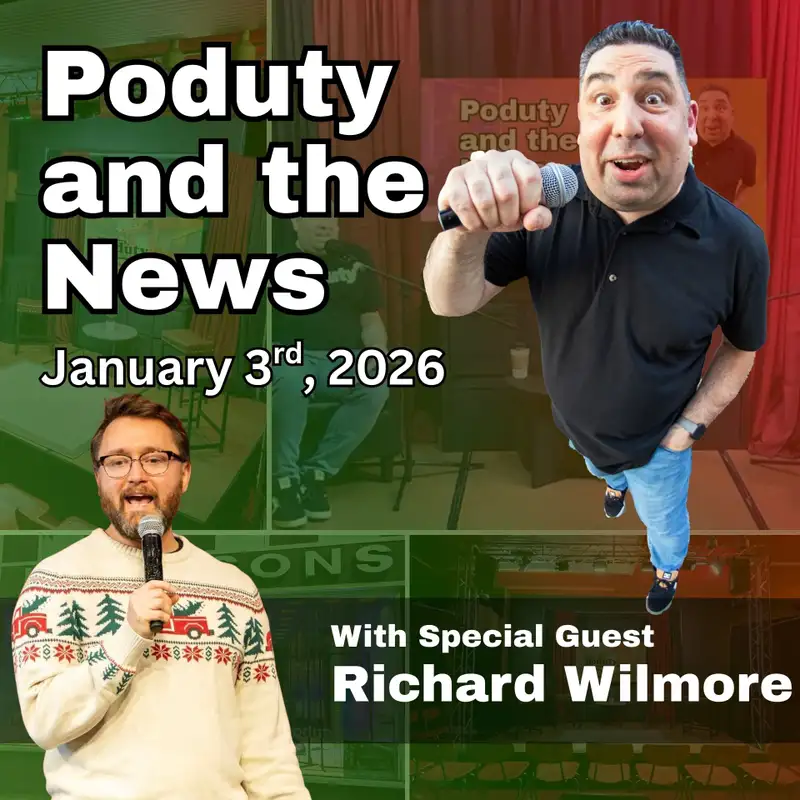
We are here at Happy Saturday, Poduty and the Crew. We have
Richard Wilmore joining me today from Make Your Day
Richer. We're at the Poduty Live Podcast theater in downtown Tarentum.
Richard, welcome to the show. Good morning. Thanks for having me. I'm
so glad to have you here. Love what you're building. And we're going to talk
about that right after the theme song. But I only have one question
for you before we get started. What time is it?
I think it's time. What time is it?
What time is it?
The only live news podcast about
podcasting from the space.
The only live news podcast about podcasting from the
stage. Richard, welcome back. From this side of the theme song.
I love it. That's that I, as someone who loves a good
theme song, you did a great job with that one.
Well, thank you, thank you, thank you. To Suno. Actually.
Credit all credit. That could be the band name Poduty. and the Crew.
Poduty and the News. That's the name of the theater that we're sitting in right
now. We're doing this live. We call this Poduty and the Crew. Richard
will officially be part of the crew after the show. There's a. A place
on the website where everybody who's ever been a guest on the show has their
own dedicated page with the shows that they're attached to, along with links to
find them. And let's find out a little bit about Richard. Richard, tell us
about make youe Day Richer and some of the things you got coming up.
You know what? 2026 is the 10 year anniversary
of me podcasting, live, streaming, making
YouTube videos. I started the Richard Wilmore show and
2016 and have been doing it ever since. In
one way or another, we did over almost
400 episodes of make youe Day Richer over the last year and
a half. And then starting Monday, make youe Day
Richer, the game show premieres. So I'm very excited about that. Getting people in the
studio playing games, like with podiums at one time.
At some point I'll get a Bob Barker mic and it's gonna be
fun. So I'm excited about that starts on Monday. Oh, that's something that's
after my own heart. Having a live theater space, bringing people in
and doing shows live in front of an audience with people
creating something new. And one of the things we talked about last week with Dave
Jackson was you create something new in the
moment. And the only time in the history of the world that that
moment exists is during that show. And that's what makes live shows
live podcasting so special is you get this once in a
lifetime experience. So any hints as to some of the games you'll be
playing? So they're all knockoffs of games,
you know, but of course I don't want to get sued. So we've changed them,
but they all revolve around my guest. So like if a guest is an author
of romance novels, I create a game around
kind of romance novel theme and their life and
we play a little game and they're everything from like drawing
games to trivia, all kinds of stuff. So every episode is kind of different,
awesome. And the best way to connect and. Find those shows
YouTube probably make your day richer. YouTube make your day
richer. I'll put the links in the show notes. Make sure you're there Monday. This
podcast comes out Monday live as a live MP3 file or not
as a live as a recorded MP3 file. In that show, notes will
be the links to go watch Richard's new game show. So check it out.
Make your day richer on YouTube. Yeah.
Are you ready to get into our stories today? Oh, I'm
ready. Well, let's go. We're going to your home
state here. From the State House to the stage. This comes to
us from South Carolina ETV and public radio
is putting government front and center with a live taping of the
South Carolina Lead Podcast. And this week in
South Carolina on January 8th at their Columbia studio.
Featuring South Carolina House Speaker Murrell Smith.
Hosted by Gavin Jackson alongside State House reporter
Mayan Schleichter, the live event will preview
the 2026 legislative session and the policy debates shaping
the state's future. Free and open to the public with limited
seating, this taping highlights how live podcasts
are becoming powerful tools for transparency, giving
audiences direct access to leaders and turning civic
conversations into shared real time experiences.
And this is one of the things that I really like about live
podcasting. It's that community aspect. And you're
bringing people into a space, a civic space where you're
going to discuss, hey, these are some things we're thinking about for the upcoming year.
And you're going to give feedback and share that feedback. And while
you're doing that, record that show and distribute it as a podcast.
When you hear stories like this, I don't know how far away you are from.
Where was this at? In probably Columbia, I think probably
in Columbia. Is this something you would ever think about attending
yourself? Listen, do you want to know something? I don't even know if I should
Say this, but I'm going to. They.
So that news, the station was.
Had a brand new show that was green lit, a podcast type
show that I applied for and
then went and auditioned for and then never heard back from them. So I don't
know if I have anything to say about. No, I'm just kidding.
They're doing this. They're live in it, right? It's not live streaming.
Yeah, it'll be a live event that they're going to record and then later release
as a podcast. I think it's interesting when you see
TV stations, TV networks starting to get on the
podcast bandwagon. I think that's very telling
of like how this is all going. And I think
probably because of, of
COVID where everything's kind of. You have to have
access. You have to give people access now. And this is the way, the way
to do it. I wish they were doing a, like a live stream
of it so people could interact that way if you're not in the room. But
I think it's, I think
it's where we need that we need to feel like we are in a room
with someone that we're giving power to. I think,
I think we're all craving that. And we've seen this a couple
times on the past episodes where traditional media
is moving more and more into these new media formats. They're doing
live streams like you mentioned. In some cases, this is going to be a recording
and then distributed as an MP3 file. It may even be recorded as a video
and uploaded to YouTube for people to later comment on
and ingest. But these are things that you're saying, this is public radio
and South Carolina ETV that are doing more
and more non traditional ways of distribution. So,
you know, keep that in mind if, if you're a business owner and you're thinking
about like, oh, how do I get my podcast in front of people? Well, start
thinking about maybe there's a live event, maybe there's like a convention in
your, in your hometown about the things you do. And guess
who's already there. People who like what you do. So you try
to think of how do you integrate and intertwine your
event or your podcast with these things that are
already happening out in the public. Now that you say that I did that a
couple of years ago. There was a writing
conference in Winston Salem and I took my show
there, set up a little studio and the authors were able to come and
talk. And so they had access to something that
they felt like they weren't able to ever do. So it was
like right there on the spot, they could come and sit down. So it's very
smart. I got a lot of great guests from that. It's a great
way really, like you mentioned, to meet people like you're already in an
environment where people like what you're doing or they like the same things
that you're doing. And it was writers and you met a bunch of writers. Hey,
I got a bunch. There's some guests for your podcast. Yeah,
exactly. Speaking of guests for your podcast, we want to
see if they'll prove they're a real fan. And this is a follow up from
a story we did a couple weeks ago on the South Beach Wine and Food
Festival. One of the, the acts there's gonna be, there's gonna be
a, like a, like a festival of live
podcasters doing live podcasts at this food festival.
And one of them, this guy Scotty B. Is part of the morning show with
Elvis Duran. And he wasn't going to go do
this because he didn't feel that this was his target audience. So
watch the video when you get a chance. So prove you're a real
fan. A member of Elvis Duran and the Morning show is drawing a
hard line on live appearances with Scotty B saying he
would refuse a million dollar live show unless fans could pass
a secret test proving they actually support the show.
Debate resurfaced around the South Beach Wine and Food Festival
where Scotty B argued he'd happily do a live show in a smaller
venue, but only for an audience that generally wants to be there,
but not for people who wandered in for the food. Fellow
cast members Gandhi and Andrew Goldstein called him out, sparking
a bigger conversation about whether live shows should prioritize
scale and spectacle or true fan connection,
even if that means fewer seats and less money. And you know my
tagline, fewer seats and less money. That's the Poduty Podcast Theater. We've got
a cap of 40 people. So if Elvis Duran in the Morning show
with Scotty B. Scotty B. I'll vet all 40 of your guests for
you. We promise you're invited tomorrow. Next
week he can come on the show. Next week we talk about these live events
and, and I really say for 90% of podcasters, a
live strategy is a faster way to
monetize your podcast than to try to get downloads and read host
red ads. So smaller venues can make money for your
podcast. It can cover your expenses for the year one show.
It could cover your hosting, your website, everything
that you need to do and a little bit more by going
live instead of trying to get to this arbitrary number to
do host red ads. Yeah. I think it all depends, I
guess, on what your goal
is, Right? Like, if your goal is just to get in front of new people,
but at the same time, sort of maybe, I don't know, there are places that
you could pay me $10 million that I probably wouldn't show up at because it
doesn't really align with my moral compass,
you know, like, so there's a little bit of that, but there's also,
like, stepping out of the box of what you think, where your
audience is. I think I talked to
other guests about that, too. Like, if you are an author,
don't just go on podcasts about being an author
because you're going to talk to other authors. Like, if you're trying to grow your
audience, maybe step out of. Of what
you think or where you think you should. You should be.
You know, you said turn down a million dollars. I'd probably play a tic tac
toe convention, you know, for a million dollars. And
this just seems misaligned. It seems like everybody
who's a fan of Elvis Duran and the morning show does eat. And
I think a South beach wine and food festival would be a
great place to hang out, meet your fans in a casual environment.
And to say that not for a million dollars, it does seem
misaligned. I get you have your ideals and your views and
you want to make. Maybe this guy grew up punk rock and he's like $5
tickets, DIY AF. But this is.
I just think. I think he could open his mind a little bit
and do a show in front of people and really capture a new
audience, make new connections, make new fans and share
some. Break bread with some of your fans. I wonder if it's maybe an
ego thing, too. I mean, Elvis Duran, the morning show, is
the most popular radio show, and he's been on
there for a long time. Maybe he. I don't
know, feels like maybe he's a little bubbit. A little bit. Well, the other
two, Andrew and Gandhi, are doing the food festival. He's just
not. He booked like a cruise and is not going. He's going somewhere else.
All right, well, we'll do it. Let's. Why don't we go. They can ask us.
We'll split the million dollars and we'll go. I definitely eat.
Yeah. Well, let's go to our next story here.
The hum stops at the mic. The Rolling Stone interview has
officially relaunched as a Video podcast debuting with a
powerful live episode featuring Florence Welch,
recorded in front of an audience at Cherry Lane Theater and hosted by
Rolling Stone senior writer Brittany Spanos. Welch
describes anxiety as the constant hum of her life, one
that only disappears once she's on stage, opening up
about the emotional weight behind her new album, her collaboration with
Taylor Swift, and why she's embracing the approach of turning
40. The relaunch shows how live
podcast interviews are evolving into deeply human experiences
where performances, vulnerability, and audience presence combine
to create moments that feel less like content and
more like connection. What'd you take away from this
one, Richard? I mean, you probably see this more.
I film in a studio with no audience. Do you still get nervous, like, before
something happens? Like, even today with no audience and we're recording, like,
are there still butterflies before you do something?
No, I actually start to thrive on this now. It's. It's not. I
don't know if it's a healthy behavior. And people have actually told me that there's
a stage Jeff. And an offstage Jeff that I'm. I am
doing some sort of performance that I don't realize that I'm doing right now.
That, like, oh, you're state you're being staged, Jeff, right now. And
I. I don't know. I. I really enjoy getting in front of people.
The only time it really gets in my head is if I over prepare.
If I think, like, this is everything I got to say, rather than just
having bullet points I want to hit on, then. Then I'm.
I'm fine as long as I have bullet points. But if I try to plan
stuff, I. I'll do this thing where I talk myself out of breath,
which is so embarrassing. I get.
I've changed it from getting NER things in front of an
audience to, like, changing kind of what that
feels like in my head. Like, it's all, to me, the same energy, whether you're
nervous or excited. And so trying to regulate that
into making sure your energy is up, all of those
things. But I always get a little nervous, like, even before
this. Like, I want to make sure that you do a good job for the
person, whether you're the guest or the interview or the performer. You want to
make sure that you're performing at your best. But then as soon as
it starts, it feels like all of that goes away.
Yeah, go time is the best time. And when I do the
show, I spend a lot of time. Each week, I do two of these.
I'm going through thousands of stories, filtering through to find
the six best shows. And once I create the show,
I think I sent this to you on Wednesday. I haven't
looked at it until this morning. Yeah, that's. That's how much I need to
just be in the moment. Yeah. I. I can't think
about the performance. I have to be the performance. Yeah,
yeah, yeah. Living in the moment, I think is part of live
theater, live music, live podcasting
is. That's why you do it. It's why I always
wanted a live daytime talk show. Like,
the energy, everybody, I feel like, sits up a little, a little higher,
everybody. There's just a energy in that room, no matter what type
of performance it is, that you can't recreate on
a. On a video. Yeah. And this example here
with Florence, they're doing what you would have read in
a Rolling Stone magazine 20 years ago. You would
have to buy the magazine, read through all those words.
Right? Yeah. Just to, you know, get an idea what happened on the stage.
But as a true fan, you can go to these types of events.
You can watch. How does Florence react to the questions? How does
she engage with the audience? How do these things happen in
real time? You get to see that eye contact and those
in the moment reactions, which you can't get from a magazine article
or even an MP3 file. You get to experience
celebrities and musicians in a whole new way. And this
case is a great example with Rolling Stone leading the charge. Well,
in a less polished, like, produced way, as going on the
Tonight Show. Right. Like, it feels like you're hanging out
with them because everything is not as
chaotic and bright and fancy and fancy. Like, it's
almost like when celebrities first got TikTok
and you felt like, oh, my gosh, I'm, like, hanging out with this person. Like,
you feel like you actually get to know them. And in these more intimate settings
of two chairs on a stage, you feel like you get to really see
personality more than. And all
done up to go on a big show. You don't get that
even on a video live stream, you don't get it as much as you get
in the moment where you get the reaction of your. Of people sitting
next to you and behind you in front of you, hearing that group laughter,
hearing the size or the oohs and the ahs, like that. All
of that is part of the community experience of experiencing
live podcasts. Yeah. Which kicks it up
into High Octane. High Octane goes live. The
NHRA Insider podcast is taking motorsports
coverage straight to the track. Broadcasting live from Las
Vegas Motor Speedway with real time racing, odds,
championship point battles, and driver interviews, the live
show dives into pro stock, top fuel, and funny car competition,
blending expert analysis with the raw energy of race weekend.
It's another example of live podcasting isn't just talking about. Isn't
just about talking heads anymore. It's about putting audiences inside the
environment, letting the sound, stakes and spontaneity of the
moment become part of the experience. And this is one
we found on YouTube, one of the ones that, you know, follow qualify for that
YouTube podcast experience. I can't verify if this is actually
released as an MP3 file, but this is a thing
that they're calling a YouTube podcast, and it's sponsored by Fox, the
NHRA, and they're right in the middle of the action.
What a better way to immerse fans than to be sitting
pit side, hearing the cars rev and tires screech
and mechanics throw wrenches. I don't know what else happens in the pit lane,
but I'm sure things get thrown.
Yeah, it's again, being thrown in the middle of something and feel like you're
involved even if you're watching online and you're not there. I mean, even
when people come to my studio, I have a
crazy set and lots of colors and they, everybody who walks in here is like,
they feel like they're transformed and their energy gets
higher just because it's so bright. And this and the, my theme song and
the lights and the colors, it all adds to
the experience. I had someone drive, I live in South Carolina,
like outside of Charlotte on the border, and I had someone drive from Nashville
to come on my show just because what he saw when I did in person
interviews, he was like, I can see the energy of
you with a person and a real person next to you and not on a
screen. I have to come do that. And he drove all the way here and
then turned around and went home. You can't replace being in
the moment. And this is another thing that I say. These live events, they
also combat all this AI slop that we're getting
that people are turning away from. People crave real time
connection. Like the gentleman who drove to your studio wanted to be in
the studio face to face because the energy was better. It was more
personal. You could dive into more intimate details or,
you know, have a better conversation face to face. And you couldn't
recreate that sharing screens, you know, across three,
400 miles. Yeah, yeah. And that's also like when you
see live music and something fumbles or
they. You know, forget the lyrics. Like, it's all
seeing someone's personality and feeling like you can relate to them.
And so when you watch stuff like this, you feel like you're with
these three, then you feel like there's just four of you hanging out, you know?
Yeah. And as a fan, if you're there, you know, one of the things we
say about live podcasting that we didn't expect when we built the theater is
whenever you go live and you tell your friends, your
family, your fans, we're going to be live on the main stage at this theater,
the credibility for your show goes through the roof.
And if you were a fan of the NHRA podcast and you've been
watching them on YouTube and all of a sudden they pop by a track that's
close to you, and you show up and they're in the middle of the tarmac
and they're broadcasting live. You're going to stick around and see them shake their
hands, maybe afterwards, try to get an autograph, maybe a picture with them.
It elevates the reality of that show. It
elevates the credibility of those hosts when you've been watching them and
then you see them face to face in person. Yeah. Yeah. I just
watched you do that thing that I like to watch,
and that's exciting. I will tell you that maybe
not everybody should do live video and that
it can be really difficult, but if
it's done well, I think it's so smart.
Yeah. Especially if you're live streaming enable, like using
streamyard and stuff, where you can get
reactions from even people that aren't in the room, and you can interact
with the people that are watching real time. We were talking
about 20 years ago, if you want to have a studio space like what Richard
has or like what I have, it'd be hundreds of thousands of dollars.
The cameras we wouldn't even be able to afford. But now we're able
to put this thing together. Mine wasn't much more than five, six
thousand dollars all in. Like, with the chairs and the truss and the
lighting, the mixer, all that stuff, you're able to put together
your own television studio for, you know, less than the price of
a Hyundai. A used Hyundai.
Yeah, yeah. And then be able to create a space that people can connect with
or at. Well, speaking of connecting with the
crowd, off the lead and into the crowd, we've got
the Sigma Sports through and off podcast took a bold
live turn at ruler live 2025
as Dame Laura Kenney and Matt Stevens record their very
first live episode Together on the Sigma Sports stage
in front of a packed audience, the conversation jumped from
freely, jumped freely from game show appearances to
commentary mishaps, embracing the unpredictability that
only live performances allows. Things went fully off
script when the microphone was handed off to the crowd for an
impromptu Ask me Anything segment, proving once again
that some of the most memorable podcast moments happen when
hosts lose the control and invite the audience
into the experience. And I always joke, like, I grew up
skateboarding and punk rock. So like anything that's chaos
is where I thrive. Like, a live environment can be anything
you want it to be, and sometimes it's way more than you ever expect.
But that's the beauty of being live. It's that unique, once in
a lifetime opportunity. Yeah. Yes. Organized chaos.
You're too punk rock for probably organized chaos, but the nerd in me is like,
I like chaos, but I like to have a little bit of control over that.
A little bit. Like, let's not go too off the rails. I used to do
on my show, I would have a random person, an audience member,
do the opening of my show and introduce the guests, and then I would talk
to them about their life or their nonprofit or whatever.
And it's a great way to get
random audience members involved in the show to
feel like they were a part of it. That's also going to mean they're going
to run home, they're going to share that episode because they were on it, and.
And it's going to be a great marketing tool.
Yeah, I love that idea. Back in the 90s, the
1900s, there was a video subscription
service for skateboarding called 411. It was a video magazine. Instead
of getting a print magazine, they would mail you a VHS tape every
month. That was all the footage that they've been capturing of the skateboarders.
But because they were in la, California area, they would run into celebrities all the
time, and they would just say, hey, hey, Jack Black.
Jack Black. Say, hey, this is Jack black. You're watching 411. So
they would always have, like, these celebrities open up the show just like what
you're doing, and it's a great way to connect the audience
to the show. And then even now, they think they have a chance to
be on the show, to open it up. They have a whole new connection with
you. Yeah. When the Rosie O' Donnell show premiered, that's her.
Every episode, in all 6,000 episodes, she did, there was an audience member
opening. And everybody at Warner Brothers was like, you can't have just a regular
person on live TV and her show was live doing that, and she
was like, yeah, you can. And it worked every day. And that
person got to feel really special and they got to talk and, you know, it's,
it's really creating a moment for someone that,
that they didn't really think they were going to have. Yeah. What a community. I
wonder if there's like a little club of people who, you know, stuck together after
the show as like, we were the openers for the Rosie o' Donnell show. I'm
going to start that Facebook group. That'd be awesome to connect and then
they can post their scenes and relive it. Yeah. Look for
openers of the Rosie o' Donnell show hosted by Contact me. I want you
on my show. Well, we have one
more story tonight. It goes so fast. It's not tonight. It's only
10:30 in the morning. We're going to welcome
to the Era Tour of Podcasting live.
Podcasting has officially entered its eras tour, highlighted
by Amy Poehler hosting a packed live taping of her podcast
Good Hang at Hollywood's Fonda Theater, where fans
cheered so loudly that comedian Ron Funches joked
they've forgotten podcasts are free. Once a
solidarily solitary earbud only experience,
podcasting is now filling theaters, arenas, and even stadiums.
The talent agents comparing fan reactions to Taylor Swift level energy.
Industry leaders say audiences who rarely attend concerts or
comedy shows are buying tickets specifically for podcasts,
driving massive merch sales. New award categories like the
Golden Globes first ever podcast nominees and a projected
$2.6 billion industry by
2026. Hey, we're in 2026. Proving that when podcasters
step on stage, fans don't just listen, they
show up. I'll let you close out the show. I mean,
this is everything you and I believe in. I think I have so many thoughts.
I saw that the basement yard guy sold out Madison Square Garden.
Podcasters selling out Madison Square Garden. I
have a question for you. What do you think of celebrities
getting in the podcast? They're on my list
of things that I want to
talk about about podcasting. So when I look at the, when I look at
podcasting as A general, there's two things above celebrities and
comedians. One is the AI slop. That's, there's, there's a
company that's launching 3,000 episodes a week just taking,
scraping headlines and within two minutes publishing
an episode of a podcast about that topic. And that's, that's rubbish.
There's also. We mentioned the pandemic earlier There
was a influx of podcasters who came
into podcasting. Some of them never recorded, but they set up their
feed. Some of them recorded one episode and was like, this is tough.
Very few of them, less than 80% made it to 10 episodes.
So if we're looking at podcasting in a whole, there's already 4.5
to 5 million podcasts listed in these app directories.
90% of them are inactive. So podcasting has a
discovery problem, I think right now, where we need a way to filter out
inactive shows. We need a way to filter out AI slop
to bring up the podcasters who are creating
new shows today in the moment they're at,
which I'm fine with now. Comedians
and comedians and actresses and actresses,
Actors, actors and actresses, they are
bringing audiences to podcasting, but they are bringing their
audience. So if you're a Whitney Cummings fan or a Bert
Kreischer or Tony Hinchcliffe or any of these other podcasters
who are doing these live huge events, then you're
probably already a fan of them and you're probably finding them.
The other problem is, if you already were a podcast listener
and you only have so many hours per week, maybe you have a half hour
commute, you listen to and from work, you have an hour a day, you have
five hours. If your favorite comedian or actor
comes out with a podcast that's an hour long, well, you just
subtracted 20% of your total listening time from that
week that you just lost that 20% of that person's ability to find
other podcasts. So there is an attention problem
where the most popular people are taking
most of the attention of the podcast industry. So
I'd rather clean up AI and inactive
shows and somehow work together. Because
I do think as we see more and more stadium shows, more and more theaters
and arenas, people aren't just going to buy one ticket to see
one podcast. You don't see that in music, you don't see that in
comedy. What you do see is opening acts, right?
A comedian can't carry a full three hour show. A
musician can't carry a full three hour show. They need to have
buffers and warm ups to get the crowd amped up.
And I think you're going to start to see these celebrities and
looking for opening acts. And I think what Richard's doing, I think
what I'm doing here at the theater, this is that the breeding ground for
opening acts. Like, you got to go somewhere. You can't just, you're not going to
go from your mom's Basement to Madison Square Garden. It's just not going to
happen. Yeah, there needs to be middle ground, stepping stones
and, you know, showing people what we do here. Showing people that
you don't just need a place like this. You have libraries, coffee shops,
bars, restaurants all over the country that's looking to bring
people in. So start partnering, start thinking, how do I get my show
to that next level? How do I perform in front of 20 people, then
60 people, then 100 people, then all of a sudden your show
is probably ready to open up for a 6, 700 seat
theater. So I think what we're building now
is that next step for podcasting, for live podcasting.
So I don't hate the comedians, I don't hate the actors. I
think they're building something bigger than it's all of us. And, you
know, you know, good for them. They are monetizing, they are taking control of their
brand. They are, you know, in some cases, you know,
skipping out on a manager, on a publicist. And they're
owning more and more of their process. Instead of 10%
here, 10% there, 10% there, they're building something
special that they own and control. I think people
watch those things. And then there's the false narrative that, one,
it's easy to do and two, that you're
going to have the audience that
Chelsea Handler has on her podcast and that you're going to get the
money that Chelsea Handler gets from her podcast
podcasts. And so I knew, I knew a ton of comedians during the pandemic that
started podcasts, talked to all their comedian friends and then
went away because it's work
to do it well. And I think people think that
you just grab your phone and start talking, and then people are going to listen,
and then you're going to get advertisers and you're going to make tons of money
from views. And it can be really discouraging. But
I think it's so smart to go out and wherever that audience is, whether
it's the wine and food festival that you don't want to go to.
I've done my show at a comedy club. I've done it in basements. Like,
it's, and I've had audience members in both places.
But I think it's, it's all in how you can make that experience special for
the people in the room. Because, like, it's the same thing for
musicians. You can listen to their music for free, but when they go on tour,
you're going to show up. Yeah, I, I,
100% agree. There are a lot of people who get into podcasting
for the wrong reason. I, I alluded to it earlier that I'm going to record
a show, I'm going to read host red ads, and I'm going to make Amy
Poer money. Like, there's, you're. You've missed five years.
In between the start and making Amy Poehler money, there is
work. Like, I'm doing this show two times a week. I'm probably putting in 16,
20 hours to do two episodes a week. And I, but I,
I love this. I thrive in this. I enjoy creating
something that other people enjoy. I enjoy sharing the news of
live podcasting with other people. So the reasons I'm doing it is
to one, okay, yeah, I'm promoting the theater. I'm promoting what's
possible with live podcasting. But in case you can't tell,
I'm all in on this. So, like, I love live podcasting. I love doing
live shows. I love when people come in and perform their podcast live, even
for the first time, and seeing them get off stage and all those nerves
are gone. They're just elated. They're shaking hands with their
fans or selling merch and signing books at the end. It's an
incredible experience that you just don't get, recording an
MP3 and releasing it. So keep these live
events in mind. Think about what Richard's doing. He's building a
game show. I'm building a theater. These are the things that are
going to become the future of podcasting. It's going to be about real life.
And the numbers tell us that we were talking
about trying to get the profitability. And just real quick, I won't do my podcast
math speech. But if you look at, if you wanted to read ads, the best
case scenario, if you could read ads, advertisers will pay you $20
per thousand downloads. Here's the problem. If
all these podcasters are chasing these host red ads, we know from
looking at Buzzsprout servers, Libsyn servers, 90% of
podcasts do not get a thousand downloads per
episode. So you can't even get to $20. And that's
okay. It's okay if you know that. But if you were to do a live
event, a live show, and you were to sell just four
tickets at $10, that'd be $40. The way my model works, you
get half of that, you would walk away with $20 with just four people.
So live events for most podcasters are such a
quicker way to profitability than trying to just
chase this arbitrary goal of I'm going to be the most successful
podcaster reading purple mattress ads. It doesn't work that
way. And that's okay. We just need to pivot our strategy a little bit.
And you could cover all your expenses for a year just by doing one
show, even as the most novice of podcasters. Well, and
like, why are you doing it? Are you trying to get customers? Are you trying
to get business from it? Like, you're going to get
more business by doing a live event that has four people show up
where you get to shake their hand after and talk to them. Those people are
going to remember you more than they're going to remember that ad that you read
about. Cheetos. That's right. Go
live. Make your day richer. Richard, one more
time. Give us your plugs, tell us how to find you, and all about your
new show. Very easy. Makeyourdayricher.com
I'm also on all the social media things. I'm on there. Richard Wilmore,
make your day richer. Monday.
New game show starting Monday. Monday. Monday.
Well, it's only one question left to answer. What time
was it? What time is it?
Podcasting from the space.
The only live news podcast about
podcasting from the stage.