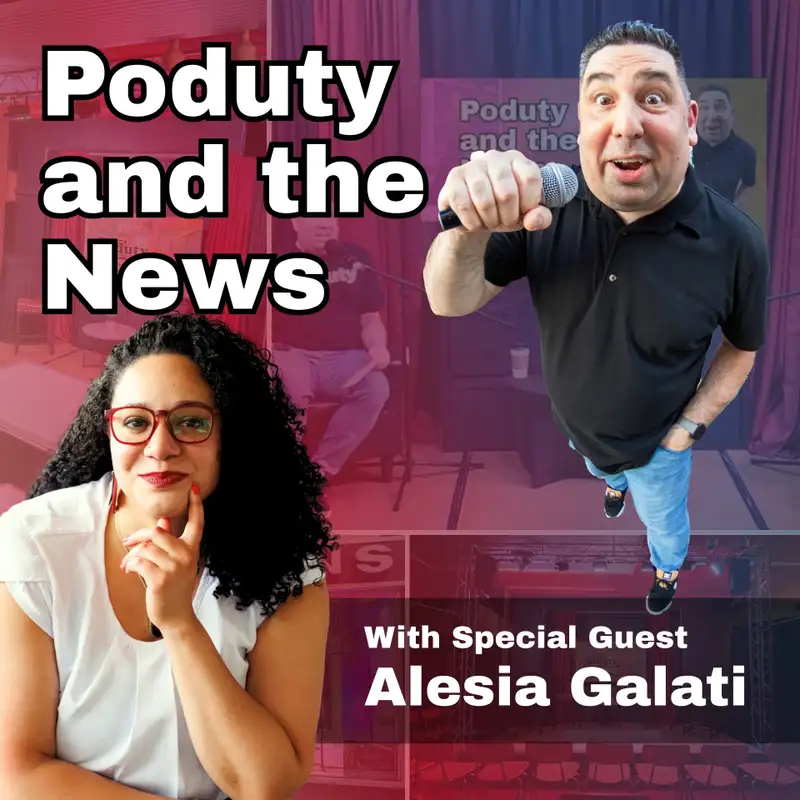
Round and round we go. We're back again. It's Tuesday night. It's
Poduty in the News at the Poduty Live podcast theater at
Harrison's on Corbet St in downtown Tarentum. I've got another
great guest joining me. We've met on several other
shows. Alesia Galati. Welcome to Poduty and the News.
Yeah, thank you so much. So much for having me. I'm so excited to be
here. It's going to be a lot of fun. We've collaborated on Rise and
Outshine. I think I've been a guest on your podcast. Were you on the trivia
show as well? I was, yeah. So we have. We have a history
we can go back through, but Galati Media has more shows
than I do. I think there's over 50 podcasts under your management, is that
correct? That we've worked with. Right now, we're.
We're downsizing, which is nice, actually.
It's actually really nice. I've been working a lot of hours, so right now
we're down to 10 regular shows that we're managing,
but we just launched two this month, so, yeah, it's not
February in January, so it's been wild. It ebbs
and flows. It's amazing, you know, how this industry works and
the cycles that come around and, you know, you'll be bombarded for
a while, and then you can kind of, like, level out, you know,
have a better process. And then all of a sudden, this. Another wave comes in.
And here we go. It's off to the races. Exactly.
Well, we've got six stories about live podcasting coming your way.
We've already preselected them. I've shared them with Alesia. We were talking a little bit
beforehand. We're going to have a good time. Coming up, about
35, 40 minutes of podcast news. Which
means, Alesia, I only have one more question for you.
What time is it? Time to get started. Let's go.
What time is it?
What time is it?
Oh, it's time for
Poduty and the News. OH. Poduty
and the News. The only
live news podcast about podcasting from
the stage and
the news. Oh. Poduty and
the News. The only live
news podcast about podcasting from the
st.
The only live news podcast about podcasting from the stage.
Alesia, welcome to this side of the theme song.
Yes. That's a banger. I love it, everybody.
That song really gets your blood pumping. It's. It's almost the highlight of the
show, but I would say the highlight of the show is having Alesia here with
us tonight. Alesia from Galati Media and the
Empowered. Oh, Empowered Podcast. What's
the. You have a podcast about all of this stuff? Yes,
Podcasting Unlocked is my podcast. That's it.
Podcasting Unlocked. Tell us a little about that show. Yeah, so
we're actually going to hit quite a couple hundred episodes. I think it's
300 episodes this year, which is pretty wild. But
it is a podcast all about podcasting twice a week.
So Tuesdays are solo episodes from me. Sometimes it's me
answering podcasting questions in 10 minutes or less, or it's me
talking about strategies that you can implement to
do better at podcasting. And then on Thursdays,
I have guests on, and it's really just to showcase other podcasters,
show what they're doing. Cause I really don't believe that there's one
right way to podcast that everybody gets to decide what's going to
work best for them. So that is Podcasting Unlocked.
Podcasting Unlocked. I'll have that in the show. Notes. And I was listening back through,
I think, a recent episode. Not only are you hitting 300
episodes, I think you have a client that just hit 300
episodes. And one of the stats that you gave was, that's less than.
Was it 0.3% or like 3% of
podcasts making it to 300 episodes? Yeah,
less than 3%. I want to say it was either 1.9 or
2.9. And I was like, it's less than 3, for sure.
I had seen it when I. We were doing. I was recording with her for
the episode, and it's just incredible one to be able to
support her through this journey. She was my very first client
that we launched her podcast, and she's consistently showed up, and I'm
so incredibly proud of her. And then, yeah, I'm hitting 300 this
year, which is just crazy banana pants to me.
But I'm. I'm excited and just. I'm also
considering what is it going to look like from 300 on? What kind of shifts
or adjustments do I want to make? And for those of you new to
podcasting, crazy banana pants is a common term that
we use to describe how absurd it is to get to
300 episodes, how much work it takes and the
processes that you have to build. And that's what we call crazy banana pants.
Exactly. Well, are you ready to get
into our six stories tonight? Yes. Let's go. I'll
have all of Alesia's links in the show. Notes. Not only that, we have a
thing called Paduti and the crew and everybody who's been on the show is now
part of the crew. There is a crew page on the back end
of the podcast website for Padoodi and the news. You can
go there and see every guest that's ever been on the show, their story, their
backlinks, links to their social profiles, and then when they come back,
because I'm certainly inviting Alesia back on future episodes. All
the episodes that Alesia will ever be on will be attached to that page,
her crew page. She'll be part of Paduti and the crew as of
Thursday morning. Love it. Well, let's get into
story number one. This one is a lot of fun.
This one. We call it you got it, dude.
And if you know just from that saying, you're going to know what this is
about. At a recent Headgum live show in San
Francisco, the host of the HD podcast took live
podcasting fully off the rails and the best way possible
by performing a table read of completely unhinged Full House
spec script written by Jeff who? Not me, not this Jeff, but
a different Jeff with a G who openly admitted he barely remembers the
original show. The script, titled Full House Blown
Smoke, leaned har into absurdity, featuring
dark cloud watching monologues from Michelle, peer
pressure via cigar smoking, cool girls named Toilet and Outhouse,
a painfully fragile math teacher named Mr. Hung, and
a fictional radio show plagued by a caller trying to invent
offensive slurs, forcing the performers to navigate
comedy, discomfort and audience energy in real time.
It was a messy, hilarious and a reminder that live
podcasting isn't just about recording an episode. It's about
creating a shared moment you simply can't replicate
in a studio. And this is one of those stories about
podcasting I love. I love live. I love riding
that edge of chaos. And this is an example of a podcast took,
something that a lot of us Gen Xers millennials are very familiar
with. We're all familiar with Full House. And they did this community
meetup where they did a fake Full House script, they did
a table read, they acted out the show. What better way to
bring a community of people who love that comedy sitcom of
the 90s with, you know, with just bringing back some of
those memories and telling some stories in this environment of a
podcast and acting it out and meeting each other and
talking and laughing and sharing stories that they loved growing
up, when they were growing up watching the show. What were some things that
you took away from doing a live event like this?
Alesia yeah, what I think is interesting is
that so many podcasts are not live, right? And so
it's like. And from my experience, a lot of the
live shows that I've seen or heard have been comedy people.
And so I think, as, you know, podcasters or
creators, how can we take, like, even just a bit of that
to say? How can we ad lib a little more? How can we infuse
more of our personality into the things that we're creating
and talk about the maybe shows that we
enjoy or the music that we're enjoying to give
more personality? And also we can delete it later.
It does ride that edge of. No, that was a little too much chaos
there. Right. But I think that it really gives you a little bit of.
Of freedom to do that. So I think it's really unique and
such a fun way to, like, get your audience involved
as well with a show that, you know a lot. I. I grew up in
a cult, so I didn't watch that show growing up.
Totally. Sidebar. That's our second story tonight.
But I still think that it's. You can infuse so much of that. Like,
right now I'm wearing my Star wars sweatshirt and on
one of my walls, I have, like, tons of Star wars stuff. So, like, how
can I infuse some of that into my personality on my show and. And
be more wholly me and more realized me
than just I am the buttoned up podcast person? There are different
podcasts and different niches with different topics. And you're
wearing Star Wars. If you had a Star wars podcast and you
liked fan fiction, this is something you could perform
live as a special event for your fans. You could go
out, hey, we're going to rent out this bar. We're going to tell stories.
We're going to even share a story that we wrote and kind of build
on that world that we all love and know about and
just have this unique experience that you can't get just from
downloading an MP3 file. You're going to be in front of people
performing something that you're passionate about to people who are also
passionate about the same thing. So whether it's Full House or Star
wars, think about how can you incorporate storytelling
with your fans, with the people who could come to see you in the community,
maybe even people who aren't familiar with you. But there are people who love
Full House in the community. Millions of people love Full House
and they find out there's a special Full House reading going on that
might just be the thing to get them out of the house and introduce them
to your podcast. Yeah, absolutely. We're Going to the
story number two. Now, a lot of times I like to find stories that are
related to my guest's background. And Alesia has a supply
chain management background, a little side note in her bio.
And I was like, well, the closest I could get this week was a
railroad conference. I said, that's kind of supply chain.
It's part of the supply chain. Maybe not what you're trying to manage. You're just
trying to get your goods into the warehouse. But this was a
conference just for the railway industry. And
part of the conference is they had live podcasting on the stage. And I
like to file these types of stories under industries where I never thought there'd be
a podcast. And here we are telling a story about the
railway industry and it's the ria. The Railway Industry
Association's annual conference got underway in London
with major news for the UK rail sector, as
Transport Secretary Heidi Alexander marked the introduction
of landmark legislation to create Great British
Railways, a new publicly owned body aimed at
unifying track and train under one accountable system.
Alongside high level policy discussions, industry leaders
and debates on rail reform, the conference program
also featured a live podcast recording, signaling how
podcasts are becoming a trusted format for unpacking
complex topics in real time. As conferences
increasingly blend policy, expertise and audience engagement,
live podcasting is emerging as a powerful tool to extend
conversations beyond the room, turning industry
events into long tail content that educates, informs
and builds authority well after the conference ends. This
is, like I said, this is an example of a place where you would never
expect to see a podcast. And the fact that
even the railway industry as part of their conference,
is starting to incorporate podcasts from their industry
as part of the entertainment, as part of the curriculum or
the stage time that they give. That's showing you the power of
podcasting over perhaps hiring just a magician or a
musician or a comedian, or just having panel after
panel after panel, having industry experts up on
stage sharing their knowledge and their stories is a
direction we're seeing a lot of conferences go. And I think if
you can tie in your expertise into a place where
your community is participating and they're participating
in this conference, what better way to put yourself and position yourself in
front of a whole group of potential new
clients or. Or new listeners. Yeah, I think it's
really unique. For sure. It makes me think of a couple years back
we did such a random
client, but they did. Why
can't I think of the word? It was like where they would buy
houses, but it was like more corporate level. I can't Think of what the
word is. Not like not flipping, but like on. A corporate, commercial real estate.
There we go. I was. I was on the grittier side of that.
So it was a commercial real estate equity company
and like, they were the ones giving a lot of the loans out and like
hiring it was very interesting. But we were
producing almost like a course that
they were selling. And a lot of it was like
getting subject matter experts in to talk about the
topic. And then we would air those and then we would have live discussion.
We. For the people that were taking the course. And I think that this can
tie in really well, especially for very industry specific things, like
even thinking about how can companies be maybe more
open with their board meetings, with
their. In, you know, the more informative conversations that. I mean, my
background is in corporate. So, like, how could we have
had more of those meetings be podcasts, right? Even if it's
a private podcast, just for employees, like, for
finding ways to connect with people, especially because we
all learn differently, we all take in information differently.
I was on a. A session this morning and
half of it, I. My brain was just not fully pro. I don't know
if I didn't have coffee yet or what, but my brain was just not fully
processing the first half. And I was like, I wish I
could, like, go back and listen to this. All right, it's a good thing it's
recorded. Hopefully when the recording's up, I'll be able to go back. But,
like, what a great opportunity having it recorded to be able to say, oh, we
have this thing. And I always think too, like, very
industry specific. No industry is
too specific for a podcast. When I first started
podcasting back in 2017, 2018, I went
to a podcasting conference and
I met a woman. She had been podcasting at that point for like five
years. So she was like an og and
she was podcasting about pez, like the
little dispensers. And I was like,
wait, wait a minute. Like, I'm trying to wrap my
head around this. Like the gas station
gross candy dispensers. Like, is that what you're talking about right
now? She was like, yep. And there are conferences and like, there are
events and we all meet. And I was like, like, my mind was
blown. And from then on I was like, anybody can have a podcast.
And that's true. That's something that we're finding out that there was something for
everybody. No matter what you're passionate about, no matter what your
interests are, maybe even what your profession is, there are other
People who are looking to share ideas with, they're looking
for your knowledge. They're looking just maybe even write
in and tell you their experiences and share their own stories.
You can find your community, you can, you can really build an audience
based on whatever you love. We'll keep it going. Let's go over
to football, but not the kind of football we're talking
about in America. This weekend, former Ireland
internationals Rory Best and Andrew Trimble brought
elite level insight to a live recording of BBC Sports.
I'm guessing it's North Ireland's the Ireland Rugby Social,
hosted at City Armagh Rugby Club in front of a
capacity crowd. Joined by Connor Murray and
presenter Gavin Andrews, the conversation focused on
Ireland's upcoming Six nations championship, examining
Andy's Farrell's evolving game plan, the pressure of
recent success and realistic expectations for the campaign
ahead. The discussion also zoomed in on Ulster's
prospects under head coach Richie Murphy, blending high level
analysis with candid reflections on life inside
professional rugby. It wasn't football at all. It was rugby. Wrong
sport. It was a reminder that live podcasts don't
need spectacle to be powerful. Sometimes authority, trust
and proximity to the audience are the draw.
And if you're a fan of rugby, if you've been following the sports, if this
is your home team, imagine how exciting it would be to not just,
you know, usually you watch a game in a stadium or on TV at home.
Here's a small pub or a small theater space where you
can go in. You're in the same room with these stars, the coaches,
and you're being immersed in the moment. You're feeling their
passion and you're hearing their stories and you're just sitting
right in there taking it all in. This is one of those experiences
that you can't recreate on a podcast, but being there,
live in the moment, it's a whole new element to these
hosts, to these players. You get a whole new perspective on the
game and who these people are. Yeah, I went
to a, I read a lot of books, if you can see my background if
you're watching this, lots of books. I read about
anywhere from two to 250 books a year.
And I went, there's a local authority to
me. And I went to her speaking about
her new book that was coming out and it wasn't recorded.
And I think kind of because it wasn't recorded, it was like, oh,
you have to be there and you have to be fully, like, pay attention and
be immersed. But the interaction and it was like
fully booked. You could not get more tickets at all. Like, I tried
to get tickets for my friend after I'd gotten mine. Not happening.
Everybody is sold out. But she did it through
NC State, which I thought was really unique. Like, they had paired
together to then create this experience. And so then you got to
meet her afterwards, which was really cool. But just having that
very interactive Q and A with someone who kind of
understood what the book was about, understood the kinds of questions that we would
want to know, but also allowed the author to go deeper, was really
cool. But there's something about this timeliness that live
brings that I think is really interesting, especially as someone
who does very evergreen content.
And I was talking to my kiddo. He's 8, and he's obsessed with
WWE, and he wants to launch a podcast about
WWE. And I'm like, look, buddy, if you
do this, we have to be very timely, because
belts change. At least according to my understanding,
at least every other week or every month,
potentially. Some people keep them longer. We're gonna have to, like.
Like, last weekend was. What was
it? Not WrestleMania. Royal Rumble was last
weekend. So we were watching Royal Rumble, and it's like, all right, Royal
Rumble happened. You got a podcast about that, like, the next
day or right after, and then share that information
and then. Because if you wait until after WrestleMania, which is
next weekend, then there's going to be too much time in between. Right? And so
there's something about this. This timeliness to the content
that makes I think it more interesting for the audience, but also
pushes them to tune in in a more timely manner, too.
So wait a second, Macho Man? Randy Savage isn't the
Intercontinental Heavyweight Champion anymore? I don't think so,
but don't ask me. That was like a
1988 joke.
And events like that, like, you're saying. You're saying
you produce a lot of evergreen content where you're giving tips and tricks
and practical uses for podcasting. The thing I've
come to notice, and I've alluded to this on a couple shows already,
is the thing that I'm really, really falling in love with with live
podcasting is it is such
a once in a lifetime, even in the history of the world.
Like, this show that you and I are doing tonight will never
happen again in the history of the world. These six stories, you
and I sharing the stage, it can only happen once. And
I say it's so different than musicians and comedy, where musicians
are. You know, they'll come to a town, they'll play the same 15 songs, and
then they Go to the next town and do the same 15 songs. And comedians
work on a routine, they perform that routine and eventually they build
it up a solid hour and they take that around and they perform
that hour. With podcasting, it
can only happen once. You and I can't go to Cleveland tomorrow and
do this show over again. It's already been recorded and heard
about. So the chance of seeing this real time
in the moment is a once in a lifetime opportunity.
And that's what I'm finding out that I love even more and
more as I do more and more live shows, is it is such a special
moment and you have to be there to be a part of it and to
be in that room with those rugby players and to hear the stories, if
you're a fan of that sport. I mean, to me,
nothing is better than those raw moments, those where
you're vulnerable, you're taking questions from the audience. You have no
idea what they're going to ask you. You could have fumbled the ball last year
and cost the game and they're still harping on you about it.
And it just makes something so much more
special than a polished studio podcast, which I'm not taking
anything away from a polished studio podcast. I'm saying this is something different.
This is a new form of entertainment that people are starting to embrace
and they, they're really, really liking live podcasting
100%. I saw the same author,
I don't know, it was maybe three months later for. She
was the interviewer for another author.
And they were. It was more of a collaborative conversation during the actual
interview space. And it was a completely different
energy, different vibe, different audience, different venue. Right. And so, like,
I bought tickets to both because I want to see her. Right. Like,
that's why I went was, oh, I have more books I need her to sign
because I only could get two of them signed at a time. Right. And so,
yeah, I think that there is something very unique about that once in a
lifetime kind of moment. Yeah. If you get the chance, go experience
it. Whether it's, even if you like, you know, if it's a cooking
show, a lot of times you'll see celebrity chefs do special one offs
or even comedians. Like, they'll come to town and before they
do their performance, they may do a taping of their podcast. Like, Doug Loves
Movies is famous for doing that. He goes to town to
perform comedy at 4. 20 is kind of his thing.
He performs an episode of Doug Loves Movies. So you could
see Doug Loves Movies, then you could catch the 7 o' clock show and you
can have a whole night out just supporting this comedian that you love. So
think about ways, where can you perform your show? What audiences can you
get in front of? It'll really change your perspective on
what's possible for podcasting. And here's one that I
love. This one happened in Australia and they built like
a giant tent city and they had all these other like
installations around. If you get a chance to check out beyond the
Valley, it's the 10th year that they've had this and it
is just an incredible event. Australia's
beyond the Valley now in its 10th year. Brands learned leaned
hard into experience led activations designed
specifically for Gen Z. And one standout move was the
creation of a dedicated live podcast space inside a
multipurpose venue called the Lounge Room. Festival
goers could drop into live programming from the daily
Os, curated conversations and late night cinema right
alongside wellness hubs and interactive brand experiences and
cultural moments. Rather than shouting for attention, brands
focused on connection, presence and value, meeting
audiences where they already were. It's a strong signal that
podcasts aren't just content anymore. They're becoming
infrastructure for modern experience driven events.
Events like this, where there were some places that looked like gas stations
and you'd walk in and be like an arcade or it looked like
an ice cream shop and you'd walk in, it'd be this whole other
immersive experience. And this lounge, if we could
pull back on that photo, it's this giant tent space. It's set up
like a living room. There's couches and there's just people
doing live podcasts all day long, in and out, telling stories,
sharing events. They're having this cultural moment
inside this one space. Yeah. Something I have
been ruminating on and I have social anxiety. So the idea of going out and
like doing something like this is really, it's a little terrifying, right?
Like full. This is me. I. It's a little
scary. But I know
someone who's hosting an event that is a bookish event. And I have a podcast,
my hobby podcast, all about books. It's called We Read Smut. And it's
exactly what it sounds like. And so this
conference, it's called Temptation in the Triangle because I
live near the triangle in, in Raleigh,
Durham. There's another one in there that is that
area. And I was talking to her about
like, what would it look like? Because I've seen,
you know, bookish conferences where they have panels and they have
all these things and I was like, what would it be like to do a
live podcast at this event, what
would it like? Maybe, maybe I get a table.
Maybe I sit there and I, I have my microphone and there's the background
noise of all of the people kind of. And like then put that up
on my own podcast. Right, of course. But then being able to maybe go
table to table and talk to each of the authors to get more of that
experience. And at what point would I be able like
realistically be able to like manage
getting all of those people together in one room, in one space
to be able like 30 authors, logistically it's not going
to happen it like in a recording studio. And so to
be able to have that experience, like what would that look like?
And so I'm, it's happening in a couple months and I'm really, I'm thinking like,
I think I might need to actually do this.
Maybe I will circle back with you and say I did it.
You would be amazed to hear how much
podcasting has become like the new media in
regards to podcasters are getting media passes to
all kinds of events and conferences just for the sake that
they want the podcasters there to record content just like
you're talking about. They'll make it happen. If you can interview 10
of the authors while you're there. If you can get a private room
with hosting your podcast live, they will do that as
part of the entertainment and they'll give you, in many cases, they'll give the
podcast host a pass to come into the conference for free.
You'll do a little bit of work on the side, but you get to enjoy
all the benefits, all the parties and the atmosphere and you get to take
in all the main keynotes and you get to
do what you love, which is interview other authors. So
please, for those of you at home watching, keep that in mind. Your
expertise is your podcast. Your podcast is your asset
that can get you into events for free. Even if that's all you want to
do, like if that's success, you could just have a podcast to get into
events for free. I'm telling you that it's happening more and more and
it's becoming easier and easier to show that you're going to do some
recording. They'll let you in to help promote the event for
that year and the following year. That is such a great idea.
Like I'm thinking about sold out events that I would not be able
to get to because they're sold out. Like I'm doing a year of
100 no's or a hundred rejections or whatever that is. What a great
ask, because I would love to be able to get to these events.
And if it's a no, it's already a no before I even ask, so why
not? And this next story is a great example of, you know, kind of
walking that line, that hybrid line. Maybe this isn't quite
performing, but this guy, Jeff Pulver, he's at a conference right now
and the gentleman interviewing him is in his home studio. So he's
doing a livestream broadcast, interviewing people at conferences,
doing a live show while the guy's live on the showroom floor.
And they're talking about AI, of course, because that's all we ever talk about anymore.
This was recorded live at Cloud Connections. Publisher Doug
Green sat down with Jeff Palver, CEO and Chief
Evangelist Officer of VCON foundation, to
unpack what Palver calls a ground zero moment for
emerging AI communications industry. Drawing
parallels to the early days of VoIP,
Palver explained how VConn introduces a
standardized, trustworthy way to capture and structure conversations
across voice, video, messaging and email
so AI can finally work with consistent, high quality Data
built around three pillars, high definition, voice, memory, and
trust. VCon embeds compliance, consent and governance
directly into the communications layer, positioning live
podcast conversations not just as content, but as
structured, intelligent assets that may soon power
entirely new products, services and revenue models.
And, and if somebody, you know, if you have some anxiety about
performing live on stage, this is a great way to maybe take
that first step, those little baby steps to work your way up to
performing at the conference on a stage or even in
a private room where they have like one of their sessions.
And you're getting their first thoughts too, right? Right after maybe they
heard someone speak or, you know, they're having discussions with other
people. And I think that that is such a, an important part of
these live conferences and being able to tap into that
because you may be high on the, like, I'm having all these
great conversations, I'm doing all these great things and oh, I have all these thoughts
and you get home and you forget half of them. Right. But you're able to
tap into them like right as those kind of aha moments are happening.
That's really incredible. Yeah, that live
reporting for that conference, you know, that gentleman is recording
that interview. He's broadcasting to his audience, he's talking about that
conference. He's probably get some other interviews that he'll release after the
conference. And as the months go on, the
weeks go on, those that information is getting out to the
public over and over and over again. You know, he's getting content
for a show while, you know, wow.
While, you know, talking about and pushing the agenda for
next year's show, he's building that momentum for future
episodes. So, you know, think about that. Think of your podcast as an
asset to help these conferences grow and get that
snowball rolling so that they have a bigger turnout the following year.
And we talked about rugby. We have a big game
coming up this year. Well, this Sunday it's the.
I think we just say the big game. We're not allowed to. We don't have
any licensing rights to say the actual name of the big game.
On February 7, February 8,
there will be a big game played for football. But
beforehand, during the weekend celebration, here's another
great way that you can tie in an event with fans
who will be in that area. Ahead of Super Bowl,
ESPN Radio is turning podcasting into an
appointment event with a live taping featuring sports center
icons Rich Eisen and Chris Berman at the American
Conservatory Theater Strand Theater in San Francisco.
The February 4th event includes a meet and greet two hour
live recording packed with SC top 10 nostalgia and personal
stories, exclusive merchandise, food, and importantly,
100% of the tickets benefiting the V Foundation for
Cancer Research. It's a powerful example of how live podcasts
are becoming cultural moments, blending community, storytelling
and purpose, while giving fans something they can't get from
a feed drop alone. And I love this example.
I love seeing examples where it's not just about, hey, I can sell
as many tickets as I can. We're going to have this moment
talking about sports and football. But all the money that
gets raised that night is for the community benefit for this cancer
foundation. They're donating all the money for a charity.
And that's. We've seen stories like this throughout the history of
this show. And it's one of the things that I admire the most
is people do just love podcasting. They do just love
getting up in front of an audience. And in some cases they can do that
as a fundraiser to build up their community, to support other
members in their community. This is a win. Win all around.
Yeah, for sure. And I think that it really, again, to like that live
event kind of aspect of the people are already there,
right? They've already shown up to the big game, they're
excited about it and they're going to be more likely to
want to engage in these conversations to be there live
rather than, you know, what else are they going to do? Maybe go out and
check out the sites, but they're there for the game, so why not get this
experience along with it? And I do like this idea of using a
charity or using this event to
promote a charity, to give back to the community in some way.
And I think that really just ties to like, how can you use your podcast
to, or even your live event to
give back to, you know, or to give purpose to.
To show that you're not just like, we're. Yeah, we're in it for the money
too. Yes, that, that's great. We need money to survive. But
also how can we use charities and use our
events to kind of show, hey, here's where my values lie.
Yeah, a lot of times, not everything. Even though we talk about live
podcasts, not every live podcast is recorded
for release. Sometimes it's a special event. It's just a
special occasion, an excuse to get your fans together. And
they don't even record it. They'll just do it as a one off. And a
get together like this, even though they're calling it a live podcast, they may
or may not record and release that. But people love Rich Eisen,
they love Chris Berman, and they're going to want to hang out and hear all
those stories of 90s SportsCenter and early 2000s
SportsCenter. And while they're doing it, it's also going to
charity. So there are multiple ways to think about live podcasting.
There are multiple types of events. We gave you six different
examples tonight and all six were as different as different
could be. And just start thinking about how can your show
go beyond the borders of your home studio or your basement?
How can you take it out into the public and create this moment in
real life? We're all craving more connections. We're
all, I think, a little bit tired of doom scrolling and
streaming all night long on Netflix or YouTube
videos. These events are steamrolling towards us.
More and more people are going out, they're hanging out with people, they're doing
these in real life connections. This is something that
is coming to us fast and it's growing rapidly.
So think about not just taking your podcast out
into the public, but there's gotta be other podcasts in your
neighborhood that you can go out and support and have a night out. You
know, you might spend 10, $15. Wow. Even if
you have the worst night of your life, you're out 10 bucks. So get out
there, support independent podcasters, independent creators, and
we're gonna. Can you believe it? Actually, it's over already. It goes
so fast. I Was also gonna say, don't forget to support Galati
Media one more time. I'm gonna turn the show
the floor over to you, Alesia. You can plug, promote, talk about
anything you'd like and tell everybody where you want them to go. Where
are you sending them? Yes, thank you so much for having me. I
really appreciate it. I have Galati Media, which is
a full service podcast management agency. We support
podcasters through launch and so much more really
around the strategy and making sure that we're doing making your podcast
the best it possibly can be. We recently have a new client that like, they
don't want to be on social media at all. So really focusing on like the
search engine optimization of that side, so working on all of
that kinds of stuff. But if you're curious about it or if you want to
know more about it, you can go to helpmypod.com keeps it
very simple. You can book a free consultation there and we can talk about your
podcast. Help my pod. I might need to go
there to get some help for this show. Sometimes I struggle with reading.
Nothing can help me with that, I'm guessing. Sorry. No, we
all struggle with that. Well, I'd like to tell you I
do this live show here. The I have so much fun.
I've met so many people, I've told so many stories. And the theater that I'm
sitting in right now we built outside of Pittsburgh, Pennsylvania. It's available
for anybody to use. If you have a podcast and you want to try doing
what I'm doing right now in front of a house of 40 people,
you're welcome to use it. I don't have a contract. I don't require any
type of minimum ticket sales. I'll build you a landing page. I'll record
the event for you, produce the event for you, help you sell
tickets. I'll give you back the recording. I don't even take any ownership
over the content. And at the end of the night, we sit down and we
Split the door 50, 50. If you like it, we do it again.
If you don't, we shake hands and we go our separate ways. And you tried
it. And that's all I'm asking people to do. This is an offer that I
don't think you can say no to. It doesn't cost you anything to say. You're
not on the hook for anything. So, you know, think about podcasting in a different
way. Think about how you can do it live on stage and
have this other asset. All these stories that we're talking about how can
you participate in what's becoming one of the fastest growing
entertainment segments? Live podcasting, live events, live event
podcasting. I really think this is the future and the business
model for most podcasters within the next two to
three years. So I appreciate everything that you
brought tonight, Alesia. It was a lot of fun. And, you know,
I just have one more question for you. Do you
know what time it was?
I mean, right now it's time for bed, I think.
What time is it?
What time is it?
The only live news podcast about
podcasting from the st.
The only live news podcast about
podcasting from the st.