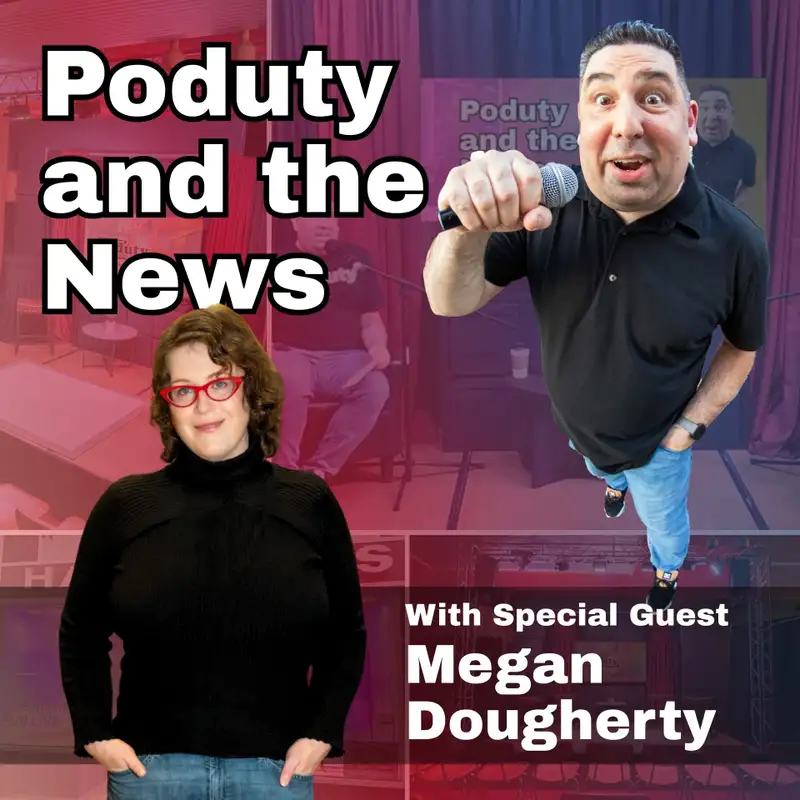
Well, very nice. We have six stories about live
podcasting recorded live coming up for you
tonight. Megan, I just have one question for you before we get
started. What time is it?
It's showtime. What time is it?
What time is it?
The only live news podcast about
podcasting from the stage.
The only live news podcast about
podcasting from the stage.
Oh, we're switching it up. Megan, welcome to the main stage.
Thank you. Thank you so much. I love the way you have this set up.
I've got to say, I do not do a lot of live podcasting, so this
is a little bit intimidating for me. But this is a very cool way to
have things arranged. I just love it. Oh, thank you so much. You want to
know the secret is when I'm here by myself, I have no way to start
the recording and get to the stage. That's why we do the backstage
segment. We do a little witty banter. I hit play
on the music video, and then I have to run to the stage and get
everything set up. Oh, I love it. Well, Megan,
tell us a little about yourself. We gave a little preview in the pre show
about what you're doing, the things that you're building with podcasters, with
businesses. You're really building something special and showing
businesses that I think podcasting can be a very valuable asset for
them. So, yeah, the work that I do,
I run a podcast production agency called One Stone Creative, and we've been producing podcasts
for small business owners since 2017. And the way
we go about it is looking at podcasts for business or
podcasts for business as different than podcasting as a hobby or building
a podcast to be its own business. Because a business that already exists, it's
running, it's functioning, it's got clients, it's got services that Scott offers, it has really
different needs from a podcast than the other types of podcasting do.
And so we look at podcasts as tools that business owners can design to
do specific things in their business. And that can be, you know, establish thought leadership.
It can be appear better in search. It can be as a sales enablement tool.
It can be a networking tool. It can do all of these different things. And
the trick for us is to figure out exactly how a business can use a
podcast and then making a podcast that does exactly those things and not too much
of the extra so that there's no time wasted or other, you know,
no investment in things that aren't actually going to give a return for the business,
because nobody's got time for that. People want to connect with you.
It's called One Stone Productions. Is that the name of the company? It's One
Stone Creative and you'll find us
at1stonecreative.net super easy. I'll
put those links in the show notes. And also as of the end of the
show, Megan gets inducted into the Crew on
Poduty and the News Podcast webpage we have the crew, which is
everybody who's ever been a co host with me. You're going to find her
link, her page and any episodes and possibly future
episodes that Megan Lover will be on will be forever
logged as the crew you're part of. Poduty and the Crew
on Poduty and the News. I love it. We're all about
titles around here. Megan, are you ready for our
first story? I am so ready. Our
story number one, from co working to community spaces
built for Connection. A new space is opening in Kansas City's
Westport neighborhood. And. And it's blurring the lines between co working,
social clubs and live experiences. And that's something
live podcasters should be paying attention to. Founded by
Darian Nimrod, the Outsiders Social Club is designed to be
a place where creatives work by day and connect by night
with DJs, events and strong sense of belonging
baked into business models. It's a membership driven,
community focused and build around how people feel when they show
up. Exactly the kind of environment where live podcasts,
conversations and shared experiences thrive.
And the one thing I really loved about this is they
aren't even realizing what they're building because they do have this social
club, they have these co working spaces, but they're bringing a building full
of creatives with the intent of at night having
DJs and music and bands. But if you have all these creative
people, they probably also want to do creative shows. How
great would it be that some night you meet some of the business
owners and they have their own podcast that night
at the social hall? Yeah, I love, I think spaces like this are
so interesting and so important. I think it's a huge thing. Right now a lot
of people are talking about the lack of third spaces, right? People outside of the
home and outside of the workplace or the school where people can actually spend time
together. And I think bringing together business owners like that, and especially
if you've got the infrastructure set up for, for podcasting, you know,
like if you've got your theater, if there are, you know, if there's mics, if
there's sound equipment, if there's cameras, all these things that can make it really useful.
That could be a wonderful addition. I know if I, if I was running a
place like that, I'd want to have a podcast with an episode with every member.
You know, it should be a real perk of membership to be part of that
kind of a body of work. And just, it's such a rich ground
for people to be creating their own projects as well. Yeah, you're right. It's a
great idea for the space. The way to promote new members, way to
introduce businesses to each other and just have a coworker. You know, if
somebody signs a lease, you have a special night, you showcase that
new tenant, you talk about their business, you introduce them. And
I couldn't imagine a better way to welcome people into the business community
in this town with this social club. It's going to be an incredible asset
for the community. Oh, yeah. And if it's, if it's live, you know, and if
you have other people there, you can, you can do live Q and A, you
can do workshopping, you can do hot seats for different business owners. Like, there's so
many directions you can go with that, that kind of content and that kind of
venue. Yeah, I'm all about it. I'm going to follow along with the
story. These links of the stories that we're talking about, they'll be in the show
notes, so make sure you visit the sources. Double check, fact
check me, because a lot of times I'm skimming through and I'm looking at headlines,
but there's a lot more information than what we're talking about. We're kind of pulling
out the nuggets that really fit the narrative for this podcast.
We want to show people how their podcast, how their business
can benefit from live and in person events. And
I think this space is heading in the right direction and building something
that's an incredible asset for their community.
Let's go to story number two, one of my favorites.
Proof you can podcast from anywhere. This next story is a
great reminder that live podcasting doesn't just require a theater,
a studio, or massive production setup. You can
podcast from anywhere people already gather. Chaz
Ebert is guesting Live on Booth 46,
hosted by Steve Dale. Recorded where right
inside Paterno's in downtown Chicago. The show
captures the energy of the room, the buzz of the conversation,
and blends live radio with podcasting, all while
highlighting what's happening in the city. It's the perfect example of how
live podcasts can integrate into, into existing spaces and
experiences without forcing people into traditional
studio Setting. And this is live from Paterna. It's
literally called Booth 46. They are in a booth in a
restaurant producing their podcast. And this is a great
interview coming up.
I think Chaz Ebert is Rupert Ebert's
child, I believe. And it's all based off of their
organization and what they keep building. Roger Ebert.
Roger Ebert. And it's just a great concept and
a great way to promote their charities and their businesses. Oh,
yeah, Yeah. I mean, that can. Especially if you've got somewhere like this where, you
know, it is. It is already a community institution, location. You know, this is a
place people know about. This is a place people want to go. It's a place
they want to be seen. And, well, for everyone listening, I have
to fess up to being a bit of a traditionalist when it comes to recording
audio. And I'm often going to be in the side of let's do this in
a studio and add sounds afterwards. But something like this, I think,
where you do have the ability to kind of have this consistent space where you
know how to manage the sound and to be able to make sure that you're
creating an experience that's as fun to listen to as it is to create,
I think you can do some really fun things. And that's sort of a concept
of the same but different. That's so popular. Right.
And it's so popular for a reason. Because when everything is okay, I know
I'm going to tune into this show and it's going to be in the booth
and there's going to be this noise, and we're going to have a conversation. It's
going to be like this. That same formula is just so repeatable. And I think
that's something really people can take away is what can you do the same but
a little different. Yeah. And probably this show, too. You could probably order
appetizers in the main course all while you're having dinner. But
thinking outside the box, where can I host these
shows? What places are available for me to take my show to?
And if I'm doing a radio show and I want to involve the community, or
maybe this business. Paternos is an advertiser
with WGN Radio. So maybe this is sort of a combination
of an advertising partnership with the dj, and
they're coming back and forth and they're promoting each other, and they're building
off each other, building momentum, supporting the community and
sharing these great stories. I think if you got, especially if
you have any kind of local business or geographically
limited business that you're doing and you want to approach sponsorship.
A perk of sponsorship, of having being an episode recorded at your physical location
could be huge. Yeah. Share the love, share the energy, share
the stories. Bring the community in and immerse them
in what's happening. We'll go
to story number three, but this one is a
fun live show. From tailgate to timeline
Live podcast, go big. This story shows just how
powerful live podcasting can be when it's tied to a
moment people already care about. Cam Newton streamed his
fourth and one with Cam Newton live on YouTube from
the roaring riot tailgate outside Carolina Panthers stadium
ahead of their playoff game against the Rams. The result was a
packed in person crowd with more than 100,000
live viewers online. This wasn't a studio, it
wasn't a theater. It was a live event layered with live
content, proving that podcasts can scale fast when
they meet audiences where the energy already is.
Yeah, this makes me think of the strategy of, I don't know if you heard
the term newsjacking. Yes. Yeah. So it sort of has
that. If there's an event or something going on in your space in
your industry that you know your audience is going to be really, really passionate about,
and if you have the opportunity to be there and sort of let them vicariously
experience that with you, I think it can be a really great strategy. Yeah, that's
a great. I mean, Cam Newton played for the Panthers big, you know,
immersed in the community. A lot of football players, they
give back, they have charities, they set up things to really support and
give back to the community. The fans give so much to the players and the
players give a lot back. And, you know, he's beloved in this town.
People love Cam Newton. He's doing the show. The
crowd is packed before a game. You're right. Showing up
where the audience is is a great strategy if you know your
podcast is about football. Maybe there's a sports bar, maybe you're
not Cam Newton and you're going to get parking lot space at the
Panthers stadium, but you could certainly find a sports
bar. You could certainly find a college town that loves sports
the way you do and try to find where your audience already is.
Yeah, it makes me think of almost the reaction or the
watch along content too. I remember
when Game of Thrones was in its heyday. Right. And getting to kind of
watch like the live experiences of other people watching
it was such an interesting phenomenon and I got so into that
type of content. I still really like that reaction and commentary content and
just being able to. It makes something a moment in time,
rather than just a piece of media that's going to kind of go into the
archive. And you both have their value. But I love
that sense of taking something to something really
transitory and turning it into a piece of content that can go on and on.
Yeah, this has come up actually a couple of times in the last couple
episodes. And this is a perfect example of here's
a moment in time. The Panthers only make the playoff if
they do once a year. They may play 1, 2, 3 games
if they make it to the Super Bowl. But in this moment, the
city is rallying behind the team. Cam Newton is loved by
the city. Only in that moment, that day,
could he go to that stadium and perform this episode of this
podcast. And in the history of the world, that'll never repeat itself.
These live events, when they're based on current
events and news stories, they're only ever gonna
happen that one time. It's a once in a lifetime opportunity. It's not
gonna repeat itself again. You have to be there or have to
watch the recording after, but you can't experience that moment
live ever again. And that's one of the most beautiful things that I've come
to realize about live podcasting is it's different than music,
it's different than comedy, where the musician or the comedian will
do their act in one city and then go to a town and do
the next city the same act with podcast.
If Cam Newton can't do that show next week down at the local
steakhouse, he's already done that show. So
podcasting is once in a lifetime, one time performance.
It never repeats itself again. Let's go on to
our next story. We're going from Cam Newton to
seven days of content. If you're performing live and only
hitting go live once. Oh, let me backtrack
a little bit here. This show is about live
podcasting. We talk about live stories, we record it live. It's very
meta that we do this. But also we've had some feedback that,
hey, if you're encouraging us to do live podcasting,
what are some tips and tricks so incorporated into the show? I'm
going to start including tips about how to do live podcasting,
benefits of doing live podcasting. And I also have a
couple things where everyone's saying, hey, you just isolate
these stories about live podcasting in front of audiences.
But like what Cam Newton, he was live streaming. So we're going to also start
to include live streaming stories too. So just a little bit of A tweak to
the show. We're going to add tips and we're going to add in live streaming.
And this first story is a tip to do whenever you're
in Megan's world, where you're recording in a studio and you're having
all this content. Well, she can also do a lot of stuff in post
production, but if you're doing live events, maybe you need a little bit of help.
Here's something that can help you out. If you're doing a live event,
if you're performing live and only hitting go live once, you're leaving
a lot of value on the table. A new update from
Streamyard shows how one livestream can fuel an entire week of
social content using AI powered clips that pull
highlight moments directly from the long form recordings.
Instead of digging through hours of footage, podcasters can quickly
generate vertical clips with clean framing,
captions, branding, and natural start and end points.
It's a reminder that the live performance isn't just the finish line,
it's the starting point for visibility, growth and audience
building. And this tip is kind of one where you're creating one
piece of content. You spend time preparing the show, you spend
time getting up on stage or setting up your live stream. You've
recorded it. Now what? It's not just that one and done
mentality. Using a tip like this and a tool like
Streamyard, you can repurpose some of that content
for the rest of the week. Now, this one I thought was
of the news stories, one of the ones I was the most excited to talk
about, because I think the prevalence and the use of the short form
clips, I mean, they're huge. Everyone's seen them, right? You have a podcast, whether it's
studio recorded, whether it's done live, and then you cut clips from
it and you post those on social, you send them to your guests if you
have them, and then you wait and you hope that things
happen because of it. And whether it's
a studio recording, whether it's a live recording, whether you're manually
selecting the clips, whether you're having an AI do it, the thing that most people
are getting wrong about them is the context. So these clips, they
so often don't perform because it's really clear
that what you're listening to is part of a larger whole, but you don't necessarily
know what that larger whole is or what it represents, or what led up to
it, or what came after it. And it's often not going to be enough to
get someone to take action. So my Advice for getting really
good with clips. Plan them and practice them in advance
and be ready to. You don't want
to speak entirely in sound bites, but you kind of want to speak in sound
bites a little bit so that you've got something that has a complete beginning, middle
and end that when you clip it or when you have a tool that helps
you clip it, you've got something to share that people can understand and take action
on. Jeff, in your experience with doing
lives or doing on location recording, I mean, do you
practice for things that you're going to share in advance or do you advise
people to. How do you manage that? Here's what I've learned from this show
in particular. Nobody wants to see a live clip of me reading the
story. If I open a clip with me reading that story and
struggling to pronounce people's names, no engagement.
But I've learned that if I can position the transitions between Megan and
myself like you just did, you just threw a question back at me.
Well, that question most likely will be a great starting point
for a clip. So when I go back to Megan, I'm like, oh, okay, that's
a great thing. Is this something that you're doing in your studio to get
viral virality on your video clips?
Just that little statement setting up what Megan's gonna talk about?
That's the kind of clips that you're looking for. You know, almost something
that sounds not outrageous, but out of line, like
something you might not agree with right away and then the supporting argument.
So if you can find those little nuggets throughout and they exist all
through, and you would have to manually comb through it. I have
learned that I have stopped relying on the AI clips like I use.
I've tested Opus, I use Clap for a while,
and I have tried the streamyard and they do decent jobs.
But I have also found that when I do this as a manual process
in Premiere and I upload the clips myself,
I don't know. I know in the metadata it says that
it was updated by Premiere because YouTube will tell you that I'm
thinking that manually updated clips
have a little bit more weight than the AI generated
ones. Only because maybe the volume of AI is so high
that there's so many bad ones compared to the
volume of ones that are manually edited and crafted by hand,
that those ones may skew a little higher in the
algorithm. I don't have science on that. That's just my gut feeling
with where we're at right now. And I do see
my shorts and Clips are performing better now that
I'm editing them myself. I think many people
who are, you know, using clips in this way are finding the same thing. And
I would encourage anyone who is podcasting, live or otherwise,
live or in studio, to get in the habit
of creating short form content within your longer content because, you know, you don't necessarily
want to come back and then record separate content just for your
shorts. But if you can set yourself up to
something like what? When you want to use short form content in your
podcast, it's really important to practice in advance that you can create a narrative arc
within the clips, that it stands alone off the cap.
That's something that could potentially be clipped and hopefully would be useful. But I think
that's something worth practicing. When you know the topics like Jeff, you know, the stories
that we're going to be talking about, and being able to have those little narratives
can make you give you really, really strong clips and hopefully increase
your following. And that was a great clip. I'm going to clip that. That's going
to be one of the clips for this episode. I bet. I was
hoping it would turn out that way. I did
not follow my own advice and practice that in advance, although as I was speaking,
I realized I should have. Well, let's go over to
our next one. This is our fifth story tonight.
Global Stages Real Time Podcasts go international.
This story highlights just how far live podcasting can go
when access and opportunity meet preparation. The making
awesome podcast took their show live to Prague
after formnext recording directly
from Prussia Research headquarters. Instead of waiting to recap
announcements later, they captured reactions, insights and product
conversations in real time, right where the innovation was
happening. It's a strong example of how live podcasts can turn
industry events into instant, authoritative content
with a global reach. So this one, they were at a conference,
they met somebody at the conference from Prussia Research. They went over
to their headquarters and they're like, hey, let's do a Show while we're
3D printing stuff and we'll just talk about stuff. We'll talk
about everything we just saw, all the things that have blown our mind.
And while it's fresh, let's get this information as fast as we can
to our audience. And I just love the strategy, this
technique of, of being somewhere, finding your audience, finding
your fans, connecting with somebody and then taking that and going,
doing a live show all about what you just attended.
Yeah, I love that. What it really makes me think about is access,
you know, access to people, access to spaces, access to information. That often
podcast hosts are in a really privileged position to be able to get.
And that means that when they have the opportunity at a live event. I mean,
you see this a lot at the podcasting conferences, Jeff. I don't know if you're
a big attender of like, podvest or podcasts podcast movement.
They've got podcasting areas where you can go and talk about what's going on and
connect and share interviews with the people that you've met and something else that
really happens there. You know, there's a lot of live podcasting, and it's bringing questions
directly from audience members, whether it's clients, community, people who listen,
people who watch, who can't attend that event, or don't have that kind of access
to people into places. It's a great way to
just get this immediate feedback and this back and
forth with the hostess, intermediary. It can be a really valuable
public service. Yeah. In this example, the host of the
podcast went to this research lab. The research lab is
testing new ways to do 3D printing. And they're just
pulling all these things together and bringing the community
together, making everything stronger. Everybody's bonds are stronger.
The knowledge that they're gaining of this new technology, the
new products that are coming out that support 3D printing, it's
just incredible how small the world has become and how fast
it shrinks with how fast news can be delivered.
It is. I don't know if you're into fiber crafts
at all, Jeff, but there's this wonderful thing that happens in, like, knitting and crochet
communities. They call them knit alongs. And it's over the course of,
you know, a month or six weeks or however long the project is. Everyone involved
is working on the same project at the same time. And I feel like something
like that would be so wonderful to have a live podcast for, so people could
dial in, people could be actually, you know, conducting the same activity in the same
place. Place. I think there's. When you think about
using the podcast, not just to create content, but to create time
for something to happen, there's some really fascinating ideas. It can be co working like
the first story that we talked about. It can be crafts, it can be hobbies,
it can be fashion. There's so many areas where that could go.
That sounds like a lot of fun. I know my daughter loves crocheting and
knitting, and I bet, like having a night out,
maybe we would get catering. Everybody's sitting in the. I could see the orange
chairs here in the theater. Everybody's filled up and having a great night. We
live stream it. Maybe other people, you know, crocheting and knitting at home.
I know they're different. By a local yarn store. Yeah, yeah,
don't come at me. I know that those are two different things. I just don't
understand the difference between crocheting and knitting. But one
needle or two, you could come in here and have a great night
out with friends and family doing the same thing. And like you said, if they're
all working on the same project and they're all contributing it in
different ways, that's got to be a lot of fun to see what they can
build in a night. I think there's the historical
precedent too, right. Of the quilting bee, where everyone comes together to complete the
project. A wonderful blending of old and new.
That'd be so much fun. And then people can learn. People could share
tips and they can show how they're doing it on the
live stream so people can follow along at home and try to crochet
or knit their own. And I bet it worked with the
3D printing, too. If they started a project at the beginning, if that was a
shared template or files that other people could access, at the end, everyone could have
their cool thing whilst having had a lovely two and a half hours
spent spending time together. Awesome. Let's go
to our last story tonight. This is a great one.
This is when brands become the stage. This
final story brings everything we've talked about full circle. Live
podcasting as a tool for community conversation and brand
alignment. On January 17, Leisha is hosting
Keeping Women's Rights in the Picture, a live in store
podcast discussion at the Leisha Store and Gallery
Boston. In collaboration with Concept
Awareness and a Yellow Rose Project. The event
centers on a live podcast recording with artists and educators,
encourages audience participation, and turns a retail space
into a platform for civic dialogue. It's a strong example
of how brands can use live podcasts, not to sell, but to
stand for something and create meaningful, shared
experiences. I'll let Megan, you want
to take this one first? I do, and I want to take it
way back in time because this for me just echoed so
strongly of where spaces, especially
for women in North America and Western Europe,
was very often in a retail setting where some of the first places where women
were able to gather to spend time, department
stores, would have tea rooms where they could sit and talk and spend time. Similarly
with vegetarian restaurants, places where they could speak and they could
have civil dialogue and they could work towards different civil actions
in spaces that were not necessarily when other spaces were
not necessarily available to them. And I think bringing this new technology
into that old concept of, you know, the retail store,
whatever you may think of, you know, retail practice now, and that
can vary a lot, but these are spaces that are traditionally
feminine, coded in a lot of ways. And so using that as a space to
talk about issues that affect. Do affect women and
people of all sorts, of different sorts, who are having
a lack of space in other areas of their life, maybe where they can talk
about these things, and using that space to create art, to create
dialogue, to talk about the reality of being
a person right now, I think is tremendously exciting. And I love
that there's businesses who are, if not intentionally,
honoring that tradition, you know, carrying on a very proud tradition.
If you think about how art makes you feel, how a photograph can make
you feel, and if you're tying all these things with history
and women's rights and how they feel in the moment
and expressing themselves with one another and some of the things
that they're going through, it's such a powerful moment, a
powerful night. And to put this on and pull this off
is an incredible, incredible feed. Just really love this story. I
thought it was a great way to close out tonight and just talk about
this. What's happening here? What can you do in your community
to bring people together? How can you share stories, share,
like, experiences, and build off those experiences to make
the world a better place? It's
as important now, maybe more than it has been. It's kind of a scary
time. And so knowing that there are people intentionally
creating the space to have this kind of dialogue and to make
the kind of access to the tools to create art and the tools to
create conversations. Another thing I love about this business, this gallery, what they're doing,
it feels very important and very of the moment.
And that means we went through
our six stories. I was looking at this picture earlier. We did not plan this,
but we're wearing the same outfit. We are wearing the same
outfit. Megan, this has
been so much fun. I really appreciate your time tonight.
We got through these six stories, and you added so much
value to what live podcasts can be, the quality of
production, how this can apply to businesses. I thank you so much
for your time. One more time. How can people connect with you
and, you know, just hear about your services, learn about what you're doing.
Absolutely. So the best way to find out about me and what we do at
One Stone Creative is to go to onestone creative.net that's o n e
stonecreative.net and if you are a giant nerd about
podcasting or would like to become a giant nerd about podcasting, you can go to
podcasting for business.com where you can download a copy of my book, which will
go through kind of our methodology for designing podcasts specifically to do
jobs within businesses. And I'd always be happy to
connect with anyone. If you are looking to have a podcast for your
business, we make it as easy as possible for busy entrepreneurs who actually have full
businesses to run. That's our thing. I was
trying to get. I didn't want to play. I got hats and I have shirts.
I will say the 10 bucks for the shirts merch if you leave.
If you leave a review. I don't have any reviews on Apple
itunes. I started the show in May. I tore my Achilles
right after. And I never asked. I realized I never asked anybody to leave me
a review. If you leave a review on itunes for Poduty and the News, I'm
gonna send you a T shirt. But if you want to come to the theater
and get one for 10 bucks, I'll do that too. We have hats as well.
And this is the theater space. This is where I'm sitting right now, underneath the
exclamation point in your show here. And this is a
theater space that I built for live podcasts for people to come
in, do their show, do their show without risk. If you were to
go to a hotel and say, I want to produce a live event, they're going
to hand you a contract and say it was a $10,000 minimum, plus
you got to buy all your food and drinks and electrical and AV tech through
us. I'm not doing that. I flipped the script on this. You can come
in. There's no risk to use the stage. There's no contract. I'll build you a
landing page. I'll record the show. I'll give you back the recording.
And at the end of the night, we Split the door 50, 50. If you
like it, we'll do it again. If you didn't like it, we shake hands and
we'll go our separate ways. But check it out. Poduty.com,
P-O-D-U-T-Y.com Megan,
that brings us all the way back to the beginning.
Do you know what time it is?
Is it still showtime? It's still showtime. What
time is it?
What time is.
Oh, it's time for duty and
the news.
The only live news podcast about
podcasting from the st.
The only live news podcast about
podcasting from the
stage.