What time is
it? Oh, what, what time is
it? Oh,
oh, it's time for
Poduty and the News.
Poduty and
the News, the only live news podcast
about podcasting from the States. Poduty and the
News.
Hey, hey, hey, On the Stage.
It's the only live news podcast about live podcasting, recorded live. I've
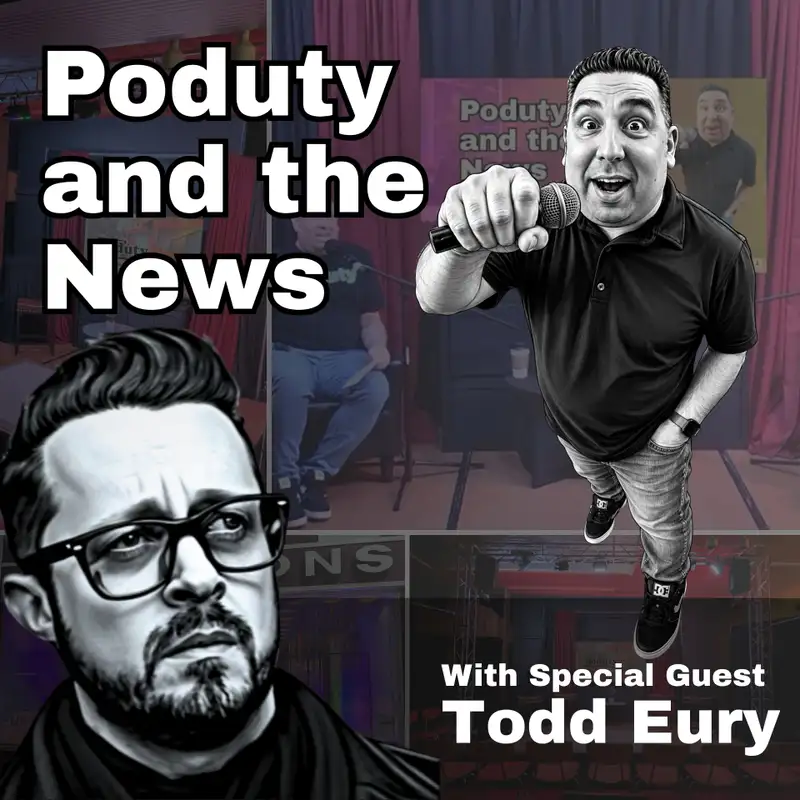
got a great guest joining me in studio, Todd Eury.
Pharmacy Podcast Network, local native Pittsburgh. We got some
Pittsburgh live news stories over the next half hour, 45 minutes.
We're gonna be talking about live podcasting, people doing live shows,
live shows here in Pittsburgh, live shows part of podcast networks too. Yeah.
And hearing about what Todd's been building and just talking about how do
we bring communities together? How do we have shows that inspire people?
How do we have shows that motivate people? I'm so excited to have you here.
We met on a couple different events throughout here in Pittsburgh. And Todd, officially,
welcome to the show. Thank you so much, Jeff. This is so exciting to be
here. You are a hero of the Pittsburgh
podcast market, and I've been following you for over
5 years. And I was always, I guess, shy
to reach out and connect with you. But when we did, you're one of the
easiest people that I've met to get to know. And you're doing things
in podcasting that is, uh, is revolutionary, and it's kind of
part of podcasting's history of Pittsburgh,
and pharmacy is part of it. Yeah, I started the very first
podcast in pharmacy back in— it was March 2nd,
2009. Goodness gracious. Wow. That— I mean, that— I mean,
you have the history of, uh— I mean, you're like Sorgetron Media,
uh, Pharmacy Podcast Network. I, uh— fun fact, I did my first
podcast in 2010. And I didn't know what an
MP3 file was. Me either. I didn't know how to distribute an MP3 file. I
used the blogging platform called Typepad. Typepad was
like a paid WordPress service that said, you can do podcasts,
but all you could do was upload a file and just tell people to go
there. There was no distribution. And I did like 6 episodes, and
then my co-host got hired to be the marketing director for Ghirardelli
Chocolates, so she didn't stick around to do that show.
There was There was no money in podcasting back then. There was no
books called Podcasting for Dummies. There was no— you had to figure it out
all yourself. I used BlogTalkRadio. You had to dial an 800
number, you had to get your guests to dial an 800 number, and then they'd
send you the MP3 like a day later. And it was like— and I was
like, now what do I do with it? Yeah, you get that great phone quality
audio. Exactly. And then Libsyn was my very first,
um, podcast distribution platform. Shout out to Libsyn. They were
also from Pittsburgh. So I think there's
heritage in what we know as specialty pharmacy,
pharmacists that control treatments in
rare disease. That started in Pittsburgh, and podcasting kind of
really got its hold in Pittsburgh too. Yeah. I mean, you've built quite a network.
You're producing shows, you're running shows, you have shows on the network,
you're a host of some shows. True. Tell us a little bit more about how
big is Pharmacy Podcast Network? Yeah, it's pretty substantial. So we're
globally listened to, we have
85,000 monthly listeners.
There's a, there's a system out there called listener.com that measures
podcasts' effectiveness through social media and interaction.
We were the first to do press. And when I asked for
my first press pass in 2016,
Initially, they said no because they thought it was a joke because podcasting back
then wasn't really a big deal. I kept at them, kept
at them, they gave me my press pass and that organization
called Cardinal Health. Cardinal Health is one of our
nation's biggest wholesalers, drug wholesalers.
They're still a network member. We have 42 shows on the network that
cover things like pediatrics and senior care, rare
disease, marketing for the pharmacy markets.
Like your independent community pharmacy. You have an independent community pharmacy right
down the street from the studio. Then there's health system
pharmacy, there's compounding pharmacy,
there's our general combo shops that are
like long-term care and community pharmacy. And what
I've done is I've gone out and found champions of each of those
themes to join the network and to put content
out on a on a cyclical basis, but usually about one episode per
month. And now we have listeners
from all over the world that connect into— my
strategy is two. It's a single RSS feed, which is
Pharmacy Podcast Network. You get 100% of the content. And then
for our paid clients, they get their own
RSS feed. And then we, of course, combine those things in order to bring
more listeners to their show, and then of course to the overall network.
It's been wonderful. So we've evolved from a
podcast, a podcast network, and now a public relations
agency that's leading by podcasting. So that's called
RXPR, which is our— we call that like our parent company.
And what that's doing for podcasting, it's allowing us to
center information with champions that
understand whatever that is, whatever the sickness
modality is or whatever. And then we put a lot of other things
around it. We put press releases around it, we put blogging around it, we put
social media around it. And yeah, it's finally a paying business. My
wife doesn't have to say every year, what the hell are we getting out of
this? You know, we're finally putting food on the table. It's an expensive hobby
is what it was. That's what I tell my wife about this theater.
It's true. It was up until
2019, we hardly made any money. And now I
have a producer, I have a social media person, I have our project
manager. So I have 3 total employees. We're bringing on a
business development employee, so I have my 4th employee.
And big organizations are finally reaching out to us saying either A,
how do we podcast? Instead of starting your own podcast and having zero
listeners, they immediately have an audience day one. Or number
2, do you wanna come to our event? Do you wanna cover the
event as press? And by the way, shout out to all you podcasters listening.
If you are in a vertical, if you're in some kind of
realm, if you're tackling horse riding or
you're some hobbying organization or you're, you know,
guns and ammo, you should be attending conferences
that are about that theme and you should go as press
and then get press credentials. That means you don't have to pay to
actually go to this event. and then cover the event and use that as, as
like some of your content. Yeah, you spent 10 years, right, before you even
got to something of profitability. True. And you're not just talking the
talk, you're literally walking the walk. You told me when you got here, you just
came back from a conference. Yep. You're heading out to another conference. Boston. You're doing—
you're networking and you're making those connections with people
who are already in the places that are interested in
what you're talking about. That's true. So, you know, go to where your audience is,
is one of the, the best lessons. And do that repetition
over and over, and all of a sudden those things compound over the
years and you build something that's way bigger than just the idea you had.
Yeah, you built this community, this network, and you're pulling all that
vertical of pharmacy into one place, into one location.
Exactly. And that's just it. Like, if you put out a podcast about
hyperlipidemia, blood disorder, or something, you're going to be in a
space that Who wants to listen to that? Unless you're a
nerdy pharmacist or a doctor or a specialist.
When people come to the Pharmacy Podcast Network, they know they can pick from
between 5 and 6 shows per week that drill down into
something extremely specific, something that's probably not getting enough
attention. We have a weekly show called
TWIRX, T-W-I-R-X, that stands for This Week in Pharmacy.
And that's our catch-all show. So that's a show that we use to
test markets. I'll test subjects, I'll test themes, I'll test
even hosts, and we bring them there, which is a nice way to say, hey,
I don't wanna just launch any podcast. Let me see if this person
is good at— good on the mic or understand what they're talking about. And then
that's a launching pad in order to get to a permanent stage
podcast. Yeah, and that's what we're talking about. These types of things
that you're building, you're talking, you're at like, 16, 17 years
now from when you started to where you're at now. And
the way that that— it's just people don't understand how well that compounds and how
important that networking is. You mentioned you could start a show about a
very rare blood disorder. Yep. But the only people interested are
people who have that disorder or know somebody with the disorder. Your
pool of people was so small. But when you start to find people
like-minded, who are producing similar content and you start grouping with them,
that group gets a little bigger, it gets a little bigger, reaches a little more
people. And that's the power of having a network. And to have something like that
based from here in Pittsburgh is amazing. I love
that that exists and that you're growing it year
after year after year. And you did the time, right? You put
in those efforts, you cut your teeth, a lot of people would say. Yeah. One
episode I think we did, I was doing one episode per month
And then all of a sudden, like 2011, I started getting
another show. In 2014, I got 2 more shows.
'16, I had about 5 shows. We were right around 2,200
listeners per month. And then all of a sudden, the hockey stick happened.
The explosive happened between 2019 and
2021, where we went, I think it
was 15 times the listener. It was amazing to just see it growing. And now
it gives us the ability to go out to brands and
pharma companies like Novo Nordisk has been on the show. The FDA
put out their own podcast. This is a funny story. They put out their own
podcast that was information just for pharmacists, and it
did not do well. They weren't getting any downloads. And they reached
out to me on LinkedIn. I thought I was being punked because they're like, hey,
I'm the FDA. Would you do— would you publish our podcast? And I'm like,
say less. Like, I can't believe you just said that. And then they hired
us to put out their podcast that was specifically designed to
inform pharmacists about things that were happening. And that's just it.
If you're a podcaster and you want that to become an
income, you have to put your nose down and you have to decide,
I'm going to do this over and over and over and keep refining.
I'm here in your studio and I'm already picking up so many ideas of what
we could change in my own personal studio. And that's just it. You have to
network in order to grow, because you have to learn from other people.
And then, of course, you have to apply your theme. Whatever your theme
is, get yourself involved in the industry that you're part of.
And that's a lot of what we're going to be talking about in these stories.
We have coins, and sports, and movies, and actors,
and live shows. And, you know, that's your
playbook, is Building the network in that vertical,
integrating it with the communities, with those conferences, you know, getting up on
stages, being part of events, covering those events, you know, positioning
yourself within that industry to be the expert, to be the go-to
source. And, and that's why I tried to pair a lot of stories with a
lot of the strategy that you're utilizing. And we're going to start with something pretty
exciting— lithium batteries. Would you think
that would be— Do not put it on your carry-on. And, uh,
before we get real quick, it's Pharmacy Podcast Network. website is
pharmacypodcast— It's pharmacypodcast.com.
pharmacypodcast.com. We'll have the links in the show notes. We build a
Poduti and the Crew page for each of our guests. Todd is going to get
inducted into the Crew page right after this episode. So you hit Todd's
bio, all the links to social media, links to the Pharmacy Podcast
Network, they'll all be there along with future shows that Todd come—
because Todd's coming back. I already— I've already approved this. Absolutely coming back.
So all those links on the crew page. Check out Todd, connect with Todd,
and let's get into our first story. We're talking
lithium, sodium, and the race to power our future comes from the website
Fully Charged. Our first story is a great example of just how
specific a live podcast can get. At Latitude Festival
2026, the podcast was recorded live from the Cosmic
Shambles Forest of Science and Culture. for an entire conversation
about batteries. Host Helen Sersky was joined by
Robert Llewellyn and battery chemist Professor Saiful Islam
to talk about lithium sodium-ion technology, 5-minute EV
charging, battery-powered aircraft, recycling, and even electric
vehicles and how they turn into power sources for the grid.
Now, while battery technology might not sound incredibly niche, there
are entire communities businesses, experts, and conferences
and sponsors built around it. And I chose this story specifically because
Todd built his network around the pharmacy industry. And
here's the same thing happening with sodium-ion batteries. Who
would've thought that there's an industry for that? That's wild. But you
think of the safety of the batteries, you think of the marketing of the batteries,
you think of the connection of the batteries, and to put podcasting behind it, that
means that whoever is involved in this could reach out to an organization
and say, hey, we want you to be a guest on one of our shows.
And now you've created an inroad for business development. And that's
exactly how I use podcasting myself. It's always, it's always
used to, uh, give a little crumb as bait so that
you get an opportunity to market to them. Yeah. And when you go to these
conferences, that's my favorite thing is go where your audience is. Yes. And,
and you're doing that when you were just in Florida, you're going to Boston. That's
where the pharmaceutical industry is, you're there and
you're, you're part of that. Have— when you go to these conferences, do you try
to get stage time? Do you try to get vendor time? You know, what are
some of your connection tactics? So a couple different things. The,
the primary thing that we do is we embed the Pharmacy
Podcast into a vendor's booth and
we create a show for them that draws so much of the crowd because
they know our brand And they know that organization. As an example, the
NACDS is called the National Association of Chain Drugstores.
It's all about chain pharmacies. So that's Walgreens and CVS and all
the big organizations, but also the regionals. It's
Giant Eagle that's out of Pittsburgh. It's Wise Pharmacy.
It's, you know, it's all Ralphs Pharmacy. It's Publix. And
they know us. So when they come to the vendor, the vendor that is
sponsoring us is called First Databank. And they're a a
data exchange company. So the data exchange
company, it's, it's boring in, in and of itself, but some of their
technology is brilliant. We're bringing an audience to
their booth so they know that their booth is going to be— it's going to
have high traffic, it's going to have interviews that's going to be about some
of their partners, some of their customers. And then the Pharmacy Podcast
Network gets to choose other things to talk about but we bring
it all to the same booth. So if you're listening and you're a podcaster
and you're in a specific industry, you should be going to a
couple different trade shows. I go to about 8 to 12, which my
wife hates that, but if you even pick
2 a year, you should be going to trade shows that is about something
that you're podcasting about, and I never have to pay to get into these
conferences. I get press credentials, I bring attention to the
NACDS as an association, but then I bring attention to my
client, which is, of course, in this case, it's First Databank. It'll be in
Boston. We'll be there Sunday, Monday, Tuesday. I'll be back, uh,
Pittsburgh on Tuesday night, and then it's on to the next conference. I
love it. We've done 80 episodes of the show, and I've talked about that
on so many of the episodes that the fact that you're here telling us that
you're going to conferences, you're working podcasting into the booths into the
sideshows, the secondary stages. Yeah, it's a conference within a conference.
Yeah, I feel so validated. Validated.
Yeah, and, and that's what we're talking about. You go where your
audience is, integrate yourself. The press pass we've talked about, it's a great
strategy to get the foot in the door. Make those connections. Even your first
time, volunteer. Exactly. Conferences need people to just
guide people to, hey, where's my next session? Well, it's down this hall. Yep.
If you wanted— or you're checking in people, they need these people to help.
And if you can get your foot in the door that way with the press
pass, then you volunteer like, oh, could I do a show? Can I work with
this vendor? Can I do something? And you just— over 2 or 3 or
4 years, that commitment, that engagement, you know,
that passion about the conference, they're going to want you there. Yeah. And Todd's
at a point where they're giving them passes. They do. You're not paying to go
anymore. They want you there. I received 22 passes for
2026, and I've only used about 8 or 9 of them so far
because I just don't have the time to go. Yeah, that, that's the strategy. And
Todd mentioned it doesn't have to be the same industry, whatever, whatever you're
into. If you're into rockets, if you're into music, uh, what
I do, podcasting, you know, there's podcast events you can go to and
start becoming part of that and be the fabric of that conference, be a
part of that and make those connections. Because guess who's also
there? The audience of people who like what you do. True.
Exactly. So we'll go to our next story here. We're gonna learn about
podcasting. This was a great— this is a fun one
coming to us from— I think this was Jersey. Were we in New Jersey on
this one? Yeah, New Jersey is my least favorite state. You're not allowed to make
any left turns. No left turns or pump your own gas. What's up with
that, Jersey? Our second story takes us to Amherst,
Massachusetts. I'm not even close. I'm on the Eastern Seaboard, but where Amherst
Media is bringing podcasters and potential podcasters together
for its Summer Pod Parlor at Amherst Coffee. The community
features podcasters Amiya
Davalosovia, Jamal Jackson, and Milan, Milan
Clark discussing how they create their shows with topics ranging
from Central Asian language and culture to local
politics and music. But the bigger story here is community. Instead
of asking people to discover these creators through an algorithm, Amherst
Media is putting people with shared interests into the same room,
giving them a chance to learn, ask questions, make connections,
and potentially become creators themselves. And a
good reason I chose this story, you know, you have your own podcast theater. You
mentioned you've gone through several iterations over the years, and I have this little
theater. We're building these spaces to record
podcasts, and this is a company that's doing it and then inviting the
community in to do these live shows together,
build this new form of media, learn how to podcast, and
they're going to make connections. I'm sure they're a studio agency. They probably
offer services, and they're building this around
what they do, what they're passionate about. They're building their community. And
coffee too. Yeah. You had me at coffee. I'm all
in. And so if you have a space like that or you're interested in building
a space, Here's a resource for you in your community. Go check it out.
Go support these local business owners. You know what's funny? You just gave
me an idea. So in Fayette County, there is a
bar and small restaurant that embeds
a podcaster into their bar and restaurant. And I'm so sorry, I
cannot remember what this gentleman's name is. He's an old guy. He's been
podcasting for about 10 years. But that is a brilliant idea,
Jeff. If you're listening right now, you're a podcaster, If there's local
coffee shops in your area, if there's bars that you know the
owner, you might want to say, hey, could I do a monthly
podcast to bring you attention? And I'm going to use
your environment, your coffee, maybe because at coffee shops
you have little musicians that'll show up with a
guitar and they'll play. Well, why not set up a podcast and do like a
live— Actually, you got my Gears turning now. I think I
might get me some coffee involved or something like that. That's
exactly it. You may not have a theater like this or like what Todd has,
but there are remnant spaces in your town. I guarantee it.
A coffee shop at 4 o'clock on a Tuesday isn't as busy
as a Sunday morning. If you can bring in 10 people, that's
10 more people than they were going to get. Such a good idea. Restaurants a
lot of times have banquet rooms. They're not renting those out on the weekday
or in the evenings on the weekday. Maybe during the day, maybe on the
weekend, but that space sits
empty. Yep. And that costs the restaurant money to have that
space, whether they're using it or not. But if you can go to them and
say, hey, on a Wednesday, I want to do a meetup. I'm in the construction
industry. I have a construction podcast. I want to bring in other contractors
and we're just going to have a podcast. We'll get some drinks, we'll get some
appetizers, and If it works out, let's do that again. You can get these
spaces for pennies on the dollar, sometimes free, if you're going to bring
them business, if you're going to partner with them, be a steward of the business,
promote the business, bring them customers. That's a win-win all
around, and you get a space to do this, and you might even get a
free appetizer. Exactly. It's such a good idea. Free coffee for
me. And now we got a couple of stories coming our way
from the Pittsburgh area. Pittsburgh. This one is a coin one.
So this is the coin vertical. You know, if you collect coins, uh, this is
a money talks podcast. And guess where it's going to debut? At a
conference. Episode 1 is going to come up on August 27th. And this
is the strongest example yet of finding your niche and going directly where
that audience already gathers. The American Numismatic
Association is launching a new podcast called Worth
Its Weight. Dedicated entirely to coins, collecting,
numismatic history, scholarship, markets, and current events.
But they're not launching it from a studio. The first episode will be
recorded live on August 22nd at the World's
Fair of Money in Pittsburgh. Geez. Right on the convention Bourse floor.
I learned Bourse is— I thought it was coarse, but Bourse is a
floor for trading coins. That's so cool. I learned that.
This is brilliant. And so that puts the podcast where? Right in the
middle of collectors, dealers, researchers, auction houses, museums,
and other people already passionate about this incredibly specific subject.
If you want to launch a podcast about coins, what better way to do it
than a room filled with people who love coins? Jeff, it's a
brilliant idea. Shout out to, um, this organization
and being able to launch their podcast. Um, and the key is to
just keep it going. But integrating this into this event, like
you just said, your audience of who you want listening to this show is already
showing up there. So that's branding. You might have a t-shirt, you might have
some kind of giveaway. It's just perfect marketing and branding.
Yeah. And I promise you that if you go to a conference and even if
you only connect with 10 or 15 people, those 10 or 15
connections could equal maybe 500 downloads of a
digital podcast. Those 500 people who download you digitally, you may
never connect with, you may never know who they are. But those 15 people,
I promise you from the conferences I've been to, they will be your friends at
the next conference. The next time you meet up, they will give you a hug.
They will remember when they met you. They will be an advocate for your show.
You can't put a price on making those connections in real
life, in person. That's true. And it's, it's funny how you do have like these
conference friends, and I'm sure You go to certain shows, you've met certain
people, and every time you go there, you know that they're going to be there,
and you go grab dinner and a drink or a special session
together. I'll be in line waiting for my pass
or somewhere waiting to pick up some coffee or whatever, and I'll be
talking to an associate, and someone will tap me on the shoulder and say,
are you the podcast guy? Because I recognize your nasally voice. They don't say
nasally voice, but I can't stand my voice. It's nasally. I've been
podcasting for 17 years. I still can't stand my nasally voice, but
it's— you're absolutely right. It's the networking. You have to involve
yourself in physical networking in order to help grow
your show and what you're podcasting about.
You have to involve those people that are in that sector or that
industry. Yeah, and there's nothing like it. There's nothing that beats
face-to-face connections. You can do a social media post and get some
likes and get some comments, but When you're there shaking hands,
having one-on-one contact, having a one-on-one conversation,
that is exponentially more valuable than anything you can do
on social media. So those connections compound over time. When you go
back next year, you see them again, guess what? They're going to introduce you to
the 5 people they met. And then you're going to have— now you have 20
connections. And then all of a sudden you have 40 and people are tapping you
on the shoulder when you're in line. Yeah, you're the podcast guy.
Podcast. I'm always the podcast guy. I'm trying to Get out— I painted
myself into the podcast corner, and I'm actually trying to push my
way out of the corner to try to be more public relations
agency that just so happens to lead by podcasting. And
by the way, that's another idea. If you are a serious
podcaster and you have an audience and you have a niche,
you need to start thinking of incorporating your blogs into it, you need to
incorporate social media into it, and you definitely should think about press
releases where if you have a sponsor, you could pick up a press release,
pay the extra money in order to get their messaging out, and now that becomes
national news. Because if you go out to Google right now and go to— and
go ahead and Google Pharmacy Podcast Network, go to the news section
where all the press releases are, and you're going to see hundreds of press
releases that have come from our network that was used as
a news source, not just a podcast. So Podcasting is
another form of news. And just like Podduty News, I mean,
this is news about podcasting, but if you're in a niche, use your podcast
as a news source. And a lot of podcasters talk about press
releases, and if you don't wanna give away any secrets, I'm gonna ask you one.
When you said that volume of services, do you have a service that
you like to use that you find works best for podcasting press
releases? Or, you know, what's your— do you have a go-to strategy? I'll bet you
I'm using the wrong source. I bet you there's probably a
press release source out there that is built for podcasting, but I
use Access Wire, which is like a little sister of PR
Newswire, which is probably the biggest press release organization out
there. And because they thought I was quote unquote cute that
I came to them as a podcast, I got a really super good rate
that I get to like divide that expense out to my client base so that
if they have a press release about an upcoming conference or a new
release of their product or something that they, you know, they want a new client,
then we're using that press release in order to drive attention to them,
but it's always tied in also to their podcasting. I'll be honest, that question was
just for me. Yeah, well, I'm stealing
secrets from you as I'm here in the studio too. I'll write them down for
you. You don't have to steal anything. And this, this has— this is another— we're
a lot of Pittsburgh. I love when we have a guest in studio. Here's— we
got Plaxico Burress and Ryan Clark in this next one here. Don't be a
jagoff. The Pivot Podcast hosts live
show at the Paley Museum. This comes to us from Amm, New
York. Our 4th story shows what can happen when a podcast
audience becomes a real community. The Pivot Podcast,
hosted by Ryan Clark, Fred Taylor, and Channing Crowder,
recorded a live episode at the Paley Museum in New York City.
The show started in 2022, so they've built up those roots over 4
years, and has since grown into an Emmy-nominated podcast with a
loyal following. For the live recording, they brought back their very
first guest, former NFL receiver and former Pittsburgh
Steeler— Go! Plaxico Burress, creating a full-circle
moment for both the hosts and their audience. But what stood
out to me was how Ryan Clark opened the show. What did he do?
He thanked people. He's, you know, wants to build on that community.
He shared clips, he sent messages and supported them over the years. And,
you know, that's what the audience relationship is about. It's something
tangible. It's eye contact, handshakes, communications. And
it's important to thank the listeners who helped build the show online. And guess what?
Now they're sitting in the room with them. They're— where are they at? Face to
face. Yeah, that's where the value is. Yeah. Hey, um, I
want to take a pause and give a shout out to my godson,
Jelani Stafford, who is a defensive
player with the Ottawa Redblacks. He's a professional football
player. Just— this is his first season he's starting.
He— I watched him on CBS Sports, um, I think it was just Thursday.
Um, they're 0 and 7— wait, 0 and 8. So they're not doing
that well, but he's doing amaz— he's doing amazing work. But the reason why I
want to mention him is I've been telling him to podcast for like the last
2 or 3 years, to start a show to talk with think
of how many NCAA wannabe players are out there
that want to go to the NFL or want to go to professional football. He
could easily start a podcast about what that path was like.
So Jelani, I'm after you to start that podcast, buddy.
100% agree. We had a show booked that didn't go through,
but the concept was the NIL, the name, image, the
likeness that college players are allowed to license now. And
what we're seeing is, okay, the probability of going from high
school to college is small. Yep. And then from college to NFL is
small. Yep. But the amount of kids in high school who have this
vision, the amount of parents who've invested this time, they
don't know anything about this. And there's horror stories of
student athletes getting taken advantage of. Yes. And they sign away
their likeness for the rest of their life. Yeah. Or they make a deal that
isn't favorable in 5 years or so. And so what
he's doing on just being a pro on a— I don't know
what the level of the tiers are for, you know,
semi-pro, I guess I would call it. Yeah. He's gone through that journey.
Yeah. Right? High school, college, and into the semi-pros and
knows what to look for, knows those pitfalls. And all those
kids that are coming up, they need somebody to— they need to know that
information too. So if he can start to share that, this is what day one
of training camp's like. Yeah. This is what trying to get health insurance as an
athlete's like. Right. This is what, you know, conversations with your manager,
your agent, you know, all those things, sharing that, he'll
have a huge following just, you know, given the behind the scenes, you know,
look behind the curtain, how the sausage is made. Exactly. Yeah.
And the, the Canadian Football League is getting more and more
popular, and it's growing. And I think every time that they
add teams, it has to be added in twos. And I think they're even considering
adding some new teams because of the popularity. But
the Canadian Football League actually isn't— it's almost
like the minor leagues in baseball, where the NFL picks up
100 players a season that they're
pulling from the CFL. So it's not impossible that
you might end up back in the NFL if you're in the CFL. But
it's funny to read this and think that Plexico's back. If I were
somebody that was like Plexico, that'd be another thing that I'd be doing on
the side is probably a podcast. Yeah, to
run the metal detector. I think he's had some
incidences with some handguns
there. And they're, they're living off of what
they perform. I mean, amazing wide receiver, Plaxico Burress. When he was here
for the Steelers, we loved that guy. And then he, he went on and I
don't know what happened with the contract negotiations. Things got a little ugly for a
while. Right. But, uh, you know, Ryan Clark, Plaxico Burress,
great time for the Steelers organization. Made that history, made that
legacy. Now they have this asset. They can go on stage and talk
about those days, talk about the NFL, and people are coming out to see it.
It's only 4 years, they're Emmy nominated, they're
filling little arenas, you know, they're having a great time doing this thing
with people. It's one of the best forms of live entertainment. That is so cool.
Our next story, we're going to go in BBC Gangsters, huh?
And this is a live show. Our 5th story comes from the BBC Radio 5
Live, where the investigative podcast Gangster is
returning for a 6-part series called The Story of the Milkman,
hosted by investigative journalist Libby Haydock. The series
tells the story of Brian Brendan Wright and the
11-year effort to dismantle the international cocaine
trafficking operation investigators said he controlled.
The podcast brings together former customs officers,
smugglers, cartel insiders, and people affected by the cocaine
trade to reconstruct the investigation. Gangster has
already attracted millions of downloads, but what caught my attention for this
conversation with Todd is the format. Instead of
creating a podcast that covers everything related to crime, Gangster has
developed a recognizable specialty and can continually
find new stories in the vertical. I like that.
The vertical is key because when you, when you become
a source of information to something that Less people are talking
about, you know, before we— before the Pharmacy Podcast
Network, zero podcasts about pharmacy. But now I am
splitting hairs inside pharmacy. We're talking about
pediatrics, we're talking about senior care, we're talking about
Rx Tales, which is like the history of different things that have
happened in podcasts— or I'm sorry, in pharmacy, like cocaine, for
example, and the use of cocaine and— There used to
be something called cocaine drops that you were supposed to give
your babies that were teething. And it was like, oh, I wonder why they're
so laid back already. Very effective. It's very effective. But
it's amazing to see what's happened to substances and things over the
years. But this is really interesting. Shout out to
the story of the Milkman and this overall Gangster
Returns, because every season they could drill down into a
specific vertical. Yeah, so you give the baby cocaine, it
wakes up with the sniffles. You're like, your baby's sick. Just give him some
cocaine. He's not sick, he's got cocaine. Just give him some cocaine. And again,
these stories are— I chose different stories in different verticals that
show people this is happening all over the world. I said I've done
80-some episodes of this podcast each week with 6 stories about
people doing live podcasts at conferences, events, bars,
restaurants, coffee shops, arenas. It's happening all over the world.
This is the one of the biggest untalked about forms of
entertainment that's going on in the world, and it's kind of going
completely under the radar. And Todd's obviously been doing it for a long
time and going to those conferences, making those appearances, and
it is now becoming a mainstream form of entertainment the same way
comedy is with comedy clubs, music is with small
theaters and venues. Podcasting is doing that And it's doing it
on a scale maybe even bigger than what comedy was in the '80s and '90s.
It's coming fast, and it's really catching on in a way that
I think most people are completely unaware of. Yeah, then think of—
we have 165
million podcast listeners just in America,
and what, there's 335 million Americans, so
that's more than half Of people are listening to
podcasts in the United States, but they wanna— but people wanna
listen to very specific things. So if you have a passion about
something and it's just a hobby, and you've either A,
started a podcast, or you're thinking of starting a podcast, that can
ripple and that can domino effect into a career for you based on
how you position it. But you have to network and you have to connect and
you have to think of creative ways of building that content as well
as getting your targeted listener to connect with you. And
conferences, like I said, is amazing. But since being here with you,
Jeff, I think the coffee shops and the bars and some of the events
that are happening— matter of fact, if you paid attention to your local
community, go to the Better Business Bureaus or go to the
Chamber of Commerce and ask them, hey, what are the new
businesses that have popped up in our community,
you know, over the last, let's say, 90 days. Those are great. You
call them, you say, hey, it's a special boutique that just came open.
Maybe a podcast from a boutique. And it does— and I think it would
be— it would really fit almost anything that you're doing, but it would
definitely fit if you're talking about cosmetics or you're talking about accessory,
or if it's a podcast that's made just for women or professionals or
whatever. But there's a connection to it. One of the unsung
heroes of the community that always falls through the cracks—
libraries. Libraries have media centers. They have rooms
for any kind of media, for recording. Some
libraries even have auditoriums and stages. And
I'll tell you, in 2026, libraries would love to bring
people in to become members, to check out books, to utilize
the services. That's how they get funding. That's how more people pay attention to them.
But they have the structure already built out. So
don't discount your local libraries. Get your library card. And I guarantee you
there's times when libraries have events. They bring in authors and
speakers. Guess what? Authors and speakers are great guests for your
podcast. So make those connections and don't rule out the library.
That's a really good idea. You just gave me another idea.
Brownsville Brownsville Community Library in
Brownsville, Pennsylvania. I'm going to reach out to them and see if they want to
do something. There you go. We got our last story. It
goes so fast. And I chose this one kind of
representative of us. And not that we're failing in our startups,
but we took a risk at some point, right? And this was from a
conference called Beta Kit and the website Beta Kit. And it came from
Montreal where the Beta Kit podcast recorded a live
episode asking a question every entrepreneur has to confront:
what kills a startup? The conversation brought together founders and
startup leaders to talk about failure, scaling companies,
artificial intelligence, and the decisions that can determine
whether a new venture survives. I wanted this story for Todd because
there's another side to building a niche podcast that we haven't discussed yet.
Somebody has to take the risk and start it. You know, Todd launched the
Pharmacy Podcast Network in 2009 when very
risky podcasting was still relatively new. I've taken
a risk with this theater, and neither idea comes with a
guarantee that it's going to work. Sometimes creating something new means
willing to build the thing before you know whether or
not the market is ready for it. Yeah, this is a hard story to
read and set up because if I look back on the last
17 years, I think I've tried to sell the company
probably 5 different times because the consistency of
sponsorships and revenue was all over the place. There were
either times that I were— I was so excited I was able to spend
money for advertising and go to more conferences, and then there's been
times over the last 17 years where my bank account has gone
negative. So it's, it's a risk. It's part of being
an entrepreneur, but you have to find ways to align
yourself in order to do something for some other
organization that you're bringing value to them. So if
you're, you know, if you're— there's a podcast
about the oil industry, and I'm part of a network that's all
about podcast networks. And it's very
meta. Yeah. And I was like, how boring would that be? But this guy
makes about $3 million a year
podcasting about every little nook and cranny
of what the oil industry is about. And I'm just like,
holy crap, maybe I should get the hell out of pharmacy and
jump into oil and go work for this guy. But it's just like, it's,
it's absolutely true that you have to not only show up and be
consistent like you are, 80 episodes, you know, congratulations on
doing that, but you have to risk, but you also have
to connect yourself to giving to a specific sector.
You have to look at what you're interested in, in your podcast.
If you wanna make a business out of it, that is. If you just wanna
talk about weaving baskets and
weaving jewelry and you just wanna
podcast about, that's fine if it's a hobby. But I'm talking about the professional
podcaster. If you wanna make a business out of it, you have to give, give,
give, give, give before you ever expect to get anything out of it. Yeah,
I think parallels that we have is you were probably very
passionate about podcasting in 2009. You fell in love with the medium.
Sure. You're like, I just, I just like, I can edit this and produce it
and release it to the world. And like, I own this. And, you know, that
started to build and compound. And you didn't go heavy investment. We've
had stories where people invested $30,000 into a conference
and they sold 20 tickets, right? So, you know, this is very
bootstrapped. I was telling Todd, like, almost everything in here came from MacBid,
and I got chairs from a church for $2. Like, They're such good
chairs. I said to you when I walked in, I said, these all came from
a Catholic school. And guess what? It did. They all look like they're
from a church. I didn't buy this TV. It was a gift to my children
for Christmas from Grandma. And I took it. I bought it
like pipe and drape. I was very into bootstrapping. I
stayed within my means to put this together. And I knew that if
it didn't work out, I'm only out what I could afford to lose.
And that was very important to getting this going. I didn't want to
have, you know, a Benidorm theater. I
didn't want to have, like, a 600-seat theater that I couldn't afford. I
needed time for this idea to breathe and grow. And I think that's very important.
I think you took the time to make connections, build a community,
and grow it over 10 years to that point where you got to in 2019.
And I think I'm trying to do the same type of thing. Don't
go bigger than I can. Sure. I'm in a small town. I'm near the railroad
tracks. You'll hear a train come by every once in a while. I'm next to
a collapsing building right now. It made national news.
But that's important. Stay within your means. Don't get ahead
of where you're at and understand what you're building. Understand the direction,
the North Star. I've gone through— you mentioned
sometimes I feel like I'm the smartest guy in the world. I can't believe I
built this. Then sometimes I'm like, what the heck am I doing?
I'm the dumbest person in the universe. And sometimes that's in the same
day or the same hour. You can go from the highest of highs to
lowest of lows, and it just hits you. And it sometimes it hurts.
And sometimes that hit like propels you 50 feet and you feel like you're
on top of the world. And those ebbs and flows of business are just part
of it. And you minimize it by not taking on
too much of a risk. You, you know, yes. Is this a hobby? Do I
enjoy doing this? Yes. But I'm building things in the background. I've been
planting seeds for 2 years. that are gonna make this something bigger than
I'm even seeing it now. And I think that bootstrap is a very important
strategy that stops
startups from getting killed right away. Yeah, I'm thinking of
any conference that comes into the Pittsburgh market.
Poduty could easily reach out to what conference is coming in
and say, hey, how would you like to have a local
podcaster help to cover this event? In order to bring in
additional recognition to the event.
And then you turn around and find out what companies are coming in and then
sell them sponsorships, sell them advertising. Yeah, I'm gonna— so you're
taking some notes, I'm taking some notes. And, uh, you know, this, this
has been so much fun. And this, this might be the best episode
we've done so far. And I'm not just sugarcoating because you're sitting here right in
front of me. Like, I don't ever go 48 minutes. I'm— and I am
a stickler. I think we could keep going, but I could go— yeah. I don't
know if listeners are going to listen. And, uh, the value that
you brought, the use coming here and saying the things that you've been
doing, the, the importance of networking and building community.
It's huge. The importance of going to those conferences. And, um, you
know, that's where you found sponsors, right? Now people, they're coming to you.
You're the market leader. And you don't have to be in the pharmaceuticals or
pharmacy industry. It could be golf. It could be
macramé pants, or you like to do whatever it is, find
that niche and go there. Go to where your audience is,
build up that network, build those connections. Yeah, and do it. But
it's consistency. So if you have a podcast and you're starting it out,
you need to commit to yourself. I like the once every 30-day
podcast as a starting point, but if you're
part of a bigger industry, Put your, put your foot on the
gas pedal and get yourself involved. For example, if
you are in the veterinarian business and you're supporting vets or
you're selling products to vets or you're doing something, you should be reaching
out to the national associations and giving your time away to
them to bring their organization more time, just like you said with,
with volunteering. And now it's putting you on the map, and
you're doing that at events or you're doing that at And you— and I don't—
when I go to these events, when I go to Boston, I leave on Sunday.
My plane ticket, my hotel stay, my,
um, you know, meals and my expenses, I'm making sure
that that's all built into the sponsorship fee so that
technically I'm not spending money. And guess what? I'm marketing the
Pharmacy Podcast Network while I'm there because people see me, they
walk by, they're like, this guy's everywhere. And that's all I hear. I always hear
that people will go to a specialty conference about rare disease
And they'll say, I see you here. All of a sudden they show up at
the community pharmacy event. They're like, here you are again. And I'm
like, yeah, you have to pick a consistency. You
have to pick getting out there in public. So if
you're local to Pittsburgh, I want you to come to Padoody. I want you
to reach out to Jeff and maybe get involved or put— I had to
wait 2 months to get on your show. So you do have a long
lineup, but— Networking, networking, it's so important. It's so important to
your lifeblood for podcasting. Absolutely. Get out there, make those connections.
And, you know, the fact that you're getting paid to go promote
your business, if that's not a mission, I think for people listening,
like, this is very possible. You are doing this right now
where you've built up the network where they, they're bringing you to their events.
And guess what? You get to talk about the Pharmacy Podcast Network. you get to
make new connections, you get to shake hands and bring in new listeners
while you're there. And you're exchanging this amazing value with your
expertise, with your knowledge, with the people who are already there in the audience.
And it compounds. There's
no other way to explain it other than going out and doing it and just
watching it go and grow and build year after year after year
after year. And I'm just so honored to have you here and hear your story.
Thank you. And shout out to the listeners. If you guys have mothers,
grandmothers, fathers, aunts, uncles, friends that are dealing
with medication errors, medication issues, you can't
get things paid for, I want you to reach out to the Pharmacy Podcast
Network because I know— Everybody. And
I will help you get that solution. And I want to make that statement. I
don't make— I'm not making any money helping you. I'm just going to push you
to the right because dealing with medication issues
is one of America's worst things that people are going through,
and they don't have enough help. If you're in Pennsylvania, by the way, reach
out to the Pennsylvania Pharmacists Association because they have so
many resources getting people answers. And people don't— the
public doesn't know to reach out to the association, but the association is
there to not only help our pharmacists and our physicians, but they're
also there to help people. Yeah, amazing. Definitely use
Todd as a resource. All the links will be in the show notes. Pharmacy Podcast
Network. I have one last question for you. All right,
let's do it. Hope it's about coffee. No, it's— now
that sounds more exciting. Do you know what time it is?
It's Poduty time! What time is
it?