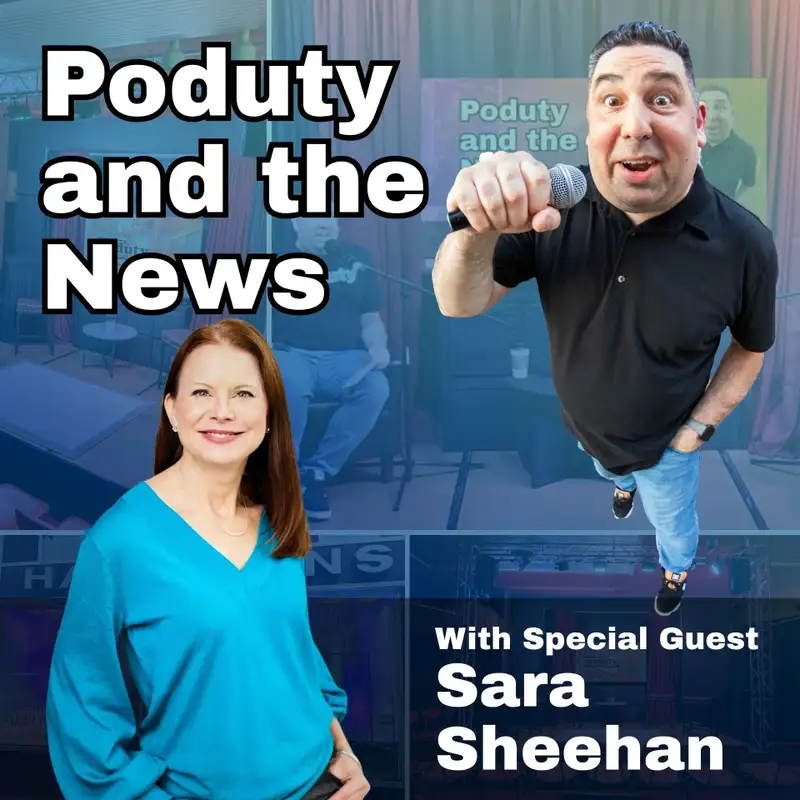
Oh my, it is August already, 2026.
Can't believe it. It's going to be cold weather soon. Oh, I'm bringing out the
Uggs and the pumpkin spice lattes. I have an amazing
guest joining me on Poduty and the News. We're going to talk about 6 live
news podcast stories about live podcasting recorded live. Sarah
Sheehan, welcome to the show. Thank you so much,
Jeff. I am so glad to be here with you. I'm so excited to have
you. We did all the prep work before I hit record, but I forgot one
thing. I always ask my guests before I play the theme song,
do you know what time it is? You know what? I sure do.
It's party time. What time is
it? Oh, what
time is
it? Oh,
it's time forPoduty
and the News. Poduty
and the News.
The only live news podcast about podcasting
from the stage. Hold to the
end of news.
Hold to the end of news.
The only live news podcast about podcasting
from the stage.
Oh, the only live news podcast about podcasting. From the
stage, Sarah Sheehan. Welcome to the show. Thank you so
much for having me. This is so exciting. Well,
I'm so excited to have you here. We met about a year ago. I was
a guest on your podcast and it was one of the most amazing guest
experiences I've ever had. You were challenging what I was doing
and building on kind of the thought process I had. You gave me so many
ideas just interviewing me. And exploring like my passions and what
I was interested in. The show's called Transformational Thinkers, and you
transformed my thinking. Oh my goodness, thank you so much. That is the
biggest compliment, and I take it dearly.
I so dearly appreciate that. I truly
do want the experience on my podcast
to be next level. I want people to walk away
Feeling I really put a lot of thought into how
I wanted the conversation to flow and go, and that I
want my guests to truly be spotlighted, to
have areas of their life and business shown in a
completely new way. If they're on a million
podcasts, I want to ask them different questions,
and I want to make it a unique conversation.
Yeah, 100%. It was so elaborate, so detail-oriented. I
was immersed in participating. I really had a great
time and it was really a great conversation. It's Transformational
Thinkers. I think you can get to it right from Sarah's website,
sarahwsheehan.com. And why don't you tell us a little bit about
your consulting practice? You have some nice ways that you
approach business consulting. You have some different strategies that you
don't see from a lot of people. Absolutely. I
have over 30 years of experience practicing
my craft, helping clients go
through really difficult, complex projects. They
work with me when it is a
make-or-break transformation, and they
really need their people to adopt new ways
of working, take on new behaviors, and
adopt change to make a project successful.
It could be anything from a technology transformation.
I've implemented SAP 19 times.
Outsourcing a global function, integrating
an acquisition, doing global
organization design, helping a client through
custom application development. Working with a client
on AI adoption. I've done all kinds of projects.
And at this point, I've worked across pretty much
every major industry. Consumer
goods, life sciences, biotech, pharma,
med device,
telecommunications, financial services,
high tech. I've done a ton of different types
of industries and helped clients through some of the hardest,
projects of their career. What I do really
sits at the intersection of strategy
and people. I'm helping the client through
the hardest project where they may be actually
changing everything a person actually does,
all of the systems that they go in, all of the
processes that they touch, or it may be a
very minor and simple change for a
particular role. It varies greatly.
But in terms of how I engage with clients, I do it in
a variety of different ways, in an advisory
capacity, a fractional consulting capacity.
If a client has a really, really hard project and needs
full-time support, happy to talk about that as well.
I have a course called Mastering
Change Management that is a course
that someone can take and sit for the
Certified Change Management Professional exam.
The course is offered in a variety of ways.
There's a self-paced version that sits on my website
that is 21 hours, and it's geared for
A new professional that wants to learn how to lead
change, or it could be a very seasoned professional that
just needs continuing education credits.
But outside of the self-paced version,
you can also take that course in a
live remote fashion,
or you can have live
cohort for your company. And
finally, I can customize the course for
you, for your business and your project.
I've gotten some really fantastic
comments from participants of the course, and I'm
super confident that
anyone that invests in it will walk
away with Tremendous
pragmatic knowledge that they can apply today.
That's incredible. sarahwsheehan.com. We'll
have all those links in the show notes. Connect with
Sarah, reach out, just check out the website, skim through it, check out the course,
check out the podcast, really build those connections with the guests that we're having
on the show. And we'll have a special dedicated page over at
news.padudi.com, which will have all of Sarah's links, her bio, along
with any episode, not only this one, but hopefully future
episodes that Sarah comes on. And you'll be able to connect
with and find her all over there on the crew page. You're now
being inducted into Padudi and the crew. That's
fantastic. Are you ready
for our first story? Yes, I am. And this one,
this is again about change. A lot of the stories that we're going to talk
about are you know, institutional change, things that are
happening. You know, we obviously— AI is a big part of things. Oh yeah.
Media shifts are a big part of things. And these types of disruptions or
change position you, uh, put you in a position
to really move your business to the next level. And how do you get there?
Well, Sarah was— somebody like Sarah will definitely help you know the
path, know the way, you know, know the direction that the, the wind is
blowing. And get you there. And this is one that's— this is one of those
media plays where you're seeing new media, old media,
traditional media kind of merge into one thing and, and
use different channels. And MSNOW is making a significant
programming shift by replacing its live weekend evening lineup with
video podcasts. The network will feature shows from its own
personalities, including Nicole Wallace and Chris Hayes, while
expanding a partnership with Crooked Media to air popular
podcast brands like Pod Save America and Strictly
Scrutiny. The move comes as MSNOW prepares to launch its
first direct-to-consumer membership platform and follows
strong early audience growth from its podcast programming,
particularly among younger viewers. And,
you know, we're seeing this a lot with traditional media embracing
podcasting, whether it's a way to scale the media that they're
producing. Maybe it's a little bit more affordable. Maybe it's meeting the
demographic. It's meeting the people with how they want to consume media.
So I think being proactive like MSNOW is, is,
you know, they're trying to get ahead of this and try to maintain that loyal
audience that's probably been slipping for, you know, 10 or 15 years.
Absolutely. I think they were pushed to a
point of no return because Audience
numbers dwindled tremendously. They
had huge
issues with on-air talent.
They were at a point of no return,
essentially. So making a complete format change, in
this case, makes a ton of sense. Let's
take it off the table and completely change what we're
doing. Using live podcasting, I
think, is an absolute winner in a
situation like this because you're going to completely
rebuild interest and audience.
Yeah, you're filling those time slots. And most people aren't glued to the
television like they were 20, 25 years ago. They're out and about. They're
looking at their phones. They're checking media at work, on
their lunch breaks, on their commutes. And this is kind of, you know, you get
home from the end of the day or on the weekend when you're not working,
you know, you want to sit down, you want to relax. And that type of
content you're familiar with, if you know brands like Pod Save
America, Strictly Scrutiny. Mm-hmm. Now you can watch them live,
watch the recording of the live video and see those people that
maybe you only listen to as an audio podcast. Now you can
see them on the big screen. You can see how they react with each
other, how they react with guests, how they interview. And you really get to, I
always say you get to see how the sausage is made when you watch a
podcast live as to just listening to the recording. And I
think it's a win-win for consumers
to ingest that media
on different platforms and really have some fun on a Saturday night.
Absolutely. And I would just offer, they really did
serve their audience well because they listened. To the audience
signal first. If you listen to
what the audience is saying, you're going to
come up with the right answer. Yeah, I love that strategy.
Well, I always often say, go where the audience is when I talk about live
events and conferences. But if, you know, if you're a station
and you need to bring people to you, you know, give them what they're
already consuming, give them more of what they're already consuming, and
give it to them on the weekend, on the weeknights where, you know,
after hours they can just sit down, you know, have an evening
cocktail and just listen to a podcast or 2 live on the television.
Absolutely. And going to
our second story here, we have the
Department of Labor is partnering because we know that AI is coming.
There's a lot of people utilizing AI tools, some
for the better, some for the, you know, what are you doing is kind of
the question that we ask sometimes. But there, there are some advantages,
and the US Department of Labor is partnering with learning
platform Ares to help make AI literacy available to
workers across America. During a live conversation at the
2026 ASU+GSV Summit,
Ares CEO Michael Loeff explained how the
program delivers short, mobile-friendly lessons designed to help people
build practical AI skills instead of lengthy
training sessions. The program focuses on bite-sized learning
that can be updated in real time as AI technology
continues to evolve. This is a fascinating
story. I think it's totally needed. This is
something that a majority
of the population needs, and the fact that they chose
to do bite-sized learning modules, that is a
huge winning strategy. But starting with AI
literacy and giving people a common language and a
common understanding around the tools and
ideas for how to start experimenting, if you're not already doing
it, is fantastic. And it sounded
like reading the fine print on the story, there are some
absolutely phenomenal organizations that are
behind this effort. And so I would
expect that he would have more Courses than just this
first one. Yeah, and I love the delivery
method here. They're announcing it at a conference, they're recording a podcast
about, you know, what's going on with this app and how to take these AI
notes, and then they're delivering it through mobile phones, you know,
right into the hands— Amazing. Of the people who are most likely
to use it. It's, it's a very powerful— you know, you wouldn't expect the U.S.
Department of Labor to be so streamlined in its delivery And I
just thought they hit on— they were firing on all cylinders
to really start to push this out there and get this into the public's hands.
Well, and Ihoff said in the interview that the course
does make real-time updates to content, which I think is
phenomenal. I'd love to understand that more at a deeper
level as a course developer myself. And
he has very high engagement in the
course and great numbers on application
of knowledge and increased confidence
using AI tools, which I think is great. Yeah, I
couldn't imagine being the person in charge of keeping it updated. There's
a new change every day. There's a new feature every day. There's a
new system every day. But, you know, just being there and
having something as a starting point for a lot of people who Some people
who have only been hearing about AI for 2 years but never took any action,
well, this could be something that helps you skip to that front of the line.
Like, it helps you clarify what all this AI stuff is.
And for other heavy users, you know, this, this could take you to the next
level or, or show you something possible that you didn't even know was possible.
Right. It's a, it's a definite, um,
creating the common denominator.
across the world. It's
incredible that it's so open and available. Yeah, I was
a big fan of everything about that story, from the delivery method to launching
it at a conference, having conversations at a conference. And, and we're seeing
that a lot more at conferences where podcasts are really becoming
a form of entertainment. Yes. At the conferences, you— where you used
to see a panelist of of 4 speakers who are
probably corporate executives from the title
sponsor doing a 2-hour panel where everybody's yawning and sitting
through. You're now seeing these podcasts come in and be the
entertainment, still delivering great information, but really
entertaining the audience and pulling them in, making it so immersive
that you can't— it's impossible to walk out of that room and not be
excited about the future. I,
I think that the more people have the opportunity to
experiment and understand the
efficiencies that they can gain from using AI,
the ability to uplevel the quality of their work
without losing authenticity, I think those kinds
of learnings are really going to help us
capture what is great about AI.
And that is the perfect segue. You must have been reading ahead. That's the perfect
segue into our next story where media leaders say AI should
empower, not replace people. Variety recorded
a live episode of its Strictly Business podcast during the Cannes
Lions Festival, bringing together executives from
Deloitte, AWS, and Sony Pictures Entertainment to
discuss how organizations should approach artificial intelligence.
Rather than viewing AI as a replacement for people, the
panel encouraged leaders to embrace new technology by building AI
literacy, solving meaningful business problems, and creating
workflows where humans and AI work together. The
conversation emphasized that successful AI adoption
depends as much on change management and
leadership as it does technology. Absolutely.
I could not agree with that more. I love the fact that they had such
a diverse panel, and a lot of these, uh,
live podcasts are sitting at the
intersection of creativity, technology,
and people. So I find that very fascinating.
On the topic here,
we definitely want to empower people and not replace them.
When it comes to implementing
AI within business processes
in a company, you want to think about
making sure that the people are focused on
strategy and vision. Mm-hmm. They're focused on bringing great
judgment. They are focused on
managing and dealing with edge cases they may not
have anticipated, or interfacing
with customers and influencing the next sale.
You can do bigger and better things
if you're not focused on some of those mundane processes
every day. And look who's sitting down at the table too. You
have Deloitte, AWS, Sony Pictures. They're like, hey,
this is something that we're embracing now. This is something we're using
to, to put out tons and tons of programming,
entertainment, different podcasts in some cases. And, you know,
this is the future and we're going to embrace it. We're going to empower people
and we're not going to replace them, but we're going to enhance. their expertise. And
that's a lot of times you'll hear people describe AI as
having a superpower. If, if you're a good marketer and you tap
into AI, you'll become a better marketer. If you're, if you're sending out emails
and you're, and you have some understanding of the English language, you can
be a much better email marketer by tapping into what you know
and building those skill sets, building off of that. And it really
is like the secret superpower. Definitely.
I think there's a ton of opportunity for
people to consider how they may use AI in different
ways. Like if they're focusing on
editing a podcast or
editing an article that they wrote, like a thought
leadership piece, there are all kinds of tools
that can level up what you're working on today
and make it better than you ever dreamed just
by trying and giving it a good prompt.
Yeah, there's so many ways to embrace it. If you're
mediocre and not skilled and you try to use AI, you're just gonna get
more of that. But if you take what you're good at and you
build off of it, you really can enhance yourself You know,
5, 6, 7 times more creative, uh, you know,
different ideas. You can riff different things and expand on your
knowledge, build off of what you know, and, you know, give it into the AI
and give it back. That's right. One of the things I did the other day
is I took a meeting,
a set of meeting notes that I got from
an AI tool. And I uploaded it and
then I uploaded one, um, the actual
link to my podcast show. And I
asked the AI to identify the
right 2-minute clip for the person I was speaking
with out of all of my podcasts. In
a matter of seconds, it came back with the
perfect clip. Based on my meeting with her.
It edited it and provided it to me. I was
able to then take it into another tool and do some minor
edits for professionalism
and provide it to her in literally
seconds. It was amazing. Yeah, I love it. And that's a
great use of AI. It's a great way of building on your expertise of
what you know. and then isolating it and getting it out into the
public faster, right? You could do that quick edit, do the turnaround, get it
off to your people, and then get it published on social media and
YouTube and wherever you're going to publish it. But you couldn't—
like, 3, 4 years ago, that was a week-long
process or 2 weeks to get that clip. Exactly. Now you have it the
day you recorded the episode. You've got that clip isolated already.
It's amazing. And keep it going with, uh,
we have some new technology. Here's a, here's a business that was looking for a
service in their area. They couldn't find it, so they
created the service that they need. And, and now they opened a podcast
studio. This is a new content creation facility, is giving
podcasters and businesses in North Wales a professional place to
record, livestream, and produce video content.
Dragon Forge Studios has opened in Mold, offering
recording space, live streaming capabilities, production support,
and flexible rental options for creators at every
experience level. Founder Rob Lewis launched the studio
after struggling to find an affordable local space to record his own
podcast, creating a solution that now serves
the broader creative community. I think these
Creative Spaces are absolutely incredible.
There literally is a new one in
every business area in town in
Dallas, and I think it's great. I think it allows
new creators places to engage
where they can get comfortable with podcasting
quicker. I love the fact that many of them are very
acoustically premium setups
where they have all of the acoustic tiles, they
have wonderful sound systems and speakers,
they may also have some incredible video
equipment. I think very
highly of many of these creator
studios, and I think it's a great thing to do. I also think that
you can cross-market it to other
types of people out there besides podcasters.
You can talk to current podcasters,
new content creators, but you could also talk to people that
need to do voice acting and record it,
or maybe someone that is a musician and wants
to record in a private space. There are all
kinds of different things that you could do to keep your
space in the black, if you will.
Yeah, I mean, I'm very bullish on this story. I, I'm very— I
built a theater space for live podcasting recording, and you're
experiencing that right now. This is— we're recording a podcast live,
and, you know, this is where I really think the future is, and I think
they're tapping into something here in Wales. You mentioned every corner in Dallas has
a studio or recording space now, which is incredible. I'm waiting for that to come
up to the Northeast here. And this is where we're going. It's
independent media created by independent content
creators that are really pushing the future of media
content, media production. Yeah. And it's this independent studio in
Mold. It's this little theater where I'm sitting at in Tarentum.
It's all those spaces in Sarah's backyard in Dallas. That's
making it happen, making the future happen for all these
creators out there. Every one of the
co-workspaces has a podcast studio,
even if it's small. It's just a great way to utilize that
space, a great way to keep people coming in. And you know, you're— they're going
to come in weekly, so your turnover is great. You're going to get people in
and out, you know, at least 4 times a month. Exactly.
Well, this one's very businessy. I had trouble understanding everything that's happening
in this next story here. This is called the PowerShell
Podcast records live at PSU, or PS
Conference EU 2026. The PowerShell
Podcast brought its audience directly to PSCon EU
by recording a live episode featuring Microsoft Senior
Security Research Program Manager Miriam Weisner.
While the conversation focused on cybersecurity,
Microsoft Teams security, and PowerShell best practices.
The episode highlights a growing trend across professional conferences
using live podcasts to capture expert discussions,
extend the event experience, and make valuable educational
content available long after attendees return
home. I think that is a wonderful way
to use live podcasting. I have noticed it at
all of The
meetings and conferences that I've gone to, there is
at least one stage that has
constant shows where people can
lean in and listen. They can engage and ask questions. I think
it's a great thing to do. In this particular instance,
I love that she is in a
tremendous subject matter expert role
and is able to share her deep knowledge in the
interview. It's— security is
hard, right? And there are a lot of ways
that cyber crooks can try to get
around the mechanisms that she
works hard to engineer in place. And she has
a ton of knowledge that she can share. Live
podcasts like this also facilitate
people being able to hear the
detailed knowledge that she's sharing if they have a
really full schedule that day. Maybe there are 5
other meetings that they need to go to, but they still want to listen to
Miriam later. And so I think this is
a great thing to do. Yeah, you mentioned
conferences are leaning into this. They're having dedicated stages. Yes. Even the
main stage sometimes has a live podcast. I've even started to see
the booths, the sponsors who are buying booth space at
conferences, they'll say, hey, 3 o'clock, maybe our
CEO is going to do a conference, or we're bringing this author who
wrote this book who's inspiring our industry. They're going to be here at 3 PM.
We're going to do a live podcast in our booth. you know, stop by the
booth. You know, we got free swag, you know, a bunch of stuff you can
try to carry on a plane on your way out of here. And we're going
to do a live show, a live recording. That's great. Like what
they're doing here, they're recording that and then taking that, you know,
after the event, and they're using that
as a media asset to distribute to their
fans, to their email list, to their social media. And they're creating
content on the showroom floor Just building that credibility and
putting in all that current event information to share with all the FOMOs
out there, who, you know, the people who missed out because they couldn't go.
Now they're going to get a taste of it, and that may help actually propel
sales for next year. Absolutely, and it may
increase Miriam's followers. Absolutely,
yeah, yeah, there's another way, you know, that's another win-win situation.
Miriam is going to get a whole new audience from the podcast. That's right.
And here we go. One of my— this one sounds more like me. The Doers
Summit in 2026 brought together founders,
investors, entrepreneurs, and technology leaders for 2 days of
innovation and collaboration alongside interactive
exhibits, workshops, and keynote presentations. The event
also included the recording of the special Doers Summit podcast
episode featuring Sportssoft CEO
Ludmila Marokina. I think I'm
pretty close on that one. While the summit showcased emerging
technology and creative marketing, the inclusion of a live
podcast demonstrates how conferences continue to embrace podcasting
as another way to capture expert conversations and
extend the impact of an event beyond the attendees in the room.
Yes, well, you definitely want to do this. This is
really great. It makes a ton of sense, and it gets— it collects
rich material for clips
and media and press kits and
website enrichment. Like, I just think this is
an excellent way to— for, let's say, a
company that wants to lean in to being on a live
podcast at an event, they're going to be able to walk away
with incredible
marketing material that they can repurpose a ton
of ways. You can create all kinds of
short segments on key topics
and really beef up your marketing
just on one live podcast. And I love it
that it's alongside interactive exhibits, alongside workshops,
alongside keynote presentations. They're doing a live
podcast recording, right? They're getting that information that Sarah's talking
about, but they're part of the event, they're part of the experience, part of the
conference, part of the, the entertainment that the conference is using
to sell tickets. So it's, it's how important has podcasting
become to, you know, to these conferences who are using it as
them as the entertainment for, you know, some of the,
some of the time slots during the day. I would also offer
that on the planning side, if the
live podcasting stage is on all the time, let's say
whoever's organizing the event, I do hope that they are thoughtful
in planning strategically around
what the topics are that are going to be covered. who the
guests are that are going to be there at different times of the day
and what kinds of questions would be asked over the
course of the day. So it all hangs together.
So the person has to book out that schedule. You know, sometimes there's different
tracks and maybe one podcast episode falls into a
marketing track or an engineer track or security track.
And when there's a break in that track, that's kind of where you want to
slip in those live podcasts, those special events. And, you
know, it's, you know, you got to figure out how to make it work for
your guests and deliver the best experience. And yeah, I would love coming out
of a session and all of a sudden there's all this hype in the corner
going on at this other stage because somebody that I, you
know, I follow in the industry is really going off and sharing these
nuggets, sharing this information, sharing this knowledge. And the audience is going
crazy because they just came out of a session, they're all pumped up, and now
they're getting this added bonus they, they may not have expected.
Yeah, I've really— on this particular event, I love how
it is, um, a complete, uh,
cross-cultural experience where there
are interaction experiences,
creative opportunities, technologies included.
There's all kinds of real engagement
and being in a situation
like that where you can experience so many different things,
adding something like a live conversation just
adds richness to the overall experience.
Yeah, so much fun. If you get out to a conference and in an
industry that you're passionate about, learning about something that you're curious
about, you know, take out— take note to all these little side events
that are happening. A lot of them now are podcasts. So if you love
podcasting and you're going to an event about something that you're
passionate about, you know, look for those little nuggets. They're, they're not always
the main feature, but they're there and they're happening more and more.
And if, and if you're in an industry and you're starting to become somebody in
industry, Reach out to the conference. You could be that
podcast at the conference up on that little side stage
sharing your show with the attendees. That is a great idea.
I have a friend that has done that
before, and I need to think
about that, where I could do that. We'll get Sarah up
on stage at the— we have a— I'm going to be announcing a conference in
about 2 days, so I'll, I'll be reaching out Your phone will be
ringing. Oh, you never know. This goes by so
fast. I always have so much fun. You believe we did 40 minutes already
of live podcasting about live news recorded
live. And this is the part of the show, one last time, I like to
turn the floor over, give Sarah the floor one last time.
You can plug, promote, talk about anything you'd like, Sarah. The floor
is yours. Gosh, I would
love for people to take a look at my
course. I'm super excited about the
quality of the course and the opportunity
for clients to learn how to do the
work of leading change and reduce
the amount of money that they spend on
expensive consultants long-term. I have
complete confidence that the
course will add value for you and your team.
And if you still needed support after
taking the course, clearly I'm open to
that conversation. But I feel really very
excited about the prospects of my Mastering
Change Management course. Changing the Game for people that
want to learn how to lead change. And
I'll have those links in the show notes on the page.
Make sure you follow Sarah. Check out the podcast Transformational
Thinkers as well. Some great interviews on that podcast.
Sarah, do you remember what time it was?
It was party time. What time is it?
What time is it?
Oh, oh, it's time for Poduty and the
News. Poduty and the
News. The
only live news podcast about
podcasting from the state.
Poduty and the News. Poduty and the News.
The only live news
Podcast about podcasting from the stage.
Yeah, yeah.