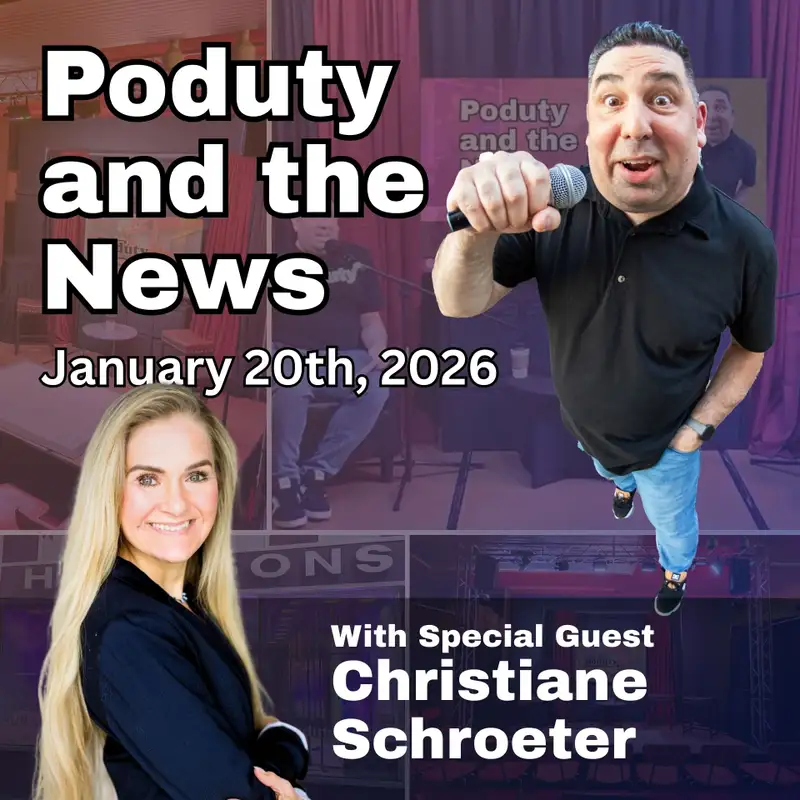
What time is it?
What time is it?
It's time for Poduty and the News.
Poduty and the News.
The only live news podcast about
podcasting from the stage.
The only live news podcast about
podcasting from the stage.
Hello. Hello. I'm on the stage, but I forgot to set up my mic stand.
Let's go. There we go. Christiane, welcome to the show. Welcome to this
side of the theme song awesomeness. I hope you at least
captured some of my fun that I had while I was
jiving to the dance song. Lots of dancing
backstage. We're having a good time already. We've got six stories
about live podcasting coming up. We're recording this live, live
on the stage here at the Paduti Podcast Theater. And
Christiane, you've got the Petite Hustle.
I left my notes on the other side of the stage. It is the Petite
process and the. Oh, I'm going
to. I will help you. Don't worry at all. Don't worry about those notes. That's
why I'm here. I'm a professor, after all. Right. I like teaching.
So it's the Petite Practice. And my podcast is
called Happy Healthy Hustle. Happy Healthy
Hustle. That's where I was getting confused. Tell us a little about the podcast.
Yeah. Started really simple. I am a
professor. I'm also, like, maybe a little bit like a standard comedian.
That's sometimes what my family tells me. Right. I definitely have fun
entertaining. And I thought other people
might not just want to read my emails
or hear about my products. They also maybe want
to watch me and listen to me as I'm sharing some
insights that are expert insights, but
I'm really explaining in a way that are more like layman terms.
And that's how I started my podcast, really, with the goal to share some
ideas, share some news, share some trends without enrolling into
one of my classes or being one of my clients, just free on the
Internet. And that's how I got started. Oh. I just ran all
the way backstage to get my notes, so I have them all here.
Perfect this time. The Happy Hustle podcast, the Petite
Practice framework. And that's the one I'm really impressed about.
I really think that framework, that mentality, that mindset
is something that a lot of podcasters can apply to their shows, to
their guests, to their structure. Tell us a little bit about that. So Petite
Practice, so you can hear from my accent. I'm from Europe. Petite
means French. In French, it means small. Right.
And Practice, we all used to. It reminds us maybe of
Sports remind of just trying something for the first
time you have never done before. So look at this. You're taking
a small step with something that that is maybe
part of a big goal. So you're really taking your big
priorities and you're breaking it down. You're translating it
into small steps. And that's, in essence, really what I do.
So I'm a leadership strategist, and I kind of sit at this
intersection of leadership, of
execution, but also of behavioral strategies.
A key Practice is the vehicle. It's the behavioral
strategy. Taking one small step in reaching your
big goals, in executing small step every
day, chipping away at something, and then eventually, of course,
you're going to get there, because it's that high five moment of
seeing momentum towards something. Just like when we
Practice in sports, we get better and better. We just have to stay consistent with
it. That's like a lot of times you hear people say, if you can
change just 1%, just a little tiny bit today,
make a little tiny improvement, think where you'll be with that change
in direction in 30 days, in 60 days, in
120 days, compared to where you would have been had you taken
no action. So this concept of taking these little tiny
incremental steps every day to get to your goals, to
get to where you want to be, I love that setup and that structure.
Yeah. Most people actually don't even struggle with
finding a strategy. Right. I mean, here we are at the beginning of the year.
Most people know what it takes to live healthy or to
run a business, improve your business, and they also have big goals.
It's really the translating of the priorities
into the Practices, that's really where the Petite
Practice comes in, because it helps you create
momentum and actually see progress that
sticks even under pressure. So even if you have a day where you
have a lot going on, where maybe not feeling the best, you can still take
a small step and you get closer to your goal.
Very good. If people want to reach out, listen to the podcast and find out
more about your Practice. What's the best way to connect with you? Well, tune
in to my podcast, Happy Healthy Hustle. Actually
globally ranked top 1%. And of course, watch
me on my YouTube channel, @doctor.christiane, or
check out my website, https://doctorchristiane.com/
awesome. I will have all those links in the show notes. Make sure you always
check out the notes. They have great links to our guests. We even have a
page on the podcast site that's called the Crew. And after
tonight's show, Christiane will be inducted into the crew.
So there'll be a crew page. You'll be able to find her photo, her
links, her bio, and all this information that we're talking about.
It's there, archived, even all the shows that she's on, this one tonight
and maybe even future episodes if she wants to join us again in the
future. But all that will be archived and you'll be able to connect with her
and follow those links and make sure you hear the podcast, see
what the offer is, and see what the Petite Practice is all about,
for sure. And it's sometimes fun even to reach
out and let me know what you really enjoyed as far as a takeaway,
because for a podcast, the best thing is
actually to feel that your message resonated. But
to really know what resonated would make me, another
guest come back. But also, you know, for Jeff,
that's also super helpful to kind of like figure out. Okay, so we're going to
do more of that. So let us know what you really enjoyed and
leave some praise and of course, reach out if you have any questions about anything.
Sounds good. It's time to get into our first story.
Are you ready? Let's do it. All right, story
number one. Tonight, Michelle Wolf turns podcasting into
live standup. Comedian Michelle Wolf is rethinking what
a podcast can be by launching Thoughtbox as a live
stream stand up experience. The show officially premieres
February 27th in Barcelona at La
Latiana Cultural. Performing. Performing in front of a
live audience while streaming exclusively on punch up. Unlike
traditional podcasts, Thoughtbox is designed to feel like a
brand new comedy show every week. Topical jokes, audience
inspired material, and zero attempt to sound like a typical
podcast. It's recorded live, streamed live,
and available on demand as video, and later released
as audio, blurring the lines between stand up
television podcasting in a way only a seasoned
comic could pull off. And this is a story that
after my heart, I am. We always walk in that line
of what is a podcast? Where can you perform a
podcast? How can you perform a podcast? And Michelle Wolf has taken
this well beyond anything I've ever conceived. To
be able to have a show, live, stream it live, and then have that
content released for audio at a later date. I really think
she's. She's firing on all cylinders here. Yeah, actually
that's how I got started, Jeff. My first
podcast experience was Instagram
Lives. I started it during the pandemic, started
my podcast 32323 and
I did Instagram Lives and had amazing guests that
would have never Been able to meet with me, meet me on Instagram Live, and
we talked for about an hour. Then I extracted the video,
extracted the audio, and I posted the audio as my
very rudimentary first podcast recordings. That's how I got
started. So very similar to what Michelle is doing right there.
That's very progressive for your first show. That's a very. That's very
ambitious. You don't hear most people starting like that. That's something that you grow
into. So. So the fact that you started at that level is.
Is really impressive to hear right off the bat. Well,
it definitely. I'm. I'm kind of like an out of the box
thinker. And the way that I think was also
I recorded the Instagram lives, and
afterwards I thought these were some really amazing guests and takeaway.
I don't want that they just lived on Instagram on social media.
I actually think that we should have them recorded for eternity, which
is what podcasts really are. They are like books, right? You.
I mean, you will always have them. You always can go back and enjoy them.
And that's how I extracted that video and transcribed it and
basically then also even shared the video now on my
YouTube channel. They are like, you know, Instagram
live quality, but they're still there.
Yeah, that's great. And this is a great example of what, when you're
creating content, what all can you do with it? What
extra can you create from it? Can you create shorts? Can you
download it and create a podcast like Christian was doing? Can
you re upload that to YouTube? Can you create shorts out of it? You
know, small clips, viral moments. And that's kind of what Michelle Wolf
is doing here too. She's recording the show, and I'm sure
she'll promote the clips all throughout social media. Well,
and what I love about the standup comedy, of course, is
that we can't all travel to Barcelona, Spain, and
watch her. But sharing that with us
really creates this moment of community, which is what podcasting
really is all about, that you feel like you are learning about something you would
have otherwise never really been able to tap into. So this is an
amazing example of podcasting taking to the next level.
Yeah, I love this story. I really think this is the future
model of podcasting. And Michelle Wolf is already ahead of the curve here
on this one. Nice job. Really, really beautiful.
Let's go to story number two. We're going to neurosurgery.
This is one of those things where I always like to find podcasts and
segments. I never thought There'd be a podcast. So this one we're going to file
under. This is a neurosurgery.
What happens when you take one of the most high stakes medical
specialties in the world and put it live on stage?
You get honesty. At Brain Waves 2025, the
Neurosurgery Podcast went live with Columbia Neurosurgery
Chair, Dr. Sander Connolly. Connolly.
Connolly. Alongside outspoken hosts Dr.
Michael Wang and John Paul Kolkom.
The result was a bold, on the record conversation tackling
some of the most controversial issues in modern medicine,
from who should be allowed to treat neurological conditions, to
whether neurosurgeon autonomy is disappearing,
to why doctor run hospitals don't exist in the U.S.
this wasn't just a podcast episode. It was a profession.
Thinking out loud, live and in public.
And we've seen a lot of this with universities especially. This was at
Columbia University. Columbia Neurosurgery,
the higher education system is really embracing this idea
of live podcasting, maybe as a value add to their
students so that the students can see what's possible in the career,
but they're also getting this firsthand experience of
what's it actually like to be in the field.
Yeah, I love this example for two reasons. I mean, first,
neurosurgery sounds scary to us, right? We are like, oh, my
gosh, I don't even know what that entails. But to really bring it to a
level where the whole world could tune in, that is just
beautiful. Right. So that's my first love about this
translation of a complicated concept into
everybody's ears. And secondly, what I think is
absolutely amazing is this interaction, really,
of topics that might be trending or might be in the
news. So we are kind of like feeling it's even
expanding our horizon of what medicine is
capable of with two top surgeons right there
and sharing that with us. Because I think if.
If you're not really opening specific magazines, you'll
probably never find out about this. But here you are meeting these top
surgeons and they're sharing something with you from modern medicine
that is just really beautiful. So first sharing it with us, but then also
taking us to the next level, taking us along on the train of
knowledge that is just absolutely brilliant. Yeah.
Imagine 20 years ago, how long it would have taken you to hear from
the top leaders in your field. You'd have to wait for a
publication, wait for it to get published, then get the article
delivered to you, then you could read it. But here,
the top people in this field are on stage. They're talking
Back and forth, sharing their ideas, their experiences, where they think
the future is going to, maybe even taking Q and A at the end,
you've cut down the time to share information
by a factor of 1000. You're really getting the info right to
the people the day that they're there to consume it.
Exactly. And what I also love is
that we probably didn't even know these people previously.
So I, a few months ago, had a colonoscopy, and
I realized when I was researching colonoscopies, even
on social media, that a fair amount of celebrities
have shared their colonoscopies on
Instagram or even, like, sometimes live. I know. Listen to this, Jeff.
Right? This sounds really, absolutely crazy, but now think
about it, that celebrities did
that for a very specific reason. I think Katie Couric did that
because I think her husband struggled with
certain health conditions. So they are basically taking
a medical condition and showing us. Giving us
all the glimpse into medicine is not scary. It's really there
to make us better. And don't procrastinate until the last minute to get
these routine checkups. And same with neurosurgery. You kind of
translate that into something we understand. You might all of a sudden
realize that maybe these surgeons are
actually there to help you. It's not scary. You can go and
see a doctor if you feel something isn't right and maybe
just ask good questions about it. But at the end of the day,
medicine is really just an improvement, especially now with where we
are with AI, an improvement in our life conditions compared to,
as you mentioned 20 years ago. So I love that about this particular
podcast. Yeah. And think about no matter what industry
you're in, what you study, what you're passionate about, there's
a group of people who are the experts in that industry. And if you're starting
to present information, if you're starting to share what you know
in your own little niche, you could rise up to become the
expert in that industry. And so don't just think of this story as, this is
only for neurosurgeons. This is also maybe for accountants
or consultants or people who collect and trade
Pokemon. You can become the expert, and then you could be on
stage at certain conferences, certain events, talking about the thing
you love in front of people who also love the thing you love.
Exactly. And of course, think of you
as the expert becoming a leader in your
field. And it could be now, as Jeff mentioned, Pokemon
cards or anything like that, because as soon as you are passionate about
something, it's going to translate into what the audience really hears
in your voice, in the way that you act, in the way that you describe
it because you are acting as somebody who's so passionate about
it that they want to share it with the world and explain to
the world why this is such an amazing thing.
Awesome. Let's keep it going. Our third story today we're going
to the court. From the the. From the the
operating room to the court. Former NBA
stars Mike Bibby, Brad Miller, Eddie House and
Ty Ellis brought the Straight Game podcast to a live
audience for the first time in California with a taping at
Sky River Casino. A hometown moment for Bibby that
felt more like a reunion than a recording. Covered by
ABC10. The night delivered classic NBA
storytelling, locker room insight and unscripted
humor, including crowd favorite moment when Bibby was
asked if his son could beat him one on one. The event
marked the first of four planned live tapings at the venue,
signaling how athlete led podcasts are evolving
into full scale ticketed entertainment
experiences. And this one really builds off of what we were just
talking about. These were the experts in basketball. These were some
of the best players that come out in the last 20 years.
And here they are hosting a show in front of an
audience who loves basketball. Loved watching them play
and they're just having a good time sharing their love of basketball.
Well, exactly. And what I actually like, it's somewhat unscripted behind
the scenes and really authentic because if there is one thing,
if you watch tv, it's been heavily edited. They have been given
questions, they have been given directions by their PR
agents, but here they're just people. And
don't we love that when people act authentically because we actually
meet who they really are and what they really care about.
And the behind the scenes is just always so interesting
and intriguing. We love it. I think there's just so much about this
and it's a brilliant idea really in terms of especially looking at athletes
lives that it's a, it's a beautiful concept really.
Yeah. And it's a fun night out if you're a basketball fan. If you love
watching basketball, maybe this is near a place where they play
professional sports. You're able to go out. A lot of These events
are 15, 20, $25. They're not very
expensive ticketed events. You get to hang out, you get to
see how these famous players react in the moment, how
they interact with each other, goof on each other. A lot of times
professional athletes, you know, they play jokes on each other, they tell locker
room stories or Funny moments from traveling around the country.
And you get to get all this in the first person perspective.
You get to be immersed in the moment in the same room that they're in
telling these stories. Well. And what I
like too is that some of these athletes might have never
met otherwise. Right. I mean, it's not that they're always
necessarily playing each other in games, but
they're just kind of hanging out there. So for me,
whenever I think about something like that, I always think of
like reality tv, how that's absolutely not authentic.
It's really scripted. But this is really the true reality
TV here. Jeff, don't you think that's a much better description of reality
tv? Yeah. You can't get much more real than
touring sports players telling stories of being on the road and
the hard fought battles on the court. There's nothing scripted, I'm
sure, about this conversation. They may have a layout of things
they want to talk about, but I guarantee you, everything you heard on that
stage was uncut and raw and unfiltered. Love it.
That's like beautiful concept to really keep us
curious. And curiosity sometimes is really something that
leads to that diversion that you need in your very stressful day. Yeah, it's a
great way to get out. And like I said, if you have the worst night
of your life, you're only out 20 bucks, $25. And you got
to go to a casino, you got to go to a theater, you got to
see a live show. It's not a bad night out. I like it.
Yeah, well, when you're out, you might get the munchies.
The movie Munchies Go fully
interactive. This is one of the new type of stories we're trying to incorporate
into the show. A lot of people have asked me about live
streaming. One, you're performing on a stage, but like Christiane did on
Instagram, she did a live stream and then repurposed that live stream.
Well, that's also a performance that you're doing live in the moment.
And so we started to incorporate some, some of the more popular live
streams into the storyline. And the line between
podcast live stream and watch party keeps getting
thinner. The best thing we watch this week proves why.
Streaming live on The Movie Munchies YouTube channel, the show
teamed up with the Ruby Tuesday for a fully
interactive episode breaking down everything from crime
thriller, the Rip to 28 years later, the
Bone Temple and Peacock's Cold War spy series
Ponies. But the real magic wasn't just the
reviews. It was the live audience interactions.
Viewers didn't just watch. They joined the conversation,
shared recommendations, and helped shape the show in real time.
Turning a movie chat into a shared live experience.
And something like this, this is kind of what you were doing on Instagram.
They're, they're talking about movies and interact, getting their
audience involved, answering questions. What were some of the things that
you really liked about not just this story, but your own livestream experience?
Well, what was the coolest was when you had guests that of course
they wrote their own home. And sometimes, I mean, of course
I asked them certain questions like, oh,
like for instance, what is like your Petite
Practice and how do you stay healthy or how do you build your business,
etc. But then I would sometimes like point on things in the kitchen. I would
say, oh my gosh, what is that cute mom there in the background? And then
they would like guide us around in the house. They were like, oh, let me
show you my kitchen while I'm here. And that was just so fun. It was
like, keep going, we want to see more. And I liked it. And then
of course, I would watch the screen and see how people commented
and read the questions that the live audience posted
while we were actually recording, which was really neat. And
people would tell their friends, you got to learn, Cristiana is talking to this person
right there. And it was really nice. It's just a great way
to connect the world. You don't think of it as this
live stream is kind of like a portal to the world where you're up on
stage, you're broadcasting, and people from anywhere
can leave a comment. You can even give them a link in some cases to
pop up on screen to join you real time.
It's really the most simple way to bring
the world together. Exactly. And what was fun about
it too is we would announce it ahead of time and then I
would sometimes read out the questions from the people that couldn't make
it, but sometimes I would read out the questions from the people and if they
were there, I was like, well, if you are here, you can hop on, maybe
even ask a follow up question because your question was asked, but you're here.
Let's get some reward for the fact that you actually showed up and
listened to this right now. And that makes it fun too, because people have something
to look forward to. They already submitted that question. Now they actually want to see
what this guest said with regard to the response. So it's really interactive.
Yeah, A great way to connect people. Tell your own stories. And like you
said, I'm looking at their background all the things that they have
hidden in there. And I'd love to hear some of the stories of, you know,
how they acquired some of those pieces and, you know, why, why
they're drawn to certain characters. Yeah. I mean it
in general, it's the best thing about, if you think
about, like, TV recording, I mean, Jeff is sitting in the
studio. You can see my background here, and it's just so fun about
really showing the humanity in us.
Yeah, let's keep it moving. Let's keep the show running because
we're going to shoe talk. 40 runs
turns shoe confusion into live coaching. This was a really
interesting way to do a live podcast.
Chasing the right running shoes can feel overwhelming, but 40
runs Shoe Talk show is making it simpler by going live.
Streaming every Monday night, this weekly video podcast
invites runners into a real time Q and A where they can ask
honest questions about everything from daily trainers versus race
shoes to carbon plates cushioning, stability and
injury prevention. Hosted by a qualified running coach,
the show blends expert guidance with live interaction,
then repurposes each episode into both video and audio
podcasts. It's a great example of how live podcasting
turns niche expertise into trust, clarity,
and ongoing learning community.
And one of the shows I really love just the
concept of here's an expert on running. People getting
into running, especially this time of year, January, people are thinking about
being healthier, getting more active. And here's a
guy that knows about shoes, knows about running, knows about safety, and,
and the best way to fit a shoe to your foot. I think this time
of year, this story, I think it's a good match for a lot of people
getting into physical activity. I like that you use the
word match. Nearly sounds like it's a fit. The shoe fits
and the podcast fits. Really brilliant.
What I like about this concept is
sometimes if you think about going to a store, you don't even
know exactly what you're looking for. You're like, why I need a sneaker.
But until you really set a foot to say it, like,
literally into the store, you don't even know what differences there are.
So this podcast allows you to do some research before you actually pick
something out yourself, especially if you haven't bought sneakers for
a while. There's probably a lot of research that has
happened and has translated into the latest research and
how sneakers are made now, say, compared to five years ago.
And I think this is brilliant because it breaks it down a little bit
and making it even, like, easier for you to narrow
it down before you go to A store and then maybe even
choose something much more educated. So it's, it's truly
the best in terms of like sharing an insight with you
that again, another expert has right here. Yeah,
you get the host's perspective but you also, in the comments you probably get
other runners perspectives and maybe you have a
specific question. Somebody else probably already answered that
in their life or they figured out a solution to that problem. Even if the
host doesn't know that community is working together to
put the show together, to give answers and to help people.
Maybe they're newcomers to running, maybe they were seasoned veterans, but
they all need to learn something at different points and that community can
really lean on each other and answer each other's questions. I did
an Instagram Live once, Jeff. I made a smoothie on the, on the
Instagram and I put all the ingredients in and I was like, oh my gosh,
Now I didn't think about the fact that I guess I need to start the
blender at some point. Now this is really the unattractive part about making something
life because it's allowed. But it was cool because
I just kind of muted it and I said, well, I'm going to run the
blender right now, so let me just mute it right now. And meanwhile you can
pop questions in and some people really ask questions about the ingredients. You
said, well, could I, for instance, instead of this
fruit or instead of this vegetable, could I use something different? And
so I even like overcame this little obstacle and
made it into an opportunity to interact with the audience and figure
out what smoothie ingredients they would really enjoy.
Well, you had to mix the ingredients. Let's go to the
morning mix. One of the things I love is traditional media
going into new media formats. And we're seeing a lot of this where
morning shows or radio shows are going out into the
community and they're recording their podcast live. They do
extra content, bonus content, and they release it as a
podcast. Here's an example where they're doing a remote.
Morning radio is stepping into the spotlight as the morning mix
goes live on stage, hosts Chris, Nikki and
Whip are bringing their most loved segments
like Chris's 3 Thursday, 3 Style,
Nikki's Thousand Dollar Minute and Whip's hot take
out of the studio and in front of a live audience at the North
Shore center for the Performing Arts. The hour long show will
be recorded and released as a special podcast edition and with
100% of the tickets, proceeds benefiting the North
Shore center foundation and its youtheater program.
Proving that live podcasting can entertain, engage, and
give back all at once. What a brilliant idea. I really
like the charity angle at the end. That's brilliant.
Yeah. This is one of those things where you can do something as a community
get together, and at the end of the night, something good can come of
it. It doesn't always have to be about who can sell the most tickets and
fill the most arenas. A lot of times you can do something that's a
fun night out. You can raffle off gift baskets. You can
have the strip tickets, the tearaway tickets, and
give back money not only to the fans, but to the
charities through little games of chance. But you can
raise additional money and then feel. Imagine how good you feel. But
you get to get entertained all night, and then at the end of the night,
you get to make a big donation to a local charity to help.
Looks like a youth performing arts, the youth theater program.
It's a really cool concept because it bridges so many different
aspects. And in this particular case, I love how you said
earlier, brings these three powerhouses together
that usually, I mean, it says right there, it brings their
most loved segments together. I mean, think about. This is like a
highlight reel of three superstars right there. And all
that for charity. That's a win. Win. Yeah. And, you know, a
lot of times we talk about when you listen to a podcast or you
listen to people on the radio, a lot of times you try to imagine what
people look like or, you know, how they react in different moments.
And in 100% of the cases, you've never guessed
correctly what somebody looks like from their voice. But when you get them out of
the theater, out of their home studio and onto a stage, and you get to
see these people face to face for the first time, you get to see them
smile, you get to see them light up when somebody asks them a question.
You get to see them talk to each other and react to each other.
You can't get that from an audio show or from a radio
broadcast, but when you're in the moment, you get that fly
on the wall feeling that you're there finally watching them
and seeing how they. How they are in every moment, in every aspect
of the performance. Oh, I have a. I have a really emotional
story for you about that, too. What I did, I have a really
good friend, and she came to my TEDx show, right?
And I had never seen her before in person.
So she set herself in the first row, and when I stood
on stage, from the corner of my eye could see her.
But that was like the Moment I really had to give my talk. Right. And
so I was like, I was kind of, like, torn between, like, glancing down
and looking at her and continuing with my TEDx talk.
And then later on now, when I watch the YouTube video,
actually can see her, how she looks at me. And it's just really cute
because we are really good friends. And how it connected seeing
me for the first time in real life on stage, where we only
ever talked via zoom in on the phone. So. So I think moments like
that are always really cool and special where you say,
like, sometimes we just hear the voice, but we don't see the person. So
to see everybody here and have them, like, really
feed off their energy together, that's absolutely magic.
Yeah. I try to explain to people that when you listen to a podcast,
if it's done pretty well, you feel like you're in the room a lot of
times with the host. Like, you feel like you're sitting in there at the table
listening to this conversation. And it's such a surreal experience.
When you finally get out to a small theater and you get to
see them up on stage, now you're actually in the room
while they're performing the show. So all that, everything that you've
built up listening to the show over the years is now right in
front of you. And it's just this experience that's hard
to explain because you've heard these people so many times, and now
you're seeing them in person doing the thing you've been listening to for, you know,
50 episodes. It's. It's. I try to tell
people over and over again, you have to just experience a podcast live, especially
one that you like. If they're ever in town near you, go.
Go see them. Go have a night out. Go listen. Go watch the
podcast you've been listening to. You won't believe how much it changes your
perspective about what podcasting is and how much goes into it.
For sure. Yeah. Actually, a friend of mine recently
visited my. My town here and. And visited my.
My campus where I work as a professor. And I ran
into him, not knowing that he would be here. And of course, he
immediately recognized me because I'm kind of like a recognizable person.
Like my bun. Right. And just the way that I look like. And I act
like I'm always really bubbly, energetic. And so he saw me
and he was like, oh, my gosh, it's Dr. Christiane. And then I saw
him, and guess what I did, of course, on the next day, invited
him to my house and we did a live recording for my podcast because
that is some magic you can't recreate to have somebody visit that
I knew for my podcast. And then, of course, I invited him as a guest.
So I completely agree with Jeff. That is an amazing experience,
and it's a beautiful way of kind of like going full
circle on something you otherwise would not have
experienced. Yeah, I really wish everybody got
to do that. So if you ever get a chance, anytime you get to see
a live podcast in your town, doesn't have to be here where we are in
Pittsburgh, but wherever you're at, there's people performing live podcasts
all over the world. And here's six more examples that we gave you
tonight, which brings us to the end of the show already. I warned you.
It goes fast. Well, Christy,
one more time, let's make sure we get your links out to everybody. What's the
best way to connect with you? And we'll drop those into the show
notes for sure. Well, check out my YouTube channel. You
get the bubbly me that I am and all the amazing
videos, the guests that I'm sharing there, of course, the insights.
It's Dr. Christiana is my YouTube channel. So
it's written out D, O, C, C, T O, R.
And then my first name, which is Christian with an e. And of
course, what I would encourage you is check out my podcast,
because there you can scroll all the way back to the beginning,
and you can listen to those Instagram lives and those guests
that we recorded on Instagram lives way back then in 23 when I
got started, and it still turned into an amazing podcast
episode. So I would encourage you, thinking outside the box
sometimes turns into the most beautiful moments of connection.
Yeah. Go back to the beginning. It's always fun to see the progress, too. So,
you know, everybody starts somewhere. And you hear those first couple episodes,
you kind of see the foundation of what will become the podcast.
And as you grow with each episode, you'll hear
how the show evolves and becomes something more and more special as
time goes on. And it's just a great archive and a great
way to see how you were through three, four years ago.
Yep. The main thing is just. And we talked about this, keeping it up,
the consistency, even. Like, sometimes you're like, oh, I don't think I
have time to do another recording. I don't have time
to do another episode tonight. Keep it up, because eventually
your audience is going to wait for it and you don't want to let them
down, so you have to. The consistency always
beats going for perfection or going for
procrastination. Now, once you have the audience, they're going to wait
for you. And yeah, that's really something that feels amazing once that
happens. Definitely. Definitely. And if you enjoyed
anything that we talked about tonight, if you enjoyed this show, there's 40
other examples of people doing live podcasts, six
stories on every show. That's 240
examples of people doing live podcasts
out somewhere in the world. So this is a form of entertainment that's happening.
If you look at the stage here. I got your show here because we want
to produce your podcast on our stage. No contract,
no minimum ticket sales. We'll sell the tickets for you, we will
produce the event, record the event, give you back the recording, and at the end
of the night, we Split the door 50 50. There's no risk. You're not on
the hook for anything. There's no hidden charges. So check it out. Poduty.com
P O D U T Y this has been Poduty and the News. Leave
us a review on your favorite app that you listen to podcast on. It means
the world to us. Or get all the back episodes @ news.poduty.com
that's
gonna wrap it up for tonight's show. Thank you so much for joining
me. I got one last question for you. Do
you know what time it is? Oh, gosh. It's time for
another theme song. Yes, it is.
What time is it?
The only live news podcast about podcasting
from the st.
The only live news podcast about
podcasting from the stage.