It's super cold already. It's Pittsburgh. It's fall time already. We just passed the summer marker. We hit fall, and all of a sudden, it decided to be, like, 40 degrees in the morning.
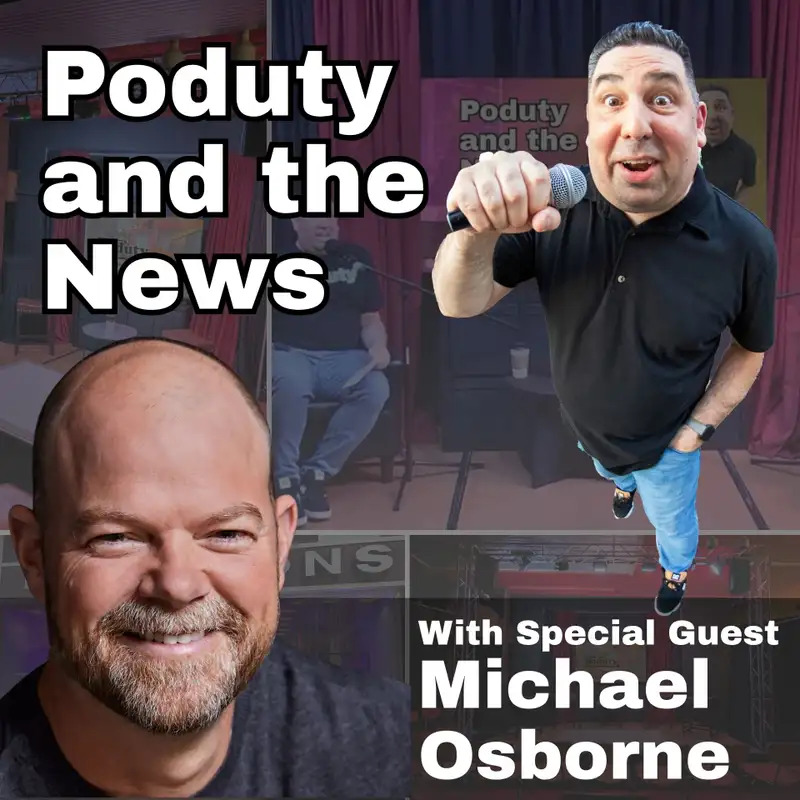
Jeff Revilla:I got frost on the car. It is freezing. But you know what's warming up? It's the Poduty Podcast Theater. We are live in Downtown Tarentum, Pennsylvania on Corbet Street at the Poduty Podcast Theater.
Jeff Revilla:I've got an incredible guest joining me for six stories about live podcasting. People doing podcasts all over the world. They're performing them live, and I've got a great expert. Gonna talk about his experience podcasting, developing podcasts on the Wondering Network, PRX for the Smithsonian Magazine from the fourteenth Street Studios. He's the host of Famous and Gravy, Michael Osborne.
Jeff Revilla:Do you know
Michael Osborne:what time it is? Jeff, it's showtime.
Jeff Revilla:Oh, the only live news podcast about Podcasting from the Stage. Michael, welcome to the show.
Michael Osborne:Jeff, thanks for having me. It's great to be here.
Jeff Revilla:Oh, I'm so excited. We have a little, you know, witty preshow banter behind the stage. I'm so excited to hear you take the stage today. Tell us... Us telling us a little bit about your experience and those things that led you to where you're at now.
Jeff Revilla:These are things and goals that a lot of podcasters are looking to achieve. And, you know, you've done podcasts with networks. You've done podcasts on your own. You've done presentations at conferences about podcasting, talking about podcasting, and and really just developing that skill set, developing, you know, what it means to get in front of a microphone, to build an audience, build a community, and and just have fun telling stories. And I've been looking at Famous and Gravy.
Jeff Revilla:And this... Tell us... This podcast is a great concept. It's one I don't think I've heard before. And I'll let you tell the concept, but, you know, it's something that I think could catch a lot of people's attention.
Michael Osborne:Yeah. Thanks. I'm really proud of Famous and Gravy. Biographies from a different point of view. On every episode, we choose a dead celebrity, and we ask, what can this life story show us about ourselves?
Michael Osborne:So it's pop culture biographies with a heavy twist of self reflection. A lot of the show is... We've gamified it, so it's all built on categories. And, you know, I've done about a 140 episodes now. David Bowie, Dolly Parton.
Michael Osborne:Oh, god. You you can go on and on. John Madden, Maya Angelou, Anthony Bourdain. So, you know, every episode is is a story, a life story, but really with this question of what lessons can we glean and and take for our... Home for ourselves.
Michael Osborne:So that's Famous and Gravy.
Jeff Revilla:And I love it. And the one you mentioned about John Madden. Yeah. John Madden lives rent free in my head. Every time I watch this new style of football where they're like, oh, should we go for two?
Jeff Revilla:And John Madden would scream, take the points, take the points, take the points. He got a chance for... I just watched the game. I think it was Sunday night. They kicked the field goal, got a penalty.
Jeff Revilla:They decided to go for the two point conversion, and then they missed it. They took the point off the board.
Michael Osborne:I am I am so with you on this. I think we've gone way too far. Whatever. It's getting told... We're getting gamified a little too much.
Michael Osborne:But I guess you asked a little bit about, you know, my experience. I've been, you know, I've been actually listening to podcasts since 2005, and I've been creating since 2010. And my big claim to fame is I've created three shows, as you mentioned, that all have resulted in major media distribution partnerships. So, you know, I work as a development producer at fourteenth Street Studios. And, basically, you know, people come to me and say, hey.
Michael Osborne:You've been able to create shows that have attracted some pretty serious, you know, partners to the table. How do you do it? And that's how I make a living largely is I consult on projects and I help people develop and grow shows.
Jeff Revilla:Yeah. It's called fourteenth Street Studios. Check out the website. I mean, you're holding two... Are those Webby Awards you're holding right there on the cover?
Michael Osborne:Yes. Thought I'd flash a little metal. Yeah. So I... That was for a project I did with Amherst College a couple years ago.
Michael Osborne:And then I've been really lucky, man, because I I came to podcasting pretty early on, you know, like, listening since 2005. That was really the very first wave. And, you know, I started making shows when I was working on a graduate degree at Stanford in earth sciences, and that led me down this career of production and storytelling ever since. And, you know, one of the commitments I have with my clients is... You know, because there's a lot of producers out there, and I think that it's not that hard to produce a podcast on the technical side.
Michael Osborne:I mean, you want good people for it. I think where there's more opportunity for producers is to really get involved and creative and say, you know, this is what I think is working. Try and develop talent, try and tell better stories, try and, you know, really surface lessons that are coming up on any given show. So that's that's basically my bread and butter. That's how I make a living.
Jeff Revilla:Yeah. It's amazing. Check it out. 14 Street Studios. We have a place on our page called The Crew.
Jeff Revilla:So we call it Poduty and The Crew, and Michael will get inducted into The Crew page. And all of his links, all the show notes, all the shows, this one and hopefully future episodes when Michael comes back, will be all listed there. So you'll be able to find his bio, all the links, his social media. So go make sure you check it out at news.poduty.com. We'll put the link to fourteenth Street Studio, we'll put the link to Famous and Gravy.
Jeff Revilla:And Michael, are you ready for our stories?
Michael Osborne:Let's do this.
Jeff Revilla:Let's do it. We got the first one. We got a little baseball coming up here. A deep dive into fandom and podcasting with the ringer's Mallory Rubin. She recently spoke with Spotify about fandom podcasting and building communities around shows.
Jeff Revilla:Ruben says podcasting creates unique intimacy between hosts and listeners and shared one of the ringer's philosophies. People may come for the topic, but they stay for the host. That's one of the things that we talk about a lot. It's about these connections, the community that you're building, the people that you're telling stories with and those stories resonate with them. I'm sure you've had some experiences where you maybe crossed paths at a conference and somebody started telling you about the show they listened to and you had no idea that it would have impacted somebody that way.
Michael Osborne:So I love this story. I love Mallory Rubin. I follow the ringer really closely. I've been a Bill Simmons guy since 2007. And I think that one of the things I often say to people who wanna start a show is, you know, every podcast, regardless of format, regardless of category, regardless of concept, you know, all great shows can be boiled down to three core qualities.
Michael Osborne:Story. You know, what is the story that's being told? What's the narrative? What's the... What are the stakes?
Michael Osborne:Who are the good guys and the bad guys? What are they up against? What is there a new resolution? Learning. What what do I...
Michael Osborne:What am I learning on a show that I did not know before? And that may be learning about, you know, smarty pants stuff like science or, you know, how to grow a business, or it may be, you know, learning about what's going on in the NFL or a movie I'd forgotten about. But I think we come to shows to be smarter. But that third thing is vibes. It's the parasocial relationship.
Michael Osborne:It's the hangout space. And I think, you know, to Mallory Rubin's point, we come for the first two, and we stay for the third. So I think, you know, one of the things hosts need to really consider is have they created a show that's bringing out their best side, that's bringing out the vibe that that people want to hang out with? Because that is so much of the value proposition of a great podcast.
Jeff Revilla:Yeah. I mean, if anybody's listening, in your introduction, you talked about producing on the creative side. And then your very first, you know, rebuttal to the story is, you know, vibes. It's the content. If...
Jeff Revilla:You know, this is why Michael is such a good producer. That first story and his first answer, go back and rewind and listen to what he just told you, that was... That's a lot of the secret of good podcasting is having a good time doing it, making the content that resonates with people and being on that creative side. Sometimes being behind the curtain and pulling those levers, you know, helps make the show better. How do you help make the host shine?
Jeff Revilla:And and Mallory shines, I'm sure has a team behind her that's, you know, pulling those levers and producing the show and and making sure that the best content goes out. So they're already off to a great start, great nuggets already. We'll go to... We'll go on to story number two. We're going on the crime side.
Jeff Revilla:We're going to a criminal turn... Criminal Turns narrative podcasting into a 13 city live show. The award winning true crime podcast Criminal is launching a North American live show called Don't Worry. Rather than simply recording the podcast in front of an audience, the production features previously unheard stories about host Phoebe Judge, her family, and experiences that influenced the creation of Criminal. Michael, when you think about this, what changes when you take carefully produced narrative audio and you put that storytelling live on stage?
Michael Osborne:It's such a great question because for me, you know, narrative shows, ones that have a lot of scripting and sound design and high production value, you know, bells and whistles, music, you know, really clever edits. So much of that is, you know, theater of the mind. And part of the reason people love that and very, very true in the crew triumph genre is that we we are lost in a story. It's as if we're... But but it's intimate because it's all in our head.
Michael Osborne:So I think the challenge from taking a a show like that that's got, you know, an immersive quality to the stage is you have to still play to people's imagination, but it's a sort of different experience if you're not just in their ears. So I think, obviously, the writing has to be good, but I I don't... You know, I think this is a a hard problem in a way. I I feel like I have seen it done effectively. I've attended shows that that are sort of narrative on on podcast, and then the live experience is different.
Michael Osborne:And I think, you know, in a way, relates to story number one that I think that is often an opportunity for the audience to spend time with the actual real person, with the actual host. Because for the most part, that's an imagined experience when you're listening virtually. But when you're in person, you know, you're... It's like, oh, it's really them. So there's this sort of heightened quality about this, you know, parasocial relationship and and the vibes.
Jeff Revilla:I came into podcasting about the same time you did, about 2005. I had a a skate shop and I was packing skateboard orders to ship all over the country. But I would listen to podcasts during that time to to get a free education, to learn more about marketing, more about podcasting, more about the things that I love. And, you know, it wasn't really until about two years ago when I opened this theater that I even figured out or learned that audio drama was a thing. I have no clue.
Jeff Revilla:And it's fascinating. We had a whole, like, a fundraiser here with four audio drama podcasts acting out their shows. And the way that they do The Folly, the way that they the sound effects and the acting and what goes into it, it is a whole different realm when you see an audio drama acted out. You may have listened to these people in your car on the way to work and you love their stories, But like Michael was saying, if you ever get the chance to see them live, go do it. It'll completely change your perspective of the show.
Jeff Revilla:It'll give you a whole new level of respect for what they're doing and performing week after week. It... It's an incredible experience.
Michael Osborne:And I think it's a really... It's a story first experience in many ways. I mean, this is the thing about podcasts and what you were talking about a second ago is some are about dialogue and conversation and back and forth, and some really are about, you know, narrative arc. So if you are going to a narrative show, you know, expect to experience a great story. I I would...
Michael Osborne:As you say, I think that they can do that in really imaginative ways. It's it's something to behold.
Jeff Revilla:Yeah. Yeah. Let's keep it moving. We got another great one coming up here from The Athletic. They add live programming to the podcast video playbook.
Jeff Revilla:The Athletic is adding more live programming to its podcast and video strategy. The sports publisher is expanding beyond traditional on demand shows with live programming built around major sporting events and its existing podcast personalities. Now I choose these stories based on my guest experience and Michael has had this great network experience. And, you know, when you get picked up by a network or maybe you decide to partner with a network, you know, what changes? What gets enhanced?
Jeff Revilla:You know, what's the difference between being independent and now you have this partner to work with?
Michael Osborne:Yeah. I mean, honestly, first thing is confidence. You know? You you feel like you've had a real stamp of approval because it is, I think, a real fantasy for a lot of people to create an independent show and then a network comes along and says, we'd like to have you, you know, join and be a part of us. So I think you're in a community, which is very exciting.
Michael Osborne:I think that it is also... You know, it's more of a... I don't wanna say industrial operation, but so much of independent podcasting, indie podcasting is scrappy. And so now I feel like what happens when you join a network is that you're really in a place to get some good step back advice about, okay, what is working and what's not. One of the things that I've become really drunk the Kool Aid on is audience research and some of the, you know, partnerships that I've been able to to be a part of.
Michael Osborne:Some of the best conversations have been, okay. Let's really dive deeper on who's listening to your show and why. Because I think the the golden rule for everybody should always be serve the audience first. And so to have a partner who can, you know, really offer some insight and some, you know, I don't know. What's the right word?
Michael Osborne:I I I guess, like, rigor to that process, I think is incredibly valuable.
Jeff Revilla:The... Oh, I had such a good point. There's a train going by right now and I lost my train. I thought the... Oh.
Michael Osborne:Can I offer another thought on the audience research point, Jeff?
Jeff Revilla:Please save me.
Michael Osborne:I'll I'll just say that I I... Like I said, I've drunk the Kool Aid on audience research. I also know how hard it is to actually engage with your audience in real life. One of the reasons I'm really impressed with your show and your message about live experiences is that you're actually getting people to connect in person. There is no substitute for that.
Michael Osborne:And so I think independent creators, regardless of the size of your audience, really need to be thinking about how can I engineer those conversations? Maybe it's a live event. Something else I've done on Famous and Gravy that's been a real unlock for me is I have a a bluff the listener quiz. It's a call in segment. And I use that segment when somebody calls in to play the bluff the listener game.
Michael Osborne:When they call in, I take a few extra minutes and talk to them a little bit like, how'd you find the show? What do you think about it? Do you have suggestions for how I can grow it? Because I think the more... What happens when you're a creator is that it's very easy to get, you know, so in love with the concept that you've not really sure what's coming across.
Michael Osborne:And I think we need other people to help us see that.
Jeff Revilla:Yeah. I think we're talking about these networks and that's where I wanted to kind of pivot a little bit is a lot of podcasters end up getting approached by by networks. And they don't know what the network is. Maybe they never heard of the network. They're like, hey.
Jeff Revilla:You should join our network. We have a network of shows. And and I think some podcasters don't ask what that is, and you've been on networks at a very high level. But there's also this other world of networks that, you know, in the independent realm that may or may not have some traction. But you also wanna look at, you know, what are you giving up to get into that network?
Jeff Revilla:What what do you what do you offer them? What does the network also offer you? Or, you know, any, like, those red flags you've ever seen with with some of these networks?
Michael Osborne:Yeah. I mean... So I have joined networks at a lot of... A couple of, you know, marquee names as well as names, like you said, that maybe you're less familiar with. I think it's...
Michael Osborne:I think that it is tempting to think, oh, when I join this network and maybe they monetize my show, all my money problems will be over. That is the hardest and most awkward question to ask is what kind of return might I expect if I were to join your network? I think that there's also a conversation about, you know, often what networks will bring to the table is cross promotion opportunities. And it's... That is something that's come with networks at all levels in my experience, but I I haven't actually...
Michael Osborne:Like, that's that's another place where you wanna hold your partner accountable, your network partner accountable, and say, exactly how many ads are going out about my show. And can you tell me are they effective? Because, you know, I've cut ads for networks I've been on, but I hadn't heard anything about it. Right? There hadn't been any kind of report out.
Michael Osborne:And so it's a little bit of a black box experience. You know, joining a network can be very good, and I think it really is a question of culture fit. It's like job or dating. You know? Just feel intuitively like the right thing.
Michael Osborne:So I think if it doesn't feel true in your heart, you know, it's really okay to say, thanks for inviting me on. I'm not sure I wanna be a part of it.
Jeff Revilla:Yeah. And that's something to look out for. It's something you wanna think about. Is this gonna benefit me as well as am I gonna benefit the network? And, you know, make sure that relationship is symbiotic.
Jeff Revilla:Make sure you're not just signing away something. There could be some networks that are predatory on on new and upcoming podcasts that lock you in, and all of a sudden, you know, you're stuck in this agreement for some period of time. So, you know, make sure it... It's a good relationship. Make sure you trust the people.
Jeff Revilla:Make sure you like the network and the people around. Don't... It it gets exciting when you start to get offers like this. Maybe brands reach out, networks reach out. You know, don't just jump on the first opportunity.
Jeff Revilla:Make sure it's the right opportunity, you know, for your goals, for your strategy, for the direction you wanna take your show.
Michael Osborne:It's well said.
Jeff Revilla:And this next one is a a story that really pulls on my heartstring. And, you know, we've seen this with Spotify opening venues. Apple is opening venues. Now in some cases, there's music centered, but this is a 600 seat theater. This could easily host some podcast, and we're seeing these traditional digital media companies open real life experiences.
Jeff Revilla:They're doing it at conferences. They're doing like... Spotify does a lot of side stages for podcasts at conferences. Apple now has a venue. Spotify has little venues that they've been popping up.
Jeff Revilla:And Keep an eye on this. This is happening more and more, and this is happening in London. There's a 600 seat theater opened by Apple. It's a 38 foot stage, professional recording studios in the back, broadcast control room, 16 cameras, live streaming capabilities. The space can also be used for Apple's radio and their own podcast productions.
Jeff Revilla:It's coming. What do you think about the the surge of of live podcasting?
Michael Osborne:I mean, I'm with you. I love that this is happening. I think that one of the most exciting things to me about podcasting, and this has really been true since the early days, is that there's just a lot of experimentation happening. And I think when creators have an opportunity to say, what would this feel like in front of a live audience? I mean, it it really is almost a whole new form of performance.
Michael Osborne:It's not exactly, you know, a traditional talk show. It's not a stand up comedy set. It may not be audio drama, or or it may not be drama like the theater. It's something totally new that we don't exactly have a name for. And I think that, you know, one of the reasons people love podcasts the way they do, one of the reasons listeners and viewers keep coming and coming is that we're all craving connection.
Michael Osborne:We're craving community. We're looking for our people. And, you know, to have a real life shared experience is the best way to, you know, find out like, oh, you're into this show too? This this is my community. It's not just an imagined thing that we're all in.
Michael Osborne:We get to actually see it together. So I am incredibly excited about this this development. And just one more point, you know, so I live in Austin, and I... I'll go to South by Southwest. It is becoming more and more a a podcast conference.
Michael Osborne:And I've I've been seeing this sort of at a lot of other conferences. I think that your point is exactly right that people are hungry for this. They really like a live taping experience.
Jeff Revilla:Yeah. A great example of conferences is I I used to joke. I'm in the automotive industry and you would go to these conferences and there would always be a panel on the main stage with four executives from the title sponsor, you know, telling us their corporate goals and their corporate direction, and the audience is just yawning 10 ways this Saturday. But what we've seen is the conference organizers recognize that, hey, that's not great entertainment just letting our sponsors have the stage for an hour. They're inviting people from the industry who have podcast to now be the entertainment at conferences.
Jeff Revilla:Whereas, you know, sometimes they're building side stages and the the the featured podcasters from that industry, they're up on that stage doing their shows live at these industry events. So, you know, keep that in mind. It it doesn't have to be just the theater space or or your show live. You can plug in to an existing event that's already happening, and I guarantee you, they're looking for shows for entertainment to entertain their guests. And a lot of times you can get passes and your travel covered just to go do your podcast live at a conference.
Jeff Revilla:And you know where else we can go? We can go to Italy where they're celebrating ten years of a podcast festival and Italy's Podcasting Festival is celebrating its tenth anniversary and this year's programming covers AI, video podcasts, branded content, business models, journalism discovery, monetization, and distribution. The event also includes live podcasts just like we were talking about, group listening sessions, sound walks, networking, and opportunities for emerging creators to pitch to their shows. And we've already talked about Michael talking at conferences and, you know, is this something you're seeing at conferences when you go? Do you see these side stages or these meet and greets with creators in the industry?
Michael Osborne:Yeah. Absolutely. And I mean, you know, when I... I'll usually go to podcast specific conferences that they're kind of one of two camps. They're often about the business side of things or they're often about the craft and, you know, good storytelling, good editing, how to put together a good team.
Michael Osborne:Personally, I tend to get a lot more out of the conversations around craft. I'm just sort of obsessed with story mechanics and how people, you know, approach approach concept development and approach episode to episode. I will say though, this is this is... It's not coincidental. All of the media partnerships that I've been able to attract all resulted from attending conferences with...
Michael Osborne:From meeting people who are just tabling and getting to know them a little bit. I would say that, you know, to to say another word about that, with all of my shows, I never really pitched through the front door. It was always sort of side door, back door conversations that eventually got the attention of the decision makers within the media institutions who then said, oh, we've got a good show here and we'd like to get behind, you know, this project. So I think conferences are critical. I think, you know, sometimes networking can feel like a little bit of a sleazy term.
Michael Osborne:It shouldn't. You know, you're you're going and finding like minded people, your friends. And one thing I love about podcasting is just got the best people. Like, the culture of podcasting is and has always been, you know, a a rising tide lifts all ships kind of space, which, you know, it's very supportive that way. I'm really...
Michael Osborne:I feel lucky to be working in this industry.
Jeff Revilla:And I say a lot of podcasters feel safe in their home studios, their home spaces, their home offices. And maybe they'll send off an email and and hoping to make a connection or an outreach. But like Michael was saying, nothing can replace being in a room with somebody, shaking their hand, face to face, having a conversation. And look what Michael was saying about where did those conversations lead to. They opened the doors.
Jeff Revilla:They were... Maybe there wasn't the... Maybe the person that you met wasn't perfect for your business or didn't fit, but maybe they recommended you. Like, oh, I met that guy and he does that thing. Oh, you should get in you should get in contact with this guy.
Jeff Revilla:And you don't get that staying at home recording your podcast. You get that by going out. You're... You know, the business community probably has meetups in your area. There's probably podcast meetups in your area.
Jeff Revilla:There are all kinds of different things happening that you can go attend and make those connections. Yeah. Maybe it's a... Like, authors come to town a lot and to release their book. Maybe the book is about what you talk about on your podcast.
Jeff Revilla:Well, guess who's in that audience? People who also like what you talk about on your podcast. So, you know, go introduce yourself and say, oh, yeah. I do a podcast about murder mystery. And and those are the ways that you grow.
Jeff Revilla:The the ways that you level up in this industry are by shaking hands, saying hi, you know, collecting business cards. It makes a huge difference long term.
Michael Osborne:I have a friend who has a rule where he says, I try and collect at least one new listener a day, and you have to get out on the street to do that, you know, and get to... You you do that over the course of a year and you got 365 listeners.
Jeff Revilla:That's pretty good. That's what... I like... I'm just... Even if it's just the mindset of I just wanna introduce my show to one person a day, I love that.
Jeff Revilla:I think that's that's a great goal, especially for starting out. Just, hey, who can I share this with today? And I warned you, it goes fast. We're on our last story already, and I love this one. From Nigeria, more than 3,000 attendees and over 50 storytellers attended the second annual festival for Podfest, and I don't know if I'm...
Jeff Revilla:Nyjah was over 3,000 attendees. The event included live podcast recordings, creator conversations, monetization master classes, and discussions covering culture, money, health, relationships, and public life. Organizers described the event as a festival of stories and just another story that I love, seeing the live element, seeing podcasting, getting out in front of people, and in this case, in front of 3,000 people.
Michael Osborne:Hey. Well, and in Nigeria, you know, like, I love... I think that I'd love this story because it's such a mark of how big podcasting is. You know, I don't know if people have ever submitted to the Apple feature request. That can, you know, be very a nice catalyst for growing your show if you get a feature request approved.
Michael Osborne:But one thing on their form is they'll say choose a country. And most people are like, well, I'm in America. I'll choose to pitch in The United States. I think that there is so much more opportunity internationally than we realize. I think that the other thing that this particular story tells me is that...
Michael Osborne:Like, I really do believe podcasting is is the storytelling medium of our time. I think that you, you know, could make a case that the storytelling medium of the twentieth century was largely film or largely on maybe TV. And I think, you know, podcasting has become the main way in which we, you know, disseminate long form stories in so many ways. And I I don't know exactly how you'd back that claim up. I'm not just talking sales or audience, but I I do think that people are finding ways to share their stories and everywhere.
Michael Osborne:And and so to see such a successful event in, you know, a part of the world that I I know very little about was really exciting.
Jeff Revilla:Yeah. 50 storytellers, the 3,000 people, what a ratio. You know, if you wanna get your show in front of people and and be there with other storytellers, people who love the medium, love the spoken word, love getting together with other people when hearing these stories, these are the types of events you wanna try to find where your podcast fits in. Even if you go as an attendee the first year, maybe a volunteer the second year, that opens doors for you. That makes those connections that enable you to maybe get a side stage or maybe perform at a sponsor booth, you know, on the on the trade floor because you got out there and did it.
Jeff Revilla:And you have to do that. And that's... I really think this is the direction that podcasting is going. We're going from, you know, strictly digital to this digital with connections.
Michael Osborne:Like Yeah. It's
Jeff Revilla:enhanced with IRL enhancements, you know, in real life, getting out, you know, shaking those hands, high fiving, you know, going to the after parties at the conferences. That... That's where these connections get made.
Michael Osborne:I think it's really well said, Jeff, and I totally agree. I mean, I... You know, what a podcast is, however we define it, whether it's audio and video, narrative, chat show, what we're doing is creating experiences. And what I hear from you that I think is a... Just really powerful and important message is that once that experience is out there, we need to make ourselves available to connect with people.
Michael Osborne:You know? And it and it really is a in real life, know, mandate. I I wish I could be there in person because it feels weird to say this on a screen, but I'm with you, man. I'm with you.
Jeff Revilla:People ask me, like, what do I like about podcasting the most? And it's... It can be anything you want it to be. Is a blank slate. It is a blank canvas.
Jeff Revilla:You come to it with your idea. You come to it and you bring your idea to life. And, you know, over the course of the years, I've talked about this infinite sea theater. Because of that, because of podcasting, because of this idea of how far can you push it, I'm sitting inside of a theater that can... That theoretically has the same capacity as Madison Square Garden.
Jeff Revilla:That's that's my that's my title. Yeah. This little 40 seat theater is something special. It's something where podcasters come in and perform their show live. And when you start seeing podcasts live, when you when you get out there, when you get out from behind the microphone in your home studio and you go see an event, you go support a local creator, I promise you, it'll change the the way that you've completely thought about podcasting for the last ten years, and it'll open up your mind in a way that you just aren't getting right now, and you will grow to a new level.
Jeff Revilla:You will enjoy podcasting on a whole new way, and you you get to see how the sausage is made too. That's one of the things I think you hinted on a little bit is when you're in that audience and you see that podcast getting made, you may have only heard their voices in your earbuds before, but when you see them reacting on stage, interacting with the crowd, it changes something. And it's it's such a beautiful moment to see that podcast being performed live. And it's the only time in the history of the world where that one performance will be done. So it's a once in a lifetime opportunity to see that show live and just go try it.
Jeff Revilla:Go try live podcasting. That's my... That's me from the pulpit today.
Michael Osborne:Well said. Very well said.
Jeff Revilla:Michael, this has been a blast. Thank you so much for joining me. The one thing I do before we say goodbye is I turn the floor completely over to you. You can plug, promote, talk about anything you'd like. Michael, the floor is yours.
Michael Osborne:Well, I would love for people to give Famous and Gravy a chance. It is a show that I'm proud of because I hope it's fun. I hope it's introspective. I hope it's smart, but I also am using it as a case study. I really wanna open the kimono and make this show available for creators to to study how, you know, how it's put together.
Michael Osborne:A lot of thought has gone into it. It's had a lot of success that I'm very proud of. I think it's original. I think it's novel, but it's also meant to be something that we can all learn from. Because as I said earlier, I think that this is a community where the rising tide lifts all ships.
Michael Osborne:If you wanted to check out some good episodes, the ones I mentioned earlier are awfully good. Very proud of David Bowie, Anthony Bourdain. I don't know about the John Madden one. Fred Rogers is very good. So famous engraving.
Michael Osborne:And then if you're interested in developing a show and you wanna have a conversation, I'm a very relational kind of producer. So you can find me at fourteenthstreetstudios.com.
Jeff Revilla:Oh, Fred Rogers. We're a Western Pennsylvania theater, so we gotta get the Fred Rogers one. But I already planned John Madden for my morning commute, so we'll see how
Michael Osborne:my day goes tomorrow. Also, George Romero, once upon a time, who's also a Pittsburgh figure. Yeah. And and there's one other. I'd love Pittsburgh, by way.
Michael Osborne:I think
Jeff Revilla:Arnold Palmer is the trifecta.
Michael Osborne:We're thinking we're thinking of... Actually, his name has come up. We very well... We're probably due for an Arnold Palmer episode.
Jeff Revilla:Well, do you remember what time it was?
Michael Osborne:It was showtime. It still is. Well, no. Not anymore.