I got that song in my head. It's a different song,
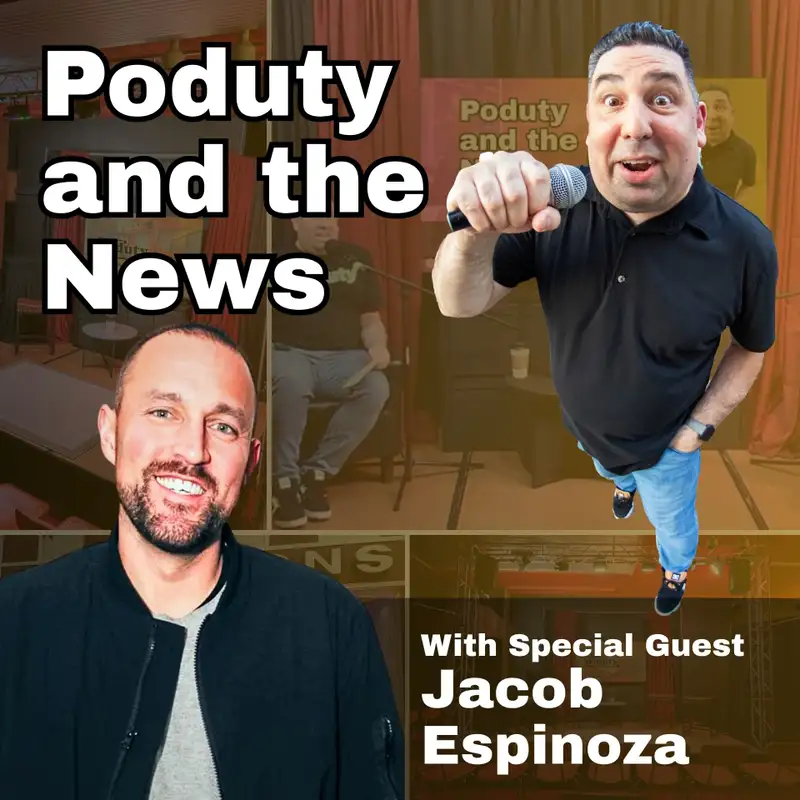
but anyway. Hey, everybody. Welcome to Poduty and the News for Tuesday, April 21,
2026. I'm Jeff Revilla, your host. We've got six
stories about live news podcasting headed your way.
I've got Jacob Espinoza joining me. Local social club.
What's happening in Salem? Jacob, do you know what time it is?
It's time for the news. What time is.
What time is it?
The only live news podcast about
podcasting from the st.
The only live news part podcast about
podcasting from the stage.
Oh, the only live news podcast about podcasting from the stage.
Jacob Espinoza, welcome to the show. Thank you for having me,
man. This is pretty cool. Oh, thank you. Thank you. So excited to have you
here. Been looking at some of the things you did. You have built something really
incredible with what's happened in Salem and the local social club.
Tell us a little bit about, you know, how did you get started? What was
your interest in. In creating these networks of bringing people together?
Yeah, I mean, I think you're. You're seeing it a lot with what you're doing,
but there's just a shift in media right now. People don't really
subscribe to newspapers anymore. They aren't listening to
radio, and they don't want to pay for news at
any level. In majority, I think the data shows, like, 14% of people
are willing to pay for news at all. So you have 86% of
your population who's just completely uninformed, unless you have
someone in your town who's stepping up and providing information on social
media or doing a free newsletter or. Or a live podcast.
Was that something that you were early to. Because I've seen that model now. You
know, it seems to be something common. And the way that you build it up,
the way that you're talking about Salem and bringing that core news
product together and becoming that media center in the town.
When did you get started doing all that? So it's been almost two
years, which is wild. Wild to say, but, yeah, we saw
growth quick. I mean, I think the first three, four months, we're at 20,000 followers.
We have 180,000 people in our city, for context. So huge
market saturation. We're at 42,000 followers on
Instagram, Facebook. We're like 15 TikTok, we're at
6, and we're still growing over there. But huge, huge
potential for the. For this type of a product and for people
to make a living, to market their Business,
whatever it might be, when you become the go to person in your community,
there's. There's lots of advantages there. Yeah, it's a great way to
become that pillar. And then from that you can branch off all these
other avenues, these events, advertising,
promoting other businesses. There's. There's a myriad of things that you
can do and anything that really surprised you, you know, once you started
a business like this, once you started becoming the media of the town,
it's just been fun how supportive it's been. I mean, we definitely try to keep
things very positive. We highlight the positive things that are happening in our
community. We really live off the motto that the things that are recognized
are repeated. So people that are taking chances, making things happen in Salem,
we want to make sure that we can shine a light on them and
just. Just been a lot of fun. I think that's been the. It really has
been a blessing as well. I think whenever you're putting yourself out there on the
Internet, building an audience, you never quite know the opportunities that
are going to present themselves. And I'm just, just being
grateful to build great relationships and make some cool things happen in Salem.
Yeah. Which I think makes you a perfect guest for what we do on this
show where we talk about bringing people together for social
events, for podcasting events and performing shows live.
You're seeing that happen on a local level. And you also are the
founder of Local Social Club. And tell us a little bit about that. How can
people connect with you and learn more about local Social Club? Yeah. In
local Social Club, we are helping other content creators
start local Instagram channels and monetize.
We have a lot of people who start started a month ago and are already
getting their first brand deals, finding ways to find sponsors,
helping people understand what type of content to create that is most engaging.
And the nice thing about it is I have a community of people who are
all trying different things. And when something works, we're quick to share it with
the rest of the group. And things that work in one city generally work pretty
well in another. So we're all doing a good job helping each other grow,
challenging each other. And it's exciting helping
people one just build great relationships, supporting their communities. We're in
a time where people are extremely isolated and lonely, and a
big part of that is we just don't know what's happening in our city. We
used to have, you know, 40 people in Salem working at our local
newspaper. That was probably 25 years ago, but at this point,
it's pretty Stripped down. We've got like five reporters and there's 180,000
people in our community. So it's just not enough people to really
tell all of the stories and share the news that's happening. So we want to
provide people, we want to help people to understand the businesses they can support, the
nonprofits they can support, and the events that are out there so they have a
chance to get out and meet people in Salem. And I love
being lean and mean and being able to scale on your own
terms and grow the business the way that you want to grow it without having
to answer to some other conglomerate, without having
to worry about all this other structure.
You're really in control. You're creating something that's a unique piece of media
for your local community and really sharing that and investing in the
community and letting the community shine on its own.
Yes, that is it. We are just kind of being the spotlight, the megaphone of
good things that are happening. And we're putting events on as well. You know, I
think one of the advantages of being a local content creator is that it's
really easy to engage with your audience and,
you know, in person events. There's a huge need for it right now.
Yeah, you're speaking our language because we are about live events.
This is what we're going to talk about over these next six stories and the
best way people want to connect with you. Find out more about local social club.
Where do you usually send people? Yeah, the
JacobSpinoza.com is a great place to go. You can
schedule a call right there as a link on the page. You can use a
schedule a call and love to learn more about what you're working on and, you
know, see if it's a good fit for us to support you. Awesome. All those
links will be in the show notes. We have a crew page, too, where anybody
who's been on the show gets inducted into the Poduty and the Crew. And
you'll find all the links for all my guests, all future episodes that they
come on. Jacob, you're welcome to come back in the future and do
other shows. All those links will be there, attached to your account, to your profile
there. And anybody that wants to see it and connect with you later on, check
it out at news.poduty.com Jacob, are you
ready for our stories? We're ready. Let's dig in. We got the
first one and people love when I pick stories of places that I can't
pronounce. So this one's from the Romania Insider and
And I'm going to guess on this one. The Souffle de Romania Festival
returns the April 25th and 26th, and it's
designed to recreate the feel of a traditional Roman
Romanian village. You've got artisan workshops, folk dances,
local food, and live performances from artists like Thea
Rose and Damian Dragici. It's free to
attend, open to the public, and expected to be their biggest year
yet. But layer into all of this is a live
podcast recording featuring a writer and a journalist
happening right alongside the festival experience. This is where
live podcasting fits in perfectly. The audience is already there,
the energy is already built. The podcast isn't trying to pull people
in. It becomes part of something people are already
excited to attend. And we see this time and time again
anymore, especially in 2026, where, where when you go to
event, they used to have magicians and musicians and
comedians as part of the entertainment. But more and
more you're seeing podcasting creeping in, storytelling
creeping in these panels where you used to go to a conference and see a
panel of four people just talk about something. Well, they're switching that
out with podcasts now. And here's an example of a festival in
Romania where part of the entertainment for the crowd
is a live podcast. And this is where I really see the future of
podcasting going, is those real life experience, like with
Jacob's building, with what's Happening Salem. You're showcasing all
those events in the city. Well, these types of events are happening at
festivals, conferences, and here's one happening in Romania.
Yeah, I think you have the right people that bring the right personality to it
and it can add an element. I think
we'll see a lot of this type of a hybrid approach. Right, where you can
visit the event, but you also have the online version for people that can't
make it as a way to create some of that fomo. But I think it
does take the right personality, somebody that's going to be entertaining enough and
engaging enough to get people's attention and then keep
people's attention. Because as we both know, attention spans are pretty short.
And, you know, you don't know when someone's going to enjoy that live,
but you want to give them reasons to stick around. And, you
know, not only that, but share it with their friends as well. Yeah, we often
see even like side events or sub events within an event
or side stages having podcasts as part of it
too. So look around when you're going out to conferences and
festivals and even music festivals now, there are
side stages Doing podcasts and interviewing the music act. So
podcasting is happening everywhere. And if you're interested in
a certain topic or a certain industry, there's probably an event
based around what you're already talking about. You know, use that podcast to
open the doors and get in, maybe get a free pass, maybe record your
show there and interview some industry experts. I really think live events
are really the future for podcasting. And I think that another angle
is just helping the event organizers understand the added
benefit that this provides to their sponsors, where you can kind of create
it as part of the sponsorship package that you'll have a chance to be
featured on this live podcast that's going to be happening at the event.
You can take the clips and share them on social. So it's not just the
exposure at the event, but it's in a lot of the conversation that's happening in
the media created afterwards as well, where they will get that
benefit. Yeah, that's a great way to sell it and even build
momentum towards the next year. You build on that, capture some
of the things that happened that year and use that to promote for the following
year. Use it on your podcast. Use it for. Let the conference.
Use it the end of the event. Use it to promote. That's a win win
all around. You're going to build your podcast in front of a new audience
and in the same time, you're going to help that event build an audience for
next year. Absolutely. We'll go to
story number two from Pod Biz. This comes to us from the Pod Biz
YouTube channel. Jeremy Ems from the Podcast
Marketing Academy. Shared perspective that a lot of people in
podcasting don't talk about. He says the biggest money in podcasting
may not be ads or sponsorships. It's the revenue that never gets
tracked at all. He's talked about small niche shows
that might not have big audiences, but they're driving real business
results behind the scenes. Six and seven figure businesses
built with podcasts that most people have never heard of.
This connects directly to live podcasting. Live
events, live meetups and conferences don't show up in download numbers
either, but they drive real revenue. Ticket sales,
sales, partnerships, relationships, all happened
outside those traditional podcast metrics. And you
hear people talk about my download numbers and you
know how many listens I had. But there are so many other elements, and
you mentioned one already. Jacob, you mentioned packaging up something
as part of a bigger package. If you have a podcast, well, maybe
you have a website. You could sell banner ads. Maybe you're building an Email
list. You could package, you know, a banner, an email list and
your podcast, and that's not going to show up in the download numbers. But
that's a real way for a small podcast to drive real
revenue. Yeah, I think you become the go to voice in
a niche and there's so many different ways to monetize. I feel like podcasts
are just a great way to develop trust with your audience. And
depending on what your, your, your business is,
it's going to kind of decide how much growth potential, how hard it is is
going to be to, to make money. If you're creating content that is in
an industry where people have exposable income or
a will add on or is a industry that will add,
you know, add on to a business's bottom line, you can charge a lot
for that service. So I think a lot of it does kind of depend. I
think if you're doing a lifestyle podcast, it's probably a little bit more challenging to
monetize because people are listening to you for entertainment, but they're not, probably not
listening to you as far as making purchasing decisions. So in that sort of a
world, you're probably, you know, having to grow your audience pretty big. But if you
are, you know, if you have a hundred people who are purchasers at
an organization listening to your podcast, it doesn't
matter that it's only 100, because those are the right hundred people who are listening
and trust you when they're making a decision to buy.
Yeah, we hear so much about this show, drove so many
downloads and drove so many dollars in ad revenue, and that's typically
the watermark that everybody's comparing against. But all the things that
Jacob's mentioning, all the things that we've already talked about with live ticket
sales of merchandise, I'm wearing DJ sky shirt
right now. You have email lists, you have banner ads,
you have all these other ways that really don't get discussed in
what a podcast business is. And the things that Jacob's building with
what's happening Salem, all those little income streams from
one website, people are recreating that with their podcast. It, it is
a media asset that you own and create and control. And you're building
a community and an audience that businesses and
advertisers, they want to tap into that and really connect with your audience.
Yeah, I've really become the voice of Salem. And this is not me saying, this
is what people are telling me. And even though my
size, you know, 40,000 followers is
a fraction of what some of my friends might have in different industries, but
it's consolidated to a specific geographic location. And so if
you're trying to reach people in Salem, Oregon or the surrounding areas
and you want to reach people on Instagram,
I'm going to be the best option for you because currently we have the most
attention know on that platform then with our, our newsletter as
well. So a lot of it is just making sure you're c creating
content that is curated for a specific audience because
it's going to be a lot easier to monetize if you know who you're speaking
to and you know who you're. Who's listening. Yeah, I mean once you build that
up, you know, you can, you can sell posts, you can
sell, you know, sponsorship packages on your website. You have all these
other ways that isn't just what's happening Salem, the content,
but there's all these other connections that you're building through gaining
the trust of that audience for having them come back, for having them trust
you and follow you. You've built a real tangible asset
that you can responsibly monetize. You don't just want to exploit
it and just sell to the highest bidder, but you can definitely
curate and cultivate an audience of raving fans. I
think the other side of that is that we all care about our downloads and
it is a signal of growth, but it's not necessarily the most important or definitely
not the only. Yeah, it's just one. And I think that
there's so many other elements and I think a lot of podcasters just get
focused on that download number but really open your mind, start
to think about what can this really be? It could be much more than just
recording an MP3 file in your home studio and delivering it
to an audience. You can make something so much greater,
100%. Let's keep speaking of making it greater.
I also love stories where traditional media really
embraces new media. And this comes to us from Flamborough. Today,
the CBC is making a big investment in local media in
Hamilton, Ontario with plans to launch a live
weekday morning audio show along with a new weekly
podcast called this is Hamilton. The live show
will feature community interviews, local news, traffic, weather,
real time updates and it'll be available across radio apps and
digital platforms. This is a part of a bigger strategy to build
stronger connections with communities by telling more
local stories. Even at a national level, they're leaning into
live, local and consistent programming. It's not just about
publishing episodes anymore. It's about showing up every day,
being part of the Community and creating content people
rely on. And you can almost imagine why I chose
this story for this episode. Jacob. Yeah. I wonder how
their approach is going to be different than like a traditional, like
TV morning show or radio. Because I feel like a lot of times a
brand will be like, hey, this used to work on the radio. Let's now turn
it into a podcast. And I feel like that never works for
anybody. I feel like you do have to really think about, okay, how
what type of content are people engaging with now? How are
they engaging and figure out a new way to tell
the. The similar stories. I feel like sometimes people try to take the same vehicle
and put it on a different track and it doesn't work. You have to have
the vehicle that's going to work. You can't put a train on a. On a
freeway. It's not going to run right. You gotta. What's the car that's gonna work
on that? Um. And yeah, so it'll be interesting to see
how that comes together. I do love just any new approach to
local news and somebody that wants to innovate and share it. It's just
so much is just the talent behind it. Like, you have to have the right
person that's going to be the. The personality that's going to carry this forward
or it's going to fall flat. It's going to be a lot of production and
nobody's going to watch it. Yeah. While it is a distribution
channel, that doesn't mean it's the right channel for the media. If you've been doing
it for live television or live radio for all
these years, it doesn't necessarily mean you're going to find an audience right away. You've
got to learn how to mold that and craft it so that it is
relevant to a podcast audience. You want to make it so that people want to
tune in and see it anytime. Not just I
missed the live show, I guess I can catch it on the podcast. So
you're right. Like the right train on the wrong tracks.
That could be very something that happens in this situation.
But it looks like they do have some investment into it. They are very local
focused too, which I liked. I thought that was kind of parallel to what you've
been building. Yes. And just to see, like, where can you take this?
How can you build more of these local, you know,
local media companies and see where it goes? CBC is obviously a
large entertainment or media conglomerate in Canada,
but to be able to pull this off at a local level, that's. That's A
new twist. Yeah, I would, I'd be interested to
see, like, because I feel like all of these companies are eventually. And
it's starting to happen already. Like, I've noticed in my area, a lot of the
local reporters now have their own social media
channels. And I'm. I don't think it's a coincidence.
I'm sure there's direction that's, you know, encouraging people to take this.
And so it's, I think right now, like we're seeing
the window closing for somebody to just pick up their phone and
become the voice of their community. Because you're starting to see people like CBC
invest in, you know, a local podcast. You're starting to see a lot of
the legacy media companies invest in having their brand
more present on social and individual creators in their brand
investing on social. So eventually they'll figure
it out. I think there's still a Runway where they're going to start it and
they're going to be really bad at it because they've never done it before. So
there still is chance, there still is the opportunity for people to jump in and
become the voice in their community. But this is just a signal. The window is
definitely closing. Yeah. I often wonder when I see the local
media personality get on social media how much of it
is they really want to do that and how much of it is their manager
is either shopping them around for a new job or they want to get 10%
of some of that YouTube AdSense money. Yeah, they're trying to figure it out. Right.
They're seeing people are making money on Instagram, the attention is there and
they're starting to realize, like, we need to make this change. It's a matter of
survival at this point for us. Yeah, let's keep it going.
Speaking of survival, sci fi, we're going to some sci fi
authors from this comes to us from Fun Cheap San Francisco.
And this free event at the San Francisco Public Library on April
26 brings together SCI fi authors Samantha
Mills and Justin Feinstein for a live reading
audience, Q and A and book signing. It runs from 3 to
5pm Is open to the public with books available for sale and time
built for people to connect after the event. But here's the layer
that matters the most for us. The entire conversation is
being recorded as a live podcast by Soma FM
for later distribution. This is the perfect example of how
content is being captured inside experiences that already exist.
The event is the draw. The podcast is the extension.
And now that moment doesn't just happen once in A room and it lives
on and reaches a larger audience after the fact.
I feel like Sci Fi fans are the perfect audience for
podcasts because they have longer attention spans than most
people. Right? Like they're gonna dig deep into a topic they
probably want to listen to. Like you remember DVDs used to have the
extra cuts where you have like the directors interviews and they would like break down
different scenes in the movie. I feel like you
don't. People don't have the attention span for that type of stuff anymore. Like you
just, you. Nobody wants to watch like the director's cut of a 30 second Instagram
reel that went viral. Maybe, maybe they do, I don't know. But
I feel like the Sci Fi audience, they have this built in attention span where
they probably want to dig deeper and there's probably lots of fun ways for
podcasts to explore that sort of love. All those little
behind the scenes stories. What happened in the making of. Or
you know, the original version of this, the alien was green, but they made them
blue and post production that. All that little, all those little things they get
immersed in and they really dive in. And you're right. An event like this
where you're, you're meeting the author, you're hearing the behind the scenes stories, like,
how did that character come about? All those things I think really do
play well into a Sci Fi audience. I think the big advantage here
for a podcaster is a chance to expand your network
where you might see this event that's coming up and they have this panel of
speakers and there's three people on that panel that you want to build relationships with,
but you don't already. Like, what a cool opportunity to present this
idea to the event organizer. Where, hey, I want to do this
podcast on the side. It's a good added value for
the forum or the people that are on the panel rather, where they have the
chance to also have this content that lives beyond the local
event. But you have the chance to kind of spearhead that and,
and be the face of that podcast and a chance to build some potentially
meaningful relationships. Because in that conversation, not
only are you getting to know that person, but they're getting to know you and
they can start understanding your value, your
experience and your goals in some capacity. And
sometimes there's an opportunity for that person to see, like, hey, this is somebody I
kind of actually want to want to work with more in the future.
Yeah, great way. Especially authors and bookstores. A great way to expand
your audience. Even if you're, you're not familiar with
that author, but you, you visit that bookstore a lot,
you maybe grab a coffee, you pick up new releases and then they, you hear
they're having an event. Just being a lover of books, a
lover of stories that could draw you into this recording and that
podcast and just really open your mind, you know, give you a new
perspective, a new form of entertainment. Yep.
Speaking of entertainment, we're going to go to a podcast where
the tickets are $1795. This is a
conference, a law conference. It's called Human X
2026 in San Francisco is a high level AI
conference with tickets priced at over $2,000,
bringing together more than 6,500 leaders, founders and
investors. And right in the middle of the event, there's a live
podcast being recorded on the floor featuring
ToberLife AI CEO David Schulhoff.
It's a quick 10 minute conversation capturing insights in real time
while the event is happening. But here's the angle. For podcasters,
if a ticket like this feels out of reach, this is your way in.
Events like this need content. They need distribution. They need
ways to extend their reach beyond the room. Your podcast
can be that vehicle. You can show up as media, offer to
record sessions, interview speakers, or create recap content
for the organizers. Instead of paying to attend, you
position yourself as part of the experience. That's the shift. Your
podcast isn't just content, it's access. And
that's, you know, most podcasters will scoff at a seventeen
hundred dollar ticket, but I want to show
podcasters that what you're building has value. And you will see
that events like this, maybe not 1700, but there are plenty of
607, $800 conferences that would love
to have more things happening at. It would love to
share your resources, your assets, your
love for creating media. And that really shows you
that your podcast of what you're creating has value. And I think a lot
of podcasters just kind of record and distribute and then
do it again and don't really think much of it. But when you start
to position yourself in areas where the thing is already
happening that you're already talking about, you can really fit
in there and you'll really see how much value you're creating if
they offer you a free ticket, you know, here's a comp ticket, come on down,
record like, oh my goodness, what I'm creating has a $600
value. That's pretty incredible. And yeah, I think sometimes it's
easy to forget when this, this thing that you're creating. You're also
Developing all of these skills that are extremely valuable. So you
might be looking at your podcast download numbers, and, man, I've been doing this for
a year, and, like, I'm only here, like, why am I not. Why am I
not bigger? And sometimes you can fall into that comparison trap, but you're forgetting
all the relationships that you formed. You're forgetting how much better
of a podcast host you have become. And sometimes it's just
shift. Shifting it a little bit and thinking, okay, what are other ways I can
use these skills? And this is a great advantage of that, right?
Becoming the go to podcast person in a specific industry
where this industry knows, like, hey, we got this event coming
up. This person set up the podcast last time. They did a great
job. The guests loved it, the sponsors loved it. Let's bring them back. And
now maybe the first time around, it's a free ticket, but next time, okay, now
I'm going to charge for it because they've seen the value I bring. They understand
I'm going to deliver. I'm somebody that's talented, but also reliable.
And now you can start monetizing it in that way in addition to getting the
free access. But I think sometimes free access is a great first step that a
lot of creators overlook because they. They do want to
be paid. And we all should, right? We have. If we're creating valuable things, like,
we should be able to monetize that. But sometimes doing that free
work or work in exchange for a trade is a great way for us to
demonstrate our value to a new audience and build new and meaningful
relationships. Exactly. And that's what I loved about that. And
that angle of, here's something I've been creating. I've been working on,
you know, hours of my life every week just to put out this
show. And then all of a sudden, you get validated by being
invited to an event or a conference in exchange for a
ticket. Like, hey, you come do what you do. We're going to give you a
pass. And, you know, that instantly shows that what you're building
is value. What you're building has value. And I just love that idea
for podcasters to have that perspective instead of just like, I got to
do this thing for free for everybody forever. But you'll see
in different ways. There's so many different ways to monetize. And just that little
switch of, oh, my goodness, I got a free ticket, I got an invitation to
a conference. They want me to be there. That's
such an accomplishment that most people,
95% of the people in that conference do not get that invitation.
Absolutely. Well, Jacob, this goes
so fast. We're on our last story already and
it's one that I missed. I'm going to file this under a podcast that I
missed. And it's unfortunate because it was free and it had snacks,
which are my two favorite things. This comes to us from the stories we
missed department. Jersey's Best Podcast celebrated its one
year anniversary with its first ever live show on March
25th at Pet Shop in Jersey City.
It was a free event, no tickets required, and it featured a full
live episode with special guests, interactive segments,
trivia, giveaways, merch drink specials, ice cream and
birthday cake. These types of events are happening
everywhere, and this is the level most podcasters can actually
operate at. Local venues, small crowds,
interactive formats, multiple ways to engage and monetize.
This opportunity isn't waiting for permission to press or
press coverage. It's already happening. And I think
that's the number one takeaway from this show today.
What Jacob's building on, what's happening, Salem? All these
six events, I mean, the takeaway is local, is
dominant right now. You can take your show into your community
and do something, give back, perform,
entertain your local community
and you can just do things. You have an idea. You don't need to wait
for someone's permission. You can just make it happen. We're doing an
award show on May 1st, and it's our third award show.
And it was an idea. We want
to recognize people that are making great things happen. There are
a lot of award shows that kind of recognize the legacy people who have been
doing things for, you know, 15, 20 years. But we didn't
really have anything that was recognizing the people that are just getting started, bringing
community together. And so we found a gap and we
filled it. You know, we didn't ask anybody, we didn't ask the city permission,
we didn't ask any legacy organizations. We just said, hey, we're going to make this
happen. What are the pieces that are needed to making a word show happen?
And something that I love about their approach for the
event. And the article is it's a demonstration of how simple it is
to bring people together. I mean, all you really need is a location,
something to eat, something to drink, and then start inviting people to
come. And right now there is such a need. I actually wrote a book
called How Parties will Save the World because I believe
that this is true. We need people who are organizing, getting
people in the space together and allowing for authentic,
meaningful conversations to happen. Whether it's a park podcast
or just a room, I mean, it literally can be that easy.
But when you have a platform like a podcast or a social media channel,
it just becomes your megaphone where you can amplify that these events are
happening, but also recap like, hey, this just happened. Here's
what was the outcome. We would love to have you at the next one.
So media can play a very important role in bringing people together and
bringing communities together all across. I'm in the Rust Belt in
Pittsburgh, Pennsylvania. There is town after town that has
old downtown areas. A lot of them are boarded up.
And I really believe that what you're talking about, local
events, local podcasts, these types of things can
start to fill those vacant businesses again in your small town.
You can start a little event center, have a little podcast place, a little
way to just bring community together and start being the center of
the community. Start being a meetup place, give a place
for people to get out of the house, come on down, talk to their
neighbors, and have entertainment. Maybe one night you have folk music,
one night you have a podcast, but you're doing something and becoming
a pillar in the community, and that's exactly what Jacob's building, and
I just love that. And it's the perfect fit for what we're trying to build
here with podcasting. And, Jacob, thank you so much for being
here tonight. This has been a lot of fun. A lot of nuggets
you dropped tonight. I appreciate it, man. Thank you so much for having me.
I love what you're doing and anything that's supporting the.
The independent creator and creating local media, I'm a fan of.
So appreciate you. Awesome. And this is the part of the show where I
turn the whole stage over, I get off the stage and I give
you the entire floor to talk about, plug, promote, anything you'd like to talk
about. Jacob, the floor is yours. Well, I'll keep this
as as short and sweet as possible, but we started the
local social club about man, what is like five months ago.
And we have 35 content creators who are all building
local platforms, monetizing, bringing the community together,
becoming the voice of their city, and we'd love to have you in it.
Jacobspinoza.com you can book a call to learn more. It's the local
social club. We're on the school platform if you want to find us that way
as well. But really appreciate you for having me. Look forward to
connecting with a few new faces. Potentially awesome.
Jacob, this has been a blast. I'll put all those links in the show notes,
check them out. Connect with Jacob. If you love what he's building, see
how you can. How can you do that in your community? It's what he's teaching.
Build these small community portals and you'll be
the number one person in town. That's the way to do it. That's how we
do it. Do you remember what time it was? It was time
for the news, I think is what it is. What time is it?
What time is it?
News. The only live
news podcast about podcasting from the
st.
The only live news podcast about
podcasting from the st.