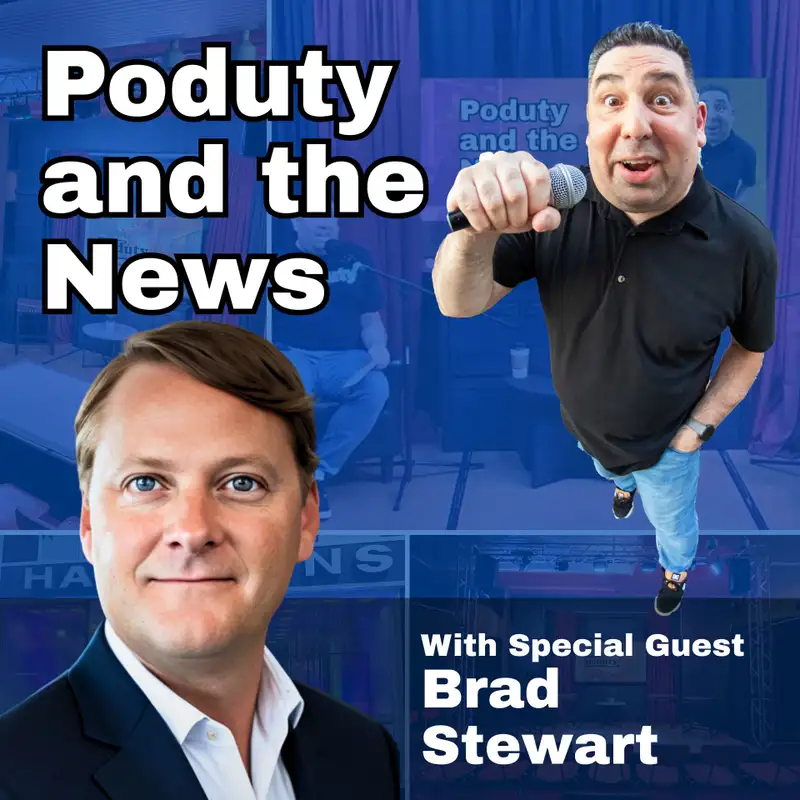
Hey everybody. Welcome to Poduty and the News for Tuesday, April 14, 2026.
We are Downtown Tarentum at the Poduty Live Podcast
Theater. I'm Jeff Revilla. I'm your host. We've got six
stories about live podcasting coming to you live. I
got Brad Stewart joining me. Music Mogul AI Brad.
Do you know what time it is? It's time for Poduty and the
News. What time is.
What time is it?
It's time for Poduty and the News.
Poduty and the News.
The only live news
podcast about podcasting from the stage.
The
only news podcast about podcasting
from the stage.
Oh. The only live news podcast about podcasting from
the stage. Brad, welcome to the show. Thanks for having me.
I'm excited to get into the discussion today.
We're gonna have a lot of fun. We've got six stories, we usually about a
half an hour. We go through all the stories and I like
to get my guest perspective. So a lot of times I try to align the
stories with my guests experience. And Brad started something called Music
Mogul AI and it's a really interesting concept.
It's a great way for especially smaller independent artists to
really get some traction. Tell us a little bit about music mogul AI Brad.
Yeah, it's essentially the first of its kind
software that leverages LLMs and
Agentic AI to manage the booking, the
marketing and the management functions for your business as an
artist. And not only do we provide
the software that is a human in the loop model, by the
way, to help you run your business that doesn't play favorites with
other bands on a roster, it only works for you. But we also
offer consulting and mentorship as well, either as
an add on to that software or as just a standalone
service if that's what you choose as well. Very nice. And the website
musicmogulai.com
musicmogalai.com we'll have those links in the show notes. I have all the
ways to connect with Brad, all the social links because Brad is now
officially part of Piduti and the crew. So as the
crew member, you'll see all of Brad's links and any future episodes that
Brad comes back on. Those will all be indexed right on the website
news.paduti.com Brad, are you
ready to get into our stories? I am. I'm excited.
Let's do it. Here we go. Our first one is
about Hollywood. Hollywood thinking comes to creator content.
This comes to us from the wrap. Top creators are no
longer chasing views alone. They are building content that
feels like movies and TV shows, focusing on
storytelling, production quality and long term audience impact.
Some are even adopting full production cycles and
repurposing content like their own media networks.
And this isn't quite like music, but it's very parallel to what
Brad's working on in the music industry. And I love that creators are
taking their craft so seriously as a DIY
medium. So they're creating the content, they're producing the content,
they own the content, and then they're putting that out in the world to share
with others and they're kind of sharing their tips and tricks on the stage here.
Yeah, it's, it's all about telling a story, you know, and
being efficient with your time. And, you know,
for me, I try to
tell artists, when we're doing our consulting and everything,
don't look at it like, oh my gosh, I have to go create this content.
You should look at it from the perspective I get to document
my journey. And when you're able to just film
it and leave the camera on, then you can get long form
content that you can push out in that form,
or you can also chop it up into smaller, you know, bits
as well. Yeah. And something I love about conferences and events like
this is podcasts are becoming the main stage
entertainment at some of these conferences. So if you're working on a
podcast, I know Brad's been doing a lot of tours, I think you're even working
on your own podcast on in the background there. But as you
become more developed within your industry, as you become
more known, you can do things like this event where the
creators are up on stage talking about something they love
in an industry they love with people in the audience who
love the creative industry, who love the movie industry, and
they're getting all these firsthand knowledge insights directly from the
stage. And that's kind of the big goal that I'm trying to teach with people
here with this small theater is this is kind of like a stepping stone
to get to those larger events. You have to kind of cut your teeth, you
do the rounds and then you can get to larger and larger
stages. That's right, absolutely. Yeah. This is really,
you know, our software is really meant to bridge that gap for artists
that already have a regional following. And we're looking to
take them to that national and international level, usually within a year
or two. That's always been my specialty in my lane
and that's what I've done, you know, with, for hundreds of bands
in my career. Yeah. And that's, that's the parallel, I love.
That's why I think Brad, your perfect guest for this episode,
it's a very parallel path. A lot of podcasters are. How do I get
established? How do I start developing my skills? How do I get my
show to a stage? That's what you're doing in the music industry. That's, that's all
you're, you're building an audience, you're building a fan base by doing
these shows over and over in different cities, in different towns.
That's right. Yeah. It's,
it's, you know, people are, they still want that live
engagement. You know, AI is great and
it can do a lot of things for us, but I think we're all
yearning for connection and to hear
a story and to be a part of a
group and something bigger than ourselves. And I think that's exactly
what podcasts and music do together.
And what a great segue into our next story. Because they're going on
the road, they're taking a tour. This comes to us from the source.
The Poor Minds podcast is taking its show on the road with a
multi city North American tour, turning
digital audience growth into a live in person experience.
The tour focuses on energy, audience interaction and community
connection as the core of the show.
And this is something that we were talking about. If you are
interested in performing your show live, if you want to get on
the road and get out there, this is what they're doing. They're taking this
show on the road, seeing different cities, different
fans in different locations and really building that connection
more one on one than. You can't just get that from like an MP3
file. But if you can get your show live in front of an audience
and you make 10, 20 connections at night,
that's a lot deeper of a connection than you're going to make with somebody just
listening to your podcast at the gym or during their morning commute.
Absolutely. I don't know any of you have watched
the Coachella live stream that's been going on. It
was this past weekend and it'll be coming up this coming weekend as well. But
I even posted something on my
channel on my LinkedIn page, you know, about how great
of a strategic partnership it is between YouTube
and Coachella. They have live streams going on
for each stage that you can watch for
free. And the
impact of that, to be able to get new fans
from a live stream, you know, you're already there. You might as well just turn
the camera on and document it, you know, like I said, and stream that
out for the people who can't be there, and maybe they will
be there with you at a future show, but it is just
massive exposure, and I think it's definitely a
trend for the future that I think is here to stay.
You're documenting that live experience, just like Brad's saying, and you're
recording it. And that one piece of content that you're creating in the
moment, live in front of an audience, you can repurpose that for
months, for weeks. It becomes shorts, it becomes clips,
it becomes separate podcast episodes, depending on how you break it up
or edit it. And that one piece of work can live on
and on forever and ever. And people can still find you years down
the road. Yeah. And eventually, not only does it help you
get more gigs because you're able to show current
live video footage of you doing your thing, working a
crowd, but eventually that will start to pay
you back. That becomes your B roll footage. That's. Look at
the experience that we've done. Look at who we've
interacted with, who we've engaged with. Look at the stages we performed on.
If someone's looking to hire a podcast for their event,
they're going to see all this experience you have, all those miles on the road,
all those times you performed your show in front of an audience, that's
there now, that's documented, and that just makes you a more valuable
asset. That makes you able to raise the bar for their conference or
eventually, because they can see that you have that type of experience.
You can control that type of crowd for, you know, 40
minutes, 50 minutes, and that's a very hireable skill.
It is, it is. And, you
know, I've been consulting with bands for many years
and have always told them that, you know, you should at least
find one venue once a quarter. You know,
that you're going to film, find the best room with the best stage, or the
best event with the best lighting, and where you're going to have the best crowd.
And, you know, you record the whole thing. You may not like the whole thing,
but you may. You'll probably get at least one or two songs out of that
that you do like. And worst case scenario is you don't like
any of it. And you're able to at least do a little bit of self
critique where you can say, oh, I hate when I make that face, or I
hate when I do this, or whatever. That is data for you.
That is valuable input for you to get better. So, yeah,
it's just keep learning, keep doing it, keep creating
content. The More you do it, the better you get. Yeah.
Even if you don't showcase your music, there's enough stuff behind the
scenes that happens. Setting the stage, the green
room, the ride to and from the venue, the
hotel. All these things happen that fans would
love to share and would love to know what happens off stage. So
there's 24 hours of content. If you do it properly,
it's just maximizing your time. You know, you have to look at it
from that standpoint. You're already there. Might as well turn
a camera on and document it. And then, you
know, now, even with AI, you can even do the editing
super fast and, you know, add music
to it. And anyway, well, speaking of maximizing
your time, how about the Shotgun Start podcast? What if there's no
faster way to start around a golf. This podcast comes to us from the
Fried Egg golf channel on YouTube. They do a podcast
called the Shotgun Start, and they hosted its first ever live
theater show in the Chicago area, turning a traditional
podcast into an interactive event with audience Q and A
theme segments and live energy that extended
beyond the audio experience. Taking
over, man, it's the. The new format that. Which has been. It's been
around forever, but I think it's just really starting to be embraced. You
know, people are really. They want to listen to
that the same way they've always listened to talk radio, but
it's with visuals now. I think most people are
surprised at how many podcasts are doing live
events now, how many times that even a show. A
golf show in Chicago. Not one I had on my bingo card for today,
but here's a podcast doing a live performance
at a theater performing for people who love golf in the
Chicago area. They found their audience, they found their niche, and they're just having
a good time talking about the sport they love. And these types of
events are happening all over the world. And I do two
shows a week with six stories on each show. This is like
episode 60. So we've done like
360 examples of people doing live podcasting in
the last year. This, like Brad's saying, this is a form of
entertainment that people are going out to see. They want to
interact with podcasters. They want to go watch a show and just
sit down and you let their. Just let their brain melt,
you know, while you're listening to somebody talk for, you know, an hour to an
hour and a half and just have a night out that's really
affordable. Some contrast between podcasting and
the. Some of the music industry is we've heard you Know, some of
the monopolies of the people owning the venues and the
gigs and, you know, they own the whole. The whole pillar of
the live entertainment industry. And some of those ticket prices get into the hundreds
or thousands of dollars, and then the resale market kicks in.
Sometimes you're talking three to four thousand dollars for tickets.
When we're talking these podcast events, a lot of times these are
5, 10, $15 events where if you go out
and have the worst night of your life, you're out like 10 bucks. It's not
a bad night. It's all based around what's called
experiential marketing. And it's really been very
prominent in the last 10 years. Five to 10
years, I guess I would say 10, but minus Covid.
You know, it's all about creating community. That's
essentially what you're doing. And
everyone wants to be a part of a community. You know,
we're really all about being a part of something
bigger than ourselves and networking and creating those
memories. That's really what you're going out to
any event for, is for connection,
and it's just a really good way to do it.
You're essentially
exponentially growing your audience by
doing a podcast and by putting things online and
documenting your video. It's just, it's a smarter way
of doing business. And the, the world is really catching
on to that as more influencers are taking
over and, you know, they're starting to really see the impact of
that. Yeah, I love that you describe it as
experiences or experiential experiences where
the only. And the thing I really love about live broadcasting is the only time
in the history of the world that you're going to see that live
show is right then, in that moment. I always
say, like, you know, Brad and I can't take this show on the road tomorrow
and go to Cleveland and do the same six stories. They're only going to
happen tonight, one time only, and that's it. It's done.
You had to be there to get the experience. And that's, that's
what I love about live podcasting. It's. It truly is a once
in a. I don't know what they call the. The time of the universe, but
it's only as a once in a lifetime experience experience
that only happens in that one moment. We all
want connection, we all want to learn, we all want to network, we
all want community. And this is, you know, we've
gone so far away, I think, from being in
our own little silos, especially after Covid. You know,
we're all working from home and, you know, we really
want to have that connection, that human
interaction, and we, we need it as
a human species. We need it for our soul,
for our mind and mental health.
Yeah, there's nothing like getting out. If, you know, this is a golf podcast. If
you love golf and there's an opportunity to see a podcast
with people who are talking about the sport you love, chances are
the audience is also going to be full of people who love golf.
So, you know, get out there, make those connections, be with people who
like the same things you like, who do the same activities as you do, and
you can really meet them focused around somebody's
podcast. Well, speaking of, I don't really have a good transition for
this show, but this is, this is one of the stories I like to throw
in. It's about podcasting. And over the last 10
years, the definition of a podcast has really changed. And so I like to
like to sneak in some of those types of stories. And this one comes to
us from the digital music news and it's about TikTok.
About two months ago announced they were going to do podcasts and
they opened with Demi Lovato and it, it got a ton of views,
maybe 40 million views. But then people are
asking, well, is this really a podcast or just a vertical TV show?
There was no other distribution. There was no MP3 file distributed by
an RSS feed. It was just a show on TikTok that they kept calling
a podcast. And they've done a couple more and each
time the views have dropped substantially. It
hasn't maintained that kind of thing, that kind of viewership.
So TikTok is pushing into long form
podcast style content with live 30 minute episodes
featuring artists and deeper conversations. While the
platform dominates short form discovery, it's
experimenting with keeping audience engaged longer through live
music driven storytelling. Now, obviously they've been
focusing on music, which is the reason I picked this with Brad, but also
they're calling us a podcast. And if you look at it and you watch
them on the TikTok channel, it's a big stretch to
call this a podcast. I think it's a, it's a Tick Tock TV
show. Yeah, it makes
some sense for sure. We have all been
conditioned, I think, on Tick Tock
to expect that super short attention
span, short form content. And this is
basically the way
of fans and viewers saying, I would like some more
depth, I would like more
connection, I would like to learn more in this, be a
full show. You're like I said earlier, you're
really already there. You might as well just leave the
camera on. And I think that that's what they are picking up on.
Not only that, but the algorithms are starting
to switch to where they reward you for
the longer form because it's more watch time. The one
thing I really take from this type of format, which I do love,
I'm not critiquing that they're creating this great content,
but to me, this reminds me of 25,
30 years ago. Once a month we would a
magazine in the mail from Rolling Stone magazine and somebody
would have interviewed a musician on the road or in
between albums and catching up with them and you would read the article,
you would look at the photos and it would happen again
next month. And you know, but maybe that interview happened. The interview
probably happened six months ago. It took them six months to get it
published, then delivered to you. But what we're
seeing with TikTok and we're seeing this on YouTube. Billy Corgan does a great
episode, a great music podcast as well, where
these are those magazine articles we used to read,
but now we're getting them delivered in real time. We're getting
visual elements, we're getting video versions of those
articles that we used to love reading in publications like
Rolling Stone. And I think that's the power here, is you're
really bringing these artists to life through a visual medium.
Sure, yes. It's a better form of
connection and it really does
enable you to go a little deeper with your
audience. And that's what both sides want. So it makes a lot
of sense. It's a win win. And speaking of a
win win, maybe not me and a Speedo, but the
Virgin Voyages is launching a podcast cruise.
How about this? This comes to us from the Caribbean Journal. Virgin
Voyages is launching a podcast themed cruise with live
recordings, fan meetings and multi day
experiences built around popular shows. Instead of a one
night event, this model turns podcasting into a multi day
high value fan experience with built in community
and repeat engagement.
Yeah, it's free marketing for them.
Makes a ton of sense. That's great branding, strategic
partnerships, that's experience, intro marketing
all in one. It really does. Whoever came up
with that I think is pretty brilliant. It's they're
already doing it around a certain genre of live music. They're
basically just saying we want influencers on our boat so that
we can get free video and free marketing of them pushing it
out to all of their listeners and viewers.
I've never been on a cruise, but I would Go on a podcast cruise. That
seems like my pace, you know, a 50 year old guy who doesn't do
too much other than sit in the chair and talk about people doing live broadcasting.
But to go on a cruise, and I know that, you know,
every couple hours I can sit down, see a podcast, see how
they put their show together. You know, a lot of times I think people
who do podcasts are the ones who want to go on
cruises like this. So I think it's great that, you know,
for me as a podcaster, I can go there and see 20 other
podcasters. I can see how they do it, I can see how they put their
show on and I'm going to learn a bunch of stuff, you know, as not
only a fan, but actually as a creator. So I think
both people get a win win. The fans, you know, and the other
podcast creators. And maybe I could do Paduti in the news there.
There you go. You can write it off. It's a tax write off,
business expense. I'll take it. Hopefully I. It's all
inclusive and I get to, you know, I get to eat one of those Guy
Fieri burgers that they always have those stations on there. There you
go. Yeah, yeah, it's, I've been on a
few cruises myself. It's, it's been a minute, it's been about
five years, I think, since I was on one last. But
they're a lot of fun and you know, it makes sense
for a podcaster because you're in these beautiful locations and
everything, so you have good backdrops, this change
of scenery and it really does make a lot of sense.
Yeah, I love it. I'm, I'm looking into it. I think tickets, I don't know
if tickets are on sale yet, but they just started to announce it. So we'll
keep you posted and if I find a link, I'll put it in the show
notes and you can't talk about music like music mogul
AI and was here with Brad. Spotify is a big
music playlist. People love to listen to the music on Spotify
and they did these prompted playlists for music and now they're rolling them
out to podcasts with. Spotify is expanding
its promoted playlist feature to include podcasts,
allowing users to generate curated listening experiences based
on prompts, trends and personal behavior.
This shifts podcast discovery from search based to
intent driven, where listeners signal exactly what
they want to hear. It's, it's a money model for them
as well, you know, so just like if you
are an artist you can go into the Spotify ads
and you can serve your songs to listeners from a similar
band that you want it to target. And
that's essentially what they're doing here, is they're enabling
a smaller podcaster to maybe target
Joe Rogan's Peeps or Mel Robbins or
whatever. And you can basically serve your podcast in
a set, in a playlist. If they
search for that one, then it's going to, the algorithm is going to serve them
if you pay for that reach. And that's
just a brilliant marketing model for
them. And it works for the, for the podcaster as well.
So it's, it makes sense for that. Yeah, like
build me a playlist around game show podcasts and
you can, your whole ride home could be different types of trivia or game
show podcasts. And it just keeps feeding that list and finding new
things for you. So this could help with discovery, it could
help you find new content and it can help your podcast get in front of
people who maybe never would have found you. Absolutely. It's
just creating that listener experience.
I am very into business and
sales, you know, so if I had a podcast
list of, you know, Russell Brunson and Alex Hermosi and,
you know, all of those type of people, I would
listen to it. I would listen to it for longer because it's something that
I'm interested in and it doesn't serve me something
that I'm not in the mood for. So it keeps you
on the platform and really makes a lot of
sense. And this is probably a great use case for
if you've ever thought, oh, I don't want to do transcripts, I don't
want to do chapters, I don't want to do all those other little
things that you can do in the back end of your podcast. Well, those
things feed these AI algorithms. So if you have
transcripts set up, if you have your chapter set up,
those help give signals about what your show's about and
can help probably get you into some of these prompted playlists more often.
Sure. Yeah. The behind the
scenes management operations,
editing is not for everybody.
Most people just want to do the fun part and be on the camera,
do that. And it can be time intensive
to do the other portion. And this definitely cuts out some
of that. Yeah, I like being on the
camera more than I like editing and which it's
hard to believe, but this goes by so fast.
We've already gone through our six stories today. Brad
Stewart, music mogul, AI or musicmogleai.com
I'm learning this is the part of the show where I turn the
entire floor over to you. You get to plug,
promote, talk about anything you'd like. Brad, the floor
is yours. I appreciate that
we are solving a lot of
problems that are currently facing the music industry.
The traditional agency model hasn't changed in
50 or 100 years, essentially where the traditional
agency model is a percentage commission based model.
And as an agency owner, I can give
you and the listeners some insight. For an
agency to really get interested in your
band or your act or your music,
you have to be making a certain amount of money for that to be
financially viable or economical for them.
And a lot of artists in general public
don't know where that is. So I can tell
you as an agency owner, it's around
$200,000 a year in live revenue,
gross income.
Most artists do not reach that point. So
that means you have to have momentum before
they really get interested. Because there's just not a
lot of meat on the bone for them to make money off of. Even if
they love your band, they'll say no
to you until you get your revenue to a certain point.
On the other hand, they could honestly not even really care
for your band. But if you're making money, they'll
probably book it. So, you know,
obviously there's music is subjective,
so there's a little gray area there. But the clubs
are the same way, the venues are the same way, the festivals are the
same way. They love your music, but
you're not selling tickets. There's only so many times that can happen.
On the other hand, they could not be huge fans of your music,
but if you're selling tickets, they're probably going to book your
actual. So music mogul AI
is really bridging that gap for artists who are at least
doing like 50 grand, maybe 75 grand a year.
And the goal is to get them to that 2,
$300,000 a year level. And it is
essentially setting up the infrastructure and the systems
in place that you need to run your business without adding
headcount and without it playing favorites with other
acts on our roster. So I have
a true cost calculator that I send out to everyone
who signs up where you can calculate, you know, even if
you're paying yourself $10 an hour to do all these job
functions, this is what it's costing you.
And I also have a cost benefit analysis where I
can say, look, this is what it's costing you now and this is how, how
much money we can save you by doing things the
Music mogul, AI way. And because it's a human
in the loop model, you get to control the
output. It's not going to ever send out
slop. And that is critical
important point here. Artists are very particular
about being authentic with what they do. They want to make sure that it
matches their tone and all that, which you really can't
do. Even if you sign on with an agency, you're not really
controlling the narrative there, but you're able to do that with this.
And our software acts as a third party.
A third party can always get you more money than you can get for yourself.
It's the same reason why people hire realtors. A realtor can
always get you more money for your house than a for sale by
owner. Not only that, but you get more reach and you get
more exposure with it and the time goes by faster. So
this is solving a lot of those problems. And
this has it. This doesn't exist anywhere in the marketplace today.
There are no other software out there that is doing
booking, marketing and management, leveraging
LLMs and agentic AI and that also
are backed by a company that has been doing
this for almost 400 bands. In my career
I'm literally giving you my database, my workflows,
the email nurturing sequences. It creates
digital contracts, it creates digital posters,
it does your post for you on social media, helps you get
more subscribers on your newsletter, it drafts your newsletter
for you. It helps you get more trackers on
bands in town, sell more merchandise doing cross selling.
It even functions as a tour manager and advances the
dates for you like a professional tour manager does.
So it is insane. The
features and the functionality that we've built into the software,
we are super excited to bring it to all of you
guys. I really appreciate PDUTI news and helping us
amplify our voice and to get this out there,
we, we know this is going to change people's lives and it's really
going to change the way artists do business in the music industry.
So when you combine all that with our consulting
and mentorship, in addition to that software that
you get to control, it's a no brainer,
especially for the cost of what we're able to do. You know, we're
really, we've made it as cost effective as we possibly can.
It is a subscription based model so we don't
collect any deposits or any payments. You simply pay us for the
subscription for the software and then you can always reach
out to us for the consulting or the mentorship if needed.
So for me this is the future of the music
industry in this model. The old model is broken. It
doesn't work. I can tell all of you I've been an agency owner, a
businessman manager, a booking agent. I know what the numbers look
like underneath the hood. And if you're an artist out there,
you know what I'm talking about. So right
now our software is being licensed out on
a monthly subscription basis to independent artists, bands, musicians
and DJs. We will eventually
be licensing this out to other booking agencies, record
labels and management firms so that they can work smarter
as well as. But right now the advantage goes to the
independent artist. So highly recommend all of
you take advant advantage of this killer
software that is built and designed specifically
for you. And you know, we really look for
input and feedback on every from everything that we're doing.
We really want to see all of you succeeding. We want to see
how many bookings you can get. We even offer you a 14
day free trial, no credit card needed, nothing.
You just get in there and we hope it gets you a date, gets you
a booking that you didn't really have to work for. You go in and
put everything in the settings and approve the emails and it
runs with your approval. So we even have an
affiliate marketing link as well in there that you can share
that link and if other people sign up with your link, then you get a
discount off of your monthly subscription. There's a
custom GPT built into the dashboard that can help
answer any of your questions about the music industry as well.
So it's trained on the music industry. I'm sure you can, you can ask
it other stuff too, but it's mainly trained for everything around
the music industry. So really excited to
see what you guys are able to do with it. If you
go to our website, musicmogulai.com you
simply click on sign up and ask you a few questions.
And you know, this is not a mass marketing thing that
we're doing. We want to make sure that every band or
artist that comes through that you're successful and that
we set you up for success. The majority of
artists that come to us, they need a little
bit of help on the branding, the positioning, the pricing
with their marketing materials. So we offer consulting on the
front end to make sure that you're making the first and right first
impression before you start running things at scale. Because
the, the software is going to amplify whatever you put into it.
If you put in subpar materials, you're kind of just running
crap at scale now. And that's not what we want.
Now, we can't make you do the consulting or the mentorship, but it is highly
recommended. So we offer that on the front end, the
middle, the back end. It's really a full suite of services.
And then, you know, if you're able to hit that 2,
$300,000 level, mogul talent Group, which is our
traditional agency side of the business, we're happy
to take a look at all of your numbers. Because now we've done consulting with
you, we've done some mentorship, probably. We've given you a system, we've helped you
organize your data, and now we can look at that,
and we could potentially take you on as a traditional
agent model or agency model. So it's really meant
to serve the independent artist and to
not even, you know, we're getting ready to help other artists
that are even signed. But right now it's mainly built
around independent artists, bands, musicians, and DJs.
Sounds good. I'm hoping I can build this theater up so I can prove
that you need a podcast mogul AI that could
be the future model that you move into. Brad, thank you
so much. The links will be in the show notes. Do you remember what
time it was? It's time for the Poduty News.
What time is it?
The only live news podcast about
podcasting from the
stage.
The news.
The only live news podcast about
podcasting from the stage.