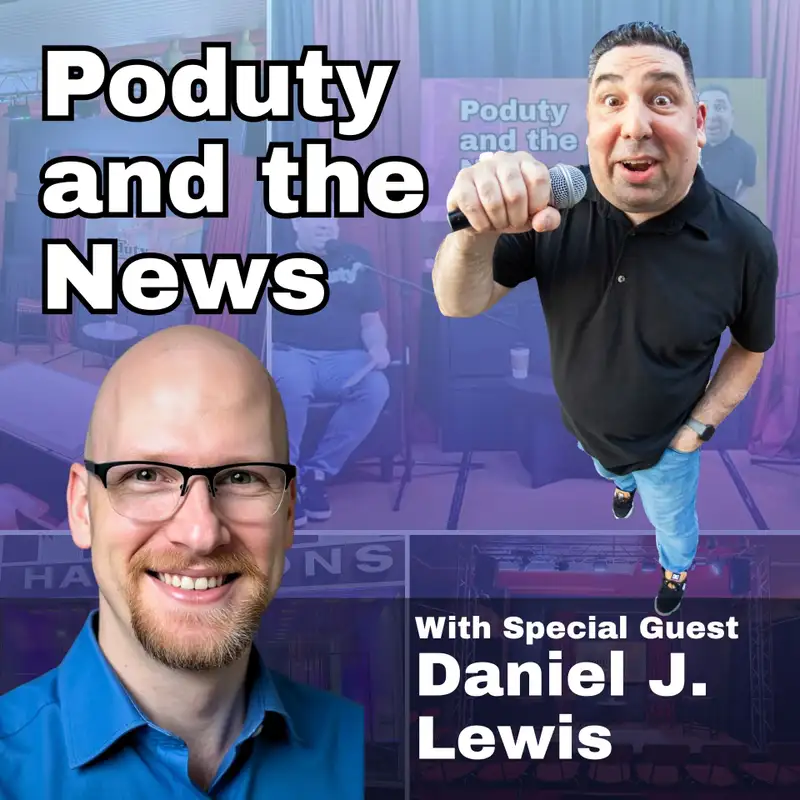
Hey everybody, welcome to Poduty and the News for Tuesday, August 18th,
2026. I've got a great guest joining me today. We're talking
Podgagement, Podchapters, the Audacity of the Podcast.
It's Daniel J. Lewis. Daniel, do you know what time it is?
It's ready to get some audacity. What time is it?
Oh, what, what time is it?
Oh, oh, it's time.
Poduty and the News.
Poduty and the News.
The only live news podcast about
podcasting from the stage.
Poduty and the News.
Poduty and the News.
The only live news podcast about
podcasting from the stage.
Oh, the only live news podcast about podcasting from the stage, it's
Poduty and the Podcast News. Today we're joined with Daniel
J. Lewis. Daniel, welcome to the show. Thank you so much, Jeff. It's great
to connect with you again. I've been looking forward to this
conversation for weeks, and I've got 6 great stories about live
podcasting lined up. They're right in your wheelhouse. We're gonna get some
amazing feedback, but You know, the thing that I keep hearing the most about
right now, I hear it on almost— I hear it on Pod News a lot.
I hear about Pod Chapters. And this is kind of a game changer
for maybe somebody who's not super technical savvy, somebody who has a podcast who
really wants to break up and really identify parts of their
podcast. It's an amazing product. And the pricing I was looking
at is really, really reasonable. You know, what was the idea
behind Pod Chapters? And, you know, how does that help podcasters? put their show
together? For me, well, let's back up and first define what a podcast
chapter is. So right now, if you are listening
to Jeff's podcast, then most likely you can have the
ability to see a chapter because Jeff uses chapters for his
episodes. A chapter can split up a podcast episode
into timestamps, kind of like an outline that if you were
to see someone speak in public and they hand out their outline in advance, you
can see the outline of what's coming. You can even tap on different
chapters to jump to that point, jump around, review. You can
also see images optionally with each chapter, and some
chapters might even include a link. So that's the basics of
what a chapter is: text, optional image, and an optional link.
And that can be inserted at a specific time, so it
provides extra context to whatever you're listening to or watching
with a podcast app. So Podchapters helps you make
those. But it does them better. And this is why I created it,
because for my own podcast, The Audacity to Podcast, I've been
using chapters and transcripts for several years.
And I just did not like the tools that were out there. They were frustrating.
They were slow. I was having to use about 5 different tools
and 30 minutes per episode just to
do the chapters. And I thought, There's gotta be a
better way to do this. I looked around and I was using the best tools
that were available at that time, and still 5
apps, 30 minutes. It just wasn't good enough. So I thought,
surely I could build something better than this for myself. I was
first thinking, I just want my own workflow to be better. And then as I
started building it and started seeing how well it could work, I realized, wait a
minute, if I'm having this problem, maybe other podcasters are
having this problem too, and they would like the time savings. So there
is no exaggeration in what I'm about to So I've already mentioned I was
going from using 5 different apps, about 30 minutes in 5 different apps,
down to now for each episode of my podcast, it takes me
about 30 seconds to do the
chapters and get the transcript for my episodes, 30 to 60 seconds depending on
how long it is. The longer episodes do take just a tiny bit longer, but
still that is with nice chapter links and chapter
titles and outlines. So that makes my episodes
Easier for people to follow. It makes them more actionable
even because I can present a link in a chapter at exactly
that moment my audience needs the link. It makes my episodes more
interesting because I have the ability to display an image
right when it's most relevant to display that image. I don't have to tell my
audience, go look at this separate website or go
watch this video. I could just display that screenshot or that
image right there. at that specific time that my audience needs it.
So I then created Podchapters for the world to be able to use,
and the podcasters who are using it are loving it. Yeah,
it's incredible. And if you think about a show like this where we're doing a
live show, so there's an introduction, you're gonna meet Daniel in this section.
So that could be a chapter of a show, and each of the 6 stories
can also be chapters. So exactly, people can skip ahead if they, they see,
oh, there's a, they're gonna be talking about this hot button topic about Spotify. They're
going to skip to chapter 2 and they can see it. We can, I could
have a custom image. I can have that section timestamp so that they can
go directly to it. And, and that's the benefit of using a service
like Podchapters. Yeah. And some people will say, well, wait a minute.
If I use chapters, that means I'm making it
easier for my audience to skip content. And my answer is
yes. And that's a good thing. Because wouldn't you
so much rather your audience get the content they want
from you than get frustrated that they can't find the
content from you and they leave and go get it from someone else?
So yes, you're enabling them to skip to what they want
from you. So I think that's a good thing. And in fact, even when it
comes to sponsors and such, and we'll talk about skipping ads and sponsors in a
little bit, but even when it comes to ads, you could use a
chapter to make your ads, your sponsorships, your any kind of call to
action, even if that's simply asking for feedback from your audience, you can use a
chapter to make that more actionable so that people can tap that
link right when they need to, or they can see a picture of the product
that you're talking about right when they need to. So you're actually
making your ads better when you use chapters.
Yeah, it's pretty incredible. podchapters.com is the website, and
just go check it out because you're telling me things I didn't even know you
could do with chapters. I'm already learning things. Check it
out, see what's possible. The idea of putting a link or an image
per chapter, that's something I bet a lot of people don't even know is possible.
A lot of— they're not even thinking about chapters in that kind of terms.
Yeah, and it's just the foundation for what chapters can do in the future because
there's this whole Podcasting 2.0 initiative that's building on top of
what a podcast can be and do. And there are some proposals for
making chapters do even more than they currently do. And they're
kind of legacy format, even though they work in different ways and different
technologies behind it, but like eventually imagine having an
image gallery or having text you could easily copy and paste
from a chapter or things like that. That's being built
onto what chapters can do, but it's all built on that basic foundation of what
a chapter is. Yeah, I love it. If you want to hear more about
podcasting, The Audacity of the Podcast, that podcast is— was
that 2000— I want to say '09. Is that Is
that late? 2010 is when I launched it. Yeah. Yeah.
So I've been going for quite a long time with that. 16 years.
Congratulations on that. Tell us a little bit about the podcast. People tune in
and they're hearing all these stories and that legacy of
podcasting over that time. Tell us a little bit more about The
Audacity of the Podcast. I started it because I was
listening to other podcasts about podcasting back then. I
started my first podcast in '07, actually, and it was a clean
comedy podcast. And I really struggled those first couple of years, but then I
got more serious about it. I learned more about podcasting, and part of that was
listening to other podcasts about podcasting. And I
started getting a little bit frustrated because the podcasts about
podcasting were not talking about things that
I thought they should talk about. They weren't mentioning certain things, especially since there was
a software program, Audacity. See, the word audacity in my title
has always had 2 meanings to it, like the audacity, but
also the Audacity software. And no one was talking about how to do things
specifically for podcasting inside of Audacity. And there were other perspectives and
approaches, like I come from a public speaking background and a digital
media production background, and no one else was talking about podcasting from
those kinds of perspectives. So I just felt like I've got
something else to say in this space, even though I felt the space was
saturated with the 2
other podcasts about podcasting that I knew of at that time.
And I thought it was saturated, but I just felt like I have other
value to add to this space. I would like to also share
what interests me and from some of the things from my background and
hope that maybe that benefits other people. And I had no
visions of running a business from it, but indeed it
was the missing piece I was looking for to eventually start my own business.
And now that business is in helping podcasters through products like
Podchapters and Podgagement and, and consulting and just
educating podcasters as well through my podcast.
That's funny, it was crowded with 2 other podcasts talking about
podcasting. Are those other 2 still around?
Yes, they are. It was Podcast Answer Man and School of
Podcasting. Wow, yeah, Dave Jackson and Cliff
Ravenscraft, right? Yes. He took a hiatus, so I
don't think— Yeah, but he's back now. Consistently running.
Well, check it out. I'll have all the links to Daniel's Podgagement,
Podchapters, the Audacity of the Podcast, the consulting. You'll be able to connect
with Daniel in the show notes. There's a special dedicated page with all the
episodes that Daniel's on, this one and hopefully in the future as well.
Are you ready to get into our stories? Oh, I am so ready.
This is the CMO Podcast Takes Creativity Live
at Cannes Lions, and they recorded at the Havas Cafe during the
festival for their second installment of a 3-part Creating
Desire series. Host Jim Stengel was joined by marketing
leaders Ryan DeLia, of Wreck-It, Jenny Weber,
formerly of Best Buy, and Matthew Bull of AB
InBev. Their conversation covered creativity, risk-taking,
workplace culture, branding, and the role of AI in
supporting human creativity. The podcast is continuing its
live strategy with additional recordings planned at Blink
Cincinnati and ANA Masters of Marketing
later this year. And one of the things I really took away from this was
that idea of expanding on what a podcast can be and
thinking beyond one single episode. Here's a podcast, they're
doing a series and they're taking it on the road to get in front of
possibly potential prospects, to meet people,
to grow their audience. And they're just thinking, not just recording
an MP3, but how do I bring that to life? How do I take
that to a conference or an event and be be a part of something bigger.
A lot of things, a lot of times I say on this show, go where
the audience is. And, and I think that's exactly the strategy that they're
doing here. Yeah, it's exciting. And this is going to be a recurring
theme through this episode, if not through this whole podcast that you host, Jeff.
But this idea that podcasters are taking their shows and doing
them live in front of an actual live audience from a
stage. And traditionally, I would say
in a new media space, is there even such a thing to say as traditionally?
But it seems that usually It's been the comedy shows that
have gone on the road or something that's been entertaining of some
sort. I know there have been other political podcasts in the past that have been
live in front of an audience and also drama podcasts or
true crime, but it's all within mostly that
entertainment category. Here, the
CMO podcast, not really
entertainment, I would say. But partially so.
But still, it is that idea of bringing the
content to the people and being able to bring
the people into the content a little bit. I really enjoy, even for some of
the entertaining podcasts that I've listened to over the years, when a show
would go in front of a live audience, like No Such Thing
as a Fish, for example, is a popular British podcast that I've listened to for
a while. In front of a live audience, the energy is
completely different and they get to hear the reactions from the
audience and respond to that. And I enjoy those
live shows a bit more when they know how to do them well. And
it's exciting to see that branching out beyond only the
entertainment-focused podcasts to all kinds of other podcasts too.
Yeah, we've covered— you mentioned covering live stories. We've done things that have surprised me.
Accountants have gone from city to city taking their podcast
and doing these free seminars, free events, recording a live episode while
they're in the town and getting new clients. We've seen it with
book signings, whereas people used to go on morning television
or do something, but now they're
doing podcast tours as part of a book launch. We've seen it
with Scott Galloway. We've seen it with— I think Oprah was just
doing that. Michelle Obama was just doing that. They're going on the road and
they're taking their book with them and recording their podcast for the
entertainment and then signing books and doing meet and greets. So it's
really grown beyond that entertainment that you're talking about with the comedians and
actors and actresses. You're seeing it in so many different niches,
niches where they're able to really expand
their audience, expand what a podcast can be when you
take it out in front of people. Yeah. And podcasts, I
still define podcasts more by it's a distribution method
specifically, but I know there's the big debate
over that even. But still, just to
get it out there in front of the audience and for the audience to realize
this isn't just some guy talking in his basement or
his closet. This is other kind of content that I
might usually enjoy going to see, and it's available even as a
podcast too. Yeah, it's the newest form of
entertainment. I try to explain to people, this is very similar
to what happened to comedy in the late '70s and early '80s. What's
happening right now in podcasting is there's a lot of people doing
podcasts, but there's not a lot of places to perform it, especially at
the smaller levels, the smaller venues. And that was what comedy was
like. People were doing it in the back of Chinese restaurants or bowling alleys.
In the early '80s until comedy clubs started popping up to
support that ecosystem. And right now we're seeing that, we're seeing
that with podcasting, the same type of thing happen. Oh yeah. And
the opportunity for that, even if you just aren't renting
a space for it, but if there's the opportunity for you to
be somewhere like a conference, I know you talked about that a little bit in
your previous episode, for you to be at a conference
presenting either from a stage or even just from a
booth and recording your podcast that way. There are so many
more ways now to take your podcast on the road to
record it. All right, let's go to
our second story. And this one has caused some ripples
across podcasting, especially the news shows, a lot of discussion
about this. And there's been an update since I wrote this. So we're going to
get into the update as well. So Spotify tests a new
podcast skip-ahead button, and they're testing this for
premium subscribers that can automatically move listeners past
portions of podcasts, including baked-in sponsorships,
introductions, promotional content, and even, I think, their
own Spotify ads. We'll get to that in a second. The feature, uh,
Spotify says it's testing it as a feature as part of the efforts to make
podcast listening more intuitive. Some publishers and creators
have raised concerns that easier ad skipping could affect the value of
host-read and embedded podcast advertising. Spotify says it's
been— it's seen listeners reinvest the time they save into consuming
more podcast content, and it does not expect the feature to
negatively affect creator
monetization. There is so much irony
here with this, and Spotify doesn't even see it themselves. I
mean, they're saying, hey, you know what? If podcast
audiences listen to fewer ads, guess what? That means they can listen
to more podcasts. Duh. Yeah. So how about we
figure out a way to monetize podcasts that don't involve ads? But then
Spotify is also trying to insert ads into podcasts. But
the, the thing that changed recently about this— so when this first came
out, at least, is that this worked
to skip the creator's own ads in their
content. But it wasn't skipping the Spotify
ads that they would add to content. And so that seemed like, hey,
wait a minute, this seems like a kind of a dirty
practice here. If you're letting an audience skip my
ads, but you don't let them skip your ads, that's a bit dirty.
So on August 18th, Spotify
was reported in PodNews that they said, That,
oops, that was a bug. We're sorry, we didn't
mean it that way. That would— we were just testing some things. We didn't mean
it to work that way. And I'm emphasizing the irony a
little bit here because I'm not so sure I trust that they actually
meant it as a bug, but they're saying that it wasn't intentional
for this technology to skip only the creator's ads and
not Spotify's own ads. But
it does open up a weird thing because we've,
as listeners, as viewers, whatever platform you're using, most
likely you already have a skip button. So if the
creator of that content, whether that's YouTube and a podcast or
whatever, if they have an ad in their
content baked in, recorded into their content,
It is very easy for you to skip. That could be a couple taps on
your phone, on your computer, double taps on your earbuds, anything like that,
even voice spoken commands to skip over things.
But that involves a listener doing that and
choosing to do that in the moment. And there are even
some clever ways that creators can work around that a little bit. Like,
here's a little tip for podcasters out there. Assume that most
skip buttons skip 30 seconds. So make your
ads or any kind of calls to action 40 seconds.
So then there's just a little bit of the call to action that might be
caught on the tail end or at the very beginning so that your
audience hears it if they're skipping only 30 seconds. But that little trick
hack aside, your audience is still choosing whether they want
to skip it. They might decide, no, I want to hear what this ad is.
Like, there are certain creators that I listen to or watch
that I consume their full ads
because their ads are actually relevant to me and to the
content that they're talking about. And I've found things that I've become
customers of through their ads. So I don't want—
I do not want the platform deciding for me
to skip that ad. I want to be the one as the listener to
decide whether I want to skip that ad. But
You and I were talking and you mentioned another platform that this is kind
of similar to. What was that? The big
daddy, YouTube. Yeah, YouTube,
for years, if you've been a premium subscriber on YouTube, YouTube
knows retention. It knows when people are looking, when they're
skipping, when they're dipping, and it isolates the entire— really
well The entire spot where people were jumping over anyway,
the algorithm detects where that is. It says, people commonly skip this,
and you just hit skip and it jumps over that ad. They've had that for
years and nobody's ever really batted an eye. I
look at this from 2 different perspectives. One, I'm a lover of
podcasts. I'm a lover of people who create content. There's
just sometimes where the ad insertion doesn't fit.
It's just forced to be there, and I don't want to waste time
dealing with this. And I want to support the creator, but I
don't want to hear something that disrupts the rhythm of the show,
that's being forced in there. And I get why they do it, and I understand
it, but I'm, as a fan, I'm the first one to hit that
skip button. I'm gonna do it. And my argument is,
make better content. Make the ad insertion better. Try a little bit harder. Always.
So that I wanna listen to, like the shows that Daniel's listened to, they're part
of the content. There's probably tools that maybe it's a
marketing show about podcasting and they're talking about certain tools that they're using.
That's interesting to the content of the show. It's relevant to the listener.
Yeah, that is the key word, relevance. And you compare
this, since you brought up YouTube, to on the YouTube side,
even just the standard YouTube videos. Yeah, you can
skip whatever the creator is including in their videos, but when
YouTube displays one of their ads, you cannot
skip that. You are forced to watch YouTube's ads. In
that case, I think it makes more sense for YouTube to force that
because YouTube is not charging creators, at least not as of
2026, surprisingly, to host content.
And they're not charging creators for the bandwidth. So for
YouTube to force the audiences to view an ad in
order to cover YouTube's costs, I can understand that. If
Spotify is building a
technology that kind of does the same thing on the podcast side, I
think that's a bit different because Spotify is
not hosting the content or providing the bandwidth for
the podcasters. The podcasters, unless they're using Spotify for Creators, which is
their own then proprietary hosting platform. But if podcasters
are using Libsyn, Buzzsprout, Captivate, Blubrry, Transistor,
all of these podcast hosting companies, those are the companies
that are providing the distribution and the hosting and the bandwidth.
Spotify is just a consumption portal for it, a
consumption app. So if then Spotify is
forcing ads to the audience
and it's their own ads, not the creator's ads, I
think that starts to become— I
don't know. I'm looking for a word that's
not as strong as fraud or
cheating because I don't want to accuse them of that. But it does seem kind
of shady for them to do that when it's really not
necessary. They don't have to monetize or
recoup expenses from the podcasters, but they do want to
monetize themselves for the podcasters. So
whether they mint this technology to be so that it
forces the Spotify ads, but allows the audiences to
automatically skip the creator's ads. Or if that was a mistake, I
don't know whether to really believe them, but it,
for me, it goes back to, and there have been other apps that have tried
to do this auto ad skipping kind of thing.
The big thing for me is, especially if this is a paid feature, oh, this
is the other, the other big irony to me and frustration with this.
If this is a paid feature, so Spotify Premium subscribers get this ability to skip
a creator's ads,
I want some of my Spotify Premium subscription money to go to that
creator then if I skipped their ad. If Spotify Premium
made me skip their ad, I want the creator to get paid
for their ad being skipped by Spotify. And some of
these other services out there that try to automatically skip ads
will not pay the creators either. And I think that's really dirty of those
platforms. And the last point here that I thought, as you can
tell, I'm very passionate about this one particular story. That's why I'm spending so much
time on this one. The other point here is
that some of these systems will recognize a call
to action as an ad, and it may skip an
important call to action. Like if I were to say, hey,
I really want to hear from you and get feedback from you on my next
episode, then please send me your feedback at such and such
address or such and such phone number. And I give that as a call to
action. Some of the systems, these are basically AI-based systems,
might recognize that as an ad. And if they're auto-skipping the
ads, then they might be auto-skipping a really important call to
action that is not a monetized or an advertised thing, but it's
something the audience needs. And some of these systems might just be
skipping it. Yeah, I knew
that you being an app developer, taking feedback from people and
making the product better and refining it. this would definitely be
a hot-button issue. Oh yeah. And I also, I'm very
skeptical that it was an accident that Spotify included that.
I'm on the side of, hey, maybe they got caught and now they're backpedaling a
little bit. And it is part of the—
I don't own the Spotify app. I don't own Pocket Casts, which I
use, which I bought 15 years ago for like $3. So I'm never
not using Pocket Casts. Because I'm grandfathered in
for life. But Pocket Casts has always had a skip button, like you
mentioned, and most apps do. But I am in control, and if
I start to hear something I don't like, I'm gonna jump ahead 30 seconds, 50
seconds, or 60 seconds at a time, and get to the part of
the show that I wanna hear. So I don't mind that. I think it's a
reflection on the creator more than
my behavior. If the show was good, I'm never going to skip.
And so having that control, I think, is important. But the reasons
behind why you're allowed to skip and why you can't skip, that's
something that we need to have a further discussion. And I think we're going to
have more discussions about that in the coming months, especially as Spotify is
rolling it out now. Other people are already in development, and they're going to
try to push that off as well. Yeah, just remember, please skip
responsibly. Well, let's keep it moving.
Let's go to our 3rd story today. Katie Price and her younger
sister Sophie are taking The Katie Price Show on a live
theater tour across the UK. The stage version will expand
their regular podcast with untold stories, live music,
singing, and conversations between sisters. The February
tour is scheduled to begin February 2nd in Stockport and
conclude February 25th in Harpenden.
Tickets just went on sale August 14th for the tour, which is being
promoted under the Pricey Is Back theme.
Again, this is the exciting thing. And I'm not sure
if you've ever used this phrase before of live podcasting, or we're live
podcasting or podcasting right now. And I don't think
that can really apply to something like what Katie and Sophie are doing.
They're not podcasting, They're doing a show, a
performance. They're providing an experience.
And in that process, they're recording it to make it
available as a podcast. And I like that approach
where people are accepting podcasting as
a way to distribute content, not as
a format of a show. Thinking outside the box. This is
something I love is is expanding on what a podcast can
be. I started in my basement in my home studio, and I just thought I
could record an MP3 file and distribute it. And that was a lot of fun.
I really enjoyed doing that. But then I had started to hang out with people,
and I found out other people like podcasting. I'm like, why don't we get together?
Maybe a couple people come over, and we all sit in a room. And that
idea and that concept keeps growing and growing. And here we are
today where 2 sisters are filling theaters
over in England doing their show live that they probably
started in a basement, just themselves giggling and having fun and
being typical sisters goofing off. Probably mom is upstairs stomping on the
floor, quiet down there. And that's turned into something so much
bigger than what they first envisioned a podcast can be. And
I love that, that they're expanding on that, but they're still using
podcasting as a distribution channel like you mentioned. They're going out,
they're performing an event for their fans. It's a special occasion.
People are coming out to see them, but then everybody who can't be there,
a couple weeks later, maybe a month or two later, they're gonna get access
to that special content through their RSS feed into their
podcast app, and they'll get to experience it as well.
Yeah, and there will be the exclusive experiences for the people who were there
live to see it. And so that's part of the benefit of
going live is you get to experience that energy there
doesn't always get conveyed through the podcast, or sometimes the podcast gets edited
down. Maybe certain bloopers are edited out or just
things that happen that it's the whole, oh, you had to be
there. And it's that premium experience that is the add-on to
being able to be there live, but then still sharing the
content experience with the audience through the
podcast is providing it to everyone who couldn't be there.
When you listen on your morning commute or while
you're doing a lap around the neighborhood walking the dog,
you hear these podcasters and you become very close to them. You
know what they sound like, but you don't know what they look like. And you
don't know how they react in the moment. You don't know the facial
expressions they make when they're thinking or reacting to the
audience. And you get to see all that, and it really adds a whole
other dimension to the podcast. When you get to see these people that
you've become friends with over the years, you get to see them
live in front of you in person, you're like, shut the front door.
I can't believe I'm watching you. I've been listening to you for 5, 10 years,
and here you are. You're on the stage right in front of me performing your
show. And it really changes the dynamic. That
relationship becomes something so much greater because you've
already been listening to them for all these years. Now you get to see
how the sausage is made. You get to see them laugh and react and
giggle and take questions from the audience and how they treat other people.
That can really, really elevate the way you think of that host.
And what's so special about podcasting for this is so many of these people who
are doing these live shows like this started with a podcast.
They were nobody before their podcast.
Yeah. Unlike the TV and movie celebrities,
they are playing a character on the show or in the movie.
So when you meet the actor or actress, you're meeting the real person
who could maybe be still be acting
even when you see them in person. But with a podcast,
you've gotten to know them in their authentic selves,
maybe a little bit projected, just like I'm projecting a little bit bigger right
now since I'm on a show with you. But still their
authentic selves so that when you get to see them in person,
it's not like they're a completely different character. Yeah,
people tell me I'm a different person on stage. They're like, normally I'm sitting
in the corner and I'm just watching everybody and, you know, minding my
business. But once the lights come on, you know, podcast Jeff is a
different Jeff. And that's just— it is. I guess I am playing
a character in that regard. And these 2 sisters who are going out,
they are, I guarantee you, slightly different on stage. They're probably their authentic selves,
but they are hamming it up. They are performing. Yeah. They are trying to
make a show for the audience. So you get to see all that and how
that unfolds and how they work together. And
even the things that may get edited out on an audio
podcast, you get to see, okay, these sisters do fight
a lot between takes. You get to see this whole other side to them. So
I'm very excited to see more events like that. We see a lot of this
in London at this level, and we're seeing a lot of it
start to come to the States. But the States generally are still those
comedians and actors— Right. That are filling the arenas and large
theaters. We're starting to see this bubbling up of these smaller
independent podcasters through spaces like this, and through
people really taking the bull by their horns and going to coffee
shops, going to restaurants, going to banquet halls, And you're starting to see
people really perform their own podcasts. And when we get to this next
story, this one even falls under
a genre that I wouldn't expect. Like, there's a podcast about shipwrecks. Right.
There's podcasts about everything. And this one happened at—
I'm not sure if they say TKA, but I would say TKA. It's the arts
center or the arts campus at Willits. And literally,
Literary Podcast First Draft, a Dialogue on Writing.
Is recording a live conversation with author Eric J. Dolan
at the Arts Campus at Willits in Colorado on August 18th. It's
happening today. We're missing it. Host Mitzi Rapkin will
interview Dolan about his New York Times bestselling book, The
Wreck of the Mentor, which chronicles the 1831
wreck of an American whale ship and the experiences of its
surviving crew. Rapkin has produced more than
600 literary podcast interviews, although
this will be her first conversation with Dolan. The live event is
free with an RSVP, and copies of the book will be available
for purchase at signing. And this is that example,
taking a book release on tour.
Yeah, meet the author. You get to hear the stories of the author and
maybe hear the author read some of their own book. But now
bringing the podcast into this is just becoming a
commonplace and accepted That people are going to
be more used to now seeing the camera and the lights maybe and the microphones
and the faces, but recognizing, all right, this is great content
and it's also going to be a podcast. These events,
these events are becoming something and they're tying in podcasting with it,
which I love. We got some great examples tonight and this is,
you wouldn't think 10, 15 years ago that an author would,
the draw to go see an author talk about the book, would be
part of a larger podcast. So to be able to
see this unfold and become a form of entertainment, it's really
incredible. And when you see a shipwreck podcast, a podcast about
talking about shipwrecks, you know the time has come.
Live podcasting, I think, is here. Oh yeah. I would love to
see someone try and livestream a podcast from a
shipwreck. That would be— someone's got to do that. Be the first one
to do that, maybe. Yeah, I mean, your retention's
as long as you can keep the boat afloat. Once it goes under, you're probably
going to lose a couple of people. And speaking of, let's go
another live one. And this is a podcast
about pubs, right? And guess where they're recording it at?
From inside a pub. And it's the Pub Crawlers Podcast has completed its
first season with an episode recorded at Peter
Cavanagh's Pub in Liverpool. Hosted by Rob Gutman,
the series travels to pubs across the UK and Ireland and records
conversations from inside the establishments it features.
Season 1 focused primarily on North England, with
stops in Chester, Sheffield, Manchester, and Liverpool.
The show combines conversations about pub culture with informal
discussions among Gutman and his guests.
I love how technology has made this so much easier to do.
If you're— especially if you're doing any kind of location-based
podcast, whether that's something like hyperlocal, all about your local
city, or you're doing something like this where you travel from pub to pub, which
is a great idea for a podcast. If you can record your
episodes actually at the location and even
do it live with a live audience if possible, and if they can promote
the recording of it at their live location, that's great for them because it
brings people out to their businesses. It's great for you because of the content it
gives you and the experience, the relationship relationships that you can build with
people, because I talk often about the podcast profit paradigm.
P-R-O-F-I-T stands for something. It's what you and
your audience can gain from your podcast: popularity, relationships,
opportunities, fun, income, and tangibles. And you can get a
lot of those from these kinds of onsite podcasts that you might
record from the location that you're talking about. So something like
doing it at a pub years ago, before
podcasting was all that popular and accessible, We would be concerned
about, oh, are there going to be microphones there? How
noisy is it going to be? Are we going to be able to hear people?
Can we just put a tape recorder in the middle of this table and it
pick up all of us around this table? No, it won't. But now
it's so easy that you can have a whole podcast studio connected
to a very portable piece of equipment. And each
person gets their own microphones, maybe even their own headphones to be able to hear
each other more easily. And you can set this stuff up and tear it down
very quickly now. And it's it's much more affordable than it was before
so that this kind of thing can now be so much easier
to do and still get good quality
audio or video if you prefer adding some video to it as well.
But that it's so much easier is great, and, and yet it's
also so much more exciting to do it from the
location and for people to— even if
you get a nicer microphone and you're talking into it very closely,
there's going to be some background noise. And some podcasters will
obsess over that like, oh, we need to remove every bit of background noise. It
needs to sound like we're in a perfect sound studio at all times. No, when
you are recording on location, I think background
noise is good because then people can feel
more like they are actually there.
Yeah, I remember those early episodes of Marketing Over Coffee with Chris
Penn Yes. And I'm trying to think. John Wall.
And they were in a coffee shop. And I loved the
ambiance. I loved hearing the silverware get thrown by the
waitress into the bin and the porcelain cup hitting the
saucer. And I loved that, that they were so
passionate about marketing that they got together in the morning and they
were having this conversation in a coffee shop.
This is the same thing, going where your audience is. This is a
podcast about pubs, The Pub Crawlers. They're going to
pubs. They're immersing themselves within their audience, their target
market, other people who love pubs, love the experience, the stories,
everything that happens inside of a pub. They're right in the middle of it.
They're showcasing these great establishments across the country.
You mentioned the T, tangibles, right? Maybe you're doing this for, you get
some free appetizers, or you get your beers for free while you're there. For
some people, that's a great reason to start podcasting. Some people
just wanna hang out, have fun, and tell stories, and if
they can get a little bit of something back, they get a booth in the
corner, they get a couple appetizers and a meal,
that's a huge win for a lot of podcasters who are just
passionate about telling stories
about these pubs all over the UK. Now, I want to give a
podcasting tip here for anyone who's thinking of doing something like this. Here's what I
highly recommend that you do. Come up with a brochure
or a card or something very simple that you can give to these
places, like give them a stack where it promotes your podcast and it's written
in generic language that says something like, hear us in this
episode. But then you leave a big blank spot where then
you can, with your own printer, you can print stickers to stick
over that spot that have the
location-specific link to the episode or a
QR code that goes to that specific episode. So then those
locations can have those little brochures that says something like,
hear this comedy show recorded from our own pub, or
hear the history of our pub in this episode, or we were featured
on such and such, that kind of thing, because they love
the news coverage or any kind of coverage that they can get. And if they
can show that off, Then that's an opportunity for you to grow your
podcast and promote it by providing the opportunity for those locations to
show off their coverage of their own location,
and it's promoting your podcast at the same time. Oh,
I love it. I never heard— that's a great tip to, you know, make those
little pamphlets and then you're promoting. The, the— my favorite one that I hear the
most, especially from podcasters who doing it longer than I have,
is using your podcast to get get press passes to conferences
to get into conferences to do more interviews, get more content. But
it's a great way. You have something of value. You're sharing
information with an audience. That conference recognizes that. And
a lot of times, people are just excited to get a $600 pass
to a conference where they can go in and record more content for their
podcast. Those types of things, you don't think of them as
monetary value. But you're creating something of value
and there's ways to get rewarded for that. Maybe it isn't cash right up front,
maybe it's these other things that you're able to create something,
share it with the world, and live a little better life.
Yeah, and the R of profit, the relationships. Like if you're going to
a conference on a regular basis or a convention of some sort, you might start
to build relationships with some of these vendors and they might be like,
hey, hey, do you wanna do a review? interview, we've got this new product coming
out, we'll give you an exclusive, or we'll let you record this interview or record
something about it ahead of time, or they get you involved in giving
them feedback. Or like, even if it's a local pub or something, they can say,
hey, we've got a whole new menu. Would you be interested in
coming back and doing another show with us? And we'll let you try some of
these new items from our menu. The ultimate
would be getting an appetizer named after your podcast. Oh, that
would be great. Yeah. Yeah. I'll get some padootie nachos, please.
That might not pass the health board, but we got one story.
This month goes by so fast. Every time I do this show, it gets
quicker and quicker, and I wish we had some more time, but we're gonna go
down to Brazil. We've been over in Europe for a while. It's
LicensingCon LATAM, L-A-T-A-M, return to São
Paulo, Brazil, August 12th and 13th with a live
podcast recording added to its conference programming. In
partnership with EP Grupo,
GKPB, and Soapbox, the event
hosted interviews with executives, creators, and
licensing industry professionals. The recordings are being distributed
through EP Grupo and GKPB channels. The
conference also introduced a creative hub and featured
companies including Warner Brothers Discovery, Mattel,
Paramount, Netflix, Hasbro, and Disney.
This is neat to see because I'm not sure if you knew this, but for
a long time Brazil had an interesting,
an interesting grip on podcasting where it was Todd
Cochran, who's since passed away, but from Blueberry, would talk about
how the podcasters in Brazil get
crazy downloads. for really long
podcast episodes. So I think the
Brazilians are really connected to their content
there. I mean, that's a place that loves
long-form content. And if, you know, that's— most podcasters are creating a
half-hour, hour, hour-and-a-half shows. And if this is a
location besides the Portuguese barrier, if you can get over that,
they're consuming content in in very long form, which is
different than what some people would say. Some people in America are
primarily short-form content. There are the long-form
people who consume content, but to have a whole
country dedicated who loves these
long-form media, these long conversations,
that's, again, that's going where your market is. Go to
that area, produce a show of people who love
long content, long-form content. Yeah, and I
remember when I had a podcast about the TV show Once Upon a Time, which
was on ABC several years ago, it seemed like I would always
hear from someone in Brazil and just
how much they loved consuming the longer-form content. And they would frequently
ask about like translations into Portuguese and such, but
they've got a passionate community there in Brazil.
I love it. And to learn more about it and to have
these companies— look at the companies that are showing up. They're recognizing it too.
Warner Brothers, Disney. They're saying, hey, there's something
here. If we're subscription services that produce long-form
content, and here's a whole country who loves long-form content,
well, let's find some of those creators. Let's find people who already
have built communities, who have built audiences in this country.
And let's tap into that. Let's, let's do some licensing agreements.
Yeah, and I love that they are enabling other creators through an
event like this, recognizing that there are plenty of
creative people out there and that they're not just in the United
States, but let's educate them. Let's provide them
with resources and connections and relationships so that they can
pursue their creativity and contribute
good to the world through that. Yeah, I love it. And I hope these
6 examples really shine some light on some, a different
perspective of podcasting. These live events are happening, these conferences are
happening, book tours, licensing, the
whole conference on licensing agreements, and their featured
entertainment during these conferences is podcasting.
They're bringing podcasts in to entertain and the people who are
buying the tickets to come to these conferences. So podcasting is
leveling up in this live environment in a way that we've seen
ramp up over the last 10 years, but recently in the last 18
months, it's becoming a whole new thing. And I'm so excited I was
able to share these stories with you today, Daniel. The perspective you
brought, the history that you brought, the apps that you're building, all
tied into these 6 stories. And I really appreciate your time tonight.
This was so much fun. Thank you, Jeff. It's been great to talk with you,
and I love talking about podcasting anytime and every time.
I'll do it all the time. The one last thing I do, I like to
turn the show, the floor over to my guest one last
time. One final plug, promote. You can talk about anything you
want. Daniel, the floor is yours. Well, the one other thing I wanted to
talk about is my other product, Podgagement, which you're actually familiar with the
first generation of it. You used a product called My Podcast
Reviews several years ago, and Podgagement is the next
generation of that. I completely rebuilt it from the ground up. It
focuses on helping podcasters engage with their audiences,
tracking all your ratings and reviews, collecting written and voicemail feedback from your
audience, tracking your chart positions, tracking your podcast SEO
rankings, discovering podcast networking opportunities to
discover other podcasts with crossover audience where you could network with
them, cross-guesting, cross-promotion, collaboration, anything like that.
And so much more to really focus on helping you to deepen the
relationship with your audience. And grow your
podcast from that. And that's over at podgagement.com. And if
you love my voice or just want to learn more about podcasting,
follow me pretty much all the socials @thedanieljlewis and listen to my
podcast, The Audacity to Podcast.
Yeah, the great tools, Podchapters, Podgagement. I will say I did
love My Podcast Reviews, but I've looked at what you've
built since then. And Podgagement is a whole new level. Oh
yeah. There are so many things happening in there. If you want to track what's
going on, track your reviews, you want to share your show, the links that
you create for you to make it easy to share your podcast,
you have to check out what's going on at Podgagement. It is incredible. There
are so many more tools that are there now than were there
back when I was using it. So I've been checking it out again, and I
think I'm coming back. I'd love to have you back. Well,
Daniel, do you remember what time it was? Oh,
it's time for some audaciousness. What
time is it?
What time is it?
It's time for Poduty and the News. Poduty and the News.
The only live news podcast
about podcasting from the stage.
Poduty and the News.
Poduty and the News. The only
live news podcast about podcasting
from the stage.