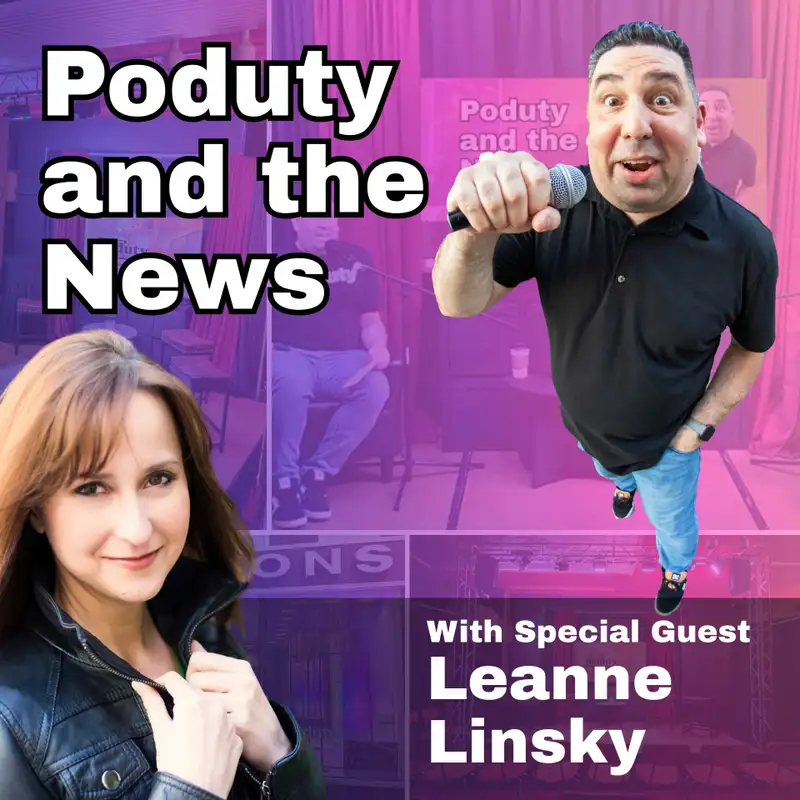
Oh my goodness. We've got a great one lined up tonight. It's Poduty and the News for Tuesday, 09/22/2026. I've got Leanne Linsky of Plauzzable joining me. We've got six stories about live podcast, about podcasters performing their podcast live all over the world.
Jeff Revilla:Leanne, you know what time it is?
Leanne Linsky:I was gonna say, Morris Day knows what time it is. That's
Jeff Revilla:Oh, the only live news podcast about podcasting from the stage, Leanne Linsky. Woah. Welcome to the show. My microphone just fell on me.
Leanne Linsky:That was pretty fancy. Hey. Thanks for having me here.
Jeff Revilla:It was a magic trick. I could make my microphone collapse right in front of me.
Leanne Linsky:It's a whole new mic drop moment.
Jeff Revilla:Yeah. But these these microphones are expensive. You don't wanna drop them on the stage. So I'm just gonna invent a mic stand that just folds. It it collapses on itself very safely and the microphones don't get damaged.
Jeff Revilla:But Leanne and I, we met about a year ago on another podcast called My Guests Tonight and I got to interview you and hear your whole backstory and I'm going to recommend people check that out. It was a great episode. I had so much fun connecting with you and learning about what you've built. Because what you've built, Plauzzable is so impressive. The technology is so in-depth where people who don't have to be those tech gurus can come in and put on a show, perform a show, and if they want, they can even do some tickets and sell some tickets to their audience.
Jeff Revilla:Could tell us a little bit about Plauzzable and, you know, the backstory behind why that came about.
Leanne Linsky:Sure. So I started thinking about this idea way back in 2014, 2015 when I was moving from New York to California. And fast forward, I get to California. I spend all of this time in traffic, and it wasn't because I was thinking, like, how do I keep in touch with everybody after I move? What do I use?
Leanne Linsky:Skype? How does this work? You know? And then I'm in California. I'm spending all this time in traffic.
Leanne Linsky:If you're familiar with the LA area, you know what I'm talking about. I was spending way more time in on traffic than I was on any stage, and I was like, how do I solve this problem? How do I stay connected with people on the East Coast and with people I've met here on the West Coast? And what about all those people in between? So I thought started thinking about doing things online.
Leanne Linsky:And then, I didn't start trying it until, like, August twenty nineteen BC before COVID, and I started experimenting with existing technologies. And people started coming. They're like, this is great. And then, of course, we all know what happened during the pandemic. Everybody got familiar with those existing technologies, but they just weren't built for comedy necessarily, and they weren't and I was like, if we could solve this problem, what about all these other problems we have as a performers getting, paid, monetizing things easily, not having to pay out of pocket upfront, still being able to stream, still being able to perform live in person and do all the things.
Leanne Linsky:And that's where Possible was born. So I created this whole infrastructure to accommodate, entertainers because they you know, post COVID world, we live both in person and online. I mean, why give up all of these other connections we've made with people, outside of our geographic area? We can still maintain those and continue on in person. So things can coexist, and there we are with Plauzzable.
Jeff Revilla:Yeah. And it's a great like I said, it's a great tech stack for anybody who wants to come into performing live virtually, who wants to be able to go live with a group of friends. You can do free shows, you don't have to always monetize. You can just have a good time hanging out, performing, working on new material, new concepts. It's a very open platform for you to to try and experiment with new things.
Leanne Linsky:Yeah. Exactly. We have people so it's we have comedians. You can come in, create a we call it a comedian account. It's like your creator account where you have the access to the dashboard with all of the tools for the virtual stage to create and schedule your events on PLAUSBLE or in person and list and promote what you're doing in person too.
Leanne Linsky:You can create a comedian profile so that you fall into that directory. Every event that you, create on Plauzzable goes in chronological order in the event directory because you don't have to fight an algorithm. You don't have to fight everything on social media to appear in someone's feed. People can search in time and date because it all happens in real time, whether you're doing it online or in person. Yeah.
Leanne Linsky:So the whole infrastructure's there, and you don't have to do just podcasting. You can create an open mic. You can create a class. You can create a show. You can do, of course, podcasting and even have your own tech rehearsals.
Leanne Linsky:So there's stuff going on there every day. Some things, multiple times throughout the day. Ideally, it can accommodate twenty four seven so you can log in at any time and create. You don't have to ask permission. There's no gatekeeper, and you don't have to, come out of pocket to to do it.
Leanne Linsky:You if if you're making money, that's how Plauzzable makes money. It's not you you pay Plauzzable and then hope something happens, like, way in the future. So it's a it's a really fun system and removing all of the obstacles for perform.
Jeff Revilla:Yeah. And I I love that idea of the calendar too. It is organized chronologically, so you aren't fighting and battling and trying to optimize for an algorithm. You can see what shows are on today. If you're around and you can subscribe to those shows or I think you can even bookmark them so you get an alert when the show goes live.
Jeff Revilla:You can do a lot of things and it's easily accessible especially for independent creators, new creators who are just getting into it. Check it out, it's Plauzzable. I'll have the link in the show notes and Leanne will also now have a Poduty and The Crew page on the Podcast website where Leanne will get inducted into the crew pages and all Leanne's links will be on the Podcast page at news.poduty.com. Go over to the crew page or to this episode and you can connect directly with Leanne, see the profiles, direct links to Plauzzable and check it out. There's no cost.
Jeff Revilla:When you win, Plauzzable makes some money on the side and that's how the platform works. It's a free platform if you want to use it. If you want to really utilize the full tech stack, there's ticketing, there's the event pages, there's a lot of things that you can do that don't cost you anything to test out and try out. Go over to Plauzzable and check out what Leanne's built.
Leanne Linsky:That's right. And you can stream to YouTube. You can download your your shows. You can record them. You can do all kinds of fun stuff.
Leanne Linsky:So, check it out.
Jeff Revilla:Check it out. It Are you check ready out these stories?
Leanne Linsky:I am. I am ready to check out these stories.
Jeff Revilla:Well, let's go to our first story today and I already warned you, I forgot my glasses so we'll see how good the lighting is on the stage. Our first story comes from Geekwire. They're bringing their podcast in front of a live audience for an event featuring co founders John Cook and Todd Bishop. The program will focus on artificial intelligence and the future of real estate, combining GeekWire's technology coverage with an in person podcast experience. The event gives attendees an opportunity to hear the discussion live while bringing together members of the technology and business community around the topics already central to GeekWire's reporting and podcast coverage.
Jeff Revilla:I chose a lot of the stories that you're going hear tonight are about performing, are about getting in front of an audience. This is one that's in a very specific niche industry. It's in the tech and the real estate and geekwire. They're talking AI, they're talking AI and the future of real estate. I didn't expect those two things to go together but they have a community that they've built and they're putting on this event for their fans, for their followers to share information.
Jeff Revilla:And how do they choose to do it? In real time. They're selling tickets. They're performing. They're giving that information.
Jeff Revilla:And I just love when these things come together that you know, where can you take a podcast? How big can a podcast be? It really be anything you want it to be and GeekWire is really showing a podcast firing on all those cylinders.
Leanne Linsky:Yeah. I agree. So it's interesting because I went to GeekWire events when I lived in Seattle, and they have some really fun things that they do throughout the year for the tech industry and startups and really good. So it's interesting to see that they're doing this. I'm not surprised.
Leanne Linsky:I think, you know, post pandemic, people are really into doing things in person again. Things are kind of you know, it seemed so long ago, but, really, it wasn't. And and and I think doing things live in person has changed. And people because of that and so many people becoming more familiar with online connections and ways to do so, hybrid events are much more popular than I think they would have been, you know, without the pandemic and with because people are now like, oh, I can just hop on here and do this thing. So, yeah, I'm I'm not surprised at all.
Leanne Linsky:I think people are seeing that podcasters. I I'll add with with one other thing. I think podcasting has become so popular. I mean, every everybody has a podcast or has had a podcast at some point. Right?
Leanne Linsky:And so how do you take it from just recording, you know, in a room with with your collaborators, partners, or friends, whatever that may be for a podcaster? And then how do you how do you expand on that? And I love that going in person is is is what people are doing. I'm a huge fan of performing on stage and and being in front of a live audience because there's an energy that you can feed off of, that you can't in a vacuum of a closed room with just a couple of people. It's a it's a much different energy that you're doing.
Leanne Linsky:And as a performer and and especially as a comedian, that is super important. And that's really when I was looking at Plauzzable and, you know, experimenting pre COVID with existing technologies and through that pandemic, seeing where things were working well, but also where they were breaking down. Because the worst is, like, being cut off mid punchline by someone coughing or something on the other end. So, like, how do we fix those thing for for performers? Because that energy and and having people whether it's a virtual room or in person is really magical.
Leanne Linsky:So I think it's really cool that they can take a a topic like AI and real estate, right, that can otherwise be somewhat dry. I mean, let's face it. Not everything is a comedy that we're putting out there, but to make it more entertaining, more interactive, and how do you how do you raise that bar? And you do that by doing something and and, you know, making it more of a production.
Jeff Revilla:Yeah. You mentioned that everybody has a podcast now. You know, this is a podcast about people doing podcasts. Podcasts. It's very meta and you also mentioned the pandemic was kind of a nice catalyst for really launching virtual events.
Jeff Revilla:It really put them front and center when everybody had to do Zoom meetings for work and they were just trying to talk to each other and stay in contact with each other. It really opened the possibility of, What can you do with a streaming show? How can this technology work for me? And that's what really came out. That's the beauty that came out of the pandemic.
Jeff Revilla:It did help connect people and it also helped those introverts. I think it was very great for introverts who was like, wait a second, I can still see the show but I can stay home in my pajamas and not talk to anybody? It's the best thing that's ever happened where I can still get all that great entertainment but I don't have to sit in the California traffic. I don't have to get dressed up or bump into people or the guy behind me keeps sneezing and coughing on me. Can watch a virtual show from anywhere and that's really the exciting part of what Plauzzable is.
Jeff Revilla:It gives you that element to be able to have those livestream shows and, like you mentioned, if you wanted to do it in person, you could do that as well.
Leanne Linsky:Yeah. And you can do hybrid too. Like, there's there's so many ways to get creative with with podcasting. And, you know, I I kind of think of podcasting as a vehicle. Like, oh, podcasting is like this thing that any performer or speaker or any anybody with a message, it's it's a a method in which they share it with the world.
Leanne Linsky:Right? So I'm and when I was thinking about this thing, was like podcasting as an art form. It is in the sense of you have to note some version of technology and how to set it up and how to create it. But within that, it's it's like it's in the similar of, like, not every comedian is a producer because there are people who are bookers and producers that know how to set up a venue and run a show and put a running order together and do all those same things. Right?
Leanne Linsky:So, like, in person is a vehicle and then, broadcasting on the radio or having TV or some some form of like that. And so I was trying to think about as as we're looking at these different events that we're talking about today, podcasting, I think, is, like, a vehicle in which to get it out into the world. And it's and it and I like the fact that podcasting can can be partnered with other existing vehicles that performers use to get their message out into the world.
Jeff Revilla:Yeah. We have another one coming up here. This one I think this one just happened and it's called the Fear and Podcast. And they were featuring their hosts, Hassan Piker, Will Neff, QT Cinderella, and Austin Show. They brought their show to San Francisco's Golden Gate Theater as part of a West Coast Live Tour.
Jeff Revilla:The performance took the podcast conversational format out of the studio and placed the four hosts in front of the theater audience. The live production maintained the unscripted conversations, debates, and comedy associated with the podcast while preserving, while presenting the program as a ticketed stage show, really building off of that last story.
Leanne Linsky:Yeah. Yeah. I think, again, it's like you have people who are performing. They're they're they're I don't wanna say shtick, but, like, their thing is a conversation. It's they typically wrap it up in a podcast and distribute it through that, you know, normal podcasting channels, and now they're expanding their reach.
Leanne Linsky:They're doing the exact same type of performance, but now their trans mode of transportation is this in person. And, oh, by the way, we're gonna take our other mode of distribution, which is podcasting, and do it all at the same time, but their performance hasn't changed. Right? It's just where they're doing it and then how they're distributing it to their audience.
Jeff Revilla:You know, I often hear comedy described as a muscle that you have to train and build and strengthen
Leanne Linsky:to
Jeff Revilla:get up on stage to perform for people. And I think podcasting is similar in that realm where you can't just get behind a microphone and think you're going have a great show if it's anybody more than mom and dad and two cousins. Struggle. You're going Podcasting also and hosting is also it's that muscle that you build and you train and you practice through repetition. And that's what this podcast was able to do.
Jeff Revilla:They performed their show for years. They built up an audience. Now they have that confidence to get up in front of the audience and perform their show.
Leanne Linsky:It's true. There there is this performance aspect of it. Right? And so like we said, everybody's had a podcast. So many people have had a podcast, and a lot of people learn very quickly.
Leanne Linsky:It's an art form. You can't just not everybody can just get behind a mic and be interesting. People don't understand, like, there's a pacing. There's a cadence. There's, importance of some sort of structure.
Leanne Linsky:Do you know where you're going with this podcast? And hosting, you know, not every not everybody is a host, and hosting is a very specific skill set. And even with comedians, a lot of comedians will admit they're like, I they they're a great comedian, but they're not necessarily the great host. And there's a difference because a host has to run the whole show and keep it moving and understand when to pull people off. It's not just about being able to perform your set.
Leanne Linsky:You're responsible for your guest. You're responsible for to keep things moving. You're responsible to keep things paced. You know, like you here. Right?
Leanne Linsky:You're making sure, like, I'm staying on topic. I'm you know, you're leading, and it's important for you to connect and have a natural conversation with your guest and also maintain order and and run your room. And in comedy, we call it running your room. So it's really interesting to see people who are podcasters take it onto the stage because, you know, to do that, like, if you have no experience podcasting and you're gonna go out on stage, oh my god. Like, I don't even know if I'd wanna see that.
Leanne Linsky:That way Yeah. I might. I might. I would probably wanna see that just be because that informs me more, but that's kinda terrifying for most people. And I'm you know, I even see newer podcasters, and you probably have experienced this, just getting behind the mic for the very first time and maybe seeing themselves and hearing their own voice is weird and freaky.
Leanne Linsky:And that like, it takes time to really get comfortable there and be okay with that and then, you know, hold a room and do all of the things. So it's it's massive skills. And I think comedians are really good at podcasting. That's why comedy podcasts in particular, maintain so much popularity. And even, like, in the news, right, we've seen a shift in in news and how it's delivered with comedians.
Leanne Linsky:And it's it's still classified as entertainment, but we see how popular some of those shows can be. And that's because comedians can really hold hold a room, hold your attention, keep things moving at a very quick pace, and and people like that.
Jeff Revilla:Yeah. Some things I've experienced similar to comedy is, yes, you can bomb as a podcast. Like, I've come onto the stage with the wrong energy. Sometimes I've come into the room with the wrong information and I'm just staring at stoned faces that aren't even reacting to anything I'm doing. And there's things that you have to figure out.
Jeff Revilla:Like, you're in a problem right now. You just walked into this room, you're not meshing with that audience. All that experience that you've done up to that point can help you meander through that and get out of that situation. How do you turn the room back around?
Leanne Linsky:It's so true. And and performing with an audience, like, that's a whole thing right there. To your point, you have to understand how to read a room and how to rectify that quickly once you get off pace. When when podcasting with just, you know, my my podcast, my cohost, or a guest or something like that, you know, we're just reading each other, and it and it's much a different much different energy and less less moving parts that you have to control. Throw an audience in there, you know, and all of sudden, you have two people in the back, you know, looking at their phone or worse in their front row doing those things, someone getting them to go in the bathroom.
Leanne Linsky:It's like, what is that? You know, being able to make sense of all of that and and act like nothing's nothing to see here, you know, and continue on and know when to shift gears and when it's not necessary to. All of those things takes, like, lots of practice.
Jeff Revilla:Yeah. And you get that experience through repetition and that's the only way to do it. And that path to learning how to do it is one of the funnest journeys you'll ever be on in your life. You will have the highest of highs, you will have the lowest of lows, and sometimes in the same performance.
Leanne Linsky:You'll have a really good therapist. Yes. Yeah. All of those things. Yeah.
Jeff Revilla:Well, speaking of therapists, let's head over to the Chelsea Arts Center. I don't think this has anything to do with therapy, but the London Theatre Review Podcast is scheduled to record a live episode of the Chelsea Arts Festival at the Chelsea Arts Festival in London. The festival was September 16 through the twentieth, we just missed it, and featured programming across theater, literature, fashion, comedy, music, and other areas of the arts. The podcast event was at the Satachi Gallery and included interviews with National Theater Artistic Director I should have brought my glasses. I apologize to Rue Bossingham and actor Samuel Barnett.
Jeff Revilla:Tickets were sold for the podcast recording as part of the overall festival scheduled programming.
Leanne Linsky:So they're taking a whole festival see, I also look at this. Podcasting is is this way to expand an audience outside of what would normally just take place locally. Right? So what a brilliant idea to increase your ticket sales. And and I'm not knocking this.
Leanne Linsky:I think it's really smart. And it also gives people who aren't able to travel or go to something in person or even people within the city who can't make it an opportunity to not miss miss out. And it's just what a great way to expand your audience of taking an in person event and allowing other people to tap in from other locations.
Jeff Revilla:And and we're seeing this a lot where these conferences, these events, these festivals, whereas twenty years ago they would bring in a magician or a musician or a comedy act as part of the entertainment to entertain their guests, they're bringing in full podcast productions now as the entertainment. That's how much podcasting has grown in the last five to ten years, that they're becoming the main events at these festivals. I really want people to start to take that away that whatever you're talking about in your industry or your podcast, there's probably an event happening where you may fit in. You might be able to plug into that event and go perform your show live because these events are looking for talent like that.
Leanne Linsky:And I think and it's funny because some well, and it depends on podcast. Right? Because I think at a lot of these conferences, they already have all of the elements there. They already have their panel of speakers on on a topic. And so all they're adding also is a way to broadcast that, and they can put it in a podcast.
Leanne Linsky:So adding a podcaster to that panel, boom. Suddenly, now the podcast is creating their episode, and you have a panel of speakers that people would be willing to see at this particular event. Like, it it it, to me, is a smooth transition. It makes sense because if I were at a conference or a festival of that nature, I would expect to see some of those things in person anyway. So just having the technology to back it up and expand it, it seems like a a the right fit.
Jeff Revilla:Yep. Ten years ago, these conferences, whoever the corporate sponsor was would get a panel of four executives would take the stage and they would do a Q and A about how amazing they were. And the feedback cards from the audience were like, stop doing this. We don't wanna hear these people.
Leanne Linsky:What conferences are you going to? May have seen that once or twice. I don't know. To me, it's just a it's a great way to, like, expand the the reach of things that might be there. And and I would hope that not every conference had terrible speakers like that.
Leanne Linsky:But, yeah, it just it just makes sense. Like, if you and I think there's more people to grab from now that podcasting exist. Because before I often have people ask me too, like, where do I find speakers for something like this? Where do I find commute people come to Plauzzable to book comedians for for things? And podcasting kind of gives people that other resource to do exactly that.
Leanne Linsky:And they can also see other sides and skill sets to, artists. Like, I think a a podcaster wears many hats. Podcasters are often entrepreneurs who have some other business who podcast. Podcasters are often comedians who their primary job is to perform on a stage, but they have a podcast. And then you have also people within interesting other interesting in health care.
Leanne Linsky:There's health care pod like, you name it, there's a podcast. And I think now people can reach for those better speakers and other qualified people to come to these events. So, yeah, to like, what you're saying to your listeners, if you're out there with and you have a niche, you know, look for those conferences. Look for those in person events that they'll be like, hey. You're a great fit, and you bring the technology to expand the reach of our conference.
Leanne Linsky:Why not do something like that? That makes sense. What better way to go?
Jeff Revilla:Yeah. It's such a win win. The podcast gets introduced to a new audience. They may bring their audience to the conference and they get this asset. They get to say, Hey, I performed live on the main stage.
Jeff Revilla:And if they were at the RTO conference, this is one where people who are putting on the conference, hey, they just snuck their own podcast into it, looks like. This one is an industry podcast becomes a conference programming at RTO World and the RTO Show Podcast recorded a live episode from the RTO World twenty twenty six conference on August 26. Host, Pete Shao, was joined by Association of Professional Rental Organizations CEO, Charles Smitherman and R and R Tire Express CEO, Adam Sutton. Conversation
Leanne Linsky:Sorry. I thought you were done. I was like, wait. I'm ready to jump in.
Jeff Revilla:Oh, if if you got it, run with it.
Leanne Linsky:Well, this goes this is a perfect segue. Right? And that's what I was saying. Like, you have people who they wear these other hats and happen to have a podcast. It sounds like, you know, they already had this this regular thing they're doing.
Leanne Linsky:Why not throughout the year keep in touch with everybody who goes in it, have their own podcast to support that year round? And then when when they have their big annual event and everybody's there, of course, you're gonna record and have a branded podcast recording live with that captive audience who comes there anyway. Like, I I just I think it's it podcasting is very interesting because it does a lot of things for a lot of people. It's not, it's not just one type of person or performer industry can use it. It's accessible to everybody.
Leanne Linsky:So it has so many opportunities. And because podcasting can be the podcaster is self sufficient. I mean, give give yourself a microphone and a and a way to record. Right? You can you can do this, and I'm not discounting the level of work that goes into it.
Leanne Linsky:But because it it's so accessible, what I'm trying to say is it and it's a susceptible way and means for people to broadcast themselves, that it's a great marketing tool. So, people in all these different industries use that to ex expand their reach. And tying this in with me, like, why am I here talking about it? You know, taking an improv class or, honing your stage skills, can really help somebody with their podcasting skills because you're on the spot. Things are gonna come up.
Leanne Linsky:You have to kinda know how to improvise, think quickly on your feet, be flexible, also honor your guest, roll with things in the moment. I think this is why comedy is a successful genre of podcasting is because these people have years of experience typically coming into something like this, or they're practicing it on a regular daily basis in real life at venues, and they can come in here and just kind of propel themselves forward so quickly. And, and I think that it's exciting to see podcasters such as yourself get that in person experience and start doing these things more often because I think it's gonna make you a stronger broadcaster or a stronger podcaster, a stronger speaker, and and understanding your audience. Right? It it and it also lets you see them upfront in person in real life to get quicker responses and inform you, in real time of what you're doing right and how you can improve and and where your where your next turn and big reveal is.
Jeff Revilla:Yeah. So many of these companies spend so much time acquiring customers or we hear about people building audiences on social media platforms or getting followers and likes and they're spending all this time building this community. And this RTO, they've done that. They probably have a giant email list. They probably have built customers over the years and they want to capture that.
Jeff Revilla:How do they really take that to the next level? How do they build an experience that their clients and customers can really understand? And through performance, through these live events, these conferences, they're going to get up on stage, they're going to give a value of entertainment back to the people who are in that industry, who want to learn more, want to have a good time with peers, are into the same interest. And all that is about that performing that Leanne you're talking about. That improv is a great way to bounce back and forth off stage to the yes and.
Jeff Revilla:I don't know how you would yes and an RTO conference, but you could do all those things and really build something greater than just an email newsletter or a video that you publish on CEOFriday, you put a video out because you've always done that. It doesn't make the same connections as, like, in real life events do.
Leanne Linsky:Oh, true. Yeah. There's a magic to to in real life. And people often ask me when I built Plauzzable, like, you know, do you think everything should be online? And I'm like, well, we're human.
Leanne Linsky:Of course not. Real life real life makes a huge difference. There's a there's an energy. There's a vibe about it. We need this human connection.
Leanne Linsky:And that's why, you know, even on PLAUSE BLE, although it's online, it's not prerecorded. It's happening so that we can still see and hear each other in real time as we're creating, as we're speaking, as we're recording. Right? And that's I don't know. I I just think that that online live online.
Leanne Linsky:So people confuse live. Like, if I if I ask people what live means, I get, like, 18 different answers nowadays because people often say, recorded live. Well, I would hope so because it'd be really weird to record dead people. I'm sorry. But
Jeff Revilla:Recorded postmortem. It's
Leanne Linsky:Right? Like, let's talk about this. But a live performance can be live online, you know, especially if we're all in the same room and we're interacting in real time. And it can be, of course, live in person. And and I I think that's a necessary we can consume a podcast after they've been packaged and distributed.
Leanne Linsky:Of course, most people consume it while while they're doing other things in their day. And the radio, we consume while we're driving, while we're cleaning, while we're working, whatever. TV, same thing. But there's a there's a connection that happens when you're interacting in real time. And and for a as a performer, I live for that.
Leanne Linsky:Right? I I live for having those moments. I would much prefer performing live in real time either online or in person rather than having to package everything up and then wait for wait for someone to know, like, did they listen to the whole thing? Did they like it? You know?
Leanne Linsky:So I I think it's so cool to see people really embracing the use of technology, but also still finding these real in person ways to connect. And going back to the great point you made of, you know, companies and organizations instead of just putting out an an email and a and a video from the CEO of really finding this way to engage in a intimate setting on a topic and hear, you know, a response and be able to react in that. And it's it's it's the human connection that you just can't replace with something else.
Jeff Revilla:Yeah. In the moment right now, we're live. We see the comments come in. We see the likes popping up. You know, it's a different experience than if you missed this live and you catch it as a recording at like 08:30 whenever Facebook finally decides to put it in the algorithm and say, Hey, Poduty Podcasts were live.
Jeff Revilla:It's a different experience. We're having reactions with people right now in real time and you and I are experiencing that. We see that some people like my introvert comments, we got some thumbs up on there. And there's things coming in that we wouldn't know about if people watched it at a later time. So live, whether it's live here, live on Plauzzable, live in a theater or a comedy club, it makes such a difference to really get up in front of people and do your unquote your shtick.
Jeff Revilla:Thing that you do, the thing that you're good at. And I wouldn't trade it for anything. This path that I've been on is the best thing I think that's happened to me in podcasting and it's very similar to what Leanne has built at Plauzzable, that path of connecting people, performing live, you know, being there in the moment in person, nothing's better.
Leanne Linsky:I agree.
Jeff Revilla:I was gonna say nothing is gonna be better than this next story which I translated from Italian and I still don't have my glasses but
Leanne Linsky:Me neither. I'm looking at blur.
Jeff Revilla:The fifth edition of the Italian Podcast Awards is scheduled for September 23 in Piazza Cavalli in Piacenza, Italy. The awards serve as the opening event for the Festival Del Penzar Contoperanios and will recognize Italian podcasts across several categories including Podcasts of the Year and Indie Podcasts of the Year. I'm going to create an international incident here. Event also
Leanne Linsky:includes Are you sure you translated it?
Jeff Revilla:Yeah. The event also includes live podcast programming. Organizers have introduced the Achenza Podcast Academy, a training program for emerging podcast creators.
Leanne Linsky:There's a lot of podcasting going on there.
Jeff Revilla:Huge scene. And then this they're it's so big that they've created this academy for people who are emerging in the podcasting to really connect with each other, learn the skill, learn the trade, and and really grow their craft and their platform.
Leanne Linsky:Yeah. It's it's really interesting how it's growing. And I would be curious, you know, one of the things across when you shared this with me is, like, I wanna know what do they include in the training in this academy? Is it about packaging? Is it about content?
Leanne Linsky:Is it about in what aspect and what do they offer in the performance part? Right? Because a performance in a podcast can really set one one so much farther ahead than another based on the host and and the and the structure and the production value. Like, it can all go together, but but performance oftentimes is, missed when people are new coming into it. They get caught up into, like, I'm putting together all of these things in this thing.
Leanne Linsky:And and and you and I have I think have been both been on a number a number of podcasts, and you've hosted, obviously, your own for a long time. I hosted a podcast for a couple years, and did, like, a 100 episodes. So being on both sides of the mic in in the situation is really interesting, and and sometimes creating a podcast. Like, even before that, I did a comedy podcast with a comedy partner. So when I came to do my own and I had this idea in my head of what it would be, and then I went out and interviewed my first three guests, and I was like, wow.
Leanne Linsky:Well, that wasn't funny. Like, I thought I was creating a really funny podcast about divorce, and apparently not everybody finds humor in that topic. So I thought, wait. I I you know, here I invited all these comedians to come in and talk about their divorce, and, like, it was really sad. I was like, what has happened?
Leanne Linsky:I found my divorces, plios, plural, hilarious at this point in my life. Not the case for everybody, and I think it's really a good lesson. And I continued on, and I I pivoted a bit with the direction that that was going and reclassified it because I still thought it was worthwhile. But, you know, really learning about what is gonna catch on, and we until we actually start doing something, it doesn't always turn out the way we thought it would. And that's another aspect about performing even with with comedy and, like, writing shows and writing sets and and comedy sets and things like that myself.
Leanne Linsky:What I the idea I might start with isn't the idea I always end up with. And I think I found that in podcasting too and in any art form, being able to be flexible, to listen to how my guests were reacting and responding to the topic and being able to adjust it because the last thing I wanted to do was put my guest in a position of being uncomfortable or put on the spot, especially with a heavy topic. So what I did instead was adjust me as a host and how I approach the topic and reset my expectations. And that's what led me to go on and do a 100 episodes. But, otherwise, I would have just had to abandon abandon it altogether, and I and I didn't wanna do that.
Leanne Linsky:So instead, I I was like, okay. Well, how can I shift my direction and my outlook on it? But that was that that I think I was able to do because I had spent years performing and and learning that art is a work sometimes a work in process, and it's just not always what we set it out to be. And that's one of the huge things that I've learned from doing comedy. I that I apply to business, to podcasting, to all aspects of my life is like, oh, well, that's interesting.
Leanne Linsky:How do I change that? Just like simple as how I would write a joke. I write it out in my mind. It's hilarious. Throw it out, not so funny.
Leanne Linsky:How do I go back, rewrite it, come back, and make it work to get that response? And I think that's the value of learning performance when it comes to podcasting.
Jeff Revilla:You said art is a work in progress, but I also think it's a work in process too. You mentioned what does this academy teach their students and like you said, sometimes it's step one, do this. Step two, you must do this. Step three, and it becomes so rigid that it's not fun, you're not pushing the boundaries. It's okay to get some sort of structure and background but I think finding what the process is so that it's repeatable, so that whatever you did tonight, you can figure out how to repeat a week from now.
Jeff Revilla:Because a lot of people who get into podcasting, they spend ten months to a year thinking about that first episode. Then they record it and then they go, oh crap, I've to come up with another episode in seven days? I can't I didn't plan for that. And so you don't have to get it perfect. It doesn't have to be exactly the podcast you want to create today but you've got to be able to do it again and you've to be able to have fun doing it so that you want to repeat it and the more you repeat it, the better you get at it.
Jeff Revilla:I always tell people, don't get hung up on the tech. Don't get hung up on the exact structure. Get hung up on the process and repeating How repeatable is this process?
Leanne Linsky:Yep. Absolutely. I I agree with all of that. I mean, it it is a process that's ongoing and there'll be some podcast some episodes that are just terrible and some that are brilliant. And that's similar in comedy.
Leanne Linsky:Right? Sometimes you're set, you just totally bomb, and other times, it's a it's a home run. So, yeah, you have to keep going. And and I think people with their ideas, they try to overthink it, try to get it perfect. You just have to get it going.
Leanne Linsky:You just have to get it going. And and then when it's that episode's done, what went right? How do I repeat that? What went wrong? Do I cut it?
Leanne Linsky:Do I change it? Do I can it be improved? Whatever. And then go from there. But if it's it's funny too when you listen to real successful podcasts that have been out there a few years and you go listen to episode one of them, it's not nearly as good as where they are today.
Leanne Linsky:Not even close.
Jeff Revilla:I tell everybody, just record the first one, you're not gonna like it anyway. But you got everybody has an episode one.
Leanne Linsky:So true. So
Jeff Revilla:true. And then something we both know about and it's an unfortunate story but not everything goes right. When you plan a live show, sometimes things go wrong. And in this case there was an illness involved and this was a sold out show and I just want to talk about let's just talk about it doesn't always have to go perfectly. Jamelia Jamil canceled a sold out live performance of her podcast, Wrong Turns After Becoming Ill.
Jeff Revilla:The show was scheduled for September 11 as part of the London Podcast Festival at King's Place. The live episode was expected to include special guests including singer, Halema Faith. Following the cancellation, the venue said it was working with Jamil's team to find a new date and that ticket holders would receive additional information once rescheduling details were confirmed.
Leanne Linsky:Yeah. Yeah. I I never liked canceling shows. And, like, when I lived in New York and was performing, I would have to be really sick in order to cancel, but sometimes people get sick. And and they have people have illnesses.
Leanne Linsky:And, I mean, just recently for me, beginning of this year, I got really sick. I lost my voice. Turned out I had, vocal cord injury, and I was put on strict vocal rest. I couldn't cough, clear my throat, whisper, talk, nothing for six weeks. And I was learning ASL with my husband so I could talk to him.
Leanne Linsky:I was using a text to voice app, which I ended up using that. You know, there was a couple times my husband stepped in and hosted my open mic for me. And then I, another comedian friend stepped in, and I would still be there, but I would use my text to voice text to voice app to tell my set. And I'm actually convinced that AI told my jokes better than I did. They didn't write them.
Leanne Linsky:I wrote them, but their delivery was pretty good. So, I mean, those things happen, and and I don't think any of us performers ever want that to happen. And I don't know many people, you know, at that level that would just cancel to cancel. Like, it it's usually something pretty substantial, and it's a lot of work to cancel a show of that size.
Jeff Revilla:Yeah. And the point I wanted to drive home is this is a sold out show. This is top level, high performance. There's a lot that went into putting this together. And things don't always go right.
Jeff Revilla:They don't always go right when you're on the stage. They don't always go right when you're backstage and they play the wrong theme music to bring you up to the stage. Things go wrong all the time but you have to be ready to pivot. You have to be ready to keep the show going on. The worst case scenario is the cancellation.
Jeff Revilla:The second worst thing is everything else that's going to happen during the live show and you just have to be ready to bounce back and forth and to get through that because I promise you, it happens at every show. Every show you've ever been to, there has been a mistake where something has happened and they pivoted. And the biggest secret I can give people is you are the only one in that room that knows there was a mistake. So if you mess up on stage, to everybody in the audience, that's just part of the show. But to you, you're like, Oh, you can figure it out after the show what went wrong and how to fix it better next time.
Jeff Revilla:But it's just part of the show and when things go wrong, keep it rolling.
Leanne Linsky:It's true. I mean, think of a wedding. For any of the listeners who've been out there and they've gotten married before, a wedding is a giant production. That's what it is. Imagine planning a wedding every you know, week or every quarter or every month, multiple times a year.
Leanne Linsky:Some of these big shows at these festivals are like the equivalent of all the work that goes into it. And when I think of all of my weddings, yes, all of them, I think there's always something that's not right, but the guests never go unless I make it a thing and advertise that and broadcast that, nobody else knows. Nobody else knows that, you know, the florist was in tears or these ladies made this lady cry or whatever happened or a mother-in-law did this and, you know, wreaked havoc. Nobody knows that unless unless they were right there and witnessed it. And the same goes for shows.
Leanne Linsky:There's stuff that goes wrong all the time, But a a good host, it won't faze them. They'll be able to handle it and and make it seamless. That's what a good host does.
Jeff Revilla:They keep the show moving and Mhmm. I warned you before we got started, it goes by so quickly. We've gone through our six stories already, Leanne. We're at the end of the show and a good host keeps it going. I do one thing before we say goodbye is I like to turn the show over one last time.
Jeff Revilla:I give the whole entire floor back to you. You can plug, promote, talk about, tell us why we should use Plauzzable. Leanne, the floor is yours.
Leanne Linsky:Yeah. Well, thank you so much for having me. I've really enjoyed our conversation. And, as as you said, I founded Plauzzable. It is a live online comedy platform and fans can create a free fan account.
Leanne Linsky:Go in there and check out our comedian directory. You can see all of the shows, open mics, podcasts, and classes happening on Plauzzable. They appear in chronological order in the event directory. You can even see what's happening in your local area. Comedians are welcome to post all of their in person events as well, so you can check out all events in chronological order and sort by wherever it is you live.
Leanne Linsky:What else do we got? Oh, in the comedian directory, each comedian has a profile. Yeah. Sign up. Join us.
Leanne Linsky:It's a great community. It's not just a a place for tech. It's people can interact in real time. We have a lovely community of people who sign in daily and weekly and support one another, write jokes together, collaborate together, work together. It's a lot of fun.
Leanne Linsky:So wherever you are, tap in and join us.
Jeff Revilla:I'll have all the links in the show notes. Connect with Leanne, Plauzzable.com. Leanne, do you remember what time it was?
Leanne Linsky:Morris Day knows what time it is. What time is it?