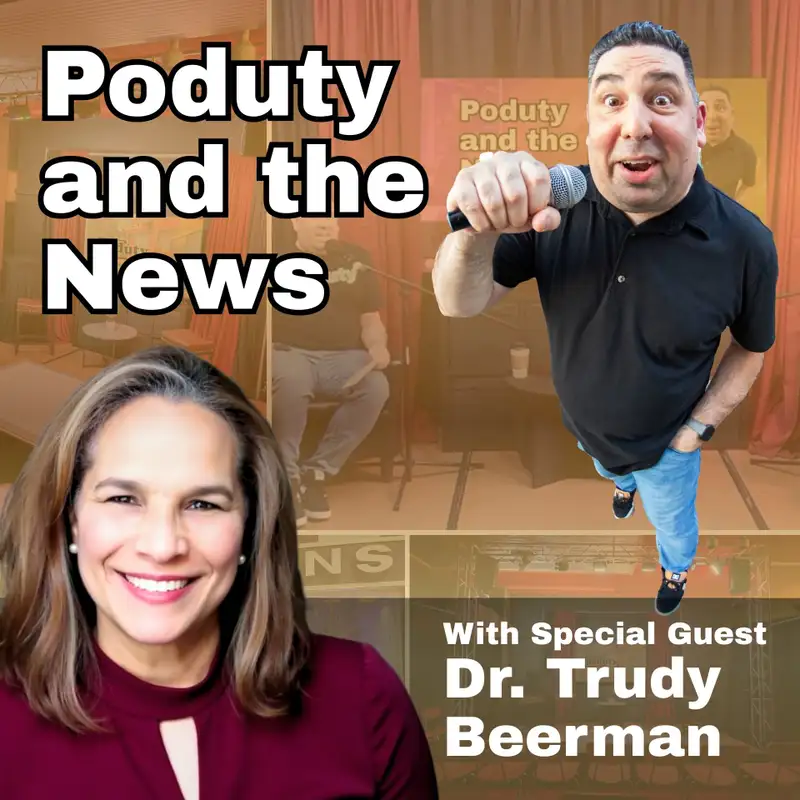
Hey everybody, welcome to Poduty and the News for Tuesday, February
24th, 2026. We're at the Poduty Live Podcast Theater,
downtown Tarentum, Pennsylvania on Corbet Street. I've got
Dr. Trudy Beerman joining me tonight, CEO of PSI
TV Network and the creator of REACHology.
We're going to learn all about that after the theme
song. What
time is it? What time is it?
Oh, it's time for Poduty and the News.
Poduty and the News,
the only live news podcast about
podcasting from the state.
Poduty
and the News. Poduty and the News, the only live
news podcast Poduty
and the News! Dr. Trudy, welcome to
the show. Welcome, Jeff. Thanks for having me.
You're very welcome. That, that song often gets my guests out of their seats,
gets the blood pumping. Uh, it is a Tuesday night, but You
wouldn't know it here with all the energy in the room. Joining
all the way from the CEO of PSI TV,
Dr. Tree, tell us a little bit about this TV network. I've been seeing so
much about it. We were talking about some of the stories that we selected for
tonight, and I just think you're going to have such a great perspective on some
of these. Tell us about what you're doing and what you're building.
Think podcast on TV. PSI TV
We interview experts and we have a channel presence on
Apple TV, Roku, Amazon Fire, and Vida TV.
And then once we've interviewed the guests, we do repurpose it and push it out
to our podcast, which is Treadmill Tracks for Leaders of
Brands. And then we also put it out to Influence Media News
and other, other publications of the social and stuff like that.
Well, tell us a little bit about the REACHology. I was learning about it, trying
to figure out, get my head wrapped around it. It's a pretty cool concept.
Of especially tying in your background with
the business strategy background and all in REACHology. Tell us
about the REACHology system. So,
yes, it is a system. Absolutely. It is a system. REACHology, I have the
trademark for that word, Jeff, and I've
defined it. So, you know, with the era of
influencers and influencers being
determined by their follower base,
influential reach has become generally understood to
be how many followers do you have, and the bigger the number of
followers, the bigger the influence you're perceived to be. The problem for me in
my space working with experts is that is not how
I am defining influential reach,
because the original understanding of influence is
your ability to persuade. And
a lot of influencers, which is a noun for
these people, are not necessarily
having any influence beyond the fact that
they get a lot of attention. So influencers
today are attention hogs. They get a lot of
attention. They put on a bikini, they do a prank, whatever the case may
be, they are definitely attracting attention,
but experts who have true influence
expertise may not actually have an audience or
a very vast audience. So what happens a lot of times is people like us
will go to the influencers and ask them to
share our influential content with
their expanded audience. So I define
influential reach as think of that big fish in a small pond,
that expert who has small audience base,
expanding that audience base where they have
actual influence over the expanded audience.
So for that definition, I just coined the word
REACHology and got the trademark for it. And there it is, a system,
because it, it explains how
we're going to— well, it doesn't explain it, but it captures the essence
of how what we do over here to
orchestrate experts getting and building that
influential reach. It's a great concept. And
is there a way for, for people to talk to you and
figure out maybe what their REACHology score is or, or
how big of a reach that they have? What's the, what's the way for a
professional to figure out, you know, how big of a reach they
have? I'm glad you asked that question because a
lot of experts think, oh, my work should speak for me. And
they will have real influence offline. So like in your
experience where you at your stage and you fill the
room with people, that is an offline
real influential action. So when
somebody can get people in the room, they do have
influence., but usually that audience
is small. So when they go digital, they open up
that audience to the world. The thing is that
when experts have real-life expertise, so for example, when I got
my doctorate, what I had to do was to go to LinkedIn, for example,
and update LinkedIn from saying Trudy Behrman, MA
to Trudy Behrman, DSL. So once we have
these real-life, real-world experiences,
credentials, publications, If the digital world is not aware of
it, we're digitally invisible. And so the
experts are— the Requology score helps the expert to
identify the gap. So I really have my doctorate, but
the internet doesn't know. So it shows you the
gaps and it shows you what is real, but what is not
visible online. It creates that report. It shows us
the lowest hanging fruit. As to where to go first to try
and really build that authoritative depth in the
digital world. That's, it's incredible. I love hearing about it. I
love, you know, learning these new perspectives, these new ways to reach communities, the
new ways to share your knowledge, and you're really honing in
on that. And if people want to reach out and connect to you and learn
about the PSITV network, is there a dedicated place you like to
send people to? Well, absolutely. They can go
to
psitvnetwork.com. Absolutely. That's super easy. We'll put the links in the show notes. And everybody
who's on the show, on Poduty and the News, we have a crew page. So
all my guests, all their links, their bio, that's all going to
be on the, the pod, not only on the show notes for this episode,
but there's going to be a dedicated page. So if Dr. Trudy comes back on
future episodes, you'll get to see all the episodes that Dr. Trudy was ever
on and all the links, all those connections. You know, follow those links,
support the guests that come on the show. It means the world to us
because they're helping us build this, this new medium of
live podcasting, and they're here to support what you're
doing. And you can also return the favor by supporting what they're
doing. And well, Jeff, if you're doing that, let me tell you, let me tell
your audience, that is a huge thing because
when you create those backlinks and media mentions
are powerful authority backlinks. So it's not just
the podcast experience, it's not just exposure to a new
audience, but when you have that dedicated page and those
backlinks to the— from the guest to your audience, that is doing much,
much more at the authoritative depth level than
you probably even realize. So kudos to
you. Yeah, it's that theory of, you know, we used to say
30 years ago, if a tree falls in the woods and no one's there to
hear it, does it make a sound? That really applies
to what you do online and offline. You
mentioned I may do a presentation at a college, but if it's not recorded
and it's not put online, then Google doesn't know about it,
the algorithms don't know about it. And what Dr. Tree's talking about, so important,
make sure that the things that you do, you're feeding it to
online, to your profiles on social media. And this, that's one
of the reasons I do this backlink page with my guests is I'm showing
them, positioning them as professionals with knowledge in the, in
the entertainment industry. I show the shows that they're talking on and we
give links back to them. So, you know, that ecosystem
of professionalism is, is what I'm, I'm trying to give
back. They're going to also link back to the show and we're going to elevate.
And that, we said it earlier today, rising tide lifts all ships.
And that's what these backlinks are for, to show that expertise, to
to share our knowledge with one another. PSI TV does the same thing,
so you'll see yours as well.
That's awesome. Are you ready to get into our first story?
Oh, well, let's go. Well, here we go. This is
Hidden Brain. It's going on the road with a live stop in
my home state of Pennsylvania at the Miller Theater, and it's been a
decade-long exploring psychological and behavior science through
audio. Now they're translating those insights into a live theater experience built
around storytelling, research, and interactions. The Hidden
Brain podcast and things like this, this is taking
that idea that you maybe thought of in your home
basement, your home studio, you started recording something and then
10 years later, you've built that community, you've built that
audience and now you're able to take that on the road. You've recorded videos,
you've recorded podcasts, now you're taking it in front of an audience. I
think this was a 10-stop tour that's coming up too,
multi-city tour. And it, to me, that's the best part of doing
these podcasts. And, and what Dr. Trede's talking about, showing your
expertise— well, this Hidden Brain podcast has developed such a
community that their community trusts them enough to come out and buy
tickets. So I, I want to throw this back to you, Dr. Trede. You, how
do you see the, this touring transforming
the podcast movement? How do you see this as a form of
entertainment for really making that connection with your
audience? Well, Jeff, honestly, your Podoodie show
is not too far off from that concept, to be honest.
So touring is, is an amazing concept. And
honestly, I may adopt that idea as well.
For someone to fill a
theater and have, as you say, a community that is
showing up in these different towns
is moving that expert from being a
big fish in a small pond to really expanding that influential
reach. They are in real time having
an impact on an audience. And I bet any money that that
show is not just the live audience. Somehow they'll have a stream feed or something
or they'll have a video that goes on after it. So I think that
is top shelf, multi-platform,
real-time experience. It builds depth with your
guests, with your audience, because they get to see you, they get to know
you. A video is a next best thing, but there's nothing
better than seeing the person in— you can say they're tall, they're
short, they're taller than I thought, they're shorter than I— you know, it's just
amazing. And it will show that the audience trusts the host. It's
just, it's amazing. And I'm telling you, it's going to carry a lot
of intellectual weight. Yeah, yeah. That's what I really wanted
to tie in with, with what you're doing, because that credibility aspect— if you're doing
a live show, even at a small theater like this, if you tell people, I'm
going to be on the main stage at the Poduty Podcast Theater, that adds
a ton of credibility. And, and what Dr. Trudy's building with the
PSI TV network, if you're on a show that's on that network,
or or you host a show or you want to run your show on that
network, that too is a way to add credibility to what you're building and
showing. So these live events are very similar to having a show
on TV on a network, and I really think that's
a great parallel between live performances and what you're
building. Well, let's give some kudos as well to
Shankar Vedantam because I mean, he does have that
NPR background. So that is a
carryover of, you know, his experience and, you
know, that connection to a very
strong brand that's carrying over into
his— into this experience. So for sure, we'll keep it moving. And my
next two stories, I've really been sitting on these two for a little bit. I
think I think Dr. Trudy is gonna be a perfect perspective
on this and podcasters, as somebody who's an
old-school DIY podcaster guy who believes strongly
in independent media, who believes still that a podcast is
an MP3 file distributed by an RSS feed to an aggregator app
to some sort of application where people can download it
on demand, there's a lot of changes happening in what we're considering
a podcast or or what a podcast could be. And the first one we're going
to talk about has been getting a lot of media attention, and it's Substack wants
your podcast on the big screen. And they're launching a TV
app for video podcasts and live streams. They're going to
give distribution to creators who are already distributing video on
the platform, and they're going to try to compete directly
with YouTube and Spotify and tap into that
700 million podcast hours that were streamed on TVs in
a single month. And the one thing people might not realize
is live streaming on TV has
surpassed the, the voice-activated machines in the house. So people
are going from their small devices— you know, 10 years ago it was
the iPod, now it's the phones— and they're skipping
over, you know, voice-activated devices and going right to the TVs.
And Substack here is another example of another media
company tapping into video podcasts? Well,
Jeff, YouTube just put out data very
recently that their TV viewing
has exceeded their mobile app and their people
viewing on mobile devices. The viewership from a
television machine has exceeded. So it is
creating a buzz everywhere and everybody's jumping on the train. But I have been
saying for years about podcasters moving to
TV. In fact, that was one of my first target audiences
because I saw the writing on the wall—podcast to
TV—and it's happening in real time. YouTube
exceeded Spotify a long time ago for
podcast exposures and viewership and downloads, much
less— I mean, to think that Spotify is in second or
third to YouTube, and now of of course Substack is going to jump
on. Of course they are. Absolutely they are. And the thing
is that when your content is on TV,
I promise you, when you say to someone, catch me on TV,
the eyebrows go up in a different way, even though
the TV is maybe YouTube. It's just something. There's something
about the TV proximity, the TV
perception that it just carries weight. It
does. Yeah, it adds so much credibility. I think here's what
I tend to boil it down to. A lot of times you start a podcast
and you start telling your friends and family and they understand like,
okay, that's a podcast and you're doing that. That's nice and
cute. And you know, you may be at Thanksgiving dinner, you might open up their
phone and show them your podcast on their phone and then
secretly subscribe. And they're like, okay, well, I'll pretend like I'm supporting you.
But when you go to, you say, hey, my podcast is going to be
on television, or my podcast is going to be on the main stage at
the local theater, that's something that's very tangible to
your audience, to your friends, to your family, to your fans.
They take it seriously at that point. You're no longer just,
you know, playing a game. You've moved to the serious
level. And, you know, it's like going from weekend warrior to pro
athlete. Exactly. It's exactly what Dr. Tree is talking about. It really gives
a whole new level of credibility to what you're producing. People
understand television, they understand radio, they understand
live performances much more than I'm just recording this episode
in my basement. Now you're going to be on the stage. Maybe it's even at
a local event or a conference invited you to speak and perform your
show live as part of the entertainment. That's something that
everybody understands, and that's That's taking podcasting from this niche
little industry to mainstream media, to
big broadcast media. It immediately puts you on that
same playing field. It's content and context
elevation. Absolutely. I love it. And we got another story coming in.
This one's a little different than the Substack one. This one
is Hulu. Hulu wants you
to watch video podcasts on Hulu, and they do something a little different
where Hulu does tie in a lot of their shows that they produce.
They also produce podcasts, little behind-the-scenes
tidbits, little stories about the casting and the crew
and, and backstories of some of the characters. And they're building this
other thing. We see HBO doing that a lot. You might watch Game of Thrones
and it says, stay tuned after, or subscribe to the
podcast after the Game of Thrones. And, and they're licensing this
full content to stream on their platform first, which is
important. But then they're also distributing it to other platforms, which is something
we're not seeing the Netflixes do, we're not seeing Spotify
do. They, they want to lock their content under these walled gardens.
Hulu's approaching it a little bit differently where they are going to
use their, you know, their proprietary shows that they're creating, but they are going
to distribute that to other platforms. And I think that's going to be a big
difference here. And we mentioned earlier that the smart TV
podcast consumption is surpassing smart speakers. So when you just
say, okay Google, you know, play Poduty and the News, that's
not as big as searching for this podcast on
YouTube. So to be able to see what Hulu's doing, we're seeing
what Substack's doing, this is bringing a whole new level
of— maybe not the level of podcasting that I'm doing here, this
smaller independent, but it's elevating the medium to
new levels. I think it's introducing it to new people And
showing people that there's a lot happening in the podcast scene. Jeff,
this is huge because we talked
earlier today about the whole rise of the indie
experience, and it is people like you and I that
are producing this kind of content that is finding
its own audience base and, and getting attention from the
big boys. And they're always searching for content,
and it's no surprise that they turn to the
podcasting world because these independent creators are
going out there and coming up with
content on a record level, you know, with a bunch
of creativity that those
paid producers have just, you know, burnt out over
time. So it's— I'm, I'm stoked about
it. That what you're talking about is one of the reasons I built this type
of space. One is we know that
major comedians and actors who have podcasts, we know that
they're filling arenas and large theaters, and we know
that most podcasters do record in a home studio, in their
basement, maybe in an office studio, but there's nothing in between.
So how do we get out of our home studio all the way
to Madison Square Garden? We're gonna need spaces to practice. We're gonna
need small theaters. We're gonna need TV shows to build
that credibility, to build that hosting muscle, to get us out
of the home studio, to small clubs, to the
theaters. So I think spaces like what I'm building here, I think
what Dr. Trudy offers, that type of
experience will lift your podcast up. It will give you new connections,
it'll bring you a new audience, and it'll give you new skills to be
able to host your show in front of a live one, in front of 20,000
people, maybe someday. Well, also, Jeff, the larger
the show, the more they are scrutinizing
your history of media appearances, the more they
want to see what you have done, where you have done it,
the kind of audience you're attracting and all of that.
And it's, it stacks, it compounds over
time. And yes, experiences lead to bigger
experiences. And the person who is not
documenting their continuous rise, you know, keeping a media portfolio and
all of that— so to my, my, my
experience here will go on my media portfolio page
to stack to and add to
the compounding of all these appearances over time.
Absolutely. Which just opens up bigger and bigger opportunities in,
in time. Yeah, you mentioned people are creating, you know,
new types of content. These big places are looking for it. And our next
story is one of the most unique stories I've seen of, for
content creation. And I love this. This was a real-time test.
So the, the GeekWire podcast, they did a live
on-air test, a 30-minute test of Amazon's
Now. It's called Amazon Now. It's a delivery service that
does deliveries within 30 minutes. So what an idea
for a podcast. You talk about what you're going to order, you order it, you
set the ball in motion, and then you see if Amazon can deliver
on it. I thought this was a very unique concept, a
very— one of those, you know, show-and-tell type shows where this
is what they say they do, let's see if they do it. So the proof
of concept, recording it live, you know, rolling the
dice not knowing what's going to happen, you know, not knowing if you're going to
get a show with some products at the end. It's— I, I just— this is
the type of content that I just fall in love with. You
know, when you go like this, you know, when you go live, in
any case, you know, you either bomb miserably before a whole bunch
of people or you do really, really well. And because
it's live, you know, flaws and all, it's
recorded, it feels more authentic. Authentic. And so,
the trust factor really skyrockets. And when you
can demonstrate something in real
time, it really, it's really like you said, proof of concept at the highest
level. Yeah, just the roll, like rolling the dice on a
whole— you could have a whole concept laid out and it could go
completely wrong. It could bomb. Yeah.
Or, you know, in this show, you do see the thumbnail where He's sitting there
with his water and it looks like a bag and it maybe it did, everything
did arrive in the 30 minutes. But to go
into a show not knowing the outcome, not knowing if it's going
to work, it's one of the most beautiful things about live entertainment, about
live podcasting. If it doesn't work, how do you carry the show
forward? How do you get through those 30 minutes? Well, I
take my hat off to all the people who do that. I'm not one of
those. Not usually anyway. So yeah. Let's keep
it moving. We're going to go over to
the BoomBastic. Mr. BoomBastic.
Yeah. The BoomBastic
Health Podcast. I like Mr. BoomBastic. He's fantastic. And I'm from Jamaica, man. So we
love that word like plenty,
plenty. It's the BoomBastic. I'm not going to be able to say the word now.
You're going to go with the song and dance. The BoomBastic
Health Podcast. Will record live from the
diagnostic zone at the VIVE 2026 conference,
positioning itself directly inside one of healthcare's
most influential innovation hubs. And this is a
great example of going where your audience is. And no matter
what niche you're in, no matter what you talk about, what your podcast is
about, there's probably some sort of gathering already in place.
There's maybe a conference that's already happening. And this is a
health podcast, guess where they're going? They're going to a health
conference and they're gonna be part of the entertainment, part of the show. They're gonna
be able to connect with other healthcare professionals, other people in the
industry, do interviews, get more content for the rest of the
year. And the people in the audience, they're already interested in what
they're talking about. So this is a, a great example of where can you put
your podcast in front of where your audience is already at.
I love this. I've, I've done this at some level, but not at
this, this experience, because this is a top-shelf experience. I
mean, being in the middle of an innovation hub and
the proximity to all these leaders—
proximity is huge, Jeff. And it's one of the reasons, like, when people come to
the PSI TV show and they are in
the studio, they are on TV, that proximity, they're
to the brand, to the host. And again, it is
huge. And a lot of times, you know, we'll see that we take a picture
with, you know, the speaker of something, or if you get an opportunity to take
a picture with the president, for the proximity is huge.
So proximity to the space is elevating
for the podcast as well. It can
almost be seen as an industry endorsement. This is brilliant.
And I mean, One of the things we do is we will
go to where our audience is, but we go for different reasons.
But this, this is, this is amazing. Yeah, on
the checkboxes that Dr. Trujillo and I have given you of positioning yourself as
an expert, you're doing live shows, getting on
television, and going to conferences where other experts are. If you can
bring other experts onto your show, that also will
give credibility to your show. If you're in the middle of
a, you know, 2,000, 3,000 people conference and you're able to perform your
show live, that's 2,000 people that just found out
about you who also are already interested in the things that
you're talking about. So don't just think about how do you perform your own
show in a bar or a restaurant, but where are the
industry headed? Where do they hang out? Where do they get
together annually? Is there a retreat? Is there a conference? And that's where you
need to start to think about positioning your
podcast. Speaking of positioning, what better place to position yourself
than on a 143-foot screen?
This is Circa Mania, is going to Circa Resort and
Casino, and it's turning a WrestleMania event into a
full media hub for 5 days. It's going to
blend podcasts, art exhibits, superstar appearances
massive watch parties at a place called Stadium Swim, and that place
has a 143-foot-wide screen. So
you imagine performing a show on a screen that
size, and it's this multi-day event, it's coinciding
with WrestleMania, they're going to bring on wrestler—
wrestling personalities, they're blending in the audience, the livestream
energy and fan engagement. This is something where they've built
up something, obviously wrestling is just bigger than we'll ever
be, but it's that community getting
together, celebrating the thing they love. So that's kind of the lesson I want to
take from this story is, you know, whatever you're passionate about,
bring those people together and maybe someday you'll be on
a 143-foot screen. Well, I mean, you can also make it
yourself, but this is layered. This is a layered experience. This
is content in layers. I mean, this is this is
huge. This is ecosystem thinking because each thing
is feeding to the other. I mean, you'll get the person who is interested in
the wrestling suddenly watching this other thing. It's, it's
amazing. I, I operate in ecosystem, so I get
this. It— this is, this is the way to go. This is like
a little TV programming because they're— this is obviously tying in
with WrestleMania happening, but different days, there's
different podcasts at different times doing different shows. So there is a little
bit element of programming, and it's already part of this event that
you're already immersed in. You're already in Vegas, you're already going to be
for WrestleMania. You go a day or two earlier, you get this
extra layer of experience that you wouldn't get just going to the
matches. Well, the one thing I always warn my guests is this
goes so fast. That was already Story number
6. Dr. Trudi Beerman, thank you so much. CEO
of PSI TV Network, REACHology. One
last time, I'd like to turn the stage over. Please plug, promote,
talk about anything you'd like. The floor is
yours. So one of the things I really would like to share with your audience,
Jeff, is, you know, we're, we're out there, we're doing
podcasting, we're doing TV. What we're really doing, we're in a content space.
And a lot of times our guests are overwhelmed with the
whole content concept. It feels overwhelming.
And social media posting, I call that
digital dots. But when
you talk about the algorithm, a lot of people say, oh, the algorithm shadowbanned me.
People don't understand what the algorithm is. And the
algorithm is simply the way that the internet figures
out what to recommend. So we have trillions
and trillions and trillions and trillions of what I call digital dots,
content pieces, trillions and trillions and trillions. And then what happens
is somebody puts in a search on Google, on Bing, on
ChatGPT, whatever. They ask a question and then
the algorithm attempts to go out to these trillions and trillions and trillions
of content pieces to look for what's the most recent. It's not going to send
up an old piece if there's a more recent piece. What is the
most relevant? And which of all of these things is it
going to recommend? So what happens is when you're doing these
content pieces, if you're just looking for virality,
you know, okay, so you did a prank and it got a lot of attention,
but if you're an expert, that's not going to get you the gig. That's not
going to get you the contract. That's not going to get you hired.
So for the audience that is of the expert
level, you're not gonna be just chasing virality, guys.
You want to be seen and respected for
the expertise that you have. You need to do more than just
create these posts, these digital dots. You need to create what
I call authority signals so that when
these questions are asked and the systems go out to look for
the answer, your content is
solid and has a better chance of being offered
up as a solution to someone's
problem. Oh my goodness, it's so important to get those dots connected
or even get those— Dots connected, yep. Get the dots placed so
that when people do the search, you may have 5 dots
that pertain to that search and you become the most relevant person
for that search. And I love that though, that The way to think
about that in terms of little dots, and then when people are looking
for you, you want to have the most dots relevant to that search.
I think there's no better way to position yourself as an
expert than to think about it that way. Think about putting these dots
online. I only have one plug I like to do. I have a theater space,
and if you like live podcasting, if you like what we're doing here, Come
on down. No contract, no minimum ticket sales. I'll
sell tickets for you. I'll record the show, give you back the recording. It's
your audio. I don't take any ownership over it. And at the end of the
night, we split the door 50/50 at the
Poduty Podcast
Theater, poduty.com. This has been Poduty and the
News for Tuesday,
February 24th, 2026. We'll see you on
Saturday. What time is
it? Oh, what time is it? Oh, it's time for Poduty and the News. Poduty
and the News, the only live news podcast about
podcasting from the States. Hold to
the end of news.
Hold to the end
of news. The only live news podcast
about podcasting from the stage.