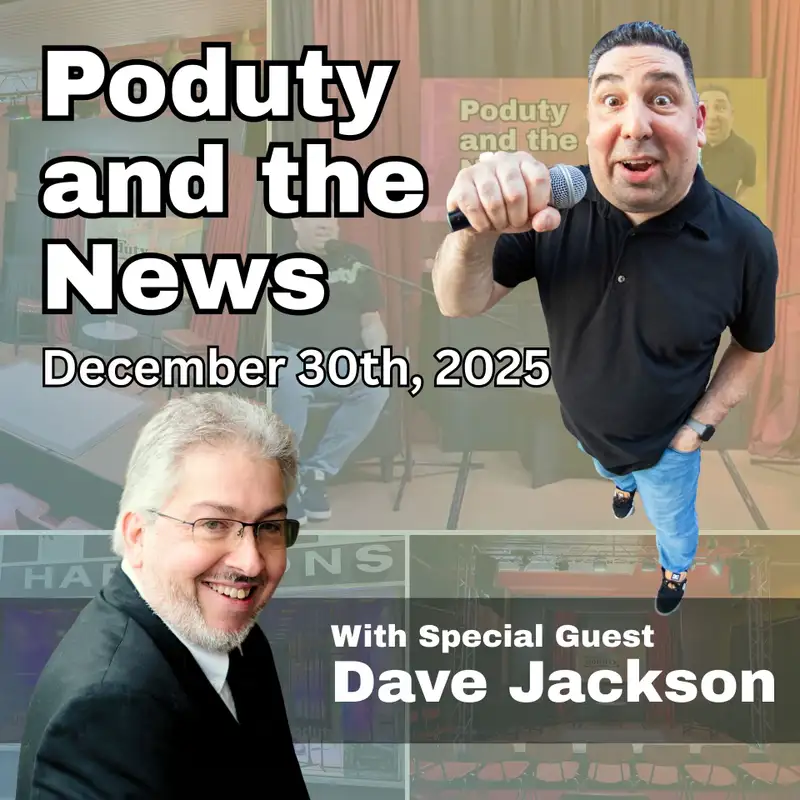
Hey, everybody. We are live Poduty and the News at the Podcast Theater on Corbet
Street at Harrison's in downtown Tarentum. We have an impressive,
amazing guest joining us tonight for six news stories. Dave
Jackson. Welcome to the show, dude. So happy to be here.
Ready to have some fun, and we're. Not too far away. We were just talking
before the show. You're in Akron, I'm in Pittsburgh. Pittsburgh just had a terrible
weekend in Cleveland. I'm as
shocked as you are, probably because the one thing the Browns can
do is find a way to lose, and I was really surprised. Well,
Dave, I got just one question for you. Oh.
Do you know what time it is? Time for Poduty and
the News, my friend. What time is it? What
time is it? The
only live news podcast about podcasting
from the stage. The
only live news podcast about podcasting
from the stage. Dave
Jackson, welcome to Poduty and the News. It's such an honor to have you here
tonight. Just a legacy in podcasting hall of fame inductee
school of podcasting. Podcasting since 2005.
Yeah, we would chisel them out of stone back then. But,
yeah, it's been fun to watch. I mean, it was in
2005 because everybody goes, why is the hall of fame full
of old white guys that are all nerdy? And I'm like, because we
used to be young white guys that were nerdy and we figured out podcasting. But,
I mean, that was pre WordPress. Really.
Pre Apple. You know, you were hand rolling your RSS feed. It
was, you know, I remember. I. I would record my podcast.
I would. I used a thing called Feed for all that. I would FTP
my feed to get updated. I would update my website in Dreamweaver. It was
just a, you know, 37 different tools to make a podcast. And so
now it's, you know, a piece of cake. And you can buy. I got a
P4 here. This thing's like, less than 200 bucks. And,
you know, it's just amazing how far we've come. Yeah, I
remember using, like, feedburner to try to syndicate my feed and
even Google Reader. Just trying to subscribe to blog posts
and trying to find podcasts and get that content delivered to you,
but before the algorithm did it automatically. I think the
Internet used to be more like a treasure hunt. You used to. Oh, big time.
Used to be able to go out and try to find these things and
you'd uncover all these things that. It'd just be amazing. Yeah. I remember
when a friend of mine had just come back from this marketing convention.
And he said, hey, and again, totally dating myself. He goes, you know how you
missed the MySpace boat? And I'm like, yeah, yeah, don't rub it in. And
he said, I've seen the next big thing. It's podcasting. And I was like,
okay. So I go to Google and I type in podcast, and there's like, one
and a half pages. And I go, wait, how do you. How do you spell
this? Again, he goes, it's podcast. Like, you know, and I go,
dude, there's nothing on this on the Internet. And I finally figured out
how to kind of paperclip one together and some rubber bands and, you know,
MacGyvered one. And then I just remember I uploaded a file and there was this
software with a big picture of a lemon on it called Juice,
and I downloaded it, and the first thing was I heard Adam Curry's voice,
and I was like, hey, I know that guy from the MTV Headbangers ball.
But I put my feet in and I saw the download come down, and
that's when the light bulb went off and went, oh, I see what this does.
And I was pretty much hooked. And then probably,
I don't know, two or three weeks later, I put out a couple episodes,
and a guy from Nuremberg, Germany, sent me voicemail.
So, number one, I'm in the middle of Cowtown, Ohio, and some guy
on the other side of the planet, like, not only found my show, but
liked it enough to send me a voicemail. And that's when I grabbed my flag,
and I'm like, I claim podcasting in the name of Dave, and
it's been fun ever since. You're hooked. You mentioned Dreamweaver
back then. I can even recall. People call this now cowboy coding.
But I remember going on Dreamweaver, editing my index
HTML file, and then just publishing it in real time, not
even working in a playground environment.
You would just edit and publish the real time on the web and
just hope for the best. That's it. Cross your
fingers and hope. Well, tell us a little bit about school podcasts.
You know, over a thousand podcasters have been helped by this program, and
great podcast, great community. If people want to
connect with that and really meet new podcasters,
you know, tell us a little bit about the school of podcasting. Yeah, it's
at its core, it's. It's courses, a community, and
consulting. So I've got, you know, everything from planning
your podcast to how to grow it, how to monetize it, how to get in
Apple and Spotify and all that fun filled stuff, all the points in between.
And then you've got consulting. So every month you get five hours of one on
one consulting with me. And then the community is really what
keeps people. So every Friday we do lunch with
Dave and then we do one on the weekend, we do one on a Wednesday
night. And it's just everybody sharing what they're doing and
what's working. And you've got everybody from
accountants to ex pastors to
ex military. It's just a wide range of
everybody. And they're dog groomers. And we're all just like, hey, I
tried this or who are you using for merch? Or whatever it is. And
then we also, I think one of my favorite things is we do what we
call listener parties. And that's where somebody especially
like your first episode and you basically, we
stream it live and everybody listens. And if you get confused or
bored or if you really like it, you just raise your hand. You're
like, hey, I don't know what you're talking about here. Hey, that was really cool
how you tied in a personal story into this to bring it in or
whatever. And so because it's one thing to
listen to somebody's show, but you know when you wanted them to laugh
or cry or whatever, and when we're all just sitting here deadpanned
and we're supposed to be laughing, well, now you can, you know that because you
can see us. And at first people are like, I don't know if I want
to do this. I'm like, look, you're going to put your show out to the
public anyway. Why not get some feedback before you put it out there?
Because so many podcasters don't. And then they just keep putting out,
you know, not that it's bad, it's, it's kind of meh, like,
okay, all right. But if we can point out that, hey,
you know, you're my favorite is like, you have a great
theme song, but there are a lot of times where people just play music and
they're like, you know, you just hit play and it's bad at. And that, that,
the debt and that and that like for 30 seconds.
And I'm like, what am I supposed to get up and dance here? What's going
on? You know, and so it's just honest feedback to help
shape it because we're all there with the, really, the
main goal of just making content that engages their audience. So
it's a lot of fun. I've been doing it for over 20 years now. And
it's always fun seeing, you know, people come in.
And I think the reason why podcasting has
such a great community is because there are companies out there
now putting out absolute AI slop. And we want to help
make as many good podcasts as possible so that when we do get that,
that person. My best friend just started listening to podcasts. I'm like, where you
been? And he said, I found a really good one. He goes, but, man, there
are so many really bad shows out there. And I go, yes, there
are so many. A lot of fun. And that's
some of my pet peeves about some of these apps is things I've
heard people talk about is we need some sort of filtering,
if not to just get rid of the AI slop, but a new
podcast or your friend just came to podcasting. Nothing is worse than
you really get invested into a show and you go back through their
catalog, and the last published episode was 2023.
Done anything. So I really wish we were working towards a way to
really filter out so that we could only see active shows. I think
that would really help the directories. It would help with the user experience. It would
help with discovery. I don't know how to tackle that. I'm not a tech
guy. Yeah, it'd be great to only show me shows
with more than five episodes because there's so many.
There's one episode and somebody going, I don't know, is this on? Oh, it's
making the lights blink. What do we do? Like, ugh, you know? And then it
sits there forever. So it'd be great if we could filter that out.
Five episodes. Last published was this year. I'd be so excited to
just have that filter. They last published date was in 2025.
Yeah. Would make a huge difference in discovery. Yeah.
Because I know they say if you make it past, I think it's 8 or
10, you're more than likely to keep going. But a lot of shows, in fact,
Riverside just put out a stat which that. I forget what it was. Something
ridiculous. Like 44% of podcasts don't make it
past, like, five episodes or something like that. And that's
it. It's pretty insane. Stat. Yeah, the drop is
very steep, even at 10. So, you know, this show, I got to 35.
I even tore my Achilles over the summer. Had to have Achilles surgery.
Haven't missed a week. And I'm. We're off to the races. I'm having
more fun doing this show than I've done anything in the past 10. Years. So
nice. We're gonna keep it going. Yeah. Well, good on you for pushing through with
the Achilles man. That's. That's no fun. It's funny you say pushing,
because I was actually pushing on a skateboard when I popped that
sucker. Ah, that'll do it.
Well, let's get into a controversial topic.
Netflix presses play on live podcasts. We're gonna file this
under Platforms and Distribution, and it comes to us from the Hollywood
Reporter. Netflix is officially stepping into live
podcasting starting January 11th with a live
episode of the Bill Simmons Podcast, streaming Sunday nights on
Netflix before living on Spotify and all major
audio platforms. This move is part of a broader partnership with
Spotify's studio arm and the Ringer, and it
signals Netflix's growing push into video podcast
as it competes more directly with YouTube, with additional
shows from iHeartMedia and Barstool becoming Netflix
exclusive. This isn't an experiment. It's a platform
strategy shift that could reshape how audiences discover
and experience podcasts. So this is the
doozy of one that we've been talking about on this show. I've heard you talk
about on School of Podcasting, especially the last two episodes.
And we've heard this on POD News. Netflix
is really making this push, just like even TikTok is doing
and Spotify is doing and YouTube is doing, trying to
maybe reclaim or take over what a definition of a
podcast is behind their paywall or in their
ecosystem. And in this case, this is very similar
to that. They want to have that exclusive deal. And
is this really a podcast? I guess that's what we're going to get into first.
Yeah. This is where I always say, from my standpoint,
being kind of a technical guy, I go by the technical definition. And
that is a podcast is audio, video, or, yes, even a
PDF delivered via rss. And I am of the no
rss, no podcast. And so when
they say, oh, it's going to be a live podcast on Netflix, I'm
like, no, it's a podcast now. That's a live stream.
It's a live show, but no rss, no
podcast. And Steve Goldstein is a friend
of mine. I've known him forever, but he keeps redefining it. And
my question is, and I don't mean disrespect to Steve, but why
are we listening to Steve? Why? And in fact, I asked him, after I threw
him under the bus on my one episode, I got on Zoom with him, and
I said, why don't you accept that
no rss, no podcast, and he's like, well, I'm surrounded by a bunch of
gen zers. And. And he's like, they all think
YouTube is a podcast. And the problem. My background is in
teaching. And so with me, I think everything can be
fixed with education. I'm like, oh, we just need to get them in a classroom
and go, here's what a podcast is. YouTube is a show. It's a
channel. That's what that is. And here, these guys in Apple and Spotify,
these are podcasts. So, you know, why do we have a different name for
books than magazines, than TV shows? It's a different
format. It's a different name. And it drives me bonkers that,
you know, Dan Granger over at Oxford Road has spent most of
2025 going, so what's a podcast? And I'm like, why? It's. Here's the
definition. Why don't you accept this definition? And it drives me
bonkers. So. And then the thing that James
Crinlund pointed out, because he's a nerd, too, he
somehow got into the back end of Netflix and
was able to see how many views those shows are getting. And
his show is Pod News Weekly Review,
gets more downloads than 20% of the shows on
Netflix. And I went, so we all get like, ooh, Netflix. Which, you
know, hey, anytime I can get more exposure from my show, that's fine.
It's great. But, you know, it's not all that. And then the thing
that I just scratched my head on is the exclusiveness,
because when all those shows went on Spotify and they were
exclusive, and then when their thing came up to
renew, a lot of them said, no, thank you, because you
want your audience to follow you to Spotify. But a. In my
opinion, Spotify's app, I love it for music
discovery, but for podcasting, not so
much. And so I didn't follow anybody over to Spotify. I'm like, well, there's only,
I don't know, 200,000 other shows I could listen to.
So I'll be interested to see what happens. But I don't know, what are your
thoughts? Yeah, you said something on a recent episode of School of
podcasting about YouTube is
shouting from the top of the mountain. We have podcasts now. Spotify
is. We have video podcasts. And what's happened over the
last couple years is there's really hasn't been an argument to counter
that. And while they get the big media, the big press, they're
using it to maybe move the stock number a little bit. You know,
they're able to get that coverage. And people like
myself, even though I disagree with what YouTube is calling
a podcast, I don't have the same voice and coverage. So for these
last couple years, they've just kind of gone unchecked trying
to tell us what the definition of a podcast is. And nobody
pushes back on the shenanigans. The
YouTube changed the definition of a view of a short
to zero seconds. So if I go to a button and I go
and tap it, There you go, That's a view. Then they came out, the
CEO came out and said,
I think it was 2 billion views in a month. And I go, well, that's
really easy to do when a view is 0 seconds.
You know, I was like, I'm like, is nobody putting these two together? They just
changed the definition. And look at us. Two billion views. I'm like, ah, this
is driving me crazy. Or grow in year after year. And let's
go to a real live podcast. We'll go to our second
story today, and this one's going to be live from the CES showroom
floor coming to us from ECAMM Live. You mentioned ecamm a little bit earlier
today, and if there's anything I love, it's a meta subject. For
example, this is a podcast about live podcasting,
recorded live. And here we got from ecamm
on an upcoming live stream of the flow. Host Katie
Fox sits down with Dave Hamilton, and we'll talk about podcasting
live from the showroom floor of the Consumer Electronics Show.
Instead of just attending ces, Dave reported live from
it. Navigating noisy environments, fast moving stories,
and constant tech distractions, the conversation pulls
back the curtain on what it actually takes to podcast live at a
massive event. What tech trends truly mattered and
why experience and context beat shiny new gear
every time. And this story just caught my attention just because the
meta, you know, he's already doing a live podcast from the showroom
floor. Now they're going to do a live stream, talking about the live podcast
from. From ces and just a great way to kind of pull technology
together and really expand kind of what this
is. This is an example of expanding what the definition of a podcast can be
because they're doing all kinds of things. They're doing news reporting, they're doing
a recap, they're doing an interview, a live stream all at one time
to make a podcast. Yeah, absolutely. And Dave
Hamilton's a good guy. I got to hang out with him at
either podfest or Podcast. Movement had been around forever, but yeah, it's
kind of, and this is kind of where Steve Goldstein is
going for. He just, he likes to use the word podcast.
But his point is that, you know,
20 years ago you couldn't have a live broadcast
and 20 years ago you didn't have this. And now it's not a matter
of, you know, if I do a live stream
and I record that, I can now do anything I want with
that. So I've got a live show while I'm doing it. I can take it
out like you do and put the video out on YouTube. I can put the
audio out as a podcast, I could put the video out as a podcast. But
who, who's got the budget for that when YouTube is free and
then I can have it transcribed and turned into a blog post?
So I get, when Steve talks about, it's a fluid area
that you aren't just video, you aren't just print, and you
aren't just, you can kind of go wherever you want. So I get his point
on that. I just push back. When he goes, yeah, that book is now a
podcast, I'm like, no, no, you had me and you lost me, Steve.
So I get it. But it's the thing that's just nuts about that
is to be doing it from a floor of some show
that just wasn't possible 20 years ago. The WI fi wasn't
there. The camera would have weighed 400 pounds on your shoulder.
So it's kind of crazy. Yeah. What used to cost a
million dollars to build a television studio. I'm not saying this is the
quality of a television studio, but I built something.
Five, six thousand dollars isn't too far off from
what took millions of dollars 20 years ago. So the
technology like you're mentioning has grown so fast
that anybody has access to do this. That doesn't mean
necessarily everybody should do it. It just means that you have the
ability that you are so connected to the rest of the world now.
The cost, the barrier to get into this is so
low that you could be live from a conference floor and then
you could do a follow up broadcast. Bringing in ecamm, you
know, a few weeks later, doing a recap. I was talking to somebody right before
I came on here, member of the school of podcasting that's in
Australia, and he sounded like he was sitting right next to me.
I'm going to jiggle my cables here. I keep hearing that that's driving me
nuts. But it's, you know, that's amazing.
And, and like, here's another. This is the new Zoom Podtrak
P4. And you know, it's under 200 bucks.
And five years ago, this would have been $1,000. You know, it's just
crazy. Speaking of great technology, when
community and beer is the headliner, this comes to us from
I Like Beer, the podcast. And this is what on
location podcasting looks like when it's done right. The I
Like Beer the podcast went live on site and at Bergen
Beer Company during its massive 50 brewery anniversary
celebration. Rather than just covering beer, the episode
asks a bigger question. How does a brewery become so respected
that 50 of the nation's top brewers show up to celebrate?
The answer isn't hype or production tricks. It's community
relationships and telling the story from inside the experience
instead of after the fact. And this is like what we preach in
live podcasting. It's about community. It's about bringing people who are
like minded together. And here's a brewery that's
so well respected that 50 other breweries want to
come hang out with them, do some live shows, and
just celebrate beer together. You know, this beer
community I don't consider. You know, there are
tons of podcasts about podcasting, and there are other podcast consultants and,
and I don't know that I've run into anybody where they're like, oh, well, I
can't talk to him because he's my competition. Because again, we're all.
Our primary goal is to help everybody make the best shows there
are. Because when we get that new listener, we
don't want them to go. I don't know, it's just some guy and his buddy
that he grew up with, and they're both laughing about Orange Gatorade.
I don't know what the inside joke is, but they thought it was funny, you
know, so we're trying to help people make great shows. And it's just
amazing that, like, some of my best friends are my
competition and. Because who else am I going to nerd out about
podcasts with than another podcast consultant? So this
is just a great example of the power of community embracing
other people, because I'm sure that those people that are coming to that
brewery are learning things. You know, you're kind of helping your competition.
But on the other hand, I'm sure there's really bad, you know,
breweries and, and they want people to go, wait, do you want, do
you want a Miller? Do you want to try some of this draft? And they're
like, I don't want to do the draft stuff or homebrewed stuff. Well, if
if it's all good, then you have more chance of people
going, yeah, let me try that new stuff. So I just think it's a
great idea. And like you mentioned, the best part about
podcasting is meeting other podcasters, even if you're talking about the
same thing. Like, I'm in Pittsburgh. I've met 70
different sports podcasts in this town, and they all know
each other, and they all share ideas and tips and guests, and
it's such an amazing collaboration for people who are
doing the same thing that you want your peer to
succeed. It's almost that rising tide lifts all ships. If we get
three or four great Pittsburgh podcasts, then the other ones start to
get traction too. And podcasting is just one of those things where the
more you help each other, the more other people help you and
the faster you grow and become a better podcaster. Yeah, I forget what the
phrase is, all boats rise in high tide or something like that, but
it's a case where we want everybody to benefit as more listeners
come in, so. Absolutely. So the more we benefit,
the more chaos there is. And if those of you watching this was
a live stream podcast from, it looks like a radio station that did
an after show. They called it Shover Time. This is
chaos as content. This is kind of the area I like to thrive. And I
grew up skateboarding for 20 years. I was into
punk rock music and hip hop music in the 90s. So, like, chaos
is at the center of my core. And this is when a live show
is the joke. This comes to us From Kroc on YouTube. This is what
happens when a podcast fully commits to the live experience.
Klein Alley show took their show on the road with
Chovertime, a recording live from Hollywood
Park Casino. The result wasn't polish or perfection. It
was chaos. Audience participation, bad bets, questionable
decisions, and a room full of people who showed up knowing anything
could happen. It's a reminder that for some podcasts, the appeal
isn't tight scripting or clean production. It's unpredictability,
shared experience, and letting the audience feel like they're part
of the madness. Something I love about podcasting that
you don't get with any other genre. With comedy, you
don't get a unique experience every show. Comedians tend to
work on material. They're trying to put a show together, a set together,
and they perform that content in multiple stages, multiple
nights, night after night, until they get that perfect joke. And when you
listen to musicians, when they play a city, they go to the next town
and they play the Same set at the next town. But when you
go to see a live podcast, and this is a beautiful example of that,
the only time in the history of the world that you will see that performance
is that night, in that moment. They won't go do this
show tomorrow night at a different casino. They only perform
that one time and one time only. And to me, that's. That's
the magic of live podcasting. The. The beauty of getting up on a stage in
front of people is it's a once in a lifetime experience every single
time. Yeah, absolutely. And I mean, if you ever watch the
movie Private Parts about Howard Stern
and there's a line in there and they're like, okay, well, you know, X amount
of percentage of the people love Howard. Why? Can't wait to hear what he's
going to say next. There was this element of, like, we're just not sure what
he's going to do. He's crazy. And then he's like, great. But what about the
people that hate him? They're like, oh, number one reason they listen to can't wait
to hear what he's going to say next, because they were getting ready to go
crazy. So, yeah, that. That element of I wonder what's going to happen
next is a great way to suck in your audience. I always say,
you know, the ingredients that you have to play with. You either want to make
them laugh, cry, think grown, educate, or entertain. If it's information,
they can't get anyplace else, which is kind of what this live show is
that's really in there. And then if you can save them time or save them
money. So when you start combining those, like, John
Oliver has that show on HBO last week, tonight. Well, he makes
me laugh, he makes me think, he gives me information. For whatever reason,
I can't get anyplace else, you know, and then,
you know, you mix those all together and you got a pretty good show. And
this is just a great example. And then the fact that it's live, and my
guess is that audience is engaged throughout the show and probably
yelling things out. I. I had a friend of mine that ran
sound for. I think it's POD Save the Queen, which is a political show. And
they were selling out theaters, like, making like 20 grand a night.
Not too shabby because they were selling tickets in this theater in San
Francisco. And he said what the weirdest part was. He goes,
their audience is there. There's no ads. It's a live podcast.
And it was like Freeberg at a Skynyrd Concert people, come on,
Play Freebird. They're like, come on, Do Blue Apron. Do. Do
Better Help. Come on. You know, and they're like, guys, there's no ads tonight. So
finally, they're like, all right, we'll just got to give the audience what they
want. So live is. It's a whole different
beast than recording at home, you know, things like that. So it's
a different skill. But, boy, when it's. When it's rocking,
it's. It's hard to beat. Yeah. And obviously, the kroc, this
is a. Probably built off of a radio show. These are probably morning DJs that
this is their environment, and they're bringing that energy, they're bringing
their fan base. And to be able to pull something off like this is
just incredible. If you. There's some crazy things that I listen to parts of it,
and they pull people up from the audience. I think they
offered to give somebody a haircut if they could cut his hair any way they
wanted in exchange for some tickets to an upcoming
concert. So you never know what to expect. And that's really
keeping the audience on their toes, keeping them guessing to what's coming next.
That's the best way to put together a live show.
Yeah. And when it's a radio crew,
most of people are listening to that in their car. And now I get to
actually see what they look like. And that whole aspect I remember in the early
days of podcasting, Jay Moore's a comedian. He was in Jerry Maguire
and done some acting. And he said how he noticed, he
goes, it wasn't the advertising. It's the fact that I used to have clubs,
and all of a sudden I could sell out theaters and people would start
shouting out things he had said in the podcast. So that's how he
got his raise, by just having more. A more engaged audience that
started showing up to shows. Yeah. Speaking of showing up,
the shows crossing borders when podcasts
outgrow their borders. Podcasting's global moment
is on full display as Tony and Ryan podcast take
the stage at Radio days Europe in 2026.
What started as a massively popular Australian show has
clearly outgrown national borders, earning them a spot at one of the
world's most influential radio and audio conferences. In
a conversation with fellow Aussie Craig Bruce, the focus
isn't just on their success, but on how podcasting and radio
continue to borrow from each other, and why live on stage
conversations are becoming essential to the
medium's future. Radio Days Europe is nothing to
sneeze at. That's one of the huge conferences
in this genre. Like we mentioned earlier, part of
their entertainment for the event is doing live podcast
recordings as the entertainment. So these are things to think of
down the road. How do you fit in there? How does your podcast fit into
even smaller conferences or smaller community events? Is
there a place for you to meet people like you and perform your
podcast? Yeah, it's great. And I know
Australia has. I forget it's something in Andy,
but there's a duo in the morning and they take their
radio show and put it out as a podcast, and it's
way more. I mean, the beauty of podcasting is it's time
shifted. So if these are like morning guys, you're like, I don't want to get
up at six in the morning and listen to the radio, but I can check
out their podcast later. And it's hugely popular, so
it's. And the fact that it's worldwide.
So, you know, if we go back 20 years ago, these people would have a
radio show in Australia, and that's kind of it. And, you know, maybe if you're
in Melbourne, you might be able to pick up the station. And now it's
worldwide. And so they've got this whole thing. And that's when you get the opportunities
to speak at places like this. I always say a podcast helps
you build relationships, and those relationships lead to
opportunities and the opportunities lead to more relationships. And
it just turns and turns and turns. And so you just never know.
I mean, I, I, many moons
ago, I was the head of podcasting at the New Media Expo, and I
hired Pat Flynn to speak. And so I got to know Pat
then, and I've known him through the years. And fast forward, I'm at
podfest, and lo and behold, there's Pat Flynn, and I'm talking to Pat,
and another friend of mine popped up. And then Michael Stelzner is
a guy that runs Social Media Marketing World in San Diego. And he came
up and we were just talking podcasting. So I was doing my, you know, you're
on my jam now I'm going to talk about podcasting. And when we got
home, Michael Stelzner called me and said, hey, you know, it was great meeting
you. Would you be interested in speaking at Social Media Marketing
World? So it's, it's again, it's those relationships that lead to
opportunities. And as long as you take advantage of that. So I'm here to tell
you, these people that are gonna be speaking at Radio Days Europe,
that you don't realize that if you're a keynote for what, let's
say it's 20 minutes, a half hour for 30 minutes, you are
Radio Days Europe. That's a huge responsibility. And
it always just blows my mind when I go and I see somebody
speak for the first time and you can just tell they're just winging it. Like,
they put the slides together last night and I'm like, wow,
you're really blowing the opportunity here. But yeah, Radio Days Europe
is one I've never been to, but I wouldn't mind going.
Yeah, a lot of times, unfortunately, some of the bigger acts,
they just get hired. They're the reason why those events are selling tickets
and they show up and it's like a Q and A. You know, they don't
have anything prepared and it's just a one on one Q&A with maybe
the host. And. But examples like this, where this is a
podcast where you had mentioned 20 years ago you were just
going to be on Australia and nobody outside of Australia would have heard you.
But now, because of distribution, because they're able to get out there, they're going to
be up on stage for 30 minutes and then think of the people that they're
in front of while they're up on that stage. So to get to that
level, to be invited to be on the main stage, but then all
those other industry connections you're in front of and you're
showcasing yourself, it's almost like a calling card or your resume for
future jobs and gigs. And it also works the other way
around. Dr. Emily Morse does a show called Sex
with Emily, and it got really popular. And
when Howard Stern, let's see, who, who did she replace? It
might have been. Yeah, Howard Stern had gone off in California because he went
to satellite radio. And so they brought in Adam Carolla and
they brought in Dr. Emily, and she was on
radio for quite some time. But unfortunately, like as radio does, they
switched their format and she was gone. But then she got a job
on Bravo, on the Bravo channel, doing tv. And
so the whole time she's kept her podcast. Why? Because it's
the entertainment business and eventually something's going to go left of center.
But she maintains her audience through her podcast. And then
it's like, oh, by the way, I'm now going to be writing a book or
I'm doing this or that. So the podcast is the thing, the
constant through all these other opportunities. So, yeah,
so you never know what's gonna come about. It's the one
asset that she owns, most likely owns has the most control
over, doesn't have to answer to TV executives, doesn't have to answer to
radio executives. This is hers. She built this media
asset and she controls it and owns it and can release it
however she wants. And yeah, Aisha Tyler is an actress. She
was, I think was Ross's girlfriend
on Friends for a while, but she's also a director. She was in,
oh, it was on FX Archer. She was the
voice in Archer, one of them. And she was a podcast movement. And she
did every aspect of her podcast. She edited it, she posted
it. At the time I worked at Libsyn, so she would upload it to
Libsyn and she said, you know, one thing, just what you just said, she said,
the one thing I love about my podcast is it's mine. She
goes. She goes, look. She goes, yes, it's my house, but it's
really my house and my husband's house. And it's not really our house because we
haven't paid for it yet. You know, she's like, but this is mine. She goes,
and if I want to make it longer, I can make it longer. If I
want to make it shorter, if I want to bring it again. She's like, it's
my show, I can do whatever I want. And you can't say
that about a whole lot of stuff. So absolutely, it's yours
and you can do whatever you want. And speaking of doing whatever you
want, Bunny XO brings live podcast
to TPAC to support memoir. I'm going to file this
under I don't understand anything. I just read. I don't know what I just
thought, but here we go. We have Live podcasting continues its move into major
performing arts venues as Bunnie XO brings her Dumb
Blonde podcast to the Tennessee Performing Arts center this
February as part of her stripped down, unfiltered and
unapologetic tour. This isn't a regular book tour. It's
a high energy onstage podcast experience built around
storytelling, humor, audience interaction and personal
reflection. It's another clear example of podcasts evolving
into full scale live events to blend performance,
intimacy and brand storytelling in front of a ticket
buying audience. I also learned that she's Jelly Roll's wife.
I was going to say, I think if I believe I know this to be
that. Yeah, that's his wife. And we've seen this a
couple times. Whereas people were releasing books in the past, they would do
morning talk shows, they would do morning radio, they would go around
and try to get coverage. But we're seeing people build
Tours now around book releases, and they're tying their
podcast audience into doing these live shows, and they're releasing the
book and going on tour. So now they're. They're selling tickets, they're selling
books, they're selling merch. It's become this whole new
element, a whole new way to promote things that you're releasing is
to take your podcast out on tour and release a book. Yeah,
as soon as you mentioned that, I'm like, oh, this is a. A
book signing in, you know, a. Almost a
live performance, you know, close. And why wouldn't you? Because
I remember once I'm a guitar player, I got to meet Ted
Nugent and he signed a book for me. But they didn't charge me
to come into the Borders. Right. I just stood in line and I had to
buy a book for him to sign. But why not charge tickets to come
in and watch me probably read some of my book, do a
little Q and A. Probably have. And that might be one where they have
kind of a preset kind of presentation that they might
do. And then at the end, of course, I'll be signing books in the back.
And so you get them coming in and you get them coming out. And that
gets real profitable. Because. Because it's not like it's a KISS show where you got,
you know, four trucks hauling, you know, lights and fire and
stuff. It's like I need a microphone and a chair to
do that. So it gets really profitable really quick. So. But
it is funny that they're calling it a live podcast. It's like, well, it's a
one man or a one woman show in this case, then we're going to record
it and probably put it out as a podcast. And if not
the reason people are there, I'm going to assume that
Mrs. Roll has. Has a podcast of some
way. So that's probably how most people address her as.
And yeah, if it's recorded and released as a podcast, then this
100% falls into this was a live podcast recorded in front of
an audience and released as a current episode. A
lot of times people, we've had stories where big
podcasts have done live experiences with the intent to
not record it just as a reward for their fans. And that's
great, too. So you've built an audience, you build a community, and you're still
going to do a performance that's live, but it's not going to be part of
it. You got to be there to get the full experience. That's it. That's the
Old, you know, supply and demand. And if you want to get, there's only one
time to get it, and. And that's where you do the fun thing where you
have to confiscate everybody's phone so they can't record it. It's my favorite thing.
I remember when Sarah Koenig from Serial was speaking at
Podcast Movement, and they had all these signs like, no recording. And I'm like,
you do know you're in a room full of podcasters, right? I'm like, the chances
of no recording are, like, slim and none. But I
know now comedians, they have a thing where they'll confiscate your phone and
you get it back at the end of the show. And that whole nine yards,
so. Well, Dave, this has been
so much fun. Exceeded every expectation I
had about this moment and. And getting through this show and enjoying this
time with you. Let's go back one more time. School of
Podcasting. Let's make sure everybody knows it's not just a
podcast. It's a community. It's a great way to connect with other
podcasters. And how can people reach out, connect with you, and
learn more about School of Podcasting? Yeah. As you might imagine, it's
called the School of Podcasting, and the website is, you guessed it,
schoolofpodcasting.com is where you can find all things. School
of Podcasting. If you want to find things. All things, Dave,
like the book behind me. And I should be selling these Christmas
trees. They're. They're kind of old in the tooth at this point, but that's
over@powerofpodcasting.com so. But
really appreciate. This has been fun, man. It's always fun hanging out,
talking about podcasts, and I really appreciate the opportunity. Yeah.
Thank you, thank you, thank you, thank you. I'm gonna go. I got two quick
plugs because I gotta get rid of some shirts. I got the early bird special.
$10 a shirt through the end of the year. You got two days left to
get them. We got four colors, five sizes Poduty shirts.
We got Poduty hats, everybody. You couldn't get enough on the shirt. You want to
double brand yourself, get your Poduty hats. Just $15. And if
anything that we talked about, whether the six stories in tonight's show
or the six stories in the 35 other episodes I've released, that's
over 200 examples of people doing live podcasts
from a stage. We have a theater space here built just for
independent podcasters. We have a no contract, no minimum
way to do this where you're not on the hook for anything. Just reach out
to me, old Jeffers. jeff@poduty. P-O-D-U-T-Y.com
and that's going to
bring us to the end of the show. Dave, thank you again so
much. I got one last question for you.
Oh, boy. What time is it?
It's Poduty and the News time, baby. What
time is it?
Cast about podcasting from the st.
The only live news podcast about
podcasting from the stage.