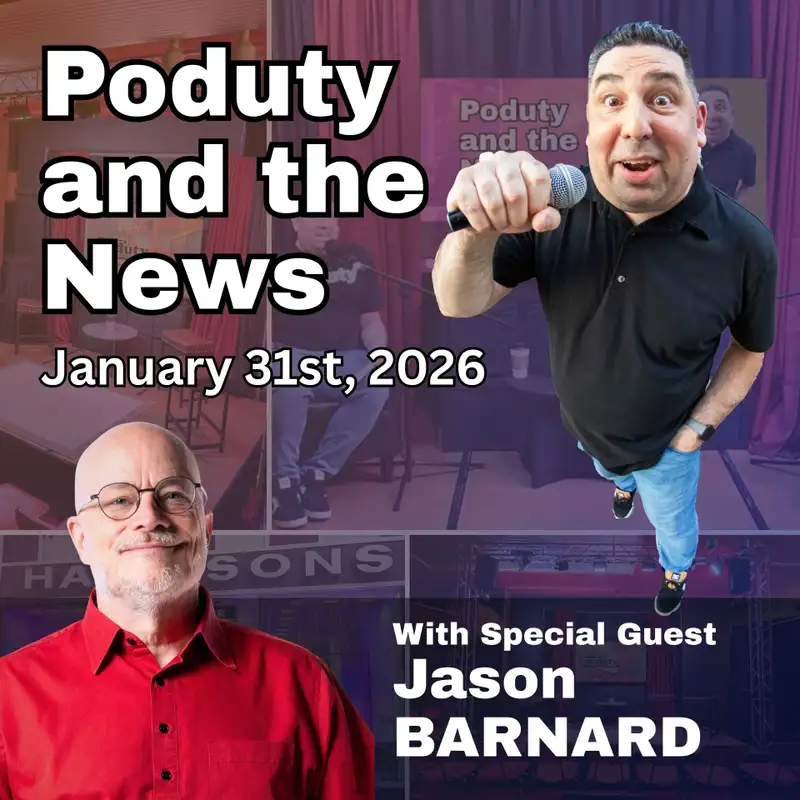
Oh, buddy. It's Saturday morning, 10am at Corbett street in
downtown Tarentum. We're at the Poduty Live Podcast Theater. I have an
incredible guest, one I will admit makes me spiral every time I
see him on a webinar. I learned so many things.
I learned so much about Knowledge Graph that I spend three days trying to
figure out what he's talking about. It is so impressive to hear and share some
of the knowledge that we're going to get today. Ladies and gentlemen, welcome Jason Barnard.
Thank you so much. I'm delighted to be here. And
that what you just said really resonates with me because I was talking to
a friend the other day and I was saying I thought that I explained all
this incredibly simply. And she said, oh, no,
you explain it. You think it's simple, but everyone else is sitting
there going, oh, right, okay, I've got to catch up. And you just confirmed it.
Three days digging into that rabbit hole. I'm sorry. I love it.
I mean, because you're showing me what's possible. I've been a marketing director for
20 years and, you know, I'm. I know just enough to be dangerous.
It's why I don't play with hand grenades. Right? I just, I know enough.
And when you teach me things and I learn new things from you, I want
to go like, what's he talking about? How do you do that? What's that mean?
And I just, I just go down this wormhole trying to figure out. And the
knowledge is incredible. And it's, it really opens your eyes to what a knowledge graph
is. And I got some great quotes coming up. Okay, really quickly.
A knowledge graph is a machine readable encyclopedia that engines
like Google and Microsoft, Bing and ChatGPT and
perplexity use to fact check. And if you imagine
Wikipedia is basically a knowledge graph, but it's very small. It's only
6 million articles. And Google's knowledge graph is
54 billion. And that's over 10,000 times bigger.
And that's a really important thing to remember, that Wikipedia is a
tiny, tiny, tiny, tiny encyclopedia. Knowledge graph. Google
10,000 times bigger. And even Kalicube, my company,
25 billion data points, 73 million articles.
We're more than 10 times bigger than Wikipedia.
So make of that what you will. But I think the point
is a knowledge graph is just a really big
machine readable encyclopedia for fact checking. Yeah,
yeah. This is what I'm talking about now. You opened up my mind to
see more ways and it's just so great. So if you
ever get a chance, obviously, look up Kalicube, visit the website. But
more importantly, if you ever get a chance to sit in on a webinar where
Jason speaking, sit in on that webinar and just see what's possible
with what can be done. Thank
you. I did one yesterday and they made me cut out 10
slides. They said, there's just too much. People are going to get overwhelmed. And in
the end, they were completely right. I took them out, put them at
the end and said, if you want to read more, 10 slides at the end,
download the slide deck, you're off to the races. And
for me, I was just going. I didn't see the problem until somebody pointed it
out to me. And I'm ashamed to say that idea that
I'm making it simple is completely false.
Well, this show is. This will be very simple. We keep it really simple here.
We got six stories about live podcasting coming up. I usually prep
my guests and tell them I'm going to ask them one question before the theme
song. I didn't prep Jason, but let's see if he knows. Jason, do you
know what time it is? Well, for me, it's 4
o' clock in the afternoon in France. That's. That's perfect.
News podcast about Podcast.
About podcasting from the stage.
We're on this side of the theme song with Jason Barnard of Kalicube and
Jason. We had a great conversation before the show. We got
a little bit, I call it witty banter before the theme song.
And one of the things we were talking about with the knowledge graph, this
was really interesting. You sent this to me about. I'm thinking about this for a
podcasting use case and you said brands with live content
see faster knowledge graph updates. Why is
that something? But before that, I'd like to say I'd love to be sitting in
that chair and I think you should get some kind of special effect that moves
me there during the show. We'll fix it at post.
Yeah, the live or consistent content is
super important. The thing about the knowledge graph is,
or Google in general, it's like a child. It's waiting for things, it's
looking for things. And when it expects you to
update, when it expects something new from you every week, it will come looking
for it because it expects it. And I do that with
my podcast every Tuesday. It's always on a Tuesday. And the
knowledge graph, Google's knowledge graph, but also the search engine and indeed Gemini,
the LLM comes looking for that content on
the dot on The Tuesday, because it knows it's going to be that. So what
you then get is a consistency of the
engines. Google ChatGPT, Bing perplexity.
Coming and collecting your information because they know there will be new information every,
in my case, Tuesday. And then the
consistency beats authenticity. I think what I mean by
that is, as you say, anyone can be authentic. So be
authentic. I wouldn't ever put anything negative about that.
But whatever authenticity you have, keep it
consistent because inconsistency confuses. Once again,
Google ChatGPT Bing perplexity. They're all like children.
They don't like inconsistency. And also when you say
they're like children too, they're thirsty for knowledge. And the more knowledge you can
provide them and feed them, the more they're going to learn about you. Yeah, and
I've evolved that Google as a child thing. I've been saying that for seven or
eight years now. Google's a child, it's thirsty for knowledge, it wants to
learn. And it's a lovely analogy, but I just realized a few
months ago that's not business.
It's actually your untrained salesforce currently selling for the
competition and you need to train it so it's selling for you.
So basically what's happening is AI Google ChatGPT
are talking to your audience 247 and they're currently
selling for the competition. Just sit down and say, well,
how am I going to train these AI sales force
engines to work for me and to sell for me and not for the
competition. One of the things I was looking through your history, you mentioned
musician earlier before the show, you know, punk
folk music, Right. And I grew up in the 80s and 90s. I
grew up skateboarding, I grew up immersed in punk rock. And I
noticed that as I've gotten older, the same people who are in the same types
of cultural things that I was in are the people who are
able to really expand their mind around different concepts. And do you
think any of that, like independent, know, music production, the
DIY mentality of, you know, producing your own music and punk
folk, do you think any of that plays into really how you're able to
see the Internet and view the world in this different way?
Well, that's a philosophical question. Did I go into
music because I see the world differently, or do I see the world
differently because I went into music?
And I would argue the former. I see the world differently and I
think I've come to accept it. I actually did
one of those super tests that you do of your personality
and who you are. And the idea is to help me understand how to work
better and am I actually very good at my job as a CEO?
And the answer is not really, unfortunately. And
it comes up with the different aspects. I can't remember quite what they were.
And I thought, oh, I'm going to score about equal on all of them. And
I actually scored the top mark on two of them and the bottom
mark on all the other four. And I was thinking, but I can do all
the other four, like strategist and implementer.
And I can't remember what they all bringing people together,
but I scored highest on innovative thought
and polishing things.
So making things perfect. And it's really contradictory because on
one side I'm going off and saying I have this completely new idea, and on
the other side I'm being a perfectionist about implementing it, which doesn't
make sense. And for information, I don't know whether, oh, yeah, that was it.
So I think that's who I am. And I've pretended to be
somebody else in order to keep the company going. I've learned
to do all these things like building things and
thinking of strategies and worrying about money, but I'm not actually
naturally very good at them. Well, I mean, being innovative
and putting the polish on it from start to finish,
that's as much of a DIY mindset as I can think about of
from start to finish. I had the ideation to
the creation that's kind of. I can
come up with a lot of ideas, but I don't put the polish on them.
So I understand how that aspect works. So it's just
interesting to hear that perspective of how you approach business
and how you scored on that. Yeah, no, no, I understand. But
what was what I found really interesting about the analysis was that I come up
with lots of ideas and they're a bit.
Well, they're out of the box and they're going to change things in the industry.
And that's what I've been doing. I'm really bad at
strategizing and my team hate me because I keep changing the strategy because, oh,
there's a new idea and off we go. And so that's really bad. So I
now know I'm bad at that and I've got to stop. I'm not very good
at building the thing, or I'm not. I don't enjoy building the thing, but I
enjoy polishing it. So what I actually need to do, have the idea, give it
to a team. They build it, they give it back to me and I finish
it off. That's the plan as of the day before
yesterday. Yeah, that's something that I've learned to rely
on too is, you know, you have certain strengths and other people have the
strengths that can fill in the gaps where, if, if I can come
up with ideas but not always execute on them, I can find somebody that
can do that part of it. And being kind of self aware
enough, I'm going through a phase at my age of radical self
clarity, trying to be incredibly honest with myself and it's
really going well. It's been upsetting for me and for other people around
me. But I think the, the result is
very positive. I feel good about it. I haven't got any friends
left, of course, but that's a different problem.
Well, Jason Bedard Kalicube. All the links will be in the show
notes. If that webinar you did yesterday was public,
I will put a link to that as well if it's available for other people
to view. Just to see some of the things we were talking about.
So are you ready to get into our first story? Yeah, I am.
I'm sorry, I was getting a bit carried away with myself. No, I love it.
I love it. Thank you so much for sharing all that. I, I always get
curious because every time I've brought up punk rock and
skateboarding and that mentality, there's always this through line of
creativity and viewing the world differently. And I
always was just curious if that applied to you as well. Yeah, well,
I think I went into punk folk music because I was adventurous
and I thought I can a go and play in the street.
And then once we decided we wanted to become rock stars and stop playing in
the street. It's the idea I can create my own record company.
Even though that's not something most people do at the time. It costs a fortune
to go into a studio and that belief and that
vision is what made it work. We were professional punk folk
musicians for 10 years. Wow. Cool.
Right, sorry, back with the show. Sorry, I've gone off track again.
Oh, I love it. I love it. Thank you so much. Let's get into the
first story. We're going live with a Puzzle Day International Puzzle Day
was on, I think Thursday of this week. And this is an
idea of a podcast who does puzzles and games and quizzes
and they tied in their podcast with an event that was
happening. So this is one strategy you can use for your podcast. Hello.
Puzzlers celebrated US National Puzzle Day with a one off
livestream interactive episode, bringing their fast, funny,
brain teasing format to YouTube for a shared real time
experience. Hosted by New York Times best selling author A.J.
jacobs and Chief Puzzle Officer Greg Pliska,
the show is designed specifically for a live audience with custom
puzzles, comedy and participation baked into the format.
Featuring guests from comedy escape rooms and puzzle culture,
this event highlights how niche podcasts can create appointment
based moments, deepen fan loyalty and extend their
brand beyond the feedback without abandoning their core
audience. And this is kind of something we were talking about earlier about
being authentic, being consistent and being there in
the moment. If people are talking about Puzzle Day and
you're creating content about Puzzle Day, there's a way that you're probably going
to get attached to and piggyback on some of that news cycle.
Yeah, brilliant. I would add to that. The child wants
consistency, but throw a bit of a surprise in there from time to time
and you're going to make the child even happier. That's what they're doing is they're
doing a special event that the child thinks, oh wow, this is exciting.
So I would add that. Sorry,
yeah, be spontaneous. And there's probably, no matter what your podcast
is about, there are probably national days or ways to
celebrate things in your industry and this podcast was able
to capitalize that. Piggyback on it. And they did get a ton of press coverage
out of this. They were on POD news, they were on Sounds Profitable. All these
other news stories covered it. While I was waiting to do this Saturday Morning with
Jason, I heard it on three other shows. So that's a great way to get
additional media attention, additional backlinks to your podcast, to
your show, to the livestream channel on YouTube and just
tying into current events. Got hello
puzzlers, all that extra coverage. Super. Yeah, I don't
know if has the. We call it in France the Fete de la
Musique, which is 21st June, longest day of the year. And
any street musician or anyone, any musician is allowed to play in the
street anywhere as loud as they like from
10am till 11pm well, we know. Where we'll
find you on February 21, no? Yeah, it's
June 21, longest day of the year. And in France, it's something that started in
the 1980s, late 1990s. It's now across Europe and I
would love it if it went everywhere because it's really lovely. In the
village I live in, you've literally got 50 groups
playing in the street and trying to organize each other not to play
over each other. It's super. That'd be amazing. I would definitely take a
vacation day for that. Yep, let's keep it going.
We'll go into the soap industry. Not
soap, detergent, soap, as in TV
shows, soap operas. Natalie Cassidy, best known for
her decades long role as sonja Fowler on EastEnders,
is taking her hit podcast Live with Nat on the Road with a
live show at Colchester Art Center. With more than
4.5 million listens and consistent top 40 rankings
on Spotify, Cassidy's move into live podcasting
highlights a growing trend. Establish public figures using
live shows to deepen fan connection, turn
conversations into experiences, and extend their personal
brand beyond the screen and into the room.
This is one of those. Here's somebody established as a celebrity who
has national recognition. Maybe. I'm not sure if they're still on
that soap opera or not, but they're extending their
relevancy into the public by connecting directly with their
fans through a podcast, through live shows. And
this is a way to get out into the world and meet some fans face
to face. Yeah. And you've got, strangely enough, a live
studio that you're currently sitting in that people can use.
So there's a nice crossover for you. And the other thing that I
find really interesting there is at Kalicube, we spend
our lives getting people to take those offline opportunities or those
offline moments and put them online so that the algorithms can see
them. And we're doing that for a client. Right now it's saying, you spoke at
a conference, let's get that conference online. Talk about who you saw, who you met,
what you did. Because otherwise Google ChatGPT
can't see it. And it's a great way to build up credibility and
authority. That's a great tip and something you probably don't even think about.
Most people are worried about catching their flight, getting to the event,
trying to perform their speech on stage in front of the
audience, and then when they're done, they're done. They probably walk off. They
maybe have some meetings afterwards and then they go back to their lives. But
who knew what happened on that stage? It's if a tree falls
in the woods and no one's there to hear it, did it actually make a
sound? That concept applies to things you're doing in
real life. If you don't log them online, there's
no way Google's ever going to know that you did them.
Let's keep it moving. We'll go to story number three.
Bigger isn't better if you lose the noise. That matters. Now,
I picked this one I think I'm still building on that punk rock
mentality and that DIY mentality. I love the story. Podcasting
is clearly entering its next era. Bigger platforms,
video dominance, touring shows, even Netflix testing
podcasts as part of its content strategy. But with that growth
comes real risk, losing the trust, intimacy and authenticity
that made podcasts work in the first place. As podcasts
scale, creators and brands are being warned not to confuse
reach with resonance and not to polish away the real
conversation audiences actually show up for. The question now
isn't whether podcasts can get bigger, but whether they can grow
without losing their voice. And this is one of the things you
always hear about people who are early to find a band,
find new music. It was always special until they got too
big. Then once it got too big, it kind of lost that intimacy,
that special connection. And, and this article was kind of about that
theory. If, if podcasting gets too large, does it just become
television? Does it just become, you know, stadium events?
Does it lose that connection with the audience? And it's a valid question
to pose to podcasters and to the audience,
but. Then don't we just move into a sphere where
podcast, some podcasts are going to become like TV
and other podcasts are going to stay for the medium sized audience
and we're still going to have the niche podcast. Then the only problem, or the
only question that I would be asking is the visibility and
the, the, the capacity or the opportunities for a small
podcast to get that audience is going to become more difficult. And we end
up with that situation we had in the web when I started in 98, where
you could, a small website could become huge
because the opportunity was that were there and the openings were there.
And then over the year, over the 2000s, the
bigger companies started to manage to suppress if you
like, or take the place of, or reduce the opportunities of the smaller
websites. I think AI is a great opportunity again
for the small players to get a place, get a foothold. If you get in
early, you can get your place. And if you get your place early on,
I believe that you will keep that place if you're smart.
Yeah. It's not just utilizing AI in your day to day life. Like this theater
is a one man show with the editing, the show notes, but
also what you're talking about too. Jason is training the AI
to recognize you as some of the answers it provides.
So now you're kind of going full circle with doing the live events,
but now AI is aware of you enough to say, okay, here's some live
Events. Here's a live event theater in Tarentum in Pennsylvania. They do
live podcasts. So a lot of times I ask friends in different
parts of the world to ask questions about what is a podcast theater, just to
make sure I'm still popping up and getting sighted. That's a very important
thing that Jason's talking about. And your industry, your niche,
your podcast needs to be part of those answers. You need to start thinking about,
how do I get into that and how do I get served as the answer?
Please, sir, you said answers. I
would say conversation. You need to be part of the conversation
between the user and the machine. So we're all talking to ChatGPT
and Gemini and maybe even Google AI mode, if you're in one of the
countries that have got it and we're having a conversation and we're
asking these machines, for example, what can I do this
weekend? And the machine, ChatGPT knows you and it
knows what you like. So what it says to you is not the same as
it's going to say to somebody else. And if it knows you love podcasts, if
it knows that it's you like hanging out with podcasters, it will say,
oh, there's a live podcast event in your town, go and see it.
So being part of that conversation is hugely important because
AI has the ability that Google never had to
bring the right people to your door. One of the
things we were talking about, about AI, and this is going to be. This is
going to be a little bit of a tangent, but AI is going to
start to incorporate ads within. Within their answers.
And some of the early estimates, the cost per
thousand could be like 60 to $80.
And whereas you look at maybe Facebook or Google, you can get
display ads. Your cost per thousand, five to twenty dollars in that range.
What I found interesting is people complaining about getting
served an answer a thousand times for $60.
The relationship between the user and who's asking
the questions in ChatGPT, they already have an interest
in that answer from ChatGPT. They believe the answer they get
is going to be a pretty relevant answer to themselves. They trust
ChatGPT and to. To get a thousand impressions for
$60, where the machine is telling the user this is one of
the best choices. I think the $60cpm might
be a steal at this point. Yeah, that's a really, a really, really good
point that most people miss. And it's interesting to hear you say that. The
IDE. These machines, we choose ChatGPT or
Gemini or Claude because we trust them and they're our
recommender, they're a recommendation engine. And
the price of the ad within that context is
definitely worth more than it is on search. Because on search you've got a
choice of 10. In a conversation with an AI, it's going to give you
a choice of one, maybe two, but really only one.
And we call that the perfect click. Yeah. So I'm looking. I forgot to put
up the slide for the last story, but on this page there's display ads. Right.
They're just natively existing alongside this content.
You're not as interested in those. But if I were to ask ChatGPT, you know,
what should I do this weekend? Like Jason was saying, and it and one of
the events, I sponsor one of the events and it cost me $60 to reach
a thousand people in the Pittsburgh area, then
what better way to spend $60 than to tell 1,000
people I'm part of the events for today?
Yep. So I was. I'm pretty excited about that. That's a little bit of a
tangent. Let's keep it moving. We're moving right along. We're going
to an Exchange podcast. This is
at an ETF summit investing in podcasts on the main
stage. The Exchange conference is elevating podcasting
from side content to centerpiece by launching a
dedicated podcast stage featuring some of the most respected voices
in the EFT and financial advisory world. Instead
of podcast reporting after the conference, Exchange is putting
these shows front and center, live in the room, giving
advisors direct access to real time insight, debate
and expert thinking. It's a powerful signal that
podcasts are no longer fringe media, but trusted
authority platforms shaping how entire industries learn,
connect and move forward. This is, here's
an example of you have a podcast about doing
trading ETFs and you somebody.
There's somebody at my door that keep knocking. It keeps distracting. Here's a
conference that's starting to realize that these podcasters have such a connection
to the audience that they are going to put them on the main stage
as part of the entertainment to entertain the audience.
You can't, you can't build that kind of trust and authenticity.
Rather than being part of the event where the event organizers and inviting you up
on the main stage, they're going to showcase you
to an audience, an audience full of people who love what you're
talking about. Well, I was kind of almost ahead of the curve there
because I started my podcast in
2019 and what I did was
contact conferences, digital marketing conferences around the world and
said to them, can I have A press pass. I've got a podcast,
and I got press passes for all of them. I had to pay my own
travel and my own hotel, but I went to all these conferences and then just
hung around. And when I heard a conversation between
two people that I thought was interesting, I would ask one of the
people, do you want to do a podcast episode? And we would just do it
in the corridor. And that was how I
started. I did five or six for each one. And I traveled around the world
twice on that idea. And I
learned so much about digital marketing.
That's probably when I upskilled the most, is just by grabbing people when
they were having an interesting conversation, saying, let's have that conversation on a
podcast episode. And I asked them the questions that I found interesting,
ended up with a great podcast episode, ended up with a lot of
new knowledge for me, and got to travel the world. What could be nicer,
tapping into what you were doing, getting a press pass, and
really connecting with some of the experts in the industry. We hear that
strategy all the time with podcasters. They get a media kit, they get a press
pass, and they're able to attend these conferences, these amazing
conferences with some of the thought leaders for free. They're
able to get content from the event and share that as
their podcast. And then they're also end up. They may
not realize this, but they're also promoting that event for six months after
really building that momentum towards next year's event.
And by the way, if you want to go and answer the door, I'll keep
everybody occupied and entertained while you go and see who it is.
They're not leaving. They're still here. So hold on one second. Let's do
a quick. A quick note about Kalicube.
Yeah. Well, I'm going to keep everybody occupied with Kalicube
and what we do and what I love. I mean, I think for me, the
most important thing about Kalicube is I found a universal truth, which
is how to educate the algorithms, how to train them, how
to change the way they perceive you so that they will
help you with your own promotion. So they become a great amplifier. They're the
biggest influences in the world. And
my belief is, because it's universal and because I think it's very important, we give
it all away for free. So if you visit kalicube.comguide, you can
download all of this stuff for free. And the reason I come on podcasts like
this is because I want to share it and I want everybody to be able
to take control for Me, it's an existential question.
Do you control the brand narrative of yourself, your company, your podcast
or your product in Google? ChatGPT,
perplexity, copilot, all of these engines.
And if you do, then a, you can feel very
comfortable that as AI takes over more and more and it's getting quite scary,
you don't have to be as scared because you know that they understand who
you are, what you do, who you serve, and they will represent you the way
that you want. And that is, for
me, something that helps me to sleep at night. So I
hope it was somebody interesting at the door. And I was just telling everybody
that they can get the free content to control what Google and AI say
about them by going to the website kalicube.com we're not selling anything
here. It's all free. Yeah, I did see. You can do a report
as yourself or as your company and get great insights.
How's Google seeing you? It was really good. I was going through last night
and I definitely want to get a report on myself. I
don't have a knowledge graph from Google, but I, I do. Jeffrey Villa is pretty
rare as far as the search, so I'm good at. I dominate the search
engine, but I don't get like the right rail. I really want to see myself
on the right rail. Yeah, it looks cool, doesn't it? But the
other thing is you have those now in ChatGPT sometimes.
So as you're using ChatGPT, you have something that looks like that Knowledge Panel.
And the Knowledge Panel, for anybody who doesn't know, is just a factual
representation of a person or a company with a description, some
photos and information. For example, in my case, who I was married to, who
my mother is, which schools I went to, what college degree I
have. And it's a really rich representative representation
of fact about you. Once again, as you were saying, people trust these
machines. They use them because they trust them. And if ChatGPT
says, I went to Liverpool John Moore's University, then I did.
And if it gets it wrong, people are going to believe the wrong thing about
me. And that's dangerous.
Yeah, feeding that knowledge, like you said, it's a child who's
hungry. And the more that you can provide it, like this event with the
ETF Summit, if you were up on stage, that's something you need to
put online and start to feed that knowledge
graph, feed Google so that they know where you were, what you're doing, who you
are, who's linking to you. Why are you an expert in the field. Then
you start to get served up. As these answers, you become the results. You become
the authority in your industry. Oh, I can make a point here.
You're explaining this much better than I do.
I don't think so. Oh, you are. But you're making it
understandable. You've just taken what I said. Now everyone's going, now I get
it. Well, if you want to keep it, we'll keep it on my level.
And let's take it to pizza. I like pizza a lot.
There's a good segue. Why pizza podcast? Why win Google
and heart? So this is a good one. The Jersey Eats podcast, part of the
USA TODAY Network, proves that live podcasting
doesn't have to go big to go deep. In a recent episode, Host
zeroed in on one simple topic. Where to find the best
pizza in North Jersey. Blending reporting opinion
and local passion into a tight, trust driven
conversation. From classic Jersey slices to Detroit style
and New Haven inspired pies, the show highlights how
hyperlocal expertise and authentic voices can build
loyal audiences strong credibility and long term
relevance across podcast platforms and YouTube. If
this isn't your playbook, Jason,
I don't know what is. This is exactly what you've been talking about the
whole time. Here is a this is a USA Today. It's a
big paper conglomerate in the United States.
Their local affiliate is covering a story
about the best pizza slices in the world.
Now if you don't think that that adds weight to those
establishments, that this major newspaper establishment
is giving credibility to these Jersey pizza slices,
you're crazy. Right? This is the gold standard of getting
recognized and getting acknowledged for the quality of your product.
Yeah. And it's a brilliant point. And number one is
hyperlocal is really important. I think often people try to aim too
big that I want to. I want to be present across the US when in
fact they just need to be present in North Jersey because people aren't going to
go all the way across America to go to that particular pizza bar.
And the other is missed opportunities. I've been working on
some on my platform today
it's a software platform that's basically got my brain in it. I'm putting my brain
into software. And one of the
points was, or one of the points I'm trying to
make the most of is all of the things we've done in our lives that
bring credibility and authority, but we forget about.
And I made a list of all the things I've done that I thought brought
credibility and I listed maybe 20 and then I Set my
little program working, and it found another 20. Like, I
worked with Wix. Wix was a client. Ahrefs have been a client.
Semrush have been a client. Yoast have been a client.
And I'd kind of forgotten all of them, and I wasn't making the
most of them. And all I now have to do is talk about it like
I just did and bring these pieces of information
that I know about that aren't very obvious online, that I have proof for
online and say, I worked with wix, they
were a client of mine. Here's the proof, and I link out
to where it says WIX was a client of Jason Barnard and Caricube.
Yeah. Oh, sorry. I'm bringing that back to the story. It's whoever's been,
whichever Peter Pal has been mentioned in that podcast, if you're watching this,
make a meal of it. And the joke was intended.
Yeah. If you're in this list, you need to put that content onto your pages,
onto your social media. You need to also
piggy. Like, our first story was piggybacking off of the National Puzzle
Day. If you're the one of the 40 pizza shops, you better piggyback off the
back of the story that mentioned you as one of the best slices in
Jersey. And just by the way, from a European perspective,
you just said 40 pizza shops in a small area of the
US as though it's completely normal in Europe. 40 pizza shops
in a small area is a completely weird idea.
Well, you're going to
me, there's 40 pizza shops in my town that I'm in.
There's. There's 40,000 pizza shops probably across
America. All right, okay. So you actually meant
just the best. 40. I was thinking 40 is a huge number.
Yeah. That's just isolating the best ones. There's, there's, There's
a hundred times more than that. So can I understand from
this that Americans like pizza? Oh, yeah. Have you seen Americans?
We. We're carb heavy. Is it?
Well, I'd be like, I know in Europe and England, like the
Indian cuisine, the curry food, that is like your
pizza shops. Yes. That would be the equivalent. If you said to
me, 40 Indian restaurants, I would assume
you meant the 40 best, because there are probably 40,000.
And they better have it on their knowledge graph that they're one of the
40 best. Well, this has been so much fun, and we're already
at our last story, and I'm going to tie it back in with
podcast movement here for the first time ever Podcast movement.
Evolutions is officially embedded inside south by Southwest,
signaling a major shift in how podcasting is viewed within
the broader media ecosystem. Evolutions
2026 will
take over downtown Austin venue with live programming, recording
studios, panels and performances, blurring the line
between podcast conference, live media experience and
cultural event. With support from platforms like YouTube and
a lineup that includes creators, advertisers and media leaders,
this move positions podcasting not as an adjacent format,
but as a core player in entertainment, business
and culture. This is the heart of
podcasting. This is an event that's about podcasting
featuring podcasters put on by podcasters, podcast of
companies, sponsors who are supporting the audio
mediums. And just as a random side note,
I made a connection this past week with a gentleman named Paul
Cranwell. He's out in. He's in Europe,
England, I believe. And he introduced me to Brian
Barletta. And today is Brian Barletta's birthday. He's the
Sounds Profitable founder of Sounds Profitable and putting together
podcast movement of south by Southwest. So happy birthday to Brian. And he gave
me a full statement. We were talking about this
independent media mentality. How do younger,
smaller shows really benefit from a podcast media? And he gave me a full statement.
I do have. I have a clip of it up here. His goal with the
changes of bringing both Evolutions and South by Southwest together
and their primary event in New York City is to evolve the industry. And when
you read the statement that I'm gonna put in the show, notes, the event is
free. The content after the event is free.
This is an event that's bringing podcasters together to
elevate the entire industry. So if you want to position yourself as
a leader, as moving entire industry, an event like
this, partnering with south by Southwest, which is one of the biggest, biggest
events that happen in America early in the year,
there's no better way to piggyback again. Here's that piggyback word again,
on top of something. Than to place podcasting in the heart
of south by Southwest. I agree wholeheartedly. I mean,
getting out there and making yourself a thought leader by associating yourself
with a huge organization is great. Question is always, how do you
get that to happen? And I would argue it's by getting out
there, pitching up and being there and being seen or actually the physical
contact with people. And that's what happened for me with my
podcast tour of the world is I met so many people and the difference
between meeting them in person at an event and talking to them face to face
and being online is Absolutely huge.
And can I make another point which has got nothing to do with that.
It's about my name. Because you said the word
adjacent, and the word Jason jumps out of that. So every time
anyone says the word adjacent, I go, ooh. But there's more.
If you think about the calendar in English, July, August,
September, October, November spells JASON.
And in technical SEO, you add schema
markup to websites, and the format is called JSON.
So every time we talk about the technical aspect of
SEO with that particular thing, everyone keeps saying JASON. I keep
going, what? Yep, yep, yep. And the same thing with the Jason.
So there you go. I was just thinking of that. It's completely random. Nothing to
do with the last story, but I thought it was kind of funny. Well, imagine
if you could start to control the conversation around July, August,
September, October, November, and your name always popped up when people were
searching for the months. I would
become world famous for something completely pointless.
Well, Jason, I appreciate your time so much today. This was
exceeded all my expectations. I've had so much fun, I've learned so
much, and I can't wait to even see the webinar you were talking about earlier
in the show one last time. I know you got
to give a little talk while I was getting the door. Talking about
Kalicube. Anything else you want to leave the viewers with? Anything you
want to really inspire people to get out there and do today?
Yeah, I'd like to sing a song. A quick
goodbye to and the show. Thank you,
Pudduty. And the news.
Well, that's better than my theme song. I don't even know if I want to
play my theme song out of here. Oh, no. I was grooving to your theme
song. Well, I forgot to tell you. I asked, hey, what time
is it? And I don't tell people what to say. They can say whatever they
want. So when you. When you told me the time, that's the best answer. I
love when people tell me the time. It was the most
obvious answer. It's such a surprising question. I thought you were
saying, oh, it must be a different time over there in the front. Or I
could have said, it's time for a cup of tea. It's time for a
cup of tea. Thank you, Jason. Check out Kalicube.
We're going back to that theme song.
What time is it?
What? What time is
it?
The only live news podcast about
podcasting from the st.
I'll do it. The news.
The only live news podcast about
podcasting from the stage.