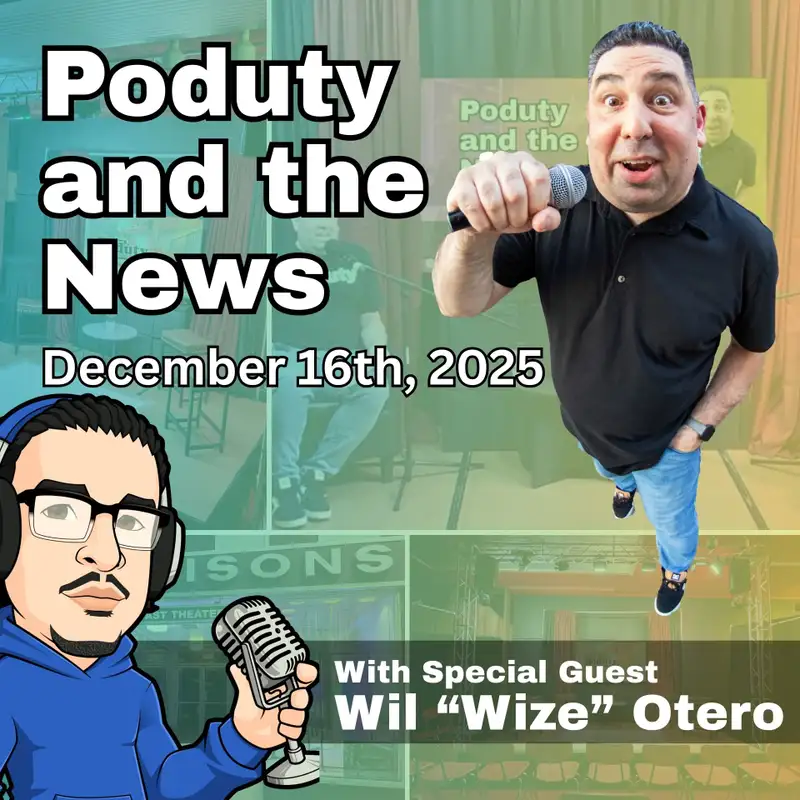
Hey, everybody. Welcome to Poduty and the News. I've got Wize joining me.
We've got six great stories headed your way.
What time is it?
Live news podcast about podcasting from the
st.
The only live news podcast about
podcasting from the stage.
If that beat doesn't get you out of your seat, check your pulse, you
might not be alive. It's Poduty and the News for Tuesday,
December 16, 2025, with Will Wize Otero
joining me all the way from the Poconos. Wize,
welcome to the show. Oh, man. Great honor to be here,
man. Always a pleasure to collaborate with you. Oh, man, I.
We were talking before the show, probably since 2020,
you three to four main things a year that we collaborate
on different events. Indie pods. The women of indie pods.
You've been out here to the theater. We did two days of live
streaming. Yes, we did. And we got you one of those Primanti
sandwiches. Yes, yes.
That was when I could eat a lot and. Yeah,
well, that was a lot of fun. I hope to get you back out here
soon. We had a little bit of a, I think, schedule conflict this year, but
hopefully coming up in the spring. And I know since we
last spoke, I don't know, it's every three
to four weeks you have a big announcement coming up like you always
have. You're always something in the works. There's something new you're working on.
I'm really excited for one big thing that you're starting to put together
next year. I don't know if you have all the details yet, but there's going
to be a way for a lot of people possibly to get together. But tell
us a little bit about what you've been working on, especially since the last time
you were out here. Oh, man, it's a lot of things, man.
We launched Real Wize Publishing.
I've learned how to self publish books, me and Poppy J. And so
we've launched Real Wize Publishing. Like I said,
we've gone a whole new
rebranding. We went from Real
Wize Productions to Real Wize Global Media,
focusing more on a lot of the stuff that we're
trying to build, man. It's just been an amazing
12 months. This, this year has been really.
It's been one of those moments, right, where you know
that you're right there at that. At that point
level where it's just ready to, like, just take off or
explode. So it feels like
2025 is just right there. So for 2026,
we just plan to just take it to another level and
Just keep grinding. Yeah, let's make
it happen. I mean, we've. We've been laying the groundwork for a few years, and
you've ramped it up over the last year with the book, with the
publishing, with the podcast, the rebrand.
I don't know if you're talking about the other. Are you still working on the.
I'm still working on the retreat, yes. That's. That's something. That's.
Because I've gotten so much great feedback from it. Right.
Especially the concept and everything that we're
trying to build around it, because it's something where I
want podcasters to come together and because
I. Because I. Actually, next month, I will be in Orlando for
PodFest. Right. But this will be completely different because
PodFest is so big. Right.
And it's so many people and you get to network with
where. I just want this to be a little bit more an intimate setting. Probably
20 to 25, maybe 30 podcasters getting
together and, and having workshops and, and collaborating and,
and the content that they create there. That's for them
to. To use and, and build from there.
Yeah, it's going to be a lot of fun. I'm going to get there. No
matter what rain, sleet or shine or snow,
you have to be there. Because you, You. You're kind of. So, you're sort of
kind of like the. The tech guy, too, as well. Even though I. I
kind of been doing it. But yeah, no, it's. You
definitely got to be there, brother man. I'll be two, three days early. You'll
be wanting to get rid of me after the event, but I'm. I'm really looking
forward to it. It's going to be a phenomenal event. I've heard some of the
details you've been working on, and I'm sure as more details come about, you'll
release more information. But you just keep an eye out, you know, make sure. Follow
Wize in the links that I put into the show notes, Stay in contact,
connect with them on Facebook, on LinkedIn, make those connections with
the guests that I'm having because they're working on things. These are
movers and shakers. This is like independent media
on steroids. And all these little things that we've been working on
are bubbling up now. They're starting to grow roots and get legs
and start to run. So, you know, pay attention. Make sure you connect with
Wize. Go into the show notes and click
Wize's links. Are you
ready for some of our stories tonight?
Yes, I am. As you know, on this show we get six stories
about different cities, small towns, conferences. People are
doing live shows in droves. It's something that
we didn't see as much six to 12 months ago, but
I now have a backlog of 40 plus stories of people
doing live podcasts. This is why we're doing the show two times a week.
There's so much news coming in. There's so much change happening in
live podcasting and live events. People podcasting at
conferences, people filling theaters, arenas, coffee.
It is happening and it's happening in bigger and bigger
numbers. This is something to pay attention to. This is probably episode
30, 35 of this show, Poduty and the News.
And every week we've done six stories. There's
180 examples I'm giving you of people around the world doing
live podcasting and I've got six more for you. Tonight we're
going to go to that first story and this is one we're
going to file under. Is that a podcast? We're not sure we know
how YouTube has been morphing the definition of what a podcast is, what
a podcast could be. And it looks like TikTok is going to take that and
put it through the ringer a little further. So is this a podcast or just
a TikTok with better lighting? We're going to put this strategy under
platform first live series and TikTok announced
TikTok in the mix, a new live podcast in
quotes series that feels like a big swing at turning
celebrity interviews into appointment viewing. Except it's
happening inside. TikTok season one is a four episode
run of 30 minute live conversations
streamed on TikTok and it kicked off December 11th with Demi
Lovato as the first guest. The real Strategy here is
TikTok packaging what looks like an interview show into a
podcast rapper. It keeps fans on the platform longer,
gives advertising a premium sponsorship lane, and
turns music culture into a repeatable live series
that can be clipped, reshared and
remonetized after the broadcast ends. And
this is the second Demi Lovato story we've had on the show in
the 30 episodes. And the first time was a
legit actual podcast. Demi Lovato has a book club
and she has a book podcast where she talks about the books that she's reading
and she shares that with her fans. And just another a great way to connect.
And she held a live event, I think it was at the New York Public
Library and invited her fans and people
to come in and just talk about books and meet the authors and have these
great conversations and it was recorded and released as a podcast.
Here we have TikTok kind of doing the YouTube playbook
here, redefining what a podcast is or what a
podcast can be and then just only
putting it on TikTok without any other kind of distribution.
What were you thinking when you, when you read through this article wise, do you
think this is a podcast or are we kind of pushing the boundaries of what
a podcast can be?
Because. All right, so when I first started in
2020 I was strictly audio, right?
I had to go get a platform. I got on podbean, got an
RSS feed and that's how I launched
my podcast. I was strictly audio.
And then as I started interviewing
people and getting together with, I got together with a branding
strategist. They were a couple and one of the things
they asked me was did I have video content? And
at that point I was using funny
Streamyard at that time to record the
audio. I wasn't really using the video
aspect of it. And so
when I got with this couple, the husband made sure
that, he kept making sure, he kept asking
like do you do video? And my. And I came up with a couple
excuses the first and then when the third time you finally asked me, I pressed
record. It made, it made sense. I was already using
the platform
video. Long form video content right now is
at a premium especially with on YouTube and everything.
And then YouTube being
the large, one of the largest search engines and.
It. Being one of the most viewed
app out there, right? Like it's, it's, it's outdone cable and,
and all these and network television people. Everyone
is on YouTube so when, so is is video.
So let me ask you a question. Is video
pod, is it video thing apart? Yes. Because
if you can take the audio from it and use it,
repurpose it and put it on platforms
that, that distribute as, as a podcast,
then I would consider it a podcast. But if you're going to just stay
on TikTok then you're just a
tick tock show. You're not a podcast because not
they have to go to TikTok to find their show. Whereas if you're a
truly are a podcast, you have RSS
feed that takes you to multiple platforms that you're not
just on Apple, you're just not on Spotify, you're on some
other lower class podcasting platforms. And
so yeah, I don't think what
TikTok is doing I would consider a podcast. But
listen we redefine things
all the time. So I heard the same conversation on POD News
the other day, and they were talking about.
He asked a question. Is it on itunes? No.
Is it on Spotify? No.
Well, if those are podcast distribution platforms, then
it can't be. Not there. It's not a podcast.
Right. So how do we go about defining what a podcast is?
How do we, you know, we want to push that boundary. We want to have
independent media. We want to have people creating things. And. And I. And
I've veered a little bit. You know, I do agree that a podcast needs to
have some sort of distribution, some sort of rss. That really is what makes it
a podcast. Otherwise, it's a video show. And this is. I think this
falls under the category of it's a nice show. It's a great way to
connect with Demi Lovato fans, but it is just a live
stream on Tik Tok. Yeah, I'm. And. And not
everyone's on Tik Tok. Right? Not there. Some people feel
that Tik Tok is. Is kind of like childish, and they don't. They
don't do it. So for.
For you to just focus on Tik Tok, especially if you're trying to grow the.
Grow a brand and. And something that was said
to me, okay, that you want to
master all these different platforms, we should master one, I
guess by just doing a TikTok show. That's your way of mastering
TikTok. But eventually, if you really want to become
truly a podcast, you definitely just cannot just be on
streaming on just one platform. You got to be in the places where
your audience is, and you have to figure that out. And the way to figure
it out is. Is through testing, testing different formats. Like right now, we're trying
LinkedIn and Facebook tonight. You know, that's part of this. And what I
do with this show is, yes, I am live streaming the show. This is very
similar to what TikTok and Demi Lovato are doing. And I have a
theater space. We're recording it live in the theater, and
Wize is joining us on the live stream. Not much different than what
TikTok's doing, but what I do from this is I'll edit
all the video feeds that took to make this live stream happen.
I will release it as a video, an edited video, and
I will release the audio as a podcast that will get
distributed to itunes and Spotify. So you can do all the things that
TikTok's doing. But I think we really get into trouble
when we start only hosting things behind these Walled
gardens where you have to be on TikTok or you don't get to
see the Demi Lovato interview. Yeah. Let's
go over to story number two. Keep the show moving.
We're going from conference stage to canon when
live interview becomes the episode.
Our second story is a perfect example of live events feeding
long form podcast content. This episode features
Chase Lockmiller, CEO and co founder of Crusoe,
recorded live at the inaugural MCJ Summit in San
Francisco at the Autodesk Gallery. Instead of a
studio sit down, Cody turns the conference conversation into
a flagship episode, diving into
Crusoe's work at the intersection of AI and energy and
Chase's journey from MIT soccer captain and mountaineer
to climate focused entrepreneur. The big takeaway here
isn't just the content, it's the strategy. Use a
live high trust room, build a built in
audience, event sponsors, then capture once
and distribute everywhere, turning a single live moment
into a long tail podcast value. And this
is kind of what you were talking about on the last story wise. Here
you have a live event and you're finding people who
like the same things that you like. This is a, a conference of
looks like AI and energy. And this company
is hosting the event and they're recording a podcast. So they're bringing people
together, potential clients, maybe people that
they're serving in their industry, industry leaders, and they're
hosting these events during the conference and then they're recording that
content to release as their own podcast episode. So you're kind
of, they're getting the double dip. They're bringing in, you know, and creating this
live experience for people in their industry. And then
they're recording all that content all week long while people are at the
summit that they can use over and over again all year
long. What, what Think about like this show right now,
right? You're, you're recording, you're, you're
streaming live, but at the same time you're also
recording this and saving it so you can repurpose
this content. Like if you wanted to take the audio from this
and upload it to Apple or whatever or
Spotify, you can do that. So
you can have the best of both worlds. So it's
important that you do both. Yeah. One of the things I
used to ask myself was, what is a podcast, right?
It's an MP3 file distributed by an RSS feed to the
aggregator app so that people could download and listen to it on demand
anytime they wanted to. And then I, I asked the question, you
know, where is a podcast when is a podcast. There's a lot of
times the when factor was people would, okay, we'll schedule
Tuesday at 7pm you want to come to my studio? Or we'll
get on a live stream. And then the wear factor was, well,
I, I, I feel safe in my office. You know, I can get on a
live stream, I can turn everything on. It sounds good.
I just feel safe about that. And we started to push these boundaries
of what, where and when a podcast could be. And
you're starting to see all this stuff pop up in these different events. And
our next story is very interesting because this
is, this is the picture I'm showing people watching on screen right now.
This is live on a showroom floor at a
conference, right? They're just like, hey, we're gonna just, we're gonna
set up a stage. People are gonna be walking by, checking out the booths on
their way to speakers, on their way to demo new products.
But right in the middle of the floor, we're gonna set up
and do our show live. And this is when the trade show becomes
the studio. This is building off of those conferences. Now you have
the trade floor where all the other
businesses are trying to gain new customers. And we'll file
this one under the industry event as a podcast engine. This episode
of Digital Builder was recorded live from Autodesk University
at Green Bill 2025, turning a major
industry conference into a podcast studio. Host
conversations with Jose Gundino of
Swinnerton and Jeff Girardi
from Autodesk explore how pre construction is shifting
from spreadsheets to integrated AI driven workflows and
why the role is becoming more strategic and collaborative.
The strategy here is using an industry event with a built in, highly
qualified audience to capture expert conversations live,
then distributing that content long after the conference ends,
extending the value of the event and positioning the podcast as
part of the industry's ongoing educational cycle.
And what you see here on the screen,
it's just a giant booth and they turned their booth into
a TV studio. And one of the things that's one of the hardest things to
do at a trade show is to get people engaged, get people
stopping by, sitting down with you, sticking around your
booth and these type of events, these types of recordings,
bringing your podcast live to that show
is a great way to make your booth sticky and get people
talking about it while they're at the conference.
Yeah, absolutely. And if you're, if you're at the trade show,
you have your badge. The people running the booth here,
they're going to scan that badge and guess what? They're getting your contact information.
You stopped by, you showed interest. So now think of this as
your business strategy. If you have a small business and you put on a
local event, maybe at your local coffee shop or your library or
a little civic area, you can bring people in who are
interested in what you do or what the services you offer. Give them
some value, train them on what you do, show them
what working with you can be like. At the end of the night, you might
get three or four or five business cards, you might make some new
connections, and you might walk away with a few new
clients. And, and what you see on the screen here is a great way to
make clients in 2025 to, you know, kind of shake out
that noise like, hey, let's slow down, let's connect, let's
collaborate right here on the showroom floor before you're, you know, off to
lunch to get like a Chick Fil A or something. Yeah,
let's head over to. Oh, one of the. This was. We're at
war. I think wise when the bots start podcasting,
you know, some of the stories are we like to focus on live events, but
there are things that are happening in this industry and one of the things I
really want to focus on at the end of this is, hey, live
events going to be very hard for AI to beat us. But
it's happening right now. The podcast industry is facing a
new kind of disruption as AI generated podcasts flood
the market by the hundreds of thousands. According to Little
LA Times, studios are now producing episodes for as little
as $1 each, using cloned voices and
synthetic hosts to dominate niche topics and trending
searches at massive scale. Some creators are embracing
AI as a tool, while others see it as a breach of listener
trust, especially when human voices are replaced without
consent. The strategy tension here is scale
versus connection. AI can win on speed and volume,
but in podcasting, trust and human presence
are still the premium currency. What do you think about this one, Wize?
It's funny because you're the one who introduced me to ChatGPT, right?
Yes. I still remember that, that, that message
vividly when you, when you sent it and it involved the
Tribe Called Quest and, and everything. And
so, and I've, and I've. Since then I've, I've run with it. Right.
It's helped me structure a lot of the things that I do.
It's. Yes, there are people doing, using it to,
to further themselves and then you get people who
use it for silly stuff. But me
personally being able to use AI to help me
structure my structure. My podcast helped me
kind of build a business plan for building the
publishing, the publishing arm of Worldwide
Global and all these different other ways
of using AI as the tool that
it was meant to be. So for
me, it's been
a very big part of the growth that I've been
able to do this past year. It's been
because of me using different
tools. AI using chat, GPT using Chat,
using Cast Magic, using Minvo, all these
different platforms, all these different AI tools to really
help save time. Because like with Minvo,
I import my video feed
and it creates 30 clips that I can use
on all my platforms that distributes it right directly to those
platforms. So there's tools that's
helped me again
with the production of the show, with the
distribution of the show, so many different things.
So I'm a big supporter of support of AI.
Do I agree that there's a lot of people
using it in a way that I don't agree with?
Yes. But I think
if you truly want to grow and evolve, then you need to
use the tools that are available and run with it.
I have no problem with AI. I have no problem using AI. We use it
here to. I'm a one man show tonight, right? To get to this point,
I had to research a thousand stories. I need AI
to help me filter through. I can't read a thousand stories every three days
if we're doing two shows a week. So I get filters, I get
summaries, I'm scanning for certain keywords.
I'm using it to build the theme song, I'm using it to write the
theme song. I'm using it for some of the editing, some of the
enhancements. And that's, that's an okay use that. That's taking
the skills that you have and elevating them. That's, that's what you want to
use AI for. What some of these agencies are doing is they're taking,
they're taking every news story that's hitting the front page,
they're taking that context and generating a
podcast. Within five minutes it's going to be live and release to
the world. They're just doing 3,000 podcasts a day at
pennies per podcast. And this is the problem that we're having.
Here's. Let me go, let me just rewind a little bit. When you talk about
active podcasts, there's about 4 or 500,000 active
podcasts, but the podcast directories have 4 to
5 million listings of podcasts. There's
90% of the podcasts are dormant or they gave up, or they
were. They did a few episodes and they stopped. That's
already a problem with, with discovery of new and
active shows. So there needs to be some sort of filtering that
helps people find new and active shows. But if,
if we're going to be battling shows where we can't even compete against
the 90% of shows that are already out of business, then
a slew of AI shows isn't going to
help discovery. It isn't going to become a better experience
for people coming into podcasting or just finding out about podcasting.
They're going to be buried up to their eyeballs and slop, and it's just
going to turn people off. And so we need a way, and we should really
call on these aggregators to filter some of this out.
Can I toggle? You know, if somebody discloses an AI podcast,
can I just toggle a switch to remove that from my feed? I don't want
to even hear that. And I don't want, I don't want to hear.
The worst thing that happens to you in podcasting is you find a new show
you get really excited about, you listen to an episode and
then you go into their. I'll go listen to some of
their back catalog. And then you realize the episode you just listened to
was four years old and they haven't produced anything in a long time.
And those types of things need filtered out. And we
need to start figuring that out now before we have 3,000
AI slot podcasts dropped every single day.
Oh, no. And like you was talking about
the podcasts that are dormant, right? Because there's
only like 400. Like you said, 400,000 podcasts that are
active. Like, I'm, I'm. My podcast is active.
I release a new episode every week. And so
which reminds me, I'm due to release this week's episode.
But anyway, it's,
it's important that if, to me,
if you can
put out at least 20 episodes, then
do. Once you get to like 20,
you can continue to grow it. Like,
my goal when I first. Because when I started,
I heard about the statistic about after two,
three, four podcasts, that's when
people just realize that they don't want to do it because it is a lot
of work. And so when I
got to episode 20, I was like, all right, I got this.
I'm way past the benchmark that people
who stop, I'm like, all right, I'm at 20. So from there, I just
started Just creating content, recording more episodes and just
started releasing episodes like there was no
tomorrow. There is a hurdle.
You do the first one and then you realize oh crap, I gotta do another
one in seven days. Oh boy. So
yeah, so being able to use the, use AI to make
things so much easier for yourself and not burn
yourself out and, and people say oh, but
you're, you're, you're not being
creative enough or well,
if you don't write the right prompts into whatever
you're, you're trying to, whatever results you're trying to get
from AI then
that, then you're not like the prompts are very
important. You can't just not put in
specifics for what you want because if you do, you're
going to get, you're going to get. If you, you put in half
ass work, that's the results you're going to get. So that's why a lot
of people be complaining about oh, AI. This, this is missing.
If you use it the proper way and you do what
you're supposed to do with it, then I think it's very beneficial.
Yeah. If you rely on AI as a crutch to
do your work for you. I've heard Robert Rose say this a hundred times.
The best you'll ever be is the best mediocre
version of yourself. You can't use it to
do everything to, to come up with your ideas, to write your
scripts. It's, it's never going to be a better version of you. You have
to have the skill set. You have to put in the time to, to
be the person who can carry a show for 40 minutes, who can
stay on stage, who knows what they're talking about, who is the expert?
Then you rely on the AI to amplify all that
and, and become a better creator like some of
the creators we saw here at the McDonald's
has had a new deal with when the brand becomes the venue. There was a
cultural hub as a live platform. This was pretty
cool and included podcasting. McDonald's didn't just
sponsor Art Basil, they built a four day live
cultural experience with UNK Arts Haas
transforming transforming Miami into a branded
hub of art, food, comedy, music and live
podcasting. Across immersive installations,
culinary storytelling and performances. McDonald's
centered black creativity and community, including a live
podcast conversation hosted by Kenny Burns and
elevate hers. The strategy here is
experiential amplification. Instead of interrupting
culture with ads, the brand became the stage.
Creating moments that were live, shareable and deeply
human and extending the impact through digital access,
QR codes and post event storytelling. And
this is just one of those experiences that you look at and if you get
to go to the article which will be in the show notes, look at this
thing that they set up. It is incredible. And what an
immersive experience. And all throughout you do see like these little McDonald's logos.
It's like very artistic, but also like there's this weird like corporate
element. But to be able to show up and
support and have like this experiential
environment where people are immersed in the installations,
they're meeting the artists and they're having conversations in real time.
You can't buy that in a 30 second TV spot.
Creating these experiences and including podcasting and
performances and live installations.
Incredible way to, to bring your brand into the community,
to the people who are, are going to be at these installations anyway.
Use some of that corporate influence to, you know, lift
everybody up, build a better community, have these experiences that you,
you just don't get from the television. Who
else better the partner with than McDonald's? Right? Because
McDonald's don't like, yes, they sell burgers and everything,
but they sell a brand. Like they have a system
in place for their franchises to be
successful. Right. So for them
to create something like this, being that they're one of the
most highly
visible brands across the
world, like there's a McDonald's, almost none in every country,
to be able to collaborate with a brand like
McDonald's, it's just showing you
the evolution of podcasting. Yeah. And we're
not just showing you this, oh, look how great McDonald's is. And
they did this whole event and they put this all together.
We're showing you this because these are things that are happening in your community
and communities all over the country, all over the world. And if
it's happening now and it's happening here and there and all these
five other stories that you've heard from us tonight, then why
aren't you doing something like this in your community? I'm sure there's an art gallery,
I'm sure there's a coffee shop, I'm sure there's a library that is
all looking for things to do and people to connect with.
So is there something you can do? Maybe you start with
the local coffee shop as a sponsor or a local bar and they let
you do in an afternoon show on a Saturday when they're not selling that many
beers. You know, you could do things like
this on a smaller scale in your town and bring your
community together and find those like minded people who are just like you,
who love the things that you do and you can tie that in
with your local business community. Oh,
absolutely, absolutely. It's, it's important
so as to be honest. To be honest,
right? To be a successful podcaster,
you, you need to first conquer
locally, need to focus on where you at locally. Right.
And build from there. Like with me, I was
blessed where I had a lot of local
support, I had a lot of co workers and friends
that supported the podcast and that were here
locally and everything to
basically carry it to where we're at
now, where it's growing.
And it's been amazing
because I recall when I first started
it was difficult to find guests and everything.
And now with the way everything is
and the way podcasting is just growing,
I'm like, I open my emails and I probably have
four, five, six people messaging me
wanting to be on the podcast. So yeah,
it's been, is crazy just to see the way
everything is just exploding and growing and just
evolving. The next story that we have coming up is very
similar to one that we had a couple of weeks ago in New York City.
This one's over in Europe. This is
another really cool venue area where they have
live shows, but they're also adding in this additional
place to record recording music, recording,
podcasting. But it's also a civic space,
a space where people can come together and put on show.
So is there this possible collaboration between. Okay,
yeah, I do record my podcast at this venue, but
I'm getting such a following, maybe I should start thinking about
doing a live event on their stage, bringing in my fans
into this venue to do a live show. And I, I love what
they're building here. It's when a music venue builds a podcast
future. A historic music venue in
ipswich called the Bass has been awarded
1.92 million lira to transform.
I think it's lira is that euros it looks like
not US dollars to transform unused space into a
creative digital lab, including podcast studios, live
recording facilities and video production rooms.
Backed by local government funding, the project treats podcasting not as
a hobby, but as a civic infrastructure, investing in
spaces where creators can record, stream and develop
digital skills. Long term, the strategy here is future
proofing venues. Live music spaces are evolving into
multi format creator hubs where podcasts,
video and immersive tech keep buildings active
even when there's no band on stage. And if you think about
every venue you go to, the venue's only open
when there's a show. Right. I, if I've learned anything in the last year and
a half is if I'm not doing a show at Poduty or I haven't
booked anybody, there's a lot of nights a month that this
place sits in the dark. So how do you transform that
space and to become something more than just
a live venue? Well, you get grants, you start thinking
about the creator economy in the long term, you start
building out places for people to record when they're not doing live
shows. And I think this is just a great investment and a win,
win for, for podcasts, wherever this area is.
Yeah, no, absolutely. It's, it's very important that.
To, to be encouraged by, by this story.
Right, because like, with what you're doing
at the theater over there is very important because
you're, you're the next evolution to, to what this is,
right? To creating live shows, to, to, to
go to having a venue like that and, and being able to,
to put out live shows and, and you're, you're
providing something very unique for
people with the
opportunity to be able to come to a
venue and be on stage
and put on a podcast.
And all you really have to do is come down and just
sit down, just come to the theater and record at the theater.
You've got it to where it's,
it's, it's growing.
You've. You've like changed things around from when you first,
from when we did the first live event, when we did that
live weekend,
to now where you got different angles, you've improved.
So yeah, it's important to, to have
places like what you're like with what you're creating because
not everyone is tech savvy and,
and can't afford to. To get the
equipment and all this. So these venues
give give podcasters an opportunity to,
to shine. Yeah, we got down to a science. I
got that white glove service you could pull up in your Uber, walk
onto the stage, record your show. While you're recording the show, call
for your next Uber. Home. Go home. You didn't have to drive here. You
recorded a podcast before you get home. I will have downloaded
the recordings and they will be waiting for you so you can edit
it and then you get half of the ticket revenue. So there's
a lot of opportunity, There's a lot of things being developed and worked on
and places like this. I love what the baths are doing
and I just hope to see more like this in my area. Not just
we know there's happening in New York City, Los Angeles, but Can this
happen in Pittsburgh and Baltimore and the Poconos? I think so. And
I think you're going to see venues like what I built pop up. And I
think you'll see more studios like that all over
the place, which means we are out of our six
stories. Wize, thank you so much for joining me tonight.
Before we go, give everybody those plugs, how can people connect with you,
meet you, see your podcast and listen to it on
Real Wize Productions? Well, my podcast is
on all major platforms. It's Stuck in My Mind
podcast. Stuck in My Mind podcast.
This is like one of my original beanies, so my
original logo. But yeah, it's Stuck in My Mind podcast. Or
on all major platforms. Or go to the Stuck in my mind podcast dot
com. You go to realwiseglobal.com
there you can connect with me. If
you're interested in self publishing, books or
whatever, or want to learn how to launch a podcast,
you can go on the website, set up a
click on one of my calendar links and set up an appointment and we can
get together. Awesome. I'll have all that
in the show notes. And I got some plugs for old Jeffers. We got
Poduty shirts. $10 a shirt, four colors,
five sizes. Get them while they last. I only ordered
100 and they were at least halfway through $10 a piece.
Small through double X and just arrived.
Poduty hats. You like Poduty but on a hat.
All we got at 15 bucks for Poduty hats. It's almost our
cost on those and we talked a little bit about it.
Their shows, your show. How about any show? We'll
host your podcast on our stage. In our theater,
we have the best model in any kind of creator economy.
No contract, no minimum ticket sales. We record it, we
build you a landing page. We handle the ticket sales, we facilitate the
event from start to finish. It's a full
turnkey white glove service. You'll have the best time
coming off that stage after your event. And like I said, before you get
home, you'll already have the recordings waiting for you in your inbox.
That we don't take any rights over your content.
It's 100% recorded for you and you can do anything you
want with it. Which means we are out of time, out
of show. We went through our six stories. We know how to connect with Wize.
Let's hear that theme song.
Only live news podcast about podcasting
from the st.
The only live news podcast about
podcasting from the stage.
From the stage. Oh, thank you everybody for joining us. Tonight,
another episode of Poduty and the News. You can watch us live every
Tuesday and Saturday. The new podcast comes out
Wednesdays and Thursdays, so
keep an eye out. We'll have this episode that is actually going to drop
tomorrow. So I'm going to go home and edit. I'm staying up late tonight.
Watch wise on the feed tomorrow. Poduty and the News. Thank
you everybody. We'll be back Saturday morning.