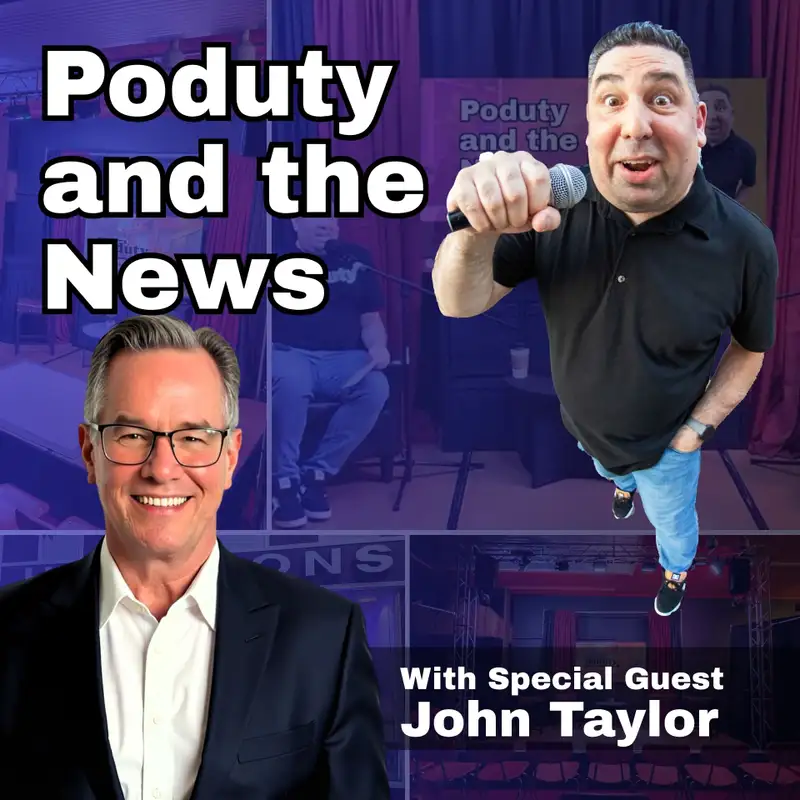
Hey, everybody. Welcome to Poduty and the News for Tuesday, April 7,
2026. We've got six great stories coming to you live
from our podcast theater in downtown Tarentum, Penns. We've got John
Taylor joining us, founder of Act 3 Agency, the
LDO method. We're going to learn all about that coming up. John, do you know
what time it is? It's Poduty time. What
time,
World, what time is it?
The only live news podcast about
podcasting from the st.
The only live news podcast about
podcasting from the stage.
The only live news podcast about podcasting from the stage. It's
John Taylor. John, welcome to the show. Thanks for having me. Great to be
here. And I love my. My dance up, up top there. That's pretty much
the way I dance. So that was an accurate portrayal. Just
swaying back and forth. Sometimes I, sometimes I like to snap
my fingers behind my back like I'm at a wedding. Do the
overbite. Yeah. Dun, dun, dun.
John, I'm really glad to have you here today. You got a lot of experience.
You got agency experience. You have some entertainment experience. We're gonna
learn all about this. The Act 3 agency is one thing that caught
my attention. Tell us a little about what you've been building over there at Act
3. Sure. So I started my own agency about three, maybe
four years ago and quickly sort of fell into the
podcast marketing niche. Been doing digital marketing 20 years, but
had started podcasting back in 2016, 2017.
So what we've really been focused on is the
intersection of podcasting and artificial
intelligence, and with a special sort of
emphasis on how that's going to affect podcast marketing,
with a special emphasis on how that affects growth and
conversions. So we specialize basically in
working with B2B podcasters, B2C podcasters,
on how to create more growth, more
listeners, more discoverability for their podcast,
and how to increase those all important conversions
from just interest to listeners to
customers and clients. Now, the
listener Discoverability Optimization, as we're reading your website,
and if you employ some of those tactics, some of the gains
that you've seen from some clients is 70% increase
in listenership. You tell us, how does, how does that happen? Because I know a
lot of podcasters listening to this show want to, like, how, okay, how can I
grow my show by 70%? Sure. It's, you know,
the bottom line is, is how are you creating discoverability
to your ideal listener and, and, or ideal client
profile? And that's really
what it's sort of a two layer Approach, it requires
that you're optimizing your digital platforms, your sort of your
entire digital ecosystem, that all those touch points
that your podcast has out there on the Internet, all of those
platforms are optimized to their highest and best use. And then on
top of that layer is the marketing content layer,
what kind of copy you're creating and posting across
this ecosystem. And is that copy,
like, really accentuating the key
differentiators, the core concepts, the brand
language of your podcast? And if all these things are working
together, then you're increasing the
foundational discoverability of your podcast.
A good example is YouTube. Right? A lot of people say, oh, yeah, I have
to have my video on YouTube, because
that's what you have to do. But the approach you have to take is that,
no, YouTube is a search engine, and it's the number two search
engine owned by the number one search engine. And you have to treat it
like a search engine. You have to position your content like it's a search engine.
You have to create copy. Your
description has to be optimized for the way a
search engine would look at it and find it. Your playlists
have to be optimized by topic.
So it's this kind of approach where you're basically doing the highest and
best use of the platforms you're on, combined with copy that is
optimized for that platform. And then what you see as a result
of this is way more impressions
than you probably thought imaginable and
therefore more conversions into listeners and
clients. Yeah, check it out. I have all the
links in the show notes. Also, John becomes part of Paduti and the
crew after today. On the website, we have a special page dedicated
to every guest co host that's ever been on the show. All of John's
links, the links to his website, links to where we're talking about the LDO
method that'll all be in the show notes, so make sure you check it out.
Check out the crew page. Really connect with John. If you have like
an email list or do you have something that you like to do to really
entice people to connect with you? Absolutely.
We do have a website. It's podcastmarketing.site.
S I T E. So podcast marketing site, you can reach out to me
individually, John@act3agency.com that's
act the number three agency dot com. And if you reach out to
me, you know, in, in any way, we'd be happy to do a
free strategic analysis of your podcast. We'll just sort of walk
through in a video every touch point
that your podcast has and how it could be optimized for
greater growth and conversions. Awesome. Check those out
in the show notes. John, are you ready for our stories? Let's
do it. We got story number one. We're going
haunted from haunties, the headliners. This story
is the perfect example of what happens when a podcast stops
thinking like a show and starts thinking like a community. Let's
get haunted. Built in a loyal audience by involving
listeners in everything from feedback to inside jokes.
And that connection led to their first live show with over
100 fans in the room with support from Spotify's
radar program. They didn't just grow downloads, they
created an experience. This is the shift that we talk about all the
time. Your audience is not just listening. They're
waiting for a reason to show up. And as John, you might tell
from this theater space, I'm very bullish on live events.
I'm very bullish on podcasters getting out there. And here's an
example of. Here's Spotify, recognizing that we can build
these types of experiences, these types of communities for our podcasters
and for our audience and put them together in a room and give something.
I think it's much more unique than just downloading an
MP3 file. You're going to walk away with stories and experiences
and connection, which is the number one thing that everyone's
looking for, looking for a great story and to connect with that
story. And in that case,
what they're really doing is they're breaking down that fourth wall, right?
They're. They're. You're able to talk directly with
your audience and involve them in the podcast,
involve them in. In what is happening. Not just, you know, not just
talking to them. Even. Even if there are live in a room, you're not
just, you know, giving them a TED Talk, for example. You're involving
them. And like I said, that breaks down that fourth wall
and is a level of engagement that
you can't get any other way. And I love this as an example,
too. A lot of podcasters, they hear that my theater space, oh, it
only holds 40 people. Well, here's Spotify, which
globally is a powerhouse, and they're putting
together small, intimate podcasting events. This one is
100 people. This works for all levels of
podcasting. And most podcasters are at a smaller,
independent podcaster level. They're not receiving major
distribution. So if Spotify is putting together events with
100 people, start to think this could be something that's possible for
my podcast. I might be able to draw 2030 people to come
see me. And now your world starts to open up when you start
performing live. Absolutely. Because you never know
to the effects of the word of mouth from that. If you had 20
new listeners and they all had this incredible kind of new
experience, just think of how many people they're going to talk to about that.
Yeah, that like Butterfly Effect. You don't know who's going to be in
that audience. It could be somebody who has a cousin who knows
somebody who's in the industry. And all of a sudden you're doing
shows that like, you know, Comic Cons in South by Southwest.
Absolutely. Let's go on to our second story. Today. We're
going to Dare to compare Dare to Disrupt at Penn
State. I threw this story in. My daughter is a Penn State student
right now, and this is happening at Penn State University. This story
shows you how podcasts are becoming more than content.
They're becoming events. Penn State's Dare to Disrupt Podcasts is
celebrating its 50th episode with a live show that brings
together students, alumni, and entrepreneurs for a full experience.
Not just a recording. You have a Fireside Chat, a
live podcast audience Q and A, and even a networking
reception after. This is what happens when a podcast becomes a
platform. It creates opportunities for connection,
collaboration, and real world engagement
beyond the download. That's
terrific. You know what I like the most about that is the
Q and A session. In a live
Q and A, your expertise is tested
and you can't lie about it.
You're on the spot, you have a question there, you need to answer it. You
need to sound eloquent, you need to sound like you know what you're talking about.
And since podcasting is so much about building authority
and showing your expertise and building trust, if you can
do that on the spot with a question you don't know about live in front
of an audience, then you're on your game and you've proved it.
Yeah, nothing shows credibility like showing up in the moment,
embracing those moments, embracing those questions. Thing that I liked
the most too was, I believe, afterwards,
did I see there was some snacks afterwards. So these are
receptions, too. These are events where people are
gathering and networking. And when you go to an event like this, it's a business
event, a business podcast, you're going to meet other people who are
probably studying the same things that you are on campus. You're going to make
connections. You'll even make connections with probably the hosts
and the guests of that episode. And that just starts to open your door.
It's like turning on faucets for connections. And you turn on another faucet,
you're making some more connections. And the more you turn on, the faster
that bathtub fills up and the faster you start to. You meet the right people.
Yeah, yeah. It's like that word of mouth that we were talking about before.
You know, when you start to get in front of these live audiences and these
larger audiences and you're creating this
deeper level of engagement than you can get from the
podcast itself, that snowball
starts to roll down the hill a little bit faster, and you really pick
up a special kind of momentum that way.
Yeah, I love it. This is an event we're seeing more and more on college
campuses as a way to expand the curriculum, as a
way to show students that there are real world things that
can happen after you leave here, that you can make these connections
and you can share that education. And it kind of like comes full circle.
You know, you leave the college, you will go develop your skills and your
career, and then people come back and they're doing these live panels
and giving the next generation of students a whole new perspective on
what's possible. Yeah, it's great. Let's keep it
going. We're going to go to some Star Trek conventions.
Yes. Speaking my language.
This story highlights a different kind of live podcast, one that
starts as a panel and turns into content. At
WonderCon, a group of podcasters and super fans took to the
stage to break down the controversy around Starfleet
Academy. And that conversation didn't stay in the room.
It became a podcast episode. This is a great reminder
that live podcasting doesn't always need to start as a show.
It can start as a moment. Panels, discussions, and
events are all opportunities to create content that lives
far beyond the stage. And you mentioned, John, that this is right up your
alley. Yeah, I've been a Trekkie or
Trekker, I guess they say all my.
I love seeing content like that. And, you know, it's great
because it's kind of like you were saying,
it's bigger than the podcast. Right. You have this panel
of experts that, you know, are
going to take this topic and
run with it in directions that you'd never thought of before.
So what better thing to do than put a, you know, a microphone and some
recording equipment in there and. And preserve it as a
podcast, you know, with no real.
With real plan or real structure, you're just automatically going
off of the expertise of these panelists.
And to me, that's just the. That's the best kind of content you can get
not just improvised, but, you know, improvised
expertise. Just. Yeah, it's.
To me, it's kind of like the ultimate form of the content.
Yeah. I think building off of your listener discoverability optimization,
what better way to optimize than to go where your
audience is already gathering? So you know that this conference already
has Trekkies. It has Sci Fi people. If you're doing a
Sci Fi podcast, that's probably a place that
you want to consider going. How do you get on their radar? How do you
become part of their event? You can really find a whole new
group of people to listen to your podcast if you go where they're already
gathering 100%. And if you
understand that they gather in places like that, you know that
Trekkers go to Comic Con and wondercon and all the different
kinds of conventions that are out there, then you can
sort of take a step back and say, I'm going to make more content
that is designed to reach those people. And,
you know, where it pertains to, like, listener discoverability optimization
is like, okay, we're. Let's plan on doing a couple of episodes that talk about
Comic Con, WonderCon, how Star Trek
material is presented at those conventions. And
then when you put it out there and you're optimizing
all of your marketing copy, all of your posting and promotion
copy to include those.
Those phrases and those concepts about the conventions and
convention life and everything like that, you're being
discoverable by that audience and growing to that
audience. And that's one thing that's. That's so important for
podcasters to remember, is that so much of
your content has to live outside of the
podcast. You need to. You need to be thinking in terms
of how do I summarize this information outside of the
podcast itself? Because especially in a growing world of AI and
AI Discoverability, AI doesn't listen to podcasts, and it also
doesn't have the patience to read your entire transcript because that takes
up too much power and too much water. So it's looking for the
content in summarized, concise
ways outside of the
podcast itself in order to discover that material.
Yeah, I love the way you're thinking about this. It isn't just the event that's
important, but it's after the event. And how do you repurpose that
content? How do you position that content well after the. The
event and have it for weeks, for months, and keep building that
credibility around this one topic and showing that you're the
expert, showing that you have the best content and the best
discussions around this, whatever we talked about at
what was a Starfleet Academy, you're going to become a thought leader in that
space because you've got all this optimized content just
focused on Starfleet Academy. Yeah. And I think you make a great point
there about the connection between
credibility and events. I think that there's something
just inherent about doing events that speaks to your credibility.
Right. No one puts on an event with people you've never heard of.
Right. It's all authorities in their field.
And so your credibility goes through the roof. And that's something you need to
repurpose again and again to emphasize your credibility
when you get that kind of content from an event. Yeah. Like, come on
down to the Paduti Podcast theater. We got shows with a bunch of guys.
Great. Yeah. Sign me up.
And sign me up for our next story. We're going to the music industry on
this one. Awesome. This story pushes the idea of what live
podcasts can be. Instead of just talking, notags
turned their show into a listening experience. They brought artists together,
played music, shared stories behind the tracks, and created
an atmosphere that you can't replicate through audio alone. This
is where live podcasting gets interesting. It's not just about
recording in front of people. It's about designing an experience that
gives the audience something they can feel in the room and then
relive after or relive later through
the content. It's
so. It's so genius the way
that the structure there is to capture a moment,
and that. That is. That.
Yeah, it kind of makes me speechless because of how important
that is and how different that is from
sort of the paradigm that we think about podcasts, because
we think about podcasts as highly researched and highly
scripted. And, you know, there. There are some
podcasts, of course, that, you know, it's. Hey, it's just me improvising.
But even if you're just improvising, it's on a topic, and it's a topic
you know about. So when you set up for something
that's live and unscripted
and, you know, I. I think that's a. That's a
great example of. Of how you create a moment.
And that's what people are looking for, that
they're looking for moments. They're looking for something cool
that they can tell their friends about. Did you see this? Did you
hear this? Oh, this was so cool.
And, yeah, those little moments are typically
unscripted and really important.
I feel bad for most kids in the last 25, 30
years of the. The Closest they've had the physical media
was, like, ripped CDs in, like, the early 2000s. Everybody was
burning and stealing music back then. But before that,
it's. It's hard to explain to somebody the power
that sitting in a friend's room, going through their music
collection, they're pulling out their favorite records,
cassettes, and they're playing music. They're sharing their
experiences with you, and you're just sitting there on a Saturday
afternoon, trying new music, hearing new things,
talking about things, laughing, goofing around. And that's kind of
what this show reminded me of. Sitting in a friend's room,
finding new tunes, listening to the B sides for the first time, and like, oh,
I never heard this song. But you're experiencing and you're taking in new things
and you're having a moment and. And I really love the way they put this
together. It felt like just hanging out in a friend's room. Yeah,
I love that analogy. Cause it's just so true. That was the
era I grew up in with vinyl records and going
and seeing your buddy's record collection. And
even though you could go to Columbia records and
get 20 records for a penny, if you remember that old promotion,
it was not easy to get records sometimes that your friends
got, you know, or old releases that
just weren't available. Right. There was no Internet, so when a record went out of
print, it was gone. So if your buddy had it and you didn't, that was
super cool. And you could go and listen to it at their place. Yeah,
replicating that kind of experience
is really cool. I have no idea how Columbia House
ever made money. I think all my friends had debt collectors in high school,
and they're like, hey, I'm a minor. I can't even sign a contract. Why would
you send me 10 CDs for a penny?
Right. Well, let's keep it going. Speaking of
money, we're going to go to Planet Money. And this is what it
looks like when a podcast becomes a super powerhouse
brand. Planet Money is heading to Boulder for a live show
tied to their new book, turning listeners into
attendees. This is not just a recording. It's an event built
around content people already trust. You have
hosts, guests, live storytelling, and a shared experience.
This is where podcasting is heading. Shows that build
authority, can step off the feed and onto the stage, creating
new ways to connect and monetize. And we've
seen this model for book releases where people used to do
morning radio or morning talk shows. We're
seeing people now tour as part of a podcast
tour to release a book. Absolutely. And I'm
glad you mentioned that. The monetization part of it, because, you
know, especially a podcast at that level, at the level of Planet Money, if
you're selling out, you know, a small theater, let's
say 500, 600 seats, and everyone paid 40
bucks, you know, to be there, and so your gross revenue on ticket
sales alone is $25,000. I mean, you want to talk about
monetization, and that's not a heavy production type
of. Of show either. Okay. You're not
bringing in sound and lights and sets and. And
pyrotechnics, you know, as if you were a band. It's just you and a couple
people and some microphones on stage, so you're keeping your costs low,
your overhead low, and you're making some money. And you do that
10 times, 20 times. You know, if you're. That. If you're that
popular, that's a monetization strategy that's
really, really worth it. And like you said, then you're selling merch, you know, you're
selling your books on top of that. Maybe some hats or something.
Yeah, it's. It's. It's a whole new.
It's a whole new way. And all these live
events, you know, it's such a
new. It's a new thing. It really is the. And I
think it really speaks to the idea that podcasting is. Is,
you know, it's been around for a while, but it's really just starting
to get its legs and, And. And discover
what it's all about and what the potential is there
for this medium. Yeah, I've been drawing a lot of
parallels between. If you ever hear comedians from the
late 70s, early 80s, before there were really established comedy
clubs, they were doing comedy in bowling
alleys, in the back of Chinese restaurants. They were. Wherever they
could find a space, they were doing it. And podcasting is
kind of in this realm where we have people, we have the talent.
A lot of people are very comfortable at home in their home studios, but we
also know that a lot of people are moving into theaters,
into arenas, and they're selling tickets. So in between,
even though there isn't that infrastructure yet of how do I get from my. My
mom's basement where I record my podcast, to Madison Square
Garden? Well, I think spots like this, our theater that we're sitting in
here, these are those stepping stones that's gonna help
develop that talent. And just like the comedy clubs did in the
80s, where they got people out of the back of the restaurants, into
clubs, touring clubs around the country, then into arenas and
main television. I think that this is the time now,
like John's saying, like, podcasting is rising and people
are catching on to this can be a very fun, very
affordable live entertainment way to experience
live entertainment. Absolutely.
Well, this goes so fast, John. We're already on our last
story. Oh, you want me to talk more?
Oh, no, we're on time. Even though we're going fast, we're
still on time. I like to throw in stories related
to John. John has some music background. John has some marketing background.
So I picked some stories for John. I picked this one for me because it's
from Pittsburgh and I really like this group. It's called the Pittsburgh Her.
This story is all about voice. Pittsburgh her is creating
the kind of conversations most people only have in private
and putting them front and center. What makes this work is not just
the topics. It's the format. You have multiple hosts,
real perspectives, and audience submitted questions driving the
conversation. This is the kind of show that builds connection
fast, and when you build that kind of trust, it opens a door for
live events, community engagement, and a loyal audience that
wants to be part of the conversation. When I read
this story, that's the first thing I thought of was they are building the
structure to take this show on the road. This would be a great live
show. Absolutely, absolutely.
And it really drives home the point that
storytelling and empathy
are the backbone of great
podcasting. No matter what your podcast is, if you are
a B2B podcasters like the ones we work with, or B2C,
you're like, oh, well, you know, it's not as much story driven. Well, yeah, it
is. It totally is, because your customers have pain points.
And so this is the story of this. You know that that's just a classic
story, right? Your protagonist, your customer, has
a problem, the pain point. Now, how do they defeat the
antagonist to get that problem solved?
Right? And so, you know, with it, with this example you're
talking about, you know, you're really. You're. You're
really driving home that storytelling and that
empathy angle.
You know, I. I had this screenwriting
teacher, Bob McKee, When I was a
student at USC, and I was fortunate to have the only
semester he ever taught. And he's, you know, considered
like the great storytelling
scholar, has this incredible book just called
Story, and it's like a textbook, and it's incredible.
Anyway, he asked us at the beginning of the semester, you know, why do people
go to the movies? Why do people watch movies?
And eventually gave us the answer. And it was to see how other people
solve their problems. And, you know, here it is
40 years later, and that's still just ringing in my head, and it's just so
true. And your story kind of, you know,
emphasizes that, is that people go to these live events especially,
and they ask these podcasters these questions
and what they're looking for answers. How did you solve this problem?
How did you get through this crisis? How did you overcome this
situation? And to get that,
not just that information of how they did it, but the
empathy of, like, this is a person who is going through what
I am going through and made it to the other side.
That's priceless. Yeah.
And something else I loved about this article was
a lot of times people come up with ideas and they're like, oh, they
already do that. Here's five ladies doing a podcast. Like, oh, maybe
that's like the View or like a talk show, but
nobody has done it. Like, these five have done it. And these are
five new voices, five new perspectives. So if you think you have
an idea and you're like, I don't want to get out there, somebody's already
doing that. They're not doing it the way you do it. And
you can come up with something that it could be very similar to something
else, but it's the way you deliver. It's your perspective
on it, it's your experiences and stories that'll make it unique.
And you know that it's a format that works. Five people sitting around
talking stories, current events, you know that it works. So
if you do it and you have some friends, you're not copying,
you're giving something to the world in your vision, in your history,
your perspective, and creating something and giving
that out which nobody else can do it like you do it, I
think you hit the nail on the head there, that it is. It's all about
your perspective. And there's the fact that someone's done it before.
That the format is the same as something else has nothing to do with it.
I mean, I think you and I probably both grew up on 80s and 90s
daytime TV, and there was plenty of room for Ricki Lake
and Montel Williams and Sally Jesse
Raphael and, you know, on and on and on.
But they all had a different perspective. They all had a different personality. They all
brought a unique element to the conversation. So that's.
That's what you need. What you need is the. Is the perspective,
not the, you know, hell, if the format was the
problem, then all of us podcasters would be out of business because we're all
just a person sitting in front of a mic. So, you know,
it's got to be about the perspective. Yeah. What a great.
I never used that example before, but I'm going to use it. In the 80s
and 90s, daytime talk shows were all the same. It
focused around one host and a panel, and they did that
format for 15 years on daytime television,
and it just worked. But each one was different. Phil
Donahue wasn't like Morton Downey Jr. That's a weird reference.
Wasn't like Geraldo. Wasn't like Sally Jesse Raphael or
Jenny Jones or Ricki Lake. They were all different and unique. And
that's a great example. And this is a great podcast concept. I'm glad
it's happening here in Pittsburgh. I can't wait to see where this goes.
Excellent. Yeah. And, you know, the other thing to note
there is that that
format never really went away. It was the distribution style that went
away. You know, when the Internet came along, all those shows dropped off because
nobody knew what this Internet thing was going to do to that kind
of content. And now we're seeing it. Right now we're seeing these
podcasts that are on Netflix, that are on YouTube,
that are on huge platforms that are basically 90s
daytime TV. It's just a person and their
perspective. And that's it. That's it. If you
take anything from this episode, get yourself a pair of red glasses. You
could be the next Sally, Jesse Raphael.
Google it, kids. Yeah. John, this is
so much fun. Thank you for your time today. This is the part of the
show I turn the floor completely over to you. You can
plug, promote, talk about anything you'd like. John, the
floor is yours. Fantastic. Thank you. Right, plug away.
I don't know if you remember that Saturday Night Live skit. Hey, I will
plug. This is what I'm going to plug. So, as I talked about earlier,
we've kind of been at the intersection of podcasting and AI,
and I fully acknowledge
the fact that I'm going to be out of a job in two years.
AI will replace me. It won't replace you. It's not going to
replace podcasters. It's not going to replace creators,
doers, makers. But all of us on the periphery, all of us
who market and promote and do that sort of thing, we're all out
of a job. The time's going to come when. When you just.
You create your episode and then you say to your computer, post
and promote this. And it will, and it'll do it more effectively than
anything that's happening right now. So I'm working hard
to put myself out of a job because I see the writing on the wall.
And so what we're doing is we're creating that new
generation of apps that are all about
podcast marketing and podcast creation,
ideation and promotion. And our flagship app is going to be coming
out in about three weeks, so look for it in early May.
It's called Podagain AI and this is
our creation ideation tool. What it
does is it taps into your RSS feed and it downloads your
entire library of podcasts. So it's especially
effective for people who have 100, 200, 300 podcasts
out there. It downloads your entire library,
reads the transcripts, listens to the audio, and creates
its own large language model based solely on your
content. Then you go into it like you would chatgpt
and you query it and you say, I want a 10
minute podcast episode about my four biggest
sugar cookie baking tips. And it will write that
script and you can edit it in the interface and
then you can either print out that script and say, okay, this is going to
be my new episode, or you can press the button, it will clone your
voice, and bingo, you have a new
podcast episode. But again, what's cool about it, it's based on your
material. It's not AI slop. It's your
proprietary content reused and
reformatted to make new episodes.
Awesome. I'm so glad you said sugar baking tips and not
sugar daddy tips. That's right. I was like, where's he going with this one? Where's
he going with that? What kind of podcast do you run,
John? Thank you so much, everybody. Check out John's links in the show notes. I
will update the link to see the tool in a couple weeks once it comes
out. And John, do you remember what time it was? It's
Poduty time. What time is it?
What time is it?
News, Poduty and the News.
The only live news podcast about
podcasting from the stage.
Poduty and the News. The
only live news podcast about podcasting
from the stage.