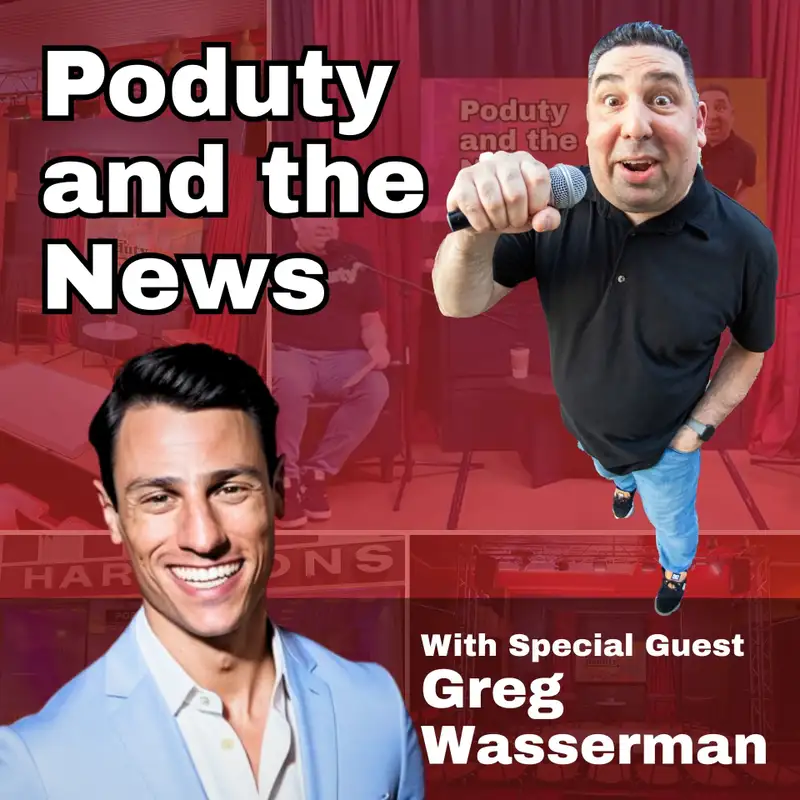
Tuesday night, May 12th. I've got a great guest
joining me tonight. We are live at the Paduti Podcast Theater at Harrison's on
Corbet in downtown Tarentum. Greg Wasserman, RSS.com
Head of Relationships. Greg, do you know
what time it is? Showtime. What time is
it?
What time is it?
Time.
The only live news podcast about
podcasting from the stage.
The only live news podcast about
podcasting from the stage.
Oh, the only live news podcast about podcasting from the stage.
Greg Wasserman of RSS.com's head of
relationships. Welcome to the show. I was dancing. What a
good theme song. You've got me pumped. I'm ready for this.
It's so much fun. It is a high energy song. It's a Tuesday night. We're
kind of winding down the day today, and we got six great stories about
live podcasting heading your way. But we want to find out a little bit about
Greg first. And, you know, we've met a while ago, a few years ago.
We did some interviews together. We just had just, I think, a casual conversation
talking about podcasting and potential. And I really appreciated your time back
then and kind of set the stage for some of the things I've been building.
But tell us a little bit about what you've been working on over at
RSS.com well, yeah, I mean, to understand where I've been, where I'm at,
it kind of helps. So backgrounds in media sales, joined
the podcast ecosystem in 2021, fell into it,
ran three listening platforms, then worked, and how we Met was at
CastMagic Content repurposing. And now I've been here at
RSS.com since February of 2025 and as you
said, had relationships. So it's been a great time.
Most people think podcast hosting is just storage and
distribution, but there's so much more and it's been really cool, especially
those that have been in the space a lot longer to see what
and just the ecosystem that's being evolved, especially as we think about
video. I mean, we're recording this over Streamyard and streaming it live,
but the whole ecosystem of podcasting, what it
stands for. It's been fun being here and seeing what we'll be able to do.
Yeah. Not only working within podcasting, but I think I've been
seeing and following along a little bit. You're releasing your own podcast
coming up. You just started putting out some episodes. Tell us a little about that.
Yeah, so everyone kept asking me when I was
guesting on podcast, when are you going to have your own podcast. I'm like, I
like being a guest. You know, the joys of being a guest and working in
industry is, is you get to see what the workflow is that a host.
Most hosts are always complaining that their guests don't share. And so being
a guest, you get to understand the psychology and understand, well, you're not
helping me share this. So it finally came to the point. I'm working for a
hosting company, so in order to use the tool
that I tell people, this is why it's a great tool, I
launched Podcast Network Insights. And there's so many shows that are,
I mean, look at yours. We've got a different angle and you've found a
niche that's very much within the live community and the value
of how to use podcasting in the live
arena. I went down the route of how do we talk to the
heads of podcast networks? Podcasters are always thinking about how do I
grow my show, should I join a network? Most of them are thinking about the
big guys, not understanding what that entails. Someone gave me an
idea, a fact that there's about 400 podcast networks out
there and there's so much more. I'm sure you could start one. I
mean, RSS.com has a podcast network plan, so
for 20 bucks a month you can start your own network. So it was interesting
to. Every month, sorry, every week on Thursdays
I release a new episode of Podcast Network Insights, interviewing
anyone and everyone that has a network. That's
pretty incredible. It's like almost building a community of community
builders. And I mean, to the point
of what we'll probably talk about. A bunch of my
guests have talked about how live is very much an
extension of what their network entails and the
power of live beyond just the power of download. So
it's been really interesting to learn that and now get to come and talk about
these great six articles. Yeah, it's no secret I'm pretty bullish
on live events. I'm sitting in a theater
built just for live podcasting. And I really think that as
podcasting evolves, it's changed so much just in the last five years
as it's as all this buzz about video that's popping
in there. But I really think skipping over video, live
and in person and one on one, face to face, those
connections are going to be, I think, the future for a lot of
smaller, independent, even mid sized podcasters
starting to take their show, performing it live in front of an audience, and
all that is centered around community and all that is exactly what
you're building. And I love that you're going to give those perspectives on
a bigger scale than we have here in our little town outside of Pittsburgh.
I think the conversation tonight is really going to focus around how do we make
those connections, how do we network, how do we build something bigger than ourselves?
And you're doing that with your podcast. You're doing that with the
work@rss.com and I'm really excited to get into the stories. Are you
ready? Yeah. Let's do it. We'll go to our first
story. We covered it when they announced this. This is the
Recombobulation area. This is 414 strong happening out
in Milwaukee. And the Milwaukee publication
Recombobulation Area recently hosted a live podcast
event at Anodyne Coffee Walker's Point
Rotisserie in celebration of Milwaukee's annual
414day. Hosted by journalist Dan Schaefer,
the event featured guests including Angela Lang and Kristen
Bay, along with local organizers and media representatives
connected to civic media. The event brought together
journalism, podcasting, local culture and community
conversation in front of a live audience at one of
Milwaukee's well known coffee spaces. And
this is everything that I believe podcasting can be. The greatness of
storytelling, the greatness of sharing ideas and
concepts and stories in front of people in your own community,
then capturing that and then releasing as your podcast, but
being part of your community, networking locally, bring in the mayor,
you'll talk to some council people, the local business people,
really showcase and elevate your local town and then use that
audio to distribute to the world. And I love adding that little
step into podcasting. I think this really is
a direction you're gonna see a lot of podcasts go into the future.
Personally, I'm bullish on it along with you. And then from a corporate standpoint,
RSS.com, we're bullish on it too. I mean, if I go in the
latter part, we launched a free
niche and local plan. So we are
incredibly bullish and unbullish that the local community,
especially as we see journalism going away,
getting people to an actual physical location is key.
I love that you've got the names that they had here.
Angela Lands. Where was it? Angela. Angela Lang.
Right. So, like, you've got some good names here, featuring guests
that you're able to tap. And so you think about, you know, are there people
in your community that you can turn to? I tell everyone
there's so many places that are dying for attendance.
If we look at restaurants, we look at
event spaces like yours, I mean, they are looking for an
attendance. So if you can just go ahead and start networking your local
community and going, hey, who could I go ahead and get and start
introducing my show to an audience locally. And like you said,
then record that and put it out there so that everyone can listen to. You
don't have to worry so much about like, oh, this is too localized. Why is
anyone outside of this local community going to care? It's like, no, it's all just
a matter of where it's recorded and the audience there. But then the
networking that you get to do afterwards is, I mean, for me, I love
networking. So that's a huge piece of. Yeah. And the
ability to record something locally. There is somebody
in other towns all over the country that are going through the same
types of things that you're going through in your town. So your small town
story can resonate across the country. So I don't think you ever need
to think that, oh, we're too small, we can't do anything about
this. Who wants to hear about our small town? But
there's 20 towns over, even locally that are
going through the same types of things that you're going through. And I
think the other side is we're all looking in the podcast space for an
audience. We're looking for attendance, we're looking for how do we find new people.
Well, couldn't you now? I mean, what I love about all these articles
we're going to go through is the concept of, hey,
go reach out to your local, I don't know, your local faith based
organizations. Go local to the civic community, go local
to restaurants, whatever, and just put the message out there, hey,
I'm recording this X, Y and Z at this place and see
who wants to come there. I mean, that's just doing boots on the ground
marketing as opposed to how do I just do social media
and know that on a social media platform I don't control the
algorithm. So I could do a post, but is anyone going to see that? Or
I can go to the community here and say, hey, I'm going to do a
live event here. Will you email your newsletter? And now,
most likely most people, 50 to 80% open rates on a newsletter,
you're getting the access that you didn't have before. Yeah. And
you touched on something, you know, community members helping community members. And
that's a great segue into our next story because we're talking
cinema mental health in a live audience. We're putting all these things together
that we're talking about. Here's an event that happens. It's a live
event. A live episode of the podcast called Sentimental
recently took place at Field Arts and Events hall in Port
Angeles, Washington, as part of the first Fed Community
Conversation series. The podcast is hosted by brothers
Jeffrey Jones and Joshua Jones and focuses on mental
health themes in movies and television. During the event,
hosts discuss films, including Good Will Hunting and the Devil Wears
Prada, while also opening the conversation up to audience
questions. The live taping, blended podcasting, film
analysis, mental health discussions, and community engagement
in a theater setting. I love this. I mean, I
hate to say it, but I'm thinking about my mom and how she goes to
the local library and they put on movies. Well, why
couldn't you go to the local library or in this case, the Field Arts
and Events hall and go, hey, I would love to put on this?
Most likely if they have the AVA set up, if they have the
equipment, so they would love for you to come in there. And I love
the. I just love this concept of sentimental. It's like, all right, we could have
two talking heads talking about a movie, or let's go
watch the movie. Let's bring that as an experience. Case in point, back to my
mom going to library. We watch this, and now you can have two
people who have a show, and you're grading in the content, but also now you're
getting the. The audience that's able to engage with you, and
that becomes part of the content that others that will listen to it
thereafter get to go. Oh, yeah, I agree with the
host, but I also agree with whoever was asking the question from
the audience. And imagine the service that this
podcast is doing for the community. Somebody sitting at home
having certain thoughts or thinking about being lonely.
And here's an event that comes along, and it
gives you an outlet. It lets you see other people in the community might.
Might share different ideas and things that they're going through, and it
might help people see that, oh, you know what? Maybe I'm not so different. I'm
not so alone. There's other people who think like I do, and
I think, you know, if one or two people walk out of that feeling
change and feeling inspired, that that really shows the power of
podcasting and really the power of bringing people to a
place to do a podcast live. And especially if you're talking about, you
know, very intense conversations, very intense topics, things that
are happening in movies and why did they happen? How did that character
deal with it? You know, that's something that People can walk away with and
feel a little better about themselves. And it also opens it
up to a medium that maybe someone in your community may
not have thought about. Right. Hey, we're doing a live podcast recording
to whatever this topic may be in this case, you know, watching Good Will
Hunting and talking about it from a mental health standpoint point, as
you said, someone's sitting at home, but now you have introduced them to
not only I want to be able to talk about this, I want to listen
to this. I've never thought about that. And what's a podcast?
I've heard all these things about listening to podcasts, but now I get to go
and just listen. And so you're opening up the field of
what podcasting could be, and the experience can be beyond
just, I got to listen to this on my phone or my computer.
Yeah. When you bring people together, the event
starts to build itself. Sometimes it compounds event after event.
And we're seeing this happen in Carlsbad here. It's a transition to our next
story. And this one had food vendors, drinks, opportunities
for attendees to connect before and after the recording. So, again,
very important. These are things that are happening in communities, and
we're bringing you very similar stories to show you. This is happening all
over the place, all over the world. These are six examples tonight, and this one
is a new live podcast series called Making It Live. It's
launching in Carlsbad Village, California. Hosted by local
artist and podcaster Taylor Gallegos, the
series is an extension of his long running Making a
Podcast, which has released more than 115 episodes over the
last five years. Instead of listening online, audience members can now
attend the interviews live at Hammy's in
Carlsbad Village, where local creatives, business owners,
photographers, and community leaders will share the stories behind
their careers. And again, it's this idea of this event
with food vendors, drinks, they're just
having a good time, getting together. I mean,
yes, all the other ones have touched on this, but I'll call out this
specifically based on the way this story has been written, the fact
that, I mean, I believe life is about time and relationships. You have no clue
where one conversation will take you now. You've literally created an environment
that enhances that connection, that conversation,
especially in long hair with artists and the local
community. So you are now able to
bring people together, especially these podcasters. Like, most of us don't know
who's listening. So imagine if you can fill a room with just 10 people,
and you know who these 10 people are. You get to Talk to them beforehand
and then talk to them afterwards. Like, hey, what did you like about this podcast?
What did you like about this recording? What. What should I talk about next time?
Fuel me for the next event, and then you can go back to these food
vendors, these drink opportunities that you're trying to find, say, all right,
I've got people. They'll be excited for this. And you're fueling your content while
fueling, at the end of the day, your connection to the community, which
is now also creating the content that anyone around the world is able to
listen to. So I love this. This is a great one.
And think about what this podcast is also doing for their local community,
because I already want to know more about Hammy's. Right. What's Hammy's
restaurant like? What's the pub like? Well, they're bringing in people
to that restaurant maybe on a Tuesday or a Thursday night,
not a busy night. They're putting butts in seats. The people
are buying food, or maybe food is part of the ticket, and
they're really supporting Hammy's getting out. A night on the
town at Hammy's seems like a thing I Seems like a thing I want to
do. Maybe I'm going to leave right here and go to Hammy's, but
that is another service. You're providing something of value
to a business owner in your town by bringing in people. You
know, the number one thing I say about this theater is all I want to
do is get butts and seats. Butts in seats, butts in seats. If you have
a product or a podcast that you're talking about something
and you have a little bit of a community and you want to do a
meetup, if you approach a restaurant, a coffee shop,
even libraries are looking to bring people in. They have
community centers, they have audio, video, technology, and
libraries. If you can bring people to the library, to a coffee
shop, to a restaurant, they're going to be more than inviting and
bringing you in because they want to also put butts in seats.
I mean, here's something that if we go back to before my
podcasting days, the company I was with, we shut down because of
COVID But our goal was to bring people to bars and
restaurants, because if you're doing takeout, the bar and
restaurants losing about 30% to the margins on
takeout, and they're making their money in alcohol sales. So if you can go ahead
and bring a person to that bar and restaurant, they're going to drink
another drink, which is the margins that the bar and restaurant needs. So if you're
looking at your commuting going, look at how many restaurants are here that are
closing or, you know, this place used to be busy. Think about what
can you do to that community and say, well, I've got a podcast, or could
I start a podcast and start bringing business to my favorite
institution where if it's not me, then they're going to
shut down. And so you are able to give back to the community in
so many ways that you may not have been thinking about.
I love thinking of it like the Butterfly Effect. I had this idea in my
basement. I started recording it. Now I want to take it out
live. I'm going to partner with a business. We're going to bring people in.
Whatever we talk about, some people might leave. They may feel inspired. They
may start their own show or podcast or whatever. And
this little idea that you start and that you're building can
become something so great. These first three stories really showcase
how much bigger your effect can be on the world by
just sharing what you love, talking about what you love, doing the thing you do,
and doing it in front of people, performing it for your friends and neighbors.
And if you look at it, the audio quality
may or may not be good. That's to be determined based on
the venue that you connect with. But if you're able to be that
person who's bringing people together, then, hey, maybe you're not getting
the downloads because the audio quality may not be there. But if you become this
consistent, I'm just getting this content. I'm having this local community
conversation. I'm connecting with people that I never would have
been able to. That's. That's huge. That's. That's taking you
beyond just the. The Talking Heads recording that
most of us are thinking about these days. And speaking of Talking Heads, let's
head out to Newport Beach. We're going to see Seth MacFarlane
accepting an award and doing a podcast. My
laptop just died. Let's see, we got The Newport Beach TV Fest
recently announced that Seth MacFarlane will receive its
Maverick Award during this year's festival in June. The evening
will begin with a live recording of Awards Chatter,
an interview podcast from the Hollywood Reporter taking place at
the historic Lido Theater in Newport Beach,
California. During the live conversation, McFarlane is
expected to discuss projects including Ted, Family Guy,
American dad, the Orville, and the Burbs. The event is part
of a larger television festival that also includes screenings,
panels, celebrity appearances, and award presentations
connected to the television and streaming industry.
All right, this is just the. If. If the if the
large media companies are looking at this, I mean, what they used to do is
just have him there and they wouldn't record this. Now they're like,
whoa, this is content. So let's go ahead and sell the fact that
we've got this great live recording, you know, of a podcast.
So podcasting has become this cool, sexy thing that we're now able to
have a major company talking about it
and bringing all these events together. So if this isn't the
guide, you need to realize this is what they're doing
at a larger scale, and the three other stories we looked at are doing at
a smaller scale. There's a reason someone at these scale
is doing this. The value of having that local community, the
value of just creating that conversation, recording it, and not saying no
one else can be there. You have to buy the ticket to this. No.
Content is king. And building an audience, wherever that audience
is, even if they're not able to actually make it to the event, is
a huge piece. So now you've got come meet Seth, come
see all these other components of their event, and get this live
recording. I love it. I really chose this one
to show the different levels that this is happening at. This is the Hollywood Reporter.
We're seeing a lot of legacy media really come back to
podcasting, which is, you know, really just. Is it radio on demand?
These live events, these remotes, they used to call these remotes back
in the 90s, where you would hire a radio station
and they would come to your business and broadcast all day from
your business as. As a remote. And we're seeing that model get
applied to podcasting, where the Hollywood Reporter is hosting this event.
They're bringing in celebrities, they're doing their awards, but
they're doing it as a way to connect with the audience
and to create new types of media for distribution later on. They're going to
certainly make videos out of this, make podcasts out of it. They're recording a podcast
here, so they're tapping into this new wave of new media
in order to really broaden their reach out. Just outside of
the hollywoodreporter.com well, here's an event that's happening
that you can go attend and be a part of. Think about
events like this at this scale. You know, Hollywood Reporter,
you're seeing a lot in this vein where
the guests that are coming and taking stages are asking, hey,
will I get a recording of this? Can I have a recording of this? So
they can leverage it for their own assets, their own
marketing, their own Value add. And so
that's why you're seeing more and more of these. Like, all right, well, if we're
getting asked for this, let's be the people that control that conversation, that
owns that and gets that distribution and bring the people
to a local event. Yeah, I love
it. And that connection idea, which is really tapping into our
next story of a mother and daughter on Mother's Day. So
we're going full circle. You're back to the family and Australia.
Media personality Bec Morse and her daughter Grace
Wakelin recently brought their podcast in the Jeans
to a live audience in Adelaide for the first time. The
Mother's Day event took place at Meyer Center, Adelaide and
featured a live recording focused on relationship between mothers
and daughters. Audience members received drinks, giveaways and the
opportunity to meet the host after the show. The free event
blended podcasting, retail space activation, live
entertainment and community engagement around a holiday
themed experience. And so if we look at a
couple of these and this story included a couple of the stories
we've looked at, they've been doing this for a while. I think one of our
stories, it's 115 episodes before they decide to go live here.
I don't know how long they've been doing it, but this is their first time.
So it's showing you there's value in, hey, build an audience, get
comfortable with being behind the mic, being comfortable on the interview.
And now you've got a little more that you can go to the local event
sponsors and say, hey, I've got an audience, or I've got
this level of credibility or this professionalism. So let's go
ahead and do an event. So you've seen someone also in our stories that
started it. And this was a whole new thing of just doing the live events.
I think that was done in the Carlsbad. So there's so many
different ways you can approach the local
live recording. An extension of your podcast.
Yeah. And this one is an example of taking an event, a
holiday that's happening and tying it into, in this
case, your podcast. Mother and daughter podcast. What better day,
you know, almost like their super bowl, once a year is going to be Mother's
Day. Mother's Day is the day that is the perfect day for these two to
get together, perform a show for other mothers and daughters and
sons too. Sons have mothers. So you can have this Mother's Day
festival based around what you're talking about. And
they tied in. They had retail space activation. So they had local
vendors from their community, they had food and drinks. It was a free
event. It was just about bringing people together on
Mother's Day to celebrate each other and talk about the thing they love
talking about moms and the trials and tribulations
of raising daughters. I have two daughters, so I can definitely speak to those
on Father's Day. But the just, just a ton of
fun and a great way to take your podcast and tie it into something. If
you're talking, you know, if you have a sports podcast, you know, tie it
around the big game. I mentioned the Super Bowl. If you're talking football, then
maybe there's a big game show event you can have at a local bar
and just pump up the local fans about the big game and
just bring people together around your central point.
I think that's another good point worth calling out is
number one reason a lot of podcasters fade out is lack of
strategy. So if you have an understanding of like, all right, I
know what the holidays are going to be. I know what the big events are
going to be. As you mentioned, you know, you know when the super bowl is
going to be, I know where the Masters is going to be. Like, I know
Belmont, I know all these different events. Or you go look at the
calendar of events, which is basically, you know,
this is Margarita Day or this is, you know, Pie Day, whatever
holiday you want, you can start actually creating local events
around these already known, quote unquote holidays.
If it's chocolates day, it's like, great, we're going to do a live recording at
this chocolate factory. And, and as long as it's tied to
your content or the, the story you want to tell, like you
have something to go with. So clearly a Mother and
daughter Mother's Day makes a lot of sense. And then as it says, it's
a free event. Well, they were probably working on this for a bit, but
it also opens you up to then local sponsors, you know, so if
I'm pulling together and creating this local event and I'm always trying to understand,
how do I get a sponsor? Well, if you can go ahead and get someone
to pay $500 locally and then you're
promoting them onto your podcast, whether they ship
nationwide, whether they ship outside of the state or still local,
I take $500 for a local event that gets my access to
my podcast audience globally over not having that
as an opportunity. Yeah, you really open the doors to other
ways to monetize with live events. And like you're saying, Greg, about
getting other businesses to participate, you know, the retail
activation spaces, maybe they rented tables for 50 bucks for the day,
and you could bring your own merchandise. And whatever you sold, you kept. And
you start thinking about, okay, well, what does a live event mean? And
it's all these other little streams of income. Is it merchandise, is it
activation, is it catering with you're buying and selling food
services? There's all these other ways to tease up the event
and think about different ways to make
money Podcasting than just reading ads for me undies and
Sherry's berries. There's other ways to bring in
revenue for your podcast. There's, as I like to say, there's over 20
ways to make money, and it's not including sponsorship and
ads. And if I remember, remind everyone, I started my career in advertising. So,
like, selling ads is what I know and have done for the majority
of my career. And that's why I love this local event angle. But
the community piece, like, now, each one of these five stories
is able to bring together an audience, connect.
Most of us in the podcast space aren't 100% podcasting.
Like, whether you're a coach, whether you're a consultant, whether you're having a fun
hobby, but you have a 9 to 5 job. If you can start bringing together
people, that creates a new conversation not only around the show that you're doing,
but also other opportunities. You know, it's no different. As you
mentioned, you've got two daughters. Like, you go into any of their sporting events or
their, their dance clubs or whatever activities they're doing. You get to meet
other parents and other people in the community. Here's just another way that you get
to get out there and you're in a sense, the catalyst.
You're at the center of the attention whether you like it or not. But
you've got a podcast, so hopefully you're looking forward that and you
get to be the bridge in the community of going like, hey,
I met Jeff at your podcast at this event. This was amazing. Thank you. We're
now doing business together. So it all came
back to you. And that that alone is a fulfilling
feeling that I think you should, you should lean into. Yeah,
definitely. And one thing that my daughters would lean into would
say that I have no business talking about our last story today.
Fashion. What do I know? I'm wearing a T shirt and jeans.
Spotify again. You know, something that I've noticed
about Spotify is they are really leaning into
these small things, themed immersive events. We've seen it
throughout Latin America with female musicians and female
podcasters. This is On Air In Style. I believe this was in New
York City where they're talking fashion. What better place to talk fashion to have a
fashion podcast? But they're building these small rooms. We saw one in
Germany. They built a small room to do podcasts for a
hundred people. And I'm really loving what they're doing. It
helps, I think, validate my, my theory on live podcasting. But
Spotify doesn't need to do this. They have tremendous
distribution, but they are leaning into these small live
events so hard. And I'm just so excited to share it, even though I
don't know anything about fashion. Spotify recently hosted
a live event in New York City called On Air in Style and
Evening with Spotify focused on the growing connection between
podcasting and fashion culture. The event was hosted
by fashion and culture creator Mina Lee and featured
a live fireside chat with creator Maya Calabrese.
During the conversation, the two discussed fashion influences,
creative identity and personal style evolution.
Spotify also shared new data showing major growth in fashion
podcast audiences and revealed that Mina Lee plans to
add video episodes. Who would have thought that with all the new
video being added to her podcast, Highbrow later this
summer? All right, so I mean, the. Of course,
I think if we look at this one compared to the other five, this is
in my, in some regards, an outlier. I mean, you gave good
context. But I mean, at the end of the day, this is an event that
Spotify is pushing advertising dollars, hence why they're.
They're putting out there the fashion podcast audience,
of course, pushing highbrow to do Spotify video.
So it was a reason around it for Spotify
to promote data and their video component.
But they could do that anyway. They could just release that
as a white paper. They could just publish and do
some PR stint around. Hey, so and so is doing video and
curate it inside the Spotify app. But no, they decided
let's do this as a curated event locally.
I think it was probably on air, so maybe it was part of the On
Air fest in New York. I don't know. I may be
speaking out on that one, but if it's not, that's still.
You're bringing the creators, you're trying to find the right voice,
and it all gets tied back to, in this case, Spotify.
Yeah, it's a good call. I didn't think about that. It probably was part of
On Air. I don't have it in my notes though, but I'm sure they were
a presenting sponsor. They probably got booth on the Side and,
and again, it's, it's, you know, I give Spotify a
lot of crap, you know, ever since they bought anchor. Like, I
really dislike anchor. I still hold a grudge on that.
But they are leaning into these, these small immersive
experiences, intimate experiences, to really give you that feeling
of, you know, when you listen to a podcast on your morning commute or
your morning run, you kind of feel like you're in the room.
But with these small type of events now you really are in that room.
I mean, if we go back to your comment about the
radio broadcasters being on site and just broadcasting from wherever
they were on location, I mean, Spotify is doing the same thing
that a radio company is and having the on site
executions we look at. I mean, I worked in radio, so
you would have every station with multiple live events and
you would have to go ahead and find sponsors, bring people, sell the tickets.
It would be an activation for the artists that we were featuring, of course,
either a new album or
an upcoming artist. So there's so much value to
what the radio companies were kind of doing. But now you're looking at it from
the podcast standpoint. At the end of the day, it's still about, we all want
the localized in person, human connection
experience and just two talking heads. I mean, you're
in the east coast, I'm in the west coast. We've never met, but we were
able to do this. But if you're go ahead and able to say, all right,
I'm just going to do this now, live in my local community
and bring the people in that local community together to
talk about whatever your topic. I mean, we've looked at a mental health one and
movies. We talked about art and artists. I mean, each
one's got its own little niche. And, and then
if I add, if I go back to the beginning, I Talked about how RSS.com
is all in on local, hence why we have the free local and niche plan.
But like we're also the stewards of the local podcast tag.
Like in our mind, that is a huge piece to tag your
podcast with the Podcast 2.0 local feature.
So that helps you from discoverability. So you not only have the live event, but
now you can say this was recorded in this local place
and people that are looking for things in that local area, you become the map,
you become a driver of commerce in your area,
which I don't know about you. If you love where you live, you should want
to do that and support your local area. Yeah, I was just
Thinking of fashion podcasts, in any town, there's people who study
fashion, love fashion, design their own clothes,
that would play well no matter where you're at. And that location
tag is huge, and I hope it gets adopted more by more and more
podcast hosts. But to be able to find that, oh, here's all the
fashion podcasts that happen in New York City. Boom. You can
filter by that. How big is that? Or, you know, mental health in
Pittsburgh, you may find, like, the one that did the Mentalist at
the theater. And you want to find some mental health podcasts in your local
hometown, you may find one, connect with one, and then find out
they're doing another event in a few months. So that location tag is
going to be huge as more and more hosts adopt it.
And I think if we go back to your comment and what I
love and maybe why I'm a guest for this is
I believe life is about time and relationship and community. And I like to think
about, how do I connect the dots? So if you're the person who's bringing people
together at your local event, go back to that mental health
Good Will Hunting movie that they were doing. It's like, well,
if someone then came up to you after your live taping and your
event and said, hey, I'm struggling, I would
love to talk to someone. Maybe you're not the person they could talk to, but
now you're the person that can go like, you know what? I know someone that
can get. I can. Let me get you help. And now you start being the
catalyst in your community, going like, hey, I know who you should talk to. I
may not be the person because I'm just running the podcast, but you become that
bridge, and you didn't ask for that. Maybe that's something you're like,
greg, I don't want to be doing that. That's more than I've got the capacity
to. But really, that's what we are. We are of service. That's what
I love about podcasting. Most of us are of service. So
by doing that live event, you are the person who is working
that room, who's bringing people together, who's helping to answer the questions
that anyone may be coming up to and. And. And fueling you
not only for the collaborations, the community, but also your content
later on. Yeah, Greg, that's exactly why
I thought you were perfect for tonight's event. These stories really
tie in all the things that you're building, all the things that you're talking about,
meeting with the different podcast networks all the work you're
doing@rss.com Greg, thank you
so much for joining me tonight. This is where the
most dangerous part of the podcast because I turned the entire floor
over to you. I'm going to have to run back because my laptop died, but
I'm going to give you the full stage plug. Promote, talk about
anything you'd like. Greg, the floor is yours.
Floor is mine. Well, I'll go with this
as I've been interviewing the heads of podcast networks. As I said,
a lot of them are talking about the value of live events.
So if you have networks who host anywhere between
10 to 100 plus shows, in some cases a thousand shows,
thinking about this, we've already looked at Spotify. I urge you
to think beyond just the host read ad, beyond just finding a
sponsor. My background is in media sales, so I understand.
My dedicated job was to go out there and find these sponsors.
It's easier than you think to go and do a
local event and find, hey, call up the
restaurants, call up these venues. You probably know them. Your
local library probably set up for the AV support that
you need to go ahead and do some kind of recording. They're always
looking for something. There's someone working there. It's community
based. I would, I would urge you to
go do that from my side. If you don't have a podcast,
look@rss.com I run your community head
relationships, so I get to, I get to lead
our trainings. Since we're recording live now,
we've got one tomorrow on Wednesday talking about the art of storytelling.
Beyond that, I live on LinkedIn. You never know where one conversation will
take you. So find me on LinkedIn. Greg Wasserman. You can't miss it. If you're
watching this, you get to see the face, but it talks about relationships. Reach
out. The greatest thing you could do is say, hey, I watched you
on pot duty in the news and love that you had
to say. And I'll go back to Jeff and say, jeff, someone listened and
they reach out to me and that just feeds him just as much as it
feeds me. And we get to have a conversation. But keep thinking about
podcasting. Keep podcasting, know that it's a grind,
but those that keep doing it are the ones that you're probably
idolizing in the first place. And don't look at those that have
been doing it for ages and compare where you are today to where they are
today. Look at where they were and look at where you are now and
just, let's just keep going. So thank you so much for having me, Jeff.
And this was fun. So much fun. I totally
appreciate your time. This was the best conversation we've had so far.
And the connection was great. I thought the stories aligned perfectly. And
your feedback, your perspective, your experiences, all tied in
to those tremendous answers. And Greg, thank you so much.
I just have one final question for you. Now that I'm backstage
and I can control it, I'm back in control of the trick. Do you know
what time it was? Oh, it was a great time.
What time is it?
The only live news podcast about
podcasting from the stage.
The only live news podcast about
podcasting from the stage.