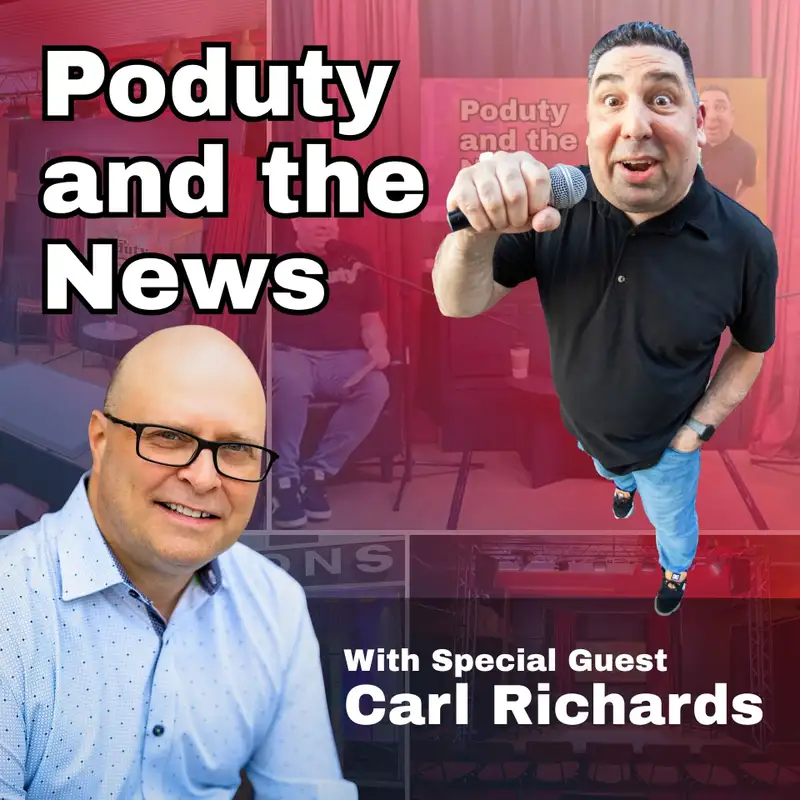
Hey everybody, welcome to Poduty and the News for Saturday, March
21st, 2026. I've got a great guest joining me. We're going to discuss
6 live stories about live podcasting recorded
live here at the theater. I've got Carl Richards joining me, Podcast
Solutions Made Simple, Communication Connection Community. It's the
Podcaster's Podcast host Carl. Do you know what time it is?
Is it time for Poduty and the News? What
time is it?
What time is it?
It's
time for Poduty and the
News!
Poduty and the
News! The only live news podcast
about podcasting from the States!
Poduty and the News! Poduty
and the News!
The only live news podcast
about podcasting from the
stage.
Carl, welcome to the show. Hey, Jeff, it's great to be here.
I feel like I should be actually sitting in that chair. Well,
someday we'll get you down here. Love to have you here anytime you want the
stage. The stage is yours. Uh, it'd be— it's a lot of fun doing the
show live. But, you know, Saturday mornings we like to slow
down a little bit, you know, get together. We're always busy during the week,
jobs and conferences and connecting and consulting. All
these things kind of compound during the week. But on the weekend, we can just
sit down, slow down, relax, and, and talk about the podcast news.
Yeah, I love it. I love it. Great. I'm very, very pleased to be here.
Well, great to have you here. I've been looking over your website, Podcast Solutions Made
Simple. A lot of services there for podcasters. Tell us a little
bit about what you do. Yeah, essentially what we do is we
work a lot with coaches, consultants, and other subject
matter experts who feel they don't have the time or the technical skills
to be in the podcasting space, whether it's as a guest or whether it's as
a host. We actually just added guesting to our slate of
services this last 6 or 8 months. We help them, you know,
really give them hope. We take care of all the backend work for them, whether
it's getting them booked or whether it's getting their podcast launched and maintained. Maintain it.
So as a busy business owner, you get to focus on your business while
we're helping you be seen as the expert, elevate your credibility, and get
that visibility, which is what you want. And also do it strategically.
I think in the podcasting space, we're recognizing that strategy
always goes ahead of just recording content and getting it out there. So that's what
we're up to. PodcastingSolutionsMadeSimple.com.
We'll have the links in the show notes and the 3 C's of
podcasting, communication, connections, community. You're also the
host of The Podcaster's Podcast. Tell us a little bit
about that show. I'm sure you're employing some of those practices that you're talking about.
Absolutely, all the time. Yeah, it's funny because my journey into
podcasting started when I had a part-time business as a speaker
trainer. And when I shifted into full-time in business,
building the agency Podcast Solutions Made Simple, I needed to tweak the
podcast because even though it was still about communications
and still about speaking, this element of adding
podcasting to it meant that, okay, well, we need to make a
few changes here. So, we
put our thinking toques on. Like a good Canadian, we always have our toques handy.
So, we put our thinking toques on and then came up with communication,
connection, community. Still, obviously, when we're podcasting,
it's about communication. It's about the connections that
you're making, whether it's with your audience or whether it's with your guests.
And it's as we find in 2026 at
this, you know, as we're doing this show today,
that community is becoming a very important aspect of that. So, and we
call it the Podcaster's Podcast because most people are business
owners and podcasting is something that they do, but they see themselves
in the podcasting chair, either, you know, whether it's as a host or whether it's
as a guest. So a lot of the principles we talk about, everything from show
structure to Communication skills,
storytelling, success as a guest,
some tales from the, from the, from the, the
world of podcasting that maybe there's been some interesting experiences along
the way. So we cover a whole gamut of it. Oh, that's
awesome. And I love it when it's easy to get to too. You can go
to the website podcast-solutions-made-simple.com. You can click the
podcast tab up at the top. And go right to the podcast and hear all
those stories that Carl's talking about. Yeah, yeah, there's a lot of great
stuff there. Awesome. Those links will be in the show notes, and
each guest who's been on the show, we have a crew page. This is Padute
and the News, and there's going to be— there's Padute in the crew. The crew
are the hosts, the guest hosts that have been on the show. There'll be a
whole page dedicated with all Carl's links, so go to that page,
check it out, connect them on the social platforms, connect check out the website. If
he has a newsletter, make sure you sign up and get on that list as
well. Are you ready for the
stories? I'm ready. Let's do it. Well, we're going to
Europe first. We're going to go to Radio Days Europe. Podcasting is
stepping off of the sidelines and into the spotlight with a dedicated
podcast room built right into the event. Attendees can
reserve time, bring their own gear, and record episodes live from
the conference floor in Riga. It's a simple setup, but
it highlights a bigger shift. Events are no longer just
places to learn and network. They're becoming content engines.
When you put creators in the same room with industry leaders, the real
value is not just the conversations that happen. It is the
content that gets created in real time and shared with the
world. And this is a bigger move that we're seeing in conferences
where they're really starting to embrace content creators, podcasters,
and they're inviting them into their network into their conference to
record, to perform, to be parts of the, of these
sessions. And what you end up having is these
podcasters are going to talk about it before the conference, they're going to talk
about it at the conference, and once they leave the conference, they're leaving
with a month's worth of material all about that conference. So these
conferences, they're pretty smart. They're strategic in the way that they're thinking
about the future. And they're creating these rooms, they're creating
spaces for content creators to really come in and
create something that'll last throughout the year and maybe help build
momentum to the next year. Yeah, I think what we're seeing, Jeff, too,
is there's this rise in popularity in podcasting. If it wasn't
popular before, it certainly is becoming popular now, especially with
the, you know, continuous erosion of conventional media, you know,
mainly radio and television. So whereas before we would use those
components and print as well, but a lot of people would look at radio video
and television as the be-all end-all for
promotion and getting the word out. And this
is a really interesting component that I really like because it's
a layer that's always been there, just not in the
podcasting sense. Depending on different events that you'd go to,
in some cases there was a main stage happening while you were at other
vendor tables or something else going on. But this is
this new layer. And the other thing too, Jeff, is it's
attracting the types of
individuals, the demographic that's already digesting
podcasting like it's just part of their regular diet. And
that's the Gen Zs, Gen Xers like you and I,
I'm assuming you're a Gen Xer. They're, you know, they're,
we're, yeah, we're into podcasting, but not like the Gen Zs,
not like the Alphas. So if we can get them in the door,
it's easier to have them come to the event. If we have that little
carrot, that hook that we can dangle, it's just going to make it even
stronger. It's a great strategy. I've had guests on the show and they talked about
15 years ago that they would use this technique to get free
passes, you know, try to get a press pass because they had a podcast. But
finally the conferences are waking up to like what's really happening and all
that content that's being created with no cost other than giving
out a press pass, they're going to get coverage and
communication, people talking about that before, during, and after the show.
It's such a great move. And one of the things that we really stress
on this, if you're going to do a live show and you want to think
like, okay, where can I start? Where can I perform my show? I
guarantee you there's probably a conference or event about the topic that
you cover on your podcast. That's where you want to start. Go where
your audience already is. And see if you can work in, you know, do a
little performance. Can you do a recording? Be a part of that community
and you'll find growth exponentially because you're where
people who like what you do are already, they're already meeting up. Yeah,
exactly. And I think it's also a very supportive environment too.
If you're just testing the waters and you just wanna, or
as you say, you wanna get some content, it's a great way
to immerse yourself into it and get what you need and
get the support and you're also going to make the connections too. As you
say, your audience is right there. You may as
well take advantage of that. Absolutely. And
that's— we'll go to the next story too, because this kind of ties right into
it. Here is an event about basketball. They're doing a
basketball podcast during the Women's Final Four. There's
no better way to find an audience who likes basketball than to do a basketball
podcast at a basketball tournament. So at this year's Women's Final
Four, Just Women's Sports is doing more than covering the event.
They're becoming part of it alongside a full fan activation
experience. They're hosting a live taping of Between the Lines
with WNBA legend Lisa Leslie right in the middle of the
action. This is where podcasting starts to look a lot more like
entertainment. Fans are not just listening after the fact. They
are showing up, engaging, and becoming part of the experience in
real time. When you combine live audiences, brand sponsors, and
cultural moments like the Final Four, podcasting shifts from
content into something people want to attend.
Yeah, I think this is something, Jeff, that we're going to see more and more
of with the— and, and I think for a couple of reasons.
It's not cheap to go to a game. Uh, I live
in Canada. Even to go to a Jays game, I mean, you're drop in a
couple hundred bucks easily just for the tickets. So I think
that venues, teams, all of those organizations,
they're looking for ways to increase the fan experience. It's
not just about going to the game and getting your peanuts and Cracker Jacks and
your foot-long hot dog. It's not just about that. As
a matter of fact, on the concourse at the
SkyDome in Toronto, I noticed there were so many
events happening and I didn't know, I didn't know, I mean,
I knew, I knew some of them were, uh, part of the, the game, but
I think that we saw that when we were at SkyDome at a Jays
game. We saw what looked like either something being recorded or
something being hosted live on top of what was
happening on the field. So I think we're going to see more of this, and
I think fans are going to love it. I think it's a reason
to bring them to the game. It's also a great way to, uh,
put your, put the fans in front of the people who they,
who they're coming to see. Because if they structure it properly,
if it's put together and produced the right way, you could actually have a
fan-based experience where, you know, fans can either be a part of
it, but they can also meet or have meet and greets with,
with players or other sporting people that is above and
beyond what, what it used to be. It used to be if you did a
meet and greet, you'd go backstage or in the dressing room or
whatever to meet the players. You could do that now or meet
former players. All those things can be a part of it. So I think it's
taking the fan experience to the next level. And as I
said, it justifies the ticket price too. Yeah. I mean, when you go
to a game, you're immersed with the crowd, the vendors,
the food carts. There's all these things happening on your way to the
stadium and to have a little stage off to the side. Where they're
just as part of the event, as part of the experience before you even get
inside, building hype, building excitement. You get to see Lisa
Leslie doing an interview live on stage talking about the
tournament. That's going to stop you in your tracks. That's going to stop you and
you're going to take that in. And that's part of the experience. And it just
elevates the whole experience where it's a value add. Like
you mentioned, the ticket prices are already not, you know, they're not the
cheapest tickets in town, but you get to have this bonus
content, bonus experience, and maybe Lisa sits
off to the side of the stage, you can thank her and congratulate her on
a great career, great show, and you can't do that just watching
it on television. No, no, certainly not.
Well, that's good. Here's one of my favorite ones. I love stories that always surprise
me, and I'm big on live podcasting. I have this theater space
But this was, this was showing how easy it is to do a
live show. They didn't have a ticketing event, a ticketing
experience. They used a Google Form. So how great is that for
ticket registration? If you're hung up on how do I sell tickets, you can start
with a Google Form. And that's what I loved about this podcast. This is at
Marquette University. A live podcast event is coming together in the
simplest way possible. No fancy ticketing platform, no
complex setup. Just a room, a topic, and an easy way to sign up.
The event features Balancing the Scales hosted by Colleen Foley
with a live audience discussion around real-world issues like public
interest law, philanthropy, and shifting political priorities.
What stands out here is not the production, it's the accessibility.
This is a reminder that live podcasting does not have to start big, it
just has to start. And when you remove the friction, more people
are willing to show up, participate, and turn conversations
into experiences.
Yeah, I have mixed feelings about that.
Okay. I like
live, but I also spent 25 years in radio broadcasting, so
I know what it means to go live. Folks who haven't really
done that, I think it's beneficial. I like the
accessibility piece. What I would caution
against in a situation like this is giving people some
parameters of what it means to go live and what it takes to go
live. It's not just about, you know, having a
conversation or opening your mouth and speaking. It's really about having
some, you know, your thoughts put together, those kinds of things.
Because I think that still content is king. So I think
by having these issues, that's great. That's phenomenal. But I still think there
needs to be those parameters in place. And by the way, having spent years
on the radio, a lot of what you hear, all those
moments that you would hear the hosts go back and forth with each other, that's
not magic. That's planned. In some
cases, it is. Certain elements are prerecorded. I can say that
because I worked in the industry. So understand that even if it's
live or it's perceived to be live, what we have come to know
isn't necessarily live. So I would still caution though against
making sure before something goes live that especially when we're at the
university level where, you know, young adults are still evolving
their communication skills, we give them the opportunity
to, you know, nail the skill set, even if it's the basic skill set of
what they need to be, of what they need to do rather in order to
go live and be successful at it. Yeah, we
say hosting, it's a muscle and you like any
muscle, you have to strengthen that muscle through through practice,
through experience, through stage time, through getting on the microphone,
through trying to entertain an audience. You have to strengthen that through
repetition. And one thing I'll tell you, you mentioned about things that surprised you
about the radio that were prerecorded. I was a kid one
time and they used to have the Top 8 at 8. If you were the
8th caller, you could call in and win Tears for Fears tickets to the
Civic Arena in Pittsburgh, Pennsylvania. I called in and I won. But
they, it didn't air live. It was like they record that segment when I
guess, well, maybe when they let the public on the air, they don't always just
let them go live on the air. They prerecord it and then they aired it
like a minute or two later. I was always disappointed by that. Yeah. There's a
reason for that. Yeah. Just in case the phone is
answered and you go, holy bleep, I won. So they
want to make sure, and it also gives the DJ or the host a
chance to do some tight edits, some quick tight edits before
it goes live. So usually I actually had a chance to shadow a guy when
I was in college and he was taking song requests
for an oldies show. I don't know how much you know about oldies, but oldies,
very, very short songs. But he was taking song requests
while a song was playing and snip, snip, reel-to-reel tape back then. So
doing it all manually, reel-to-reel tape, snip, snip, and getting it on the air within
seconds of the phone call being hung up.
So, but again, still is edited so there's enough
of all the stuff you don't want there
taken out, right? So there's that. But I think with live
podcasting, again, I think as long as the parameters are in place so
that all the participants know if you're
going to be on the air, if you're going to be live, here are some
things to keep in mind. And it's not about having it regulated or
having people shackled, but understanding that it's a journey,
right? A communication or a conversation rather is a journey. And if you're in the
hosting chair, even if you're in the guesting chair, you need to be able to
help be the person that moves that conversation forward.
Absolutely. You still have to entertain. You have to provide value at the end of
the day. But you don't have to start in large theaters or
auditoriums too. Like you could do this at a flea market and sell tickets, you
know, buy a $10 booth, a parking spot, set up your podcast.
And you could even do tickets and sell pre-registrations that small on that, that
kind of a tiny level. And that's where you start, that's where you cut your
teeth, that's where you learn to perform in front of people. And this, the
way that this podcast went about it, which you mentioned, that the
efficiency of not having to rely on another platform,
just having a Google Form— hey, if you're interested, let us know you're coming and,
uh, yeah, we'll register you that way. I thought that was pretty creative and a
great way to get started at least for your first live show. Try
it out, see what happens. You know, get started. You can't— you're not going to
take that second step if you don't take your first step. Yeah, 100%.
Let's keep running to our next show, our next story.
This is a podcast about marathon running.
Grandma's Marathon is celebrating its 50th anniversary,
and along with record sellouts, they're adding something new to race weekend.
A live podcast recording of Nobody Asked Us with
Olympians Kara Goucher and Des Linden at the North
Shore Theater. This is a perfect example of how live podcasting fits
into existing events. You already have the audience, you already have the
energy. Now give people something else to attend. With
450 tickets available at $20 each, that's— I think that's important to
these types of events that we're talking about aren't the same as going to a
basketball or hockey game. You know, it could be $20, $10, $20
to have a night out. And this turns the podcast into a
revenue-generating experience that complements the main
event. It's not competing with the marathon. It's enhancing
the entire weekend. And I think this is— we kind of touched on this with,
you know, going to the game on your way to the arena, having a side
stage. This is that example. Yeah, I
think this is a phenomenal experience of that where you're right,
it's a great way to, hey, there's an event going on.
And obviously you want to, I would say, be checking in with organizers and stuff
like that. Or maybe you're the organizing committee that's thinking, hey, what can
we do that's different? Because that's the other thing. What can you do
that's different than what's happened every single year?
So for something like this, I think it's great that they have other events going
on. It's kind of like when you go to, it's kind of like when you
go to the agricultural fair, right? You've got the
agricultural fair, but then you have a side stage with
entertainment. You've got something else going on that might be, you know, maybe is
game related. You've got all these other things that are components of,
and why not a podcast? Why not take advantage of that? Even if it is
an extra charge to be in on that.
Same as the other thing that's very prominent in a lot of agricultural fairs now
is the midway, right? So there's a lot of midway rides. So all part of
one big show and podcasting is well
positioned. You can set this up any way you want
to. So it can be, and I like how it's, it's a couple of
Olympians who are doing this because they're, they're bringing
their experiences and all of that and also giving—
maybe some of the racers are having the opportunity to come on, on camera
or come on mic as well. So I think that's great. I think it's a
great fit. Gives credibility. You're having a
marathon, you're having some Olympians come in to do a podcast.
Other people who are racing maybe the night before They want
to hang out. They want to hang out with other marathon runners to probably trade
tips of training and fasting and eating and carbing the night
before. And here's an add-on event as part of the marathon
experience where you can sit down and hear stories from
Olympians. There's no better way. This is that go where your
audience is. If the marathon runners are running the race anyway, they're
having record attendance, and you're adding in this podcast, Well, that
podcast is going to see windfall from this experience. They're going to
gain new listeners. They're going to make new connections because they are
where their audience is at. I like it too, because as you've
just indicated, it gives you a look behind the scenes. I refer to
this as green room conversations, and I always say to,
to content creators when they're conceptualizing their, their show,
is there a way to build bonus content that is saleable or that you
can have as a premium or subscriber content.
And green room conversations, the things that you don't hear
on the show is a great way to do that and a great way to
hook people into that. So this I think is phenomenal because there is
that monetization piece in. It is a behind the scenes or can be.
And also, yeah, brings the human side of it forward
too, because we don't know what's going on before the race, but we will.
Because here's the podcast to show it. Yeah, I'm a sucker
for those quote-unquote "how the sausage is made" stories where
that behind-the-scenes content, that bonus content.
Last week with Scott Edwards, we were talking about how much
comedians have embraced podcasting and it's not that they're just being
funny, they're actually telling you the road stories, they're telling
you how jokes came together, They're telling you these
behind-the-scenes, those greenroom stories that you're mentioning, Carl.
That type of information isn't typically available to
everybody, but as bonus content, that's a tremendous strategy to
roll that out to your select audience, your private audience,
the people who are really out there supporting you. Give them that extra content, that
extra bonus. As I like to refer to them as your raving fans.
Yes. The ones that will, if you post something, they're going to want
to watch it, see it, listen to it, digest it, whatever. So yeah, it's a
great way to, to definitely bring them along on the journey.
Well, let's keep the journey going. Spotify is celebrating
5 years of its EQUAL program by launching EQUAL: The
Podcast. While continuing to host live events around the world and bring
artists together in real life, what started as playlists and
promotion has now evolved into something much bigger: a full
ecosystem that includes content, community, and live experiences
This is where podcasting is heading. It's no longer just about
distribution, it's about connection. When you combine
storytelling through podcasts with in-person events and global communities,
you are not just building an audience, you're building a movement. And
I've seen a ton of things come out from Spotify lately. They're building these,
these small stages, they're building these podcast experiences, and
this is another example of them doing that around the world.
In having these shows and showcasing not just their podcast
talent, but artists from different genres are also now having
these live shows and live experiences with their fans. Yeah, I think
platforms like Apple, Spotify, they've been in the
game long enough to know that it's not just about a distribution platform,
it's about being a part of the game that they're in
already, right? So it's about providing
not just a distribution platform, but the stages,
they also have the resources to tap into
larger scale events and be a part of
the experience, you know, a very immersive
experience too, because they have budgets, they can do that. All of those things
that I think make Spotify or Apple or, you know,
other platforms too, it greenlights them, I think, to be
able to bring that forward.
Whereas as opposed to just saying, hey, you can post your content here and yeah,
we'll make sure it goes out and yada, yada, yada. No, they want to be
a part of the journey that they're bringing people on. So I
completely, I completely think this is a great, because I
mean, here's the thing too, Jeff, is that podcasting has evolved
a lot in 22 years from being just, you know, a bunch of
talking heads to now being this video components.
We're talking a lot about community building, live podcasting, all different aspects
of it. So this is another layer for,
and I think it's a good showcase too for larger companies to be able to
say, hey, you know what, you can get in on this game too. So I
think it's a great way to showcase and highlight what
can be. And as you say, invite artists to be a
part of it too. This whole genre
of Spotify doing these events with their artists, it really is the
replacement to what we would have done 20, 30 years ago, whereas we would have
opened up a Rolling Stone magazine or a Teen Beat, maybe a Teen
Beat magazine, and read an article about New Kids on the Block.
And, you know, you would hear the tour stories from the magazine
article. You would read the reviews and you would read,
like, you know, letters from the fans. But what's happened as
podcasting has evolved and grown into this multimedia platform,
you're now seeing those magazine articles really in real life.
And this Spotify experience is the artist up on stage,
probably being interviewed by a host. The audience is now the
mailbag. They're answering questions. To me, like, this type
of Spotify event is an immersive experience that really replaces
that magazine experience we used to have 30 years ago,
but we had to wait 6 months to get our copy.
Yeah, yeah, I think there's a lot that can be taken from to, you know,
I think independent creators can look at this and say,
what can I do that's different? You know,
there's— someone said, maybe many people have said it, there's no such
thing as an original idea. Somebody's probably already done it. So why
not take some of those ideas that have been done before and find a
way to incorporate them into new media,
which again, podcasting is part of that. And I like how you highlighted
that it's not just one medium, it's
multimedia pieces. So you can think about that for
your own show. What can I do that's different as opposed to just have a
conversation? I mean, look at Jeff's setup. Look at this. This is
phenomenal. I mean, no one's doing this or probably very
few people. So what can you do that's different? And I'm not saying you have
to build a studio like Jeff has done, but what can you do? What can
you do that's instead of just reading another letter or opening the
mailbag, what can you do that's different? That's an experience for
your audience that's going to want them coming back week
after week or episode after episode to
tap in, right? You mentioned some people
get hesitant because like, oh, you know, that's not an original idea. Other people
have done that or other people have talked about that. But the thing is,
you haven't. You haven't given your perspective, you haven't
done it your way, even though all these things have been done. Like,
this theater concept that I built isn't much different than a comedy club, the
comedy circuit. It's a stage with chairs, people listen to
people talking. It's a comedy club, right? But I put my
own twist on it, my own perspective of what I thought it can be, and
it's a little bit different. And same thing if you think that you're copying somebody,
You're not because you haven't done it your way. The world hasn't seen
what you offer and what your perspective is. So don't let that be a hindrance
to you starting your own show. Yeah. The only way you're copying something is
if they have a copyright or trademark on it. In that
case, yeah, don't do that. But otherwise, I
mean, I also like to say, Jeff, in podcasting,
there are no rules, which means you can do anything. But
the caution is, remember, in podcasting, there are no
rules, but you should always be thinking about the audience and what
their experience is going to be because that's, those are the people who are going
to follow you. If you're using your show for business, they're going to buy from
you. All of those things become a part of it, but have at it.
Do what you want. Yeah, you can do anything, but
maybe, you know, maybe not do everything.
Exactly. Well, Carl, these go so fast. We're on our last story
already. This is from Downloads to Destination. The
Thrifty Traveler podcast is taking things to the next level. I love
the, the thumbnail if you're watching the video here, with a live show at the
Parkway Theater in Minneapolis. What started as a growing travel
podcast is now becoming a full experience, complete with
trivia, audience Q&A, and ticketed access to be part of the
show. This is that shift in action we keep talking about.
Podcasts are no longer just something you listen to, they are something you
attend. By adding elements like games, interaction, and
community, this becomes more than an episode, it becomes a night
out, and that is where the real connection and real monetization start
to happen. Yeah, I like this immersive
experience, and I know we've covered this a lot
today. It's funny, there's been a theme all the way through. But,
but again, I think it's, again, it's, it's opening the
box and doing something different or getting outside of the box, right? It's
what can you do? And I've talked to many people say I'd
like to start a podcast. Okay, well, why? Number one is why?
Well, I need it for this. Okay, well, what, what's going to make your show
different? What are you going to do? And you don't have to go to this
extent, of course, but I like how it's building. Firstly, it's
building community. You know, it's giving the opportunity to build a
community, to have followers, to take the show. I mean, you know,
taking show on the road, all of those aspects that
can be your show too. So I do like that.
I do like that where people are not just,
I worked in the radio world, like I said, and you know, the radio world
became very cookie cutter. For me. It's literally sitting in a
room, playing some tunes, talky talky talky, and you do that day in, day out.
Same, same stuff. The only thing that changed was the music and the commercials. That's
it. And news. Everything else was the same.
Everything else was the same. Very rarely were you outside of the studio. This gives
you the opportunity to do something that's different, to bring in community
to where you are, to be a part of the experience, to have some fun.
And again, continue to have people come back,
heck, even travel, even follow you on the journey if they want to.
Yeah, we're talking about these big events that these people are going to a theater,
and what I— if you haven't thought about this, we talked about how do you
sell tickets. Well, the one story, use the Google Form, and these,
these podcasters have been doing it for years, and they're going to go to a
theater and do it, but you haven't done that yet, so start to think
out of the box. In your neighborhood. There's probably a coffee shop that sits
pretty empty at 2:30 on a Tuesday afternoon.
There's a library that has a media center. There's restaurants that have
banquet rooms or back rooms. There are places for you to
start planting the seeds of doing live podcasting, of building a
community in real life. Start thinking outside the box. How do I get
started and how do I do it? It's not going to be a theater or
arena your first show, But you're gonna train that muscle, you're gonna do the
repetitions, and you'll build up something that's much bigger than you
ever thought it was because you took that first step and you tried it
and you refined it and you got a little bit better, a little bit better,
a little bit better, till someday you're like the thirsty
traveler there in the Sahara on that episode. But the
Thrifty Traveler podcast on my birthday, June 12th, is going
live at a theater, and that's That's the end goal here is how do we
do something that involves a community that builds an
experience and just takes podcasting to the next level?
Yeah, thinking outside of the box or in this case thinking
outside of the studio. What can you do that's different, especially for
something that's live? You know, a number of people do a live
show and they'll stream it from their house and there's nothing
wrong with that. I'm not saying you can't do that, but What can you do
that again? What can you do that's different? And you don't even need to, Jeff,
like you said, you don't need to break the bank. All you need is to
go into, for example, the coffee shop and say, hey, thinking of doing a live
show from here once a week or whatever. How would you feel about that?
Or if you're like the Thrifty Traveler, yeah, I think they're doing a
podcast in your community this day, this time. How do you feel about that? So,
and don't be afraid to test stuff. Test
test it out, try it out. If it doesn't work, build on it. And if
that doesn't work, keep, keep building on it. Because I mean, you can't do anything
wrong because as I said already, there are no rules in podcasting,
right? So just— and have fun. I mean, it's a journey, so enjoy it.
Yeah, I'd do a show at a coffee shop for a blueberry scone and a
cup of joe. 100%. Yeah.
Well, Carl, this has been so much fun. Podcasting Solutions Made Simple. This is
where I turn over the floor. Anything you'd like to plug,
promote, talk about, the floor is yours. Oh,
I get the full floor? Oh my goodness. Yeah,
Podcast Solutions Made Simple. Always like to have
conversations with people. So if anything that's resonated today with what Jeff
and I have talked about, don't hesitate to reach out. There's a form on the
website, a site in which to do that. Speaking of community, I mean, we have
quarterly meetups too. So we'd love to have you come to the next one if
you're available. It is virtual. I will say it is virtual,
but after my conversation today with Jeff, maybe there's an opportunity to take it on
the road. But certainly love to have a conversation with— if you'd
like to find out more about what we do or find out more about our
community called the Podcast Alliance, it's not just a meetup, it's a meetup and mastermind
with guest speakers. And we have some fun, we have some prizes. So
always, always a hoot. Would love to have you there too. So, and Jeff, this
has been a great opportunity. Thank you so much. Oh, thank you for joining me.
These Saturday morning shows are my favorite. The pace is a little bit slower. We
can sit down, talk about these stories, and give new perspective. And
you really brought it today. You've added all that history of radio, podcasting,
production. Hearing your side of it for these 6 stories
just took it to a whole nother level. And I appreciate your time. And this
was, this was a ton of fun. Yeah, thanks, Jeff. It was fun. And
do you remember what time it is? Is it time to
go home? What time is it?
The only live news podcast about
podcasting from the stage. Poduty and the News.
Hold to the
end of news.
The only live news podcast about
podcasting from the
stage.