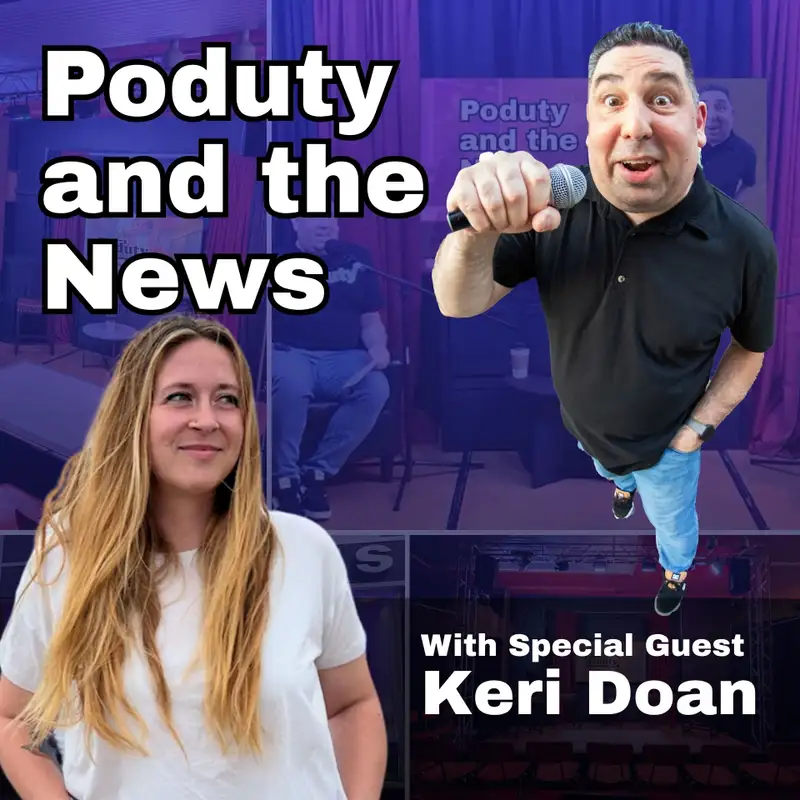
Hey, Everybody. Welcome to Poduty and the News for Tuesday, June 2,
2026. We've got six stories about live news podcasting
coming your way. I've got a great guest, Keri Doan,
joining me. Keri, do you know what time it is?
It's go time. It's go time.
What time is it?
The only live news podcast about
podcasting from the st.
The only live news podcast about
podcasting from the stage.
Oh. The only live news podcast about podcasting from the stage. A little
behind the baseball. I forgot the script and I had to run back
and I think I pulled my calf muscle. I got to
get in better shape. Keri, waiting on West. Excited to have you here.
waitingonwest.com. i know that you're doing a lot of things that
really parallel with what we're trying to build here at the theater, especially with
showing business owners, showing people. It's not just about creating
more content. It's about creating the right content, the right time for the
right people. Tell us a little bit about Waiting on West.
Yeah. So I run basically a social media business. At the end of the
day, that's what I focus on. But it's all about visibility for growing
businesses and making it really accessible and
realistic and something that can be sustained long term.
And a huge piece of that is the understanding of what.
What content that connects is and what actual results
we want as humans on the Internet with growing businesses,
it's not all about virality. It's about having a room full of
people, your people that you want to have. And so I get to kind of
help people find their direction, whether that means I'm coaching them or doing it for
them. Waitingonwest.com, i'll put all the
links in the show notes and on the podcast page, we have what's called the
crew. So after today's show, Keri is going to be part of the crew.
Poduty and the Crew. If you go to the page and you look for the
crew page, it's every guest that's ever been on the show. Keri will be there,
along with links to the website, her bio, social
media links. You're going to be able to connect and follow along with Keri. And
then obviously, after this show, I'm going to invite her back on the show whenever
she wants to come on. But all those future episodes will also be tied
together to her profile on the podcast page, which is a really nice way
to. If you like this episode, you might want to find other episodes
in the future. Are you ready for our
stories? We're going to go right to the library. Got your library card
ready to go? When people think about live podcasting, they
usually think about theaters, conference stages, or comedy clubs.
But this new partnership between beyond the Green Podcast,
the Morris County Park Commission, and the Parsippity
Library is a great reminder that libraries can be incredible
venues for live podcast events. Their new series
combines live recording, audience Q and A and local
storytelling to bring history directly to the community.
It's a simple concept, but it highlights something we talk about often on this
show. Podcasters don't always need bigger audiences.
They need better places to connect with the audiences they already
have. And this is kind of that, you know, what can you do
in your own community? And most communities have small
coffee shops, they have bars, they have restaurants with
back rooms. But what a lot of people don't realize is a lot of
libraries have media centers. A lot of libraries have media
rooms or performance halls where you can
take your own, show about something that you're passionate about in
your community and go to your local library, perform a
show, make some new connections, build that community within your
community. And it's a great way to get great content that's
unique to you and that you can share all over the place and really
boost your credibility 100%. I was so
excited as soon as you hit libraries, I'm like, I am in. We are a
military family. And I always say when you get to a new community,
the first two things you need to visit are your local library and your
local farmer's market will immediately learn so much about the area
and the people that are there through those two places. But also
libraries. I mean, ours also has a podcast studio. You can borrow it
anytime you like. But even just a meeting room, you know what I mean? If
they don't have a high tech meeting or, you know, podcast space,
even just one of their meeting rooms or ours have like soundproof booths
you can sit in and do some work, prop your phone up there and film
some content. And like you said, like these connection, like
this place that you can go to connect with people that are there, but also
to create content that connects with your people. Like, you know,
can you imagine if you just had 30 people that just always
listen to your podcast and they commented every single time. And I mean, like, how
cool would that be to have a little community? It doesn't have to be this
huge thing. Yeah, a lot of libraries too, they'll do
special events, special occasions. Sometimes they have little fairs or
festivals and they're looking for community Members to volunteer
to help run it, but also to be the entertainment. So if you want to
boost your credibility in your own community, that type of
volunteership where you can go help somebody, put on a
little event at a library and get to meet new people.
It's a win win for everybody, for the community and for your podcast or your
business. Absolutely. I feel like, I don't know if everyone
experiences this, but our library for sure. If you go in and say
you want to host a class or you want to do a SPE arrangement
or something, they'll always give you the space to do it and they'll let you
put your poster up. Like, it's absolutely a great place to
network, to make friends and to have like a creative
outlet. Our library also rents out like gardening tools and like
snowshoes. We're in Canada. They had snowshoes.
You could do everything that you dream of at the library, and I will stand
by that for the rest of my life. Yeah. And like you mentioned, a lot
of this is low cost. Sometimes it's free to you and
sometimes running these rooms might be 25 or $50,
but that might be for the whole like four hour segment that you want to
set up and tear down and record the show. So these are very
affordable ways to start taking your show out into the community.
Start thinking outside the box of how can I, how can I build
something? How can I promote something? How can I make something bigger than just
my little office space? Well, these types of spaces,
we're talking about the library here, but coffee shops in the
afternoon sometimes, slow down, everybody already has their caffeine fixed for the
day. They have spaces, they have stages. A lot of times
restaurants have little banquet halls in the back room.
They're looking to bring people in. If you can bring in an audience, you're going
to add value to that business. You're going to build something in your community and
have a really good time doing a live show.
Yeah, absolutely. And community is the key to everything that we do. So if you
can have, you know, a couple friends at the coffee shop or your local
library, it really is that word of mouth that we, I think maybe
sometimes forget about now that we have social media. But it is the core
of everything that we do. Yeah. Our next story kind of blends
that community building with what I love, which live performing and
small theater spaces, small podcasts, that DIY mentality.
Like, how can you do something that you own control from
start to finish? And in this episode of this was come to us from
The Recruitment Mentors Podcast with Hisham Au
this was a One of the biggest misconceptions about live podcasting
is that you just show up, you hit record and let the magic happen.
The Recruitment Mentors Podcast recently shared a behind the scenes look
at how they sold out a 100 person event in London. And
what stood out to me was how much preparation went into making the
event feel effortless. From carefully selecting panelists
to choosing the right venue and planning the conversation flow,
this is a great reminder that successful live podcasting isn't about
winging it. It's about creating an experience that feels
natural because the hard work happens way before
anybody walks in that door.
So true and effortless. I feel like we should probably never use that word because
the only thing that makes something effortless is pre
planning is pre thought. If you look at someone and what they're doing and
you think, wow, they did that with zero effort. You really need to
remind yourself of how much they did on the back end that you didn't get
to see that created that effortless look that
comes from work and strategy. And sometimes that means you
give yourself more time to plan or, you know, do things that will
make micro steps towards that goal as opposed to, oh
yeah, we just showed up. It was super effortless. Effortless is a lie.
It's like that meme you see of the iceberg where just the little bit of
the iceberg sticks out of the water, but the preparation is really
below the water. All those things that go into it to make it
work, to make it feel effortless, to make it feel seamless. There's a lot of
planning and preparation to put all those things together to get the
right venue, to get the ticketing right, to. To get that even
the check in experience is one of the things I stress about when I talk
about live events. How are you going to get people through the door that
have paid tickets? How do you check people in? That little bit can
make or break an event of. If people are waiting 10, 15
minutes just to get their name checked off of a list, they're going to be
upset right from the start. So that those
little things that you think about, it's all about the experience, the
presentation, the night. You know, how can you put all those little
things together and make it seem effortless, make it seem
smooth for the viewer. Absolutely. And
I think it's so easy when you're a creative or a business owner to see
that top part of the iceberg and go, oh, I could never do that. But
really you're not thinking about all that's below. There's so much going
on and being able to curate down to that first, first step
in the door. What does the person experience is a skill that maybe
not everyone has. So it's really cool to be able to put that into play.
Yeah, it's a great. It's a short little video. It's about, I think, 15, 17
minutes. Check it out. All the links for all the stories are in the show
notes and it'll just give you an idea of what all goes in
to putting these local events together. And it's not magic
just because you showed up and it looks like a great event. A lot of
prepping and planning went into it. And speaking of prepping
and planning over the years, how about getting to a billion
downloads and still going out and selling tickets? I love
this. When a podcast reaches half a billion downloads, you think
they might not need to do live shows anymore. But no such thing
as Phish is doing exactly the opposite. They're heading back to the
Royal Institution in London for a four night run of live
recordings with one show also available as a live
stream. This is one of the clearest examples of podcasting isn't just
about downloads, it's about experiences. And even
after 600 episodes and worldwide success, they're still
creating opportunities for audiences to gather in a room, laugh
together, and be part of the show in real time. That's the
biggest lesson podcasters at every level can take from this story.
It really is. That example we always Hear about having 10
people in the room with you as opposed to 100 viewers on social media,
right? Like it's connection, it's that call back to analog
and experiential things that we want to do. And I would
say as a creative, right, as a business owner,
of course, having that many downloads is a huge, huge
milestone and we absolutely give them kudos for that. But do they
feel that kind of. You only feel it when you have an
audience of humans, of community, of connection, and you get that
when you're in a show and you get to hear them cheer or boo or
cry or, you know, whatever they're feeling with you in the moment.
You don't really get that. And I think especially for creatives, right, they like that
feedback of a show that you don't get all the time from a podcast.
Yeah, you touched on something that I harp on all the time is the value
of a viewer. And when we talk about podcast advertising,
you're lucky if you can get about $20 per thousand
downloads for your ad rates, which breaks down to about 2 cents
per listener. So if 1,000 people download, you're
going to get about 2 cents per person on that download.
But if you can sell a ticket and make a $5
profit off of that ticket, that's 250 times more
valuable per listener than trying
to hope that you can get this audience to get people to download and
sell ads. So really, these community events, they know they're onto
something because they know a theater that's full for four nights in a
row is probably going to make substantially more than some podcast
advertising. Yeah. And if you think of how it ties back to. To
their show, I bet that everyone that's in that audience will continue to listen to
the podcast, of course, but they'll probably be actively engaged in the comment
section too. Right. Because that connection is there. So they're kind of continuing to
sustain that community. Yeah. And a lot of times
people listen to podcasts solo, but they like to go to podcast events
with a guest. So not only are you going to get the biggest fans
that are buying the ticket, but they're going to drag along two, three, four people
like, hey, you got to see these guys. No such thing as fish.
It's crazy. So it's a great way to expand your reach,
expand your audience, especially when your super fans are bringing other
people along. That's a great point. I love that.
And going to digital this time, we're going to do a
little bit of tech on the tech side here, this place called Punch up,
start building new tools for creators, for comedians, for
podcasters, and one of the things they're even doing is ticketing.
So keep that in mind for when you start to book the library and you
want to have some shows. But one of the biggest challenges for podcasters is
that their audience, memberships, premium content, and ticket sales
often live on completely different platforms. Punch Up Live is
trying to change that by launching a podcast tool that combine
subscriptions, premium content, and live event ticketing all under
one roof. What's interesting isn't the technology itself.
It's the philosophy behind it. They're betting that the same people listening
to a podcast are also people, most likely, who to buy tickets,
attend events, and support the creators directly. That's the
concept you've had people on this show have heard me talk about for
the last 70 episodes. But the closer you can bring your audience to the
experience, the easier it becomes to build a sustainable
business. Isn't that cool? And like the
fact that they're kind of, I would say getting a little bit ahead of this.
I haven't seen anyone doing this type of model before and I really love that
they're thinking in that space that we are seeing, we're seeing it in
micro doses kind of happening here and here. It's only going to grow.
And as someone who spends all day, every day on
a computer, how nice is it to have everything in one place instead of
having 99 tabs open? If anything
brings me joy, it's unsubscribing or canceling
subscriptions to things. So if we can just narrow it down to one place,
I'm all in. Sign me up. Yeah, a one stop shop
for creators. And you're kind of hinting on this too that there's a wave
of interest of people who want to get back to real life,
who want to get back to real events, who want to sit in rooms with
people, laugh with people. We've gotten so disconnected through
cell phone addiction, through video scrolling at night,
through those streaming services that you're mentioning where we're not
doing things as a society together. We're doing a lot of things
independently. And those apps make us feel
like we're connected, but we don't really have connection. And
there are a lot of people waking up right now to like, hey,
maybe this thing I carry around all day and I check 70 times
a day, maybe it's not a good thing for my
mental health. And you are seeing that. And I think especially
with the push of AI into everything, people are
revolting from AI. They're starting to get sick of the social media
apps. They're starting to crave human connection. And I
think what Punch Up Live's doing, I think what you're starting to see in this
area in Pittsburgh with this theater space, these are
things that are happening now. And there's a like a tidal wave
of people coming who are hungry for these type of events.
You know what I was thinking about was like how even if
you K you're in a situation where you have to be online, right? I can't
book a space. I don't have someone to care for my
grandparents or you know what I mean? Like whatever your life is, you can't do
it right? It's just not going to work. It just really reminds
us of again with AI coming in, how
important it is and how much it's valued when you are showing up online
to, you know, make mistakes and fumble your words
and you know, have a little bit of a mess in the background. And those
are things that actually do connect and they help you stand out. And so we
get to kind of be very human, which sometimes means we make mistakes,
sometimes it means there's a pile of laundry behind us and we get to do
that and still make friends and connect. And honestly, I would say even
for myself, my best performing pieces of content have been things where
people are commenting on, oh, I have that shirt. Oh, I have this. Oh, I
also have my website on here. Right. They're finding a number of things
to talk about from one piece of content. That all comes from
humanness. Right. So we have to let go of that kind of picture
of like, I have to be poised, I have to have a perfect background, I
have to have a blouse on, I have to have a script. We can get
rid of that now and that's really cool. So even if you can't be in
an in person space, be a little bit of a
messy human because that's what we're supposed to do. Yeah, I
think we're getting back towards a healthy balance. The social media
is still important for discovery, but it's not just
what I post, you know, not just about what I'm posting, which is important
and helps people find the podcast, find your business, but building
on that through these in person events and then that
becomes the content that goes back on social media and it becomes
this self fulfilling prophecy where you're talking about live
events, you're sharing that to get discovery. The people watching that
come to the live events, now you have more content and
there's really a balance being restored. Whereas we were
100% social media, especially after Covid, where we
were all on our phones all the time. But now we're restoring
that balance to where social media is becoming like a tool, it's becoming
an asset again to drive these local and in person
events. I like to call your social media a soft place
to land. So if I hear about you from a friend or if I see
you in an in person event and I'm kind of curious or whatever. We want
your social media to be a soft place for someone new to land and kind
of get to know, like, are you personality? Are you silly, Are you
serious, are you bold, are you funny? But also like, what do you educate on?
What do you care about? What are your offers, what are you selling? And so
it kind of is like this pillow. And the only way the pillow can be
soft is if you have a little bit of all of those categories.
Yeah, I love that analogy. It's a great way to think about it is, you
know, it's. It is kind of like that first impression is, what are you like?
You know, even. You don't have to be fully serious all the time, but, you
know, you have something you want to share, something that's personal,
something that's relatable to your audience. And it's not everything all at
once, but it's a nice, soft introduction, a nice way to get to know
somebody. Yeah. And how about
knowing somebody for 50 years? And I
pulled this one up because it's about connection and making friends when
you don't know where it'll lead to, making connections where you don't know it'll lead
to. This was a connection that somebody
made 50 years ago, and it just turned out that it was
Chaka Khan, and they were able to book them
on a podcast 50 years later. So one of the most powerful
assets a podcaster can build isn't a microphone, a camera, or
even an audience. It is relationships.
Filmmaker Chan Berry recently launched his new
Conversations in Music Live podcast series in Oakland
by sitting down with the longtime friend Chaka Khan. Their
friendship goes back decades, and that connection was obvious
throughout the event as they shared stories, took audience questions,
and even performed music together. This story highlights something
important about live podcasting. Sometimes the reason people buy a
ticket isn't the format. It's the opportunity to witness a
genuine conversation between people who have real history
together. That's such an impressive flex. Like, oh,
yeah, my podcast guest, Chaka Khan. Like, no big deal.
How impressive is that? That's amazing. But you really, like, there's
no course you can buy. There's no hacks, there's no cheat
codes to making friends, like, to being. Having some
sort of connection with people. Whether you join your local. Local chamber of commerce or
you get to know the librarian or the guy at the coffee shop. Like, there's
nothing that can replace that. And it's something you can do through the
Internet, but it's even stronger if it's in real life, where
you can kind of find things that you resonate with, with other people,
or even things that you just want to debate about, depending on the person.
But there's. There's no funnels, there's no transactions to a
relationship, and. And you never know what
it'll lead to. 20, 30, 40 years down the road, you know, there
might be small meetups and small gatherings, and, you know, maybe some
people dismiss them. Oh, there's only going to be five or 10 people there, but
one of those five or 10 people could be someone that you network with
or they know somebody who can get you to the next step. And you
just never know. Like, who would have known 50 years ago that, you know, Chuck
A. Cod would be a powerhouse celebrity and then be able
to come on your podcast, you know, after being friends
for all these years. And I just say you take advantage of
every opportunity you can get, especially when you're building community,
make friends and make those connections, because the next
Chaka Khan could be there. But it really is
crazy. Like, I've had situations where I've met someone and I've gone, oh, you know,
I know that they don't want to be on social media. They're not a lead
for me. And then I guarantee you, every single time
that person, within a week, someone will reach out and they'll say, oh,
yeah, so and so recommended you. They said that they met you here, and you're
kind of going, oh, right. Like, you really see it in action, but you don't
get to see it if you don't get out there. And if you don't show
up to these things. And even if you just stand in a corner and smile,
inevitably someone's going to come up to you. It's going to be okay. But you
got to kind of take that leap. Yeah, you just never know.
Take advantage of every opportunity. Except for
maybe if you go too public with AI when you have
great talent on staff already. This is kind of a learning lesson, I
think, for some of us. Just because AI can do
something, you know, doesn't mean it should. And AI is
making its way into every part of content creation, but that doesn't mean
audiences are automatically going to embrace it.
Cleveland.com has taken some heat for using AI generated
cartoon versions of its podcast host to promote episodes
on social media, and the reaction has been
overwhelmingly negative. What's interesting to me is that this
wasn't a case where they lacked content. They already had real
video of the hosts available. The decision was about choosing
AI over authenticity. As more creators experiment with
AI tools, the story raises an important question. When
does technology make content better? And when does it
create distance between creators and its audience?
This is this one. This one really gets me. As soon as I
saw those pictures, I was like, it reminds me of
2007. My husband and I went to New York City. We're from the west
coast of Canada, and we get a caricature, you know, the side of the road.
It's still in our house here today. That's what that first one Looked like. It
looked like a caricature, but we only paid like 18 for
that. And an artist made it, you know what I mean? So as silly as
a caricature is, like, a real human could have made that. I
also see a. Like, you know, sometimes bakeries will do this. So they use,
like, cartoon AI images of baked good. It's like, you
guys make beautiful things. You have these humans. What is going
on? What should we use AI for? Like, research
for automations. Like, for things that we don't have time for.
I always say the boring stuff, right? But the things that we need to be
present for, the things that we need to be human for, you can't replace it.
Like, we've. We've touched on that. If you didn't get that in the last five
stories, like, it's. It's all
there, you know, like, we've already kind of got into that. But, like, you
can't replace the human. You can't replace yourself. There's no prompt,
there's no information you can give it that would replace you. Whether it's
in a photo or a script or whatever, it will
always perform better. If you're just a little bit goofy, a little bit silly,
make a mistake, it's fine. I say only you can
be you. There's no need to replicate it. People
have already come to the show to see you. They listen to you
on the podcast to hear you. They go to your social media to
see you. You don't need to replicate that.
There's one of you in the whole entire world. And those people have found
you based on the way you perceive the thing that you're
passionate about by the way that you share your interests.
They're connected to you. You don't have to go above and beyond
to, you know, to be something else. Just be yourself. Like Keri
said, you. You know, you are the one that people want to see and talk
to. And unfortunately, like, I even noticed at my
grocery store closest to me here, that when you go look at the board, you
know, the bulletin board by the tills, so many AI posters. And
I find that people, they kind of immediately, right,
they wall up. They can't be anywhere near it when they see something
that looks like AI. So they're going to swipe past your poster for your event.
They're going to, you know, just go away from your content. They're going to
immediately pull back even more. They won't even give it a
chance to get to know you. If they feel that disconnect right off the bat.
It's almost like you don't want to connect with them, so why should they do
that with you? Yeah. And this is probably a warning
too. Six months ago, eight months ago, you may have gotten away
with, with this type of content, but the tide has
really turned since the beginning of the year where,
like, you get that visceral reaction that Keri's talking. People
are really revolting against anything AI Whether it's
done well or not. It gets labeled AI slop. Now
everything does. And they will just ignore you. They will tune you
out. And I, like, I looked at, I look at a story like this and
it's not terrible. I, I get that it's cute what they were trying to do,
but you also have to read the room and the room
temperature on AI is changing very
rapidly in this country. And like, like you said, even at the
grocery store people are like, what, what's this AI poster doing in my grocery store?
I don't want to see that here. Yeah. Trust is everything. You
have to, you have to build trust. And even if you're just having a yard
sale, like, as soon as there's an AI poster, people kind of go, is it
a yard sale? Really? What are you really doing here?
Because it just doesn't connect you. You would probably be better off to just get
a Sharpie and a marker. People will probably be at your yard sale right away.
Yeah. So just keep that in mind and really think about the things that you
publish. And like Kerry says, AI should be a tool. It should be
an assistant, an executive assistant that helps you with the boring stuff,
helps you filter out some of your
ideas, build on some things, craft some
emails, do things that you would maybe in the
1950s hand off to an executive assistant. But
today you don't have the resources. So you use
tools to do that behind the scenes boring stuff. But
for the creative stuff that's public facing, I think now more than
ever, you've got to be as authentic as you can be.
Yeah, absolutely. Feel free to be a little bit messy or make mistakes.
I think that's why it connects so well, because people go, it's too
perfect. Did AI do it? So, I mean, you don't
have to show up with a stained T shirt, but just be okay.
If you fumble your words, it's all going to be okay.
Well, Keri, this goes by so fast. We did six stories
already and this is the part of the show one final
time. I turn the entire floor over to you.
You can plug, promote, talk about anything you'd Like, Keri,
the floor is yours. Thank you
so much. Oh, my goodness. The pressure now. I mean, listen, I don't really
love talking about myself, but I love helping other people. I love
this topic of connection and community. And I think that
when we're, you know, hosting events in person or trying to promote
ourselves on social media, we are really seeing so much
information being fed to us. And it's important to kind
of like, take that information and pause and decide, is
this information to benefit me? Is it to grow that person's business and
what pieces of that information help me? Right. Is there a
system there that doesn't work? But I can take these tips and tricks
to myself? Is there things that I notice my audience connects with and think
about your ideal audience that I can do to connect, to get them to
want to hang out with me? Like, I had a client that recently got monetized,
and I said, well, that's because of your people. Your people are engaging with your
content. She looked at me and she's like, I got people. And, you know, it's
that feeling of, like, what can you do to find your people? It's only to
be yourself. So that's all I really want people to do. If you want to
find me. Waitingonwest.com but you can also do it on your own, and you will
do really, really well. Waitingonwest.com will have the link in the
show notes along with all Keri's profiles. Keri, do
you remember what time it was? It was go time. Is it
go time again? It's. Well, it's go home time. What time is
it?
What time is it?
The only live news podcast about
podcasting from the st.
The news.
The only live news podcast about
podcasting from the stage.