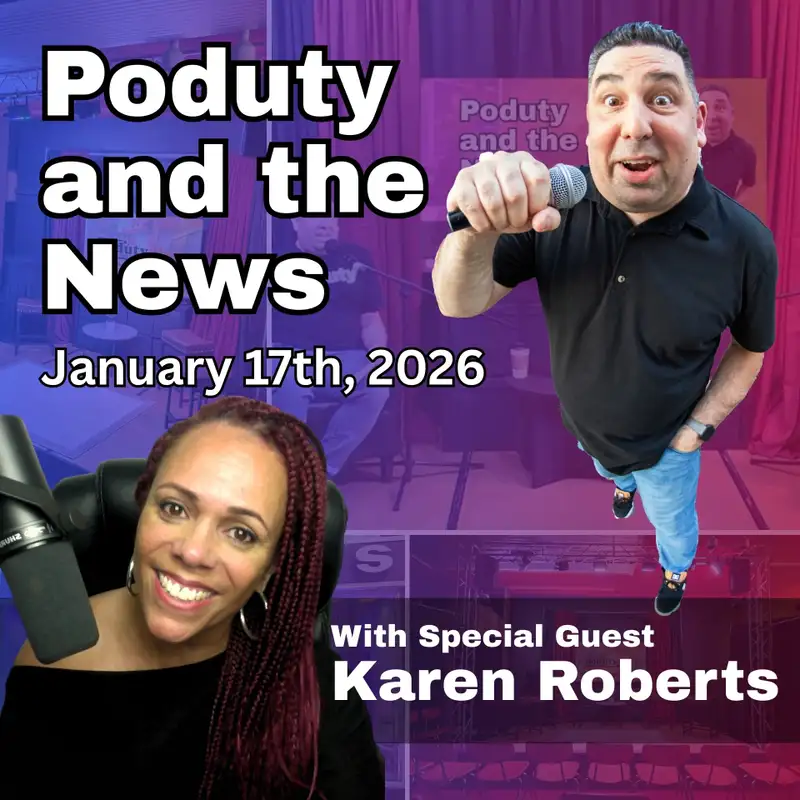
Karen Roberts, welcome to the show. We got a great pudootie in the news
coming. This is a Saturday morning show, so we do coffee with
Poduty and the Crew. And after this episode, Karen is
officially inducted into the
Poduty and the Crew. Check out the website news.poduty.com
you'll see the crew at the top of the page. That's everybody who's ever been
on the show, along with links to the shows they've appeared on
and links to all their social profiles, their websites, their businesses.
And make sure you support the people who are coming on here. Karen, all the
way. You said you were in Mexico this morning. How's it going?
Yeah, I am. I mean, as you can hear, I am from
England. I'm from London, but yeah, you know, London's pretty cold.
It's pretty dull in the winter. So I'd told my
daughters a few years ago I wasn't going to do another winter in
England. So, yeah, I'm here in Mexico. What a great place
to spend the winter. How's it going so far? Loving it.
Loving it. Why didn't I do this sooner? You don't miss the snow
and the rain and the in the freezing cold? Not at all. Not
at all. Well, as everybody knows at home, we got six
great stories coming your way about live podcasting. This is a
live show about live podcasting. We record it live. It's a
very meta concept, very high level.
We touch all the bases on this show. And that means I only have
one question for my guest going into the show. Karen,
do you know what time it is? It's showtime.
What time is it?
What time is it?
It's time for. Poduty and the News.
Poduty and the
News. The only live
news podcast about podcasting from the
stage.
The only live news podcast about
podcasting from the stage.
Oh, there we go. I'm on the stage. I had to do a little transition,
a little sneakiness. I grabbed my coffee, I grabbed my glasses, I grabbed my
show notes. I'm buried in stuff on the stage right now.
I'm so excited. Karen and I had a great conversation before the show. We were
hanging out for about 10, 15 minutes, laughing, telling stories about
podcasts. Karen's got a great concept. Podcast
profits Unleashed. It's a little bit of a podcast, a little bit of
consulting. Karen, tell us a little bit about what you do.
Well, where do I start? You see, I did this
fear of bankruptcy, shall I say? And being stubborn
because I've had my podcast for five years and I started
in radio. I had a radio show. That's how it started. And the
owner of the radio station offered it to me one year and
I just went, yeah, that sounds cool.
Didn't have any idea of what I was doing.
At the same time, I launched a podcast network. And I was just like, hey,
you want to show? There you go. And I wasn't giving any
guidance or anything. And I don't know about you,
but I think the stats are so true.
You know, 90% of podcasters don't make it past three episodes.
And at the 10% that do, 90% don't make it past 20. And
I got that because my business
was failing. And it got to the point where I was like,
if things don't change, I'm going to be bankrupt
by the end of the year. So this, I went into this not
really with a plan, but from, you know,
I don't want this to end because I love doing my podcast.
So I needed to sort of reverse engineer, if you
like, well, why are other people giving up and
I'm not? Mine's growing. What's going on?
So I decided to sort of. I realized the problem was me.
I needed to own it, and I wasn't doing enough. I was just,
hey, there you go. So I needed to coach them more.
We went more into podcast production, but still,
you know, people were giving up because it was. They were finding it
overwhelming. And so what I. What I was doing
for my own podcast, I was trying to coach my
own guests on how to show up on my podcast,
show up and shine, if you like. And I was like, well, maybe I can
do this for others. And so that's what we
really focus on now. I still have my podcast network, we still do podcast
production, but we focus more on helping
people guest on shows, how to share their
system, origin story, if you like, and. And do
it in a way that hopefully drives business
their way. So that's how I ended up here. It was
without a clear plan from the beginning,
but a stubbornness to refuse to give up. I think.
I love that strategy. I love showing people the benefits of
podcasting and guesting on other shows. There's
nothing that opens up your world more then finding people like you
who have the same interests, the same passions, and then you start
interacting with these other creators about doing the thing. It's such a
great way to expand your sphere, make new connections, maybe even
make new business opportunities. 100%.
100%. It's more. It's like, you know, when people
go Networking. Right. They might have a minute spiel.
Right. They have their elevator pitch. I. I wasn't that
keen on networking, but I understood the concept because
everybody has this title, right. They have this title, which
doesn't necessarily mean much to people, or people create this
idea in their own mind of what that person does. And the
elevator pitch in a networking event, you might go, oh,
oh, that's what it is. Well, a podcast
expands on that because you're having just authentic
conversations, and by the end of it, your perceptions completely
changed about what this particular person does. Right?
Yeah. Because you have. What I tell people is you only have
your perspective of the world, your perception of the world. And even
though you may have the same interest as the guest or the host on the
show, their perception, their perspective of the world is
different, completely different than your own. So there's nothing better than
making new connections and then getting the. Getting the ability
to look at what you love in a different light, from a different point of
view. And that's one of the things guesting does. It helps you grow and expand
your mindset and like I said, like you say, make great connections
and increase your exposure. Absolutely. And I
think a lot of people miss out on. They, They. A lot
of people, they think, I'm just going to borrow this. They see it at the
stage. They see it as just the platform. And
what we say is like, ah, you're missing out. Right. It's through. Actually,
I feel personally, it's from the relationships
that I've built with either as a host with the guest and
as a guest with the host. Right. It's the relationships that
could open doors to opportunities you, You. You never even knew
were there. So it's not just the listener, because, you know,
everything really about the podcast episode should be about the listener,
but it's also about the relationship with a host or guest,
if that makes sense. Yeah. And if people want to check out your network,
learn more about your services and how to be a better guest, what's the best
way to connect with you, Karen? The easiest thing, I
mean, I do have an. Well, I'll give it towards the end. If
anybody's interested in being a guest on
shows and doing it in a more of an intentional or
strategic way, then, yeah, I'll give you a
link to my freebie at the end of the show, if you like.
Awesome. Then that link will be in the show notes. You'll have to wait till
the end to get it. But if you're listening to the recording in the
future, you can go down the show notes. Check out Karen's links, check out
Karen's piduti and the crew page over on the podcast
website. Karen, are you ready to get into our stories?
I'm not sure. I don't know that I'm qualified for this. Live
podcasting is new concept to me. I think you're perfectly
qualified for this. All your experience, all those things that you're prepping your guests for,
those things apply to the stage. You know, you still want to put a great
show together. I think you're going to have some great perspectives and you're really going
to help the audience learn how to be more present as a guest, how to
be more in the moment on stage. And I think we're going to have a
great time over the next half hour. Cool. Here we go. We're
going Big farmer. Big farmer. Farmer is the second story, but
big pharma, bigger stage. Live from jpm.
Recorded live at the JP Morgan Healthcare conference in San
Francisco, the Stat podcast brought the boardroom to
the microphone with a high level sit down. Featuring
Novo Nordisk's new CEO and top biotech
investors, the episode blended real time industry news,
leadership, storytelling and future focused innovation.
They covered everything from how an office Clerk rises to CEO
to AI's growing role in biotech, to the battle
for market share in the obesity drug space. It's a strong
example of how live podcasting can turn major conferences into
multi listen media moments, delivering
insight, credibility and access that simply doesn't lend
the same in a pre recorded studio episode. And I think a
lot of what we're seeing here is everything you probably teach about Karen,
about being in the moment, being on stage, being
with people who are in the same industry, who share
the same interests and here they are at a conference. What
better place to position yourself than in front of people who are probably
your customers? Absolutely. I mean this is
the first time I'm sort of seeing, I didn't realize this was going on. And
it has. You've really made me think my brain's been going,
oh, like the opportunities here I think are massive
because it's very different going to an event and
speaking on stage. Like I started, that's what I started out with doing
right. And, and I can honestly say it was, I've
never been so scared. It was the most petrifying experience
of my entire life getting up on stage. And it's a very different
concept because you, you have to. Well, not everybody. I'm sure
there's seasoned speakers that can just get up on stage and speak from
the heart. But my first time, I felt like I had to
learn my signature talk and absolutely
perfectly. I couldn't work the clicky thing at the same time,
so the sound engineer had to help me. And so when I came into
podcasting, it was so much easier because
you are speaking from the heart. It's just conversations.
So this. This is sort of combining the two things. I can see
why podcasting live at an event, because
you're not just reporting on the industry,
you're actually inside it in the moment. So, you know,
there's the energy of the room, there's a whole buzz
around it. And I think because it's live,
you're really on your game. You're really sort of aware.
Whereas I think when I do podcasts, right, I'm
in the safety of my room, where I am,
I'm in the safety behind my computer and in the
knowledge that, if need be, I can edit, whereas all of
that's gone out the window at a live event. So it's, It's.
It is completely. We talk about being
authentic on a podcast. This is just taking it up to
a whole other level, right? Yeah. And this is something
we're seeing more and more where conferences are starting to use
instead of musicians or magicians or comedians as their
entertainment, they're booking podcasts on the main stage now
as to entertain the guests, maybe in between keynote speakers,
maybe as a way to have a panel discussion in a new way,
in a way that they can record it and promote it after the
event. And the podcast that's going to appear on the stage, guess what
they're also doing? They're promoting, leading up to the event that they're going to be
on the main stage. So we're seeing this as a great strategy
for conferences. Start to incorporate the podcasts that are
in their industry as part of the entertainment for the event.
Well, it's combining things. You're really sort of utilizing your time
well, aren't you? Because you're creating
content at the same time as building
deeper relationships with the people who are actually in the room. They're going
to be more involved, if you like,
the more bought into you. Right. That you're building on that trust
factor. I think it's a great concept. Yeah. And this little
tweak, I find it much more rewarding as a. As an
attendee than a panel, than a Q and A. It's.
You're getting that interview, you're getting that insight in a different way
than a panel. Delivers because you know, they're trying to record something
for entertainment value to not just answer the questions, but entertain the
audience and entertain the future listeners. I find live
podcasting is a better structure for a conference and than
just a panel with a Q and A.
Yeah, love it. Well, I said farmer on the first story.
We're going to the farmer at this time for
real, not farmer. We're here in Pennsylvania. The
Pennsylvania Farm show returned with the Spark
podcast, delivering live on location coverage straight
from the show floor. Spotlighting the people behind Pennsylvania
agriculture. From maple syrup producers and mushroom farmers
to dairy leaders and alpaca educators, the
podcast turned a massive in person event into an accessible
storytelling platform. By recording live conversations
with farmers and producers, the Spark captured the passion,
expertise and innovation driving agriculture across the
commonwealth, proving that local events, when paired with
live podcasting, can reach far beyond the
fairgrounds and into homes, headphones and
communities statewide. And honestly, this was a place
I never expected to see a live podcast. How about you,
Karen? Never would have given it a thought,
but again, it's just going back to that whole, I think,
perception thing. You know, you can, you've got, I mean, I don't
know, what are they talking about? Certain products you could
expand again. It's introducing people to maybe
things they not thought of purchasing before. I mean, there's just
so much you can go into and it's,
I presume it's because it's
local, it's read there. These are local, regional events.
You know, you've got, you know, you might not have a massive
stage. So you're bringing in the community maybe in,
in a way because the local shows are going to be packed with
people who are passionate. I'm sure they're going to have
incredible stories. They're not going to have the fluff. They're not going to
then because they're not coming from that background. It's going to be even more
authentic, I would have thought, you know, it's, it's really
going to be where the trust is built. And I suppose the mic
just then becomes the bridge, if you like, between
the, the actual community and the whole world really,
because it's, it's, it's broadcasting out to a
larger area. I think it's a great way to do things.
Yeah, we think so much in this country of processed food, the
industrialization of our, of our food supply. And
here's a chance to connect with the people who are growing the food,
the maple, you know, they're harvesting the maple syrup, they're
raising Alpacas. There's real people here and, and you're getting to hear
their stories and how much passion and care that they put into those products
that maybe the next time you go to the supermarket, maybe you don't reach,
reach for the box item, you reach for the thing in a mason
jar with a, with a handwritten label because you know the
face to that product now it's somebody putting in their, their blood,
sweat and tears into producing this wonderful thing. Whether it's, you know,
honey or, you know, corn raised. I don't know how you raise corn. So,
you know, there's some sort of, you know, there's a person there now, there's an
expert behind the story of this product and you get to share in that
story now and share that story with your friends when, when you consume it.
Brilliant. And look, so I'm from England,
right? So if you guys, if you've ever heard of Jeremy
Clarkson, now he has a show in
the UK and what he's done for farming
has been probably more than anybody has done in the
uk. So this is the idea of doing this,
I think would be awesome for where we are, for the,
especially for the organic, grass fed, more family,
family farms. Because again, it
humanizes, I suppose is the word. It humanizes
the people behind the scenes and it will
attract, you're going to attract more clients. I think it's just
a great way to do things and I've really never ever thought
about doing this before. I think this is
something that could help the local smaller businesses
incredibly. Yeah, like if you have a client who maybe
is an accountant. We've had stories where accountants have gone
into cities to host workshops and at the
end of the workshop they recorded their podcast with that city. So it's
a great way to just connect the audience to, to the, to your show
in a way in an environment that you don't get sitting in your home
studio, sitting in your basement. You get to really go out there,
tell the stories with the people who are out in the field, you know, making
it happen. Absolutely. And you're going to. Because this,
I would have thought within an event like that, it's,
you're really going to sort of turn the real niche topics
into real compelling content because it's, it's human
centered storytelling rather than, you
know, what maybe some copywriters might tell them to
put on, on a website. It's got to be, you know,
it's different, isn't it? It's in a different way. This is definitely more,
more humanized yeah. Really love it. And it's
one of these stories that we file under places. I never expected to see a
podcast, and it was just so great. It's my home state, where I'm from in
Pennsylvania, and to see you live podcasting happening at the farm
show, it just blew me away. And congratulations to the Spark
for putting that all together. Yeah, it's about the people,
isn't it? It's all about the people behind the scenes. Great.
Speaking of people, on this podcast, they're creating people.
The life happens Live podcasting parenthood in real time.
In a deeply personal live episode, the kind of funny
podcast Live, the host turned the mic inward for
real life, as Tim Geddes shared the final days leading up to becoming
a father. From hospital visits and parenting
anxieties to running jokes, pop culture moments and
emotional honesty, the episode showed how live
podcasting thrives when hosts let audiences into
unfiltered human moments. Rather than polish
storytelling, this live show leaned into authenticity,
proving that sometimes the strongest live podcast content
isn't about news or strategy, but about being present,
vulnerable, and connected with your community in real time.
And I think you hit on this a little bit earlier on our first story,
Karen, about how can you give yourself to the community?
How can you be present for people in the moment when you're
telling your story, telling your elevator pitch? How do you make that
something that people can relate to? And I think this live stream was a really
open and vulnerable conversation about becoming a parent, becoming a
father, and just getting to share that personal moment with their
audience. I think this is massive,
actually, because I feel
that when people are going through this, I know
that. Not that I went to a lot of these mother and child
groups when I had had my girls or,
you know, they. Parents, young
parents can. Can feel like it's
only them that are going through this. It's only them
that are feeling like this. Because on the, on the
outer, you know, when you see people outside,
everybody's got it together, and then they maybe have
feelings of guilt or shame because they're not so having
these honest conversations. And especially guys, I think
that's, that's, you know, it's great because they
can. They're going to relate to people at home that
might be, you know, some might be going through that, others
not. But the whole thing of that, it's being real and they're
talking about real issues rather than the polished
exterior that you see maybe on social media, people,
parents posting about their kids, and they think they've got it all you
know, is working really well. Why isn't my child
going to sleep at a proper time? And. And they're waking me
up. So you're having natural conversations about,
you know, the challenges that we all go through. It's just
that most people don't get to sort of really see into that
because they see the polished version. So I think it's. It's really
inclusive from a mental health point of
view. I think that must, you know, that
could be a lifeline to people maybe who are having
challenging moments because they go, oh, okay, you know, this
is normal to feel like this. So, yeah, again,
great way. And to bring humor to it, too.
Yeah. A side effect that when we opened this theater space here and people would
do their show live, and it goes usually 90 minutes for a show,
the longest part of the night is people actually leaving the
theater. People hang out, they want to talk to the host,
they want to thank them for an episode maybe they did a couple months
ago and how it got them through a moment, and they just appreciated
that storytelling. They were having a rough time and it was a great
episode. And we really do have trouble getting people out
of the theater after shows because there's such a connection between
that vulnerability and sharing your experiences. Like you
said. You think you're the only one going through that? Well, guess what?
We all panic when we bring home that first child. We're like, the
hospital's letting us just leave with a baby. What are we supposed to do? And
you don't know that because you're immersed in that moment. You
don't realize that thousands of other people are feeling the same thing.
And I think this, like you said, Karen, this is a great way to share
those moments that we don't really talk about in public. Absolutely.
So when you open up about your life,
not just your expertise, you know, you're really inviting
people to stay for the long haul. They're not just following
your tips, they're following your whole journey. And that is what
builds the kind of trust money. You can't buy that.
Right. And it's. It is that balance between, you
know, you bring in humor, but also sort of responsibility
and the real life storytelling in a live
show, you know, you can be the light,
right. Without. Without. You don't have to be shallow. You're just sharing
stories with humor. That is going to help
to reach people and sharing them responsibly
is going to help them, you know, help you keep them watching. I
think it's great. Yeah. If you have too many Toddlers, they start
bouncing around, they start wrestling everywhere. And that
takes us to our next story about from fandom to front row
Wrestling goes live during WrestleMania weekend,
Denise Salcedo is taking podcasting out of the
studio and straight to the fans with a live show at
Circa Resort and Casino, Las Vegas as part
of Circa Mania. The one hour event blends a live
podcast, special, guest audience, Q and A, raffles
and a meet and greet, turning a major pop culture moment into an
immersive ticket experience. It's a great example of how
podcasters can plug directly into large scale events,
activate fandom and create real world connections while still
producing meaningful monetized content.
And this is something we were talking about earlier, piggybacking on
current events, current conferences, things that are happening.
Here's somebody who's a wrestler who's going to a wrestling event
and hosting a wrestling podcast. Is there, is there a better way to plug into
your target market? There you go. You've just, you've just
got everything done in the same amount of time that the show was on. You
know, if people are already showing up every week to hear
from you, why not give them a chance to, you know, show up in person?
Wrestling fans get it. You know, they don't just want to watch, they,
they want to be part of it. So a live
podcast event, again, you know, that just gives them
that whole stage. So, yeah,
podcasters could really tap into any sort
of existing cultural moments, I suppose, or
any crate, all sorts of events. This is
again, like, I've just never heard of this. I think what
an absolutely brilliant idea. What, what
a way to, to build that momentum, you know, step
into the moments that are already happening.
Yeah, very different, very different. There's
most likely whatever your passion is, whatever your podcast is about,
I guarantee you somewhere within a 50 mile radius is an event
about that thing sometime during the year. You can always find
some way to plug in or, or some way to connect with people. And
this is the perfect trifecta of. It's a wrestling podcast
at a wrestling event where the wrestling fans are. Yeah, you couldn't,
you couldn't be more targeted on April 12th or April.
I can't read it. 17th, 2026. I should have my glasses on.
So are they interviewing the actual wrestlers? Yeah,
it says special guest audience, Q and A, raffles and a meet and
greet. So what to hear, maybe some of the
backstories of the storyline, like why are you fighting this
guy who, you know, what did he do to you? And you know, did he,
why did he slash your tires or something? I don't, I don't know wrestling storylines.
But, you know, why do you throw a piece?
Again, that's, that's really unique because people who watch sports,
right, they don't get to see the, the athlete. They don't get to hear
that much about the athlete. They might get interviewed by
Sky News or whatever right at the end for a couple of minutes,
but not to share stories and, and really get a little bit more
of an insight into that particular person. It goes back
to what I've said all the way throughout this episode. It's all
about humanizing people because they just see this
wrestler as this. Well, they're, they're a character, if you like.
So you're bringing them in and, and you're hearing their stories again.
I'm sure that's going to attract more
fans, isn't it? Because they get to find out
more about the athletes that are involved in the show, if you like.
Yeah, you're already there for the weekend for WrestleMania. This probably, you know,
preceding the show, you're going to get an extra event based
on the reason why you're in Vegas. It's just a great way to tie
in the weekend. Yeah, Again, it's just, you know
how to max out, you know, get, get as
much that you can get done in that time
period and utilize it live
and then again later that you can repurpose and so you
can get so much out of that one event. Yeah,
and getting so much out of an event. How about even when your local government
gets involved and starts talking about the future of energy. And here we
go. At Enlit Europe 2025, the port of Bilbao
stepped into the spotlight during the EU Project Talk live
podcast Energy and European Ports Turning
complex policy and infrastructure conversation into accessible
real time dialogue. Port president Ivan
Jimenez used the. I did good on that. Jimenez
used the live platform to outline
Bilbao's push toward electrification, renewable
energy and hydrogen innovation, while also challenging the
European Union to reward ports that are actively investing
in decarbonization. The episode shows how live
podcasting is increasingly being used at global conferences
to influence policy, shape narratives, and give leaders a direct
voice in high stakes industry conversations.
And we've been seeing this a couple times with
some of the policy podcasts, some of the political
podcasts, where they're doing this not just to have a
conversation, but to also make it accessible to people that couldn't get
there. Sometimes they live stream these or they record it for
distribution so that they can make the public aware On a
larger scale? Well, I suppose these types of
ones, it sounds like they're
going for the more educational.
Going back to what I sort of said earlier about
people's perceptions. So if something's going on
in their area. So what was this? The Port of Bilbao?
You know, the, the public might have a certain perception as
to, oh, this is a good idea, this is a bad idea. And,
and having a live podcast where again,
you're getting, you're having that, you're having these people have
the conversation about it to raise awareness
about it, to educate people about it, so they're more informed.
So, yes, I can see why that would be. Oh, I mean, I,
I think they need to do that more in politics. But would the
politicians turn up? Because maybe they, they won't want
to be just showing up conversationally, because
quite often, I'm sure our lot just want to sort of
prepare a speech that has been handwritten to them. Oh, I, I shouldn't get into
politics, but I think
it would be a good idea because again, it's more real, it's raw,
and they can't fake it. Yeah. I'm sure a lot of times you
don't want to go on the record with how you really feel, especially when your
donors. Yeah, it could, yeah, it could
backfire. It could backfire.
But as far as producing a podcast for
something that needs a discussion in the public,
making it accessible for more people to attend, that wouldn't be able to get here,
that part of this is another thing to consider when doing your show live
is how can you increase accessibility? How can you put something out
that's important for people to hear and give people
more opportunities to hear it, regardless of what side of the
aisle you're on. Yeah, well, it gives everybody the opportunity
to make an informed decision, a more
informed decision, rather than their own bias, if you
like, before for that conversation. So it's gotta be a good
thing. Well, speaking of good things,
we couldn't have a week go by without talking about
ces, the Consumer Electronics Show. It's all over the news, all over the media.
Every story has something about CES and human led.
AI takes the live stage at CES. And this was
recorded live at CES 2026. A bonus
episode of the CMO podcast brought listeners
directly into the heart of the AI and creativity conversation
with Yannick Balor, Chairman and CEO of Havas
Broadcasting from the C Space stage at Consumer Electronics Show.
The live discussion focus on how brands can embrace AI
at scale without losing the human judgment, empathy,
and creativity that define meaningful marketing. The
episode highlights how live podcasting at major innovation events
isn't just reporting on the future. It's actively
shaping the conversation in real time.
And every year, CES is the center of the conversation.
Everything that's going to happen in the next year, the next two years, you get
to see the future of technology. And here they are on stage
discussing where do they think it's going? What are some things that are going to
roll out in the next year or two.
Interesting, because they. I think there's two camps. Is there some
that are for AI and some that are very fearful of it.
So maybe, you know, within this
world, I suppose it could be filled with. There's lots of
buzzwords, whereas having a live
podcast can cut through all of that
and give people a little bit of clarity. You know, it says
it's talking about. Well, then they're not there to pitch stuff.
Again, tech can get very complicated,
can't it? So going back to. I think my favorite word of today
is humanizing. It humanizes the
tech. And it can position you as just a real. A
real voice in that space
and sort of dissolve maybe some of the fears that people
have about AI. And again, it's.
It's because it's a conversation rather than
a scripted speech that could have been created by AI. It's
combining the two. We've got to come together. Look, we use. We
use AI after the event, right? You
know, now I think, oh, my goodness, how did I do this
prior to having AI? Because I can take the transcription.
I can. I. I've created my own, like, custom train
chat, GPT. So I've taught it because I, I want it to deliver it in
a certain way. And at the click of a button, I can put the
transcription in. It's created my show notes, a blog post for me, a
blog post for my guest, social media posts for
me, Social media posts as though they've been written from my guest,
you know, at the click of a button, they, They're. I think some
people are fearful of it.
So having these live podcasts, I think are really, really important,
again, to inform and
to create. Yeah, create clarity around it and that, you know,
I think if you're not gonna. You've gotta. You need to embrace it. Don't
be fearful of it. I think it's a good thing,
but everyone's gonna have their own opinion about it. And it goes back to
the fact that is this going to educate so the people listening to
the podcast again can come to an informed decision
themselves. Again, I think it's a very
clever way of getting your message out there. Yeah, you don't know
what you don't know. And conversations like this bring to the forefront
where AI is going, the technology that they're building. I think during
this particular session they took a
picture of somebody from the audience, they uploaded it, and then 20 minutes
later their system made a movie about her.
So, you know, that's some of the things that are coming down the
pipeline and with content creation and you decide what you
want to do. If you want to fully immerse your life in AI, you can
do that. If you want AI to assist you and use AI as
a, to become a superhuman, use it as a superpower.
You can really enhance the things that you create. If you want to just
keep it real. If you want to do real life events on stages like this
and just be one on one conversations with people, you can do
that. You can dial up or down the amount of AI that you want to
use. And when you learn about it, you don't have to be fearful about the
unknown. You can have a meaningful dialogue, a
conversation with people and figure out what's the best use for this for you.
Absolutely. And I think so many people get
caught up. They're still using it as though it's Google. They're just asking
it questions like we, we, we did before
we would type into Google. And it's being
aware that it can do so much more. It's
not necessarily a negative. It's not a negative. Well, I
don't see it. Again, everyone's got their own opinion of this,
which is fine, but I think, you know,
embrace it. I think it's, I think it's going to, it's a
good thing when, you know, used
correctly. I think again, the fear comes from the unknown and the
possibilities of what it can do. That is negative.
And there have been films
made in the past about the future of these things and they
never ended well, did they? Nope, nope, nope.
Well, Karen, this brings us all the way back to our
main slide. And we were talking before, you're like, you know, I
haven't done live before. I've never done a live. And you knocked it out of
the park. Your experience, everything that you've delivered today was
phenomenal. And you added so much of the conversation. I thank you
so much for joining me. And now everybody's been waiting. We
want to hear the magic link that you're going to send us.
Oh, well. And this is really just
for. I would say, if there's anybody out there, and I tend
to focus on coaches and consultants, so if there's anybody that has
been thinking about guesting on podcasts as a way to sort
of grow their business this year, then I do have a
gift for you. Now, this is normally
exclusively for paid clients, but for your
listeners. For your listeners, you can get access to my
four part mini course. It's called the Podcast Profits
Funnel. But there's a caveat to that. I'm
giving it to you free. So you would need to complete it in
five days and complete the short assignments. And if you do,
you'll get the reward video that you can't get anywhere else. It
is a part of my $5,000 offer and that is how to
automate your sales. So if you're a coach and
you're tired of doing sales calls, you don't like sales, and you
or you don't want to waste time doing no shows, then maybe
this would be a good idea for you. So go to Podcast profits
unleashed dot com. So that's podcast profits unleashed dot com
forward slash free.
Awesome, Karen. Thank you again so much. I got,
I got a slide to go through. I got shirts. If you ever, if you
ever in the theater, get a shirt. 10 bucks. Hats too. But
more importantly, everything that we talked about, all these live events that are happening
around the world, we want to do that here in Pittsburgh. We have a little
stage, a little theater space. Why don't you try it out? There's no contract, no
minimum ticket sales. We just split the door at the end of the night. I'll
facilitate the ticket sales. I'll build you a landing page. I'll record and produce
the event for you. It's impossible to say no to this offer.
Check it out. Poduty.com
P-O-D-U-T-Y.com which means
I only have one more question for you, Karen. What
time is it? It's showtime.
What time is it?
The only live news podcast about
podcasting from the stage.
The only live news podcast about
podcasting from the stage.