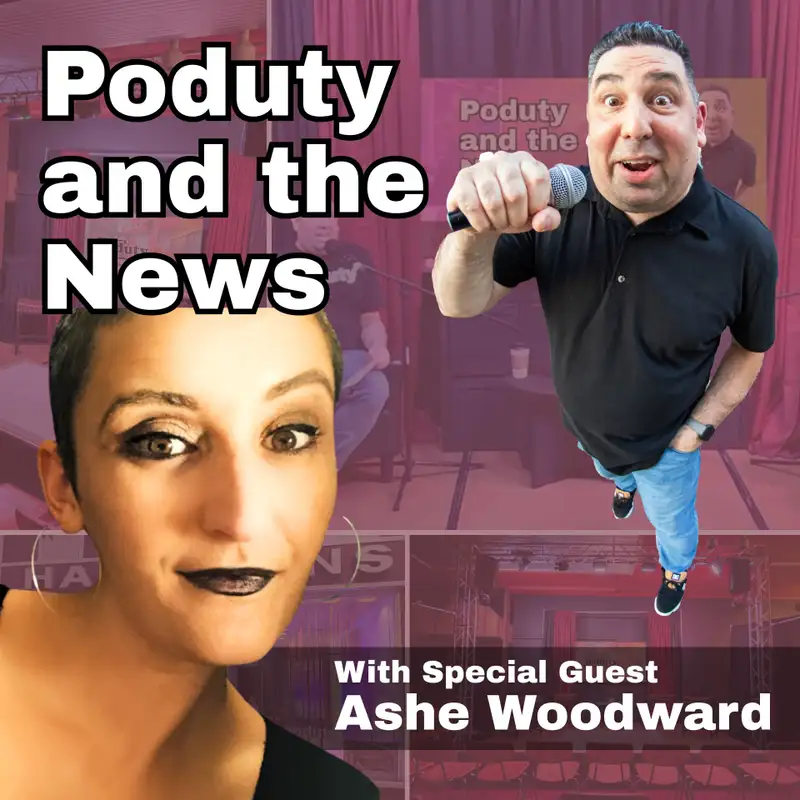
Hey everybody, welcome to Poduty and the News for
Tuesday, March 10th, 2026. I have Ashe Woodward joining me
from the Spooky Scholars Podcast. We've got 6 great stories about live
podcasting coming your way. We're talking about attention economy,
behind bars podcasting, crossed wires, and art
educators save the world. Ashe, do you know what time it
is? I do. It's Mario time. What time is it? What time is
it? Oh, oh, it's time for Poduty and the News. Poduty and the News, the
only live news podcast about podcasting
from the state.
Poduty
and the News.
Poduty and the News, the
only live news
Ashe Woodward, welcome to the show. Howdy. Thanks for having
me. You did mention Eeets a Mario Day. It's March
10th, M-A-R-1-0, Mario, March 10th.
And we were just talking, it's about 8 PM when we're recording here.
I didn't hear a single person tell me today that it was Mario Day. No,
I saw nothing. I was, you know, on social media way too much all day.
I didn't see anything. Sometimes trends are so in your face, like the
McDonald's CEO eating a cheeseburger. And then sometimes you
don't hear anything, like Mario Day was a huge thing the last couple of years,
but I guess Mario's already faded from pop culture.
Whoa. Well, that was fast. After 40 years. Yeah, right.
I don't think so. Well, Ashe, I know you do a radio show.
You do The Spooky Scholars podcast. You're an author.
You're so well qualified to talk about the stories that we're going to talk about
today. And also, this is your second appearance on the show, so
we're really excited to have you back. I'm excited to be back. Thank you so
much for having me and putting up with me again. I can't wait to talk
about this stuff. That's my favorite part of the day. But tell us
a little about the Spooky Scholars and a little bit about the radio show that
you host. Oh, sure. I'm in Spooky Scholars. It's my
podcast about scholarship in horror. So
we look at things like everything through a
queer lens or feminine gaze and male gaze and all of these
things that maybe you don't think of when you're just watching like a cheesy horror
movie. We dive deeper and we show you things that maybe you didn't think
of before that actually matter and connect to society.
And then Horror Helpline is the radio show where I— it's
a call-in show, so I have people call in with their problems So everything
from like boyfriend blues to like school issues
or just dealing with life. And then I match them with a horror movie
that maybe helps them out, maybe shows them that it's
not so bad actually, or maybe has the same theme and connection there.
And that's going to be turning into a podcast real soon
too. So you'll have that as well. Oh, that's incredible. And
the best way if people want to connect with you, find you, we do have
the crew page. You're already inducted into Poduty and the Crew, so all your
links are already on there. But for the show notes, anywhere particular you'd like to
send people? I mean, I mean, like I said, I'm on
social media a lot. You can find me there, probably see that I'm online. So
it's @spooky.scholars. You'll find me around.
Look for the green light and send a message. Yep.
Awesome. Are you ready for our first story? Totally.
We're going to talk about the growth of podcasting. We're going
to Insider Radio, Inside Radio, and podcasting is
winning the battle for attention and the data is starting to make that
crystal clear. According to new research from Edison and MRI
Simmons, podcast listening is not just growing, it
is replacing other media habits. Almost 40% of
listeners say podcasts are replacing time spent scrolling social
media. More than a third say they are listening instead of
watching TV or streaming music. And get this,
adults are now spending an average of over 100
minutes a day with podcasts, which is more than TikTok, Facebook,
or Instagram. And for advertisers, that kind of focused attention
is gold. It also shows why brands are shifting
more ad dollars towards podcasts, because when people choose podcasts,
they're choosing deeper engagement. I don't think anything about
this article is a big surprise. We've seen this
growth pattern happen over the last, certainly last 10 years. We
were talking on the last show, really when Serial rolled on the
scene with Sarah Koenig and her episodic
series really just captured people's attention. And that was a big
growth spurt for podcasting. So, and then COVID came and that was
another growth spurt for podcasting. So The trend has certainly been
upward for the last 10 years. The trend is trending.
I mean, I think, but because we're now seeing it change,
right? There's kind of this, there's been a turn where,
well, I guess it depends what kind of podcast you have, but
there is that change to get more polished. There is that change to get more,
again, advertising dollars on it and all of that. But I still think that there's
also people coming to podcasting because it feels old school.
It feels like people can just kind of say what they want. It's still
the place for people to just have people and interview and do those deep
dives like I do. So yeah, I think there's
maybe we'll see even more separation. Maybe that's what it's going to show us, like
different kinds of podcasts that people are focusing on.
I don't know. We've also seen an expansion
of the definition of a podcast too. I think that may play into some of
this too, where We used to say 10 years ago, if it wasn't an
MP3 file distributed by an RSS feed to a podcast
aggregator, was it really a podcast? Get out of here, right? Get out
of here. But now, you know, we now accept video
as podcasts. We accept just YouTube shows as a form of
podcasting. And, you know, really just anything that you're creating now
could technically be a podcast. So does that
expansion of that definition increase what we are
considering for consumption? Maybe, but I do think that
independent media has certainly been on a trending trend, as you had
mentioned, for the last 10 years. I did my podcast for a long time with
no video. I was like, no way. I'm just going to do, like I was
saying, I'm like team old school podcasting. I don't need
video, but then you go, ah, but you get
so much more engagement. You get so many more
views, you can be in so many more different places. Like it's much more ready.
Like, of course you can have a video-less podcast, a
faceless podcast on YouTube, but that doesn't get as much engagement. So you
kind of get pushed into it, but luckily there are a lot of
platforms and there's a lot of help out there to do that now. So that's
made it easier too. I think that's part of it. I'm here to ride this
wave to wherever podcasting is taking us. I've also
veered from 2015 Jeff, who was adamant about that definition of
a podcast. I will now accept video podcasts. I'll accept
really anything that's independent created. If you're going to do something with passion
into it and you want to call it a podcast, that's okay. I'm going to
be there to support you. I'm going to be there because you're creating something special
and putting out into the world. I don't have to get hung up on the
definition. So maybe my hours are over 103
minutes per day because I'm including almost everything I'm watching now as a
podcast.
Well, let's go to story number 2. I did a story about
this podcast, Ear Hustle. They actually came to Pittsburgh,
uh, maybe a year ago, and they did another show.
This show actually started in prison. It's pretty impressive story. One
of the most powerful examples of podcasting's impact happened inside a
prison. The award-winning podcast Ear Hustle recently
recorded a live episode at the Central California Women's Facility.
The show actually started inside prison years ago, created
to tell stories about life behind bars. For the incarcerated women who
attended the recording, it meant more than entertainment. It meant a
connection and hope. Some said it reminded them they were still being thought
about on the outside. It's a powerful reminder that podcasting
is not just about downloads or ad revenue. Sometimes it's about giving
people a voice and creating moments that matter.
This one, like I mentioned, is they went on tour. I know they did a
stop in Pittsburgh, and part of the stops that they must be doing on their
tours, they're actually going back, you know, talking to some
of the inmates, places where they may have been incarcerated. But they're having
these shows, they're having these tough conversations, they're having
conversations with people who mentioned they may not have had so
much hope, they may have felt neglected from the outside, or does anybody even know
what's happening 'cause they may even know what they're doing. And that kind
of connection, that outside connection, can really boost morale,
can really help people just feel human again, to feel
part of society, feel connected to the outside world.
Yeah. And I mean, this kind of also connects to what we're saying about,
you know, the power of podcasting too, because without
podcasting, this is the kind of group or like
niche kind of group of, um,
inmates that have these kinds of stories, people on the inside, and
then maybe people on the outside dealing with their trauma. Like,
those are the kind of people that don't get attention. So podcasting is
the perfect way that at least we can shine a light on some of these
stories as well. Yeah. Whether you're inside or outside
that system, you have stories, you have experiences, you
have things that maybe you can't talk to with other people. They just
don't understand. What the life or the transition was like.
And this podcast could be that bridge to, you know, maybe give some
balance back to the two different worlds, whether you're, you know,
incarcerated or now free. That, you know, there's things
that you know that you just can't talk about with your brothers and sisters and
mom and dad. They don't— they just won't get it. But these stories are going
to have those roots, are going to have that connection, and it could, it could
give some peace, some clarity to you as well. Mm-hmm.
And the very good thing about this podcast in particular is they're doing very
well. They're a very popular podcast. I think people really
get that, you know, these are just good stories as well.
Um, and they also, I will say they have a beautiful website. I think the
guy that is part of developing this, he's the artist, but there's
beautiful art all over the website and it's really, it's, it's really cool. You should
check it out. Well, let's go to We're sticking in
California. This time we're about making policy and
housing too. So this next story is a great reminder that live podcasting
does not have to be about entertainment alone. It can also make big,
complicated issues feel personal and real. In a live
conversation with Assemblymember Buffy Wicks, housing policy
was not presented like a dry press conference. It became a human
story about security, affordability, family, and the future
of entire communities. She talked about grow—
she talked about growing up in a mobile home, how housing shaped her life,
and why California's shortage of homes touches everything
from education to healthcare to climate goals.
This is the power of live conversation done well.
It turns policy into something that people can actually connect with,
follow, and care about. The
housing in this country is one of the most talked about things
that I, I talk about with anybody under the age of 40.
There's not a path forward for a lot of young people to even
think about purchasing a house at these prices with the, the
value of the dollar. It's a very tough— and that's,
that's a half the population under 40 trying to find
homes, trying to buy home ownership. Trying to get
that fastest— the fastest path to building wealth is to
start buying your own home, having that property, having that
ownership. And there's a big chunk of people for the last
15 years who haven't been able to do that. So having events like
this, bringing a podcast, bringing the Assemblywoman Buffy
Wicks to the stage to talk about some of these issues,
can help, you know, maybe unfreeze that market a little
bit and make housing a little bit more affordable. Yeah. And I
think this is such a great strategy as well, because like you're saying, that group
that has kind of been shut out of homeownership,
they're disgruntled. They're like, you know, why is
minimum wage where it is? Like, this is impossible. So, you know,
I think somebody very smart in their media team is thinking,
yeah, if she just comes out here and gives a press conference, that's going to
feel very top down, right? Like just another person talking down to us
about housing or making empty promises. So I think using the
podcast format or conversation format in that way.
Just, it makes it a story. What a novel, I didn't mean to use a
pun, but what a novel idea to give it a story and an actual human
story behind it that people will listen to and not feel talked at,
I think is the power of this one. Yeah, most of the
press conferences or speeches you hear
directed at the younger generation is, hey, stop buying
coffee. And work harder. We worked harder when we were kids and we
could buy houses. But having a
conversation and opening that dialogue with the public, you're going to hear
the other side as well. You're going to be able to take questions. You're going
to be able to hear feedback like, hey, I've been saving and
I'm just nowhere close to even having what a bank will consider
a down payment. I'm not keeping up with the, the rising price
of housing. What can we do about this?
Yeah, exactly. And just for the record, the same is happening in Canada.
So we're the same. Global.
And so I— now it's a little silly, we're going to go from talking
about incarceration, talking about housing prices, to me
not being able to find out what the price of a ticket was, uh, for
a podcast. This website drove me crazy. I'm excited
about the event. I love that there's all these podcasts together, and I'll I'll go
through my one complaint about this whole thing. And the
CrossWires is building something huge in the live podcasting space.
The festival is adding more headline acts, expanding to
4 days, and leaning into a mix of comedy, true
crime, politics, and fan events that could attract a wide
audience. On paper, this looks like a big win for live
podcasting. They brought in 25,000 people last year. And they
are going even bigger in 2026. But this is the thing that
drove me crazy: this great programming is only half the battle.
If the ticket, ticket buying experience is full of
friction, you're making it harder for fans to support you. In live
podcasting, every extra click, every confusing step, and every
moment of hesitation can cost you a sale. And I feel like I need to
explain what's happening here. All I wanted to do was find out what the
average ticket price was so that I could say, hey, these are tickets are
starting at $20. You can go to an arena, watch a live
podcast, and it's going to cost you $20, $25. That's what I
wanted to do. But because Ticketmaster is their—
I think Ticket— I think it was Ticketmaster is their ticketing agent. They're trying
to capture everybody's information before you get to the
ticketing site. So every time you click on one of these shows
to watch them or to get their tickets or find out the ticket price, You
have to enter your name, you have to enter your email, you have to enter
your cell phone. Then only after you do that can you
go into the Ticketmaster site. Then you can start to select your
tickets, but it's only for one of the shows. So it is unbelievably
complicated for me. I did— maybe I just couldn't figure it out, but
having to do all that just to find a ticket price was like 10
extra steps, and that just infuriated me, and I wanted to talk
about that. I'm sure you're not alone. I mean, that's annoying, and we have
enough of that all day. If we want to go to a fun event, event,
I don't want it to be work, right? That sounds arduous.
Yeah. And every single one, you heard your name again.
No, thank you. No, you definitely got to streamline that user experience,
especially for something like this. Like, this is the kind of event that's really cool.
And like, you and I are going to think this is awesome. But I think
for a lot of people, this would be something new. They're like, we're going to
go see a live podcast. I've never done that before. So they take a chance
and click on the website. And then it kind of lets them down. It's like,
oh, okay, we'll just give up because it probably wouldn't have been good anyway, right?
Like, so you're going to lose those people that might be like newcomers that could
be joining in and making the event even bigger. Yeah, I have to fully
identify myself just to browse. That would— yeah, no, I'd be
out too. I feel you. That's
old Jeffers turning 50 this year, and I'm angry about giving up my
email. Well, let's
keep it moving right along. That's— and I am very impressed. It's a great
lineup. It looks like a great festival. I wish I was in the area to
go to that. Uh, if you do and you love any of these
podcasts, go support them for, you know, do the extra steps to find the
tickets. But next year, I hope they streamline that process where,
you know, I can just get a ticket, I can just see the pricing. Um,
what can we do about Ticketmaster? I mean, oh man,
hopefully their, their grip is slipping. I've heard
some, uh, yeah, some things that may be changing in the Ticketmaster ecosystem.
Yeah, they might be getting called out, which would be good.
And let's go to one of the coolest slides I've ever put on this show.
When podcasting meets the arts from KPBS. Here's
a story that reminds us podcasting does not always have to chase big crowds
or big-ticket prices. The Art Educators Save the World
podcast recently recorded a live episode at the Comic-Con
Museum in San Diego. For just $5, and you didn't
have to give up your email, phone number, and full name.
Audiences could watch a conversation between Emmy-winning writers
Joshua Pruitt and Scott Peterson about membership,
creativity, and the role education plays in building a career in the
arts. Events like this are small, intentional, and community-driven.
They show how podcasts can support the arts, connect generations
of creators, and create spaces where learning and
storytelling come together on stage.
The thumbnail for this website was like my favorite thing in the whole
story. And to hear what they put together, what
they're doing and what they're building, it just inspires you and gives
you hope for the future. Yeah, we need some hope for the future.
Yeah, we'll take some of that. I mean, I love the aspect of this just
being real people. I mean, all of these are real people, but
like it's specifically designed to be like a mentorship and like give
some leadership. It's doing so many things, right? But I think,
you know, charging $5 again is that grassroots kind of feeling of
podcasting. I think it's the, that's also tapping into like
real people giving mentorship to kids and not just letting them go
and do like digital platform learning, you know, get out, go see a show,
actually hear from real people, authors, come on, you know,
support books, support
words. I'm a big fan of words, words and words. Yeah.
But the, the caption, exploring the mysteries of what can happen in a classroom
when teachers and students inspire each other, was
a truly joyful surprise. That was a quote right on the page by Peggy
Pfeiffer. Peggy Pfeiffer. So right on the home page, uh, just
a really cool, like, superhero type, uh,
imagery. You have this event where you're going to the Comic-Con
Museum, which I didn't even know there was a Comic-Con Museum. Yeah, that's And
for $5, you're hanging out with this podcast. You're hearing the
stories. You're hearing about the future. You're hearing about educating
the young minds in different ways. And it's just a fun,
great way to spend a night for $5 and get them into
podcasting. Yeah.
And speaking of podcasting, we're going to our
last story. It always goes so fast, but Not
every podcast needs words. And this one I like to file sometimes
live streams or live shows under
topics where I didn't really expect to see a podcast, a genre I
didn't expect to see a podcast. And this is our final story today, a
reminder that not every podcast needs a microphone conversation.
The Alpha Rhythm Drum and Bass podcast is celebrating how many?
400 episodes with a live show built entirely around
music mixes. Every week the show releases new tracks and
live streams, DJ-style performances that introduce
listeners to new electronic and drum and bass
artists. It's a great example of how podcasting can go beyond
talk shows and interviews. Sometimes the content is the music
itself and the live experience becomes more like a concert
than a podcast recording. And the DJ just spins music
for, you know, an hour, hour and a half. And informing
you about the tracks, telling you a little backstory, when it came out, when the
album— who released the album. So you're getting a little— there is some words
happening throughout the show, a little bit of dialogue. All right,
go words again. Good word.
No, I love this too. This is like— it's a way to also
expand our mind on what a podcast is, but also just
like diversify the space, right? Like, I don't know, it's
funny because when I think about my radio show, You know,
it's me. I'm just like a talk show. It's just me talking.
Sorry, guys. But then after me, it's people doing music. So
it's kind of like mimicking, of course, that radio space music,
obviously. But it's mimicking that in a way that it's
still within. You can also switch over to a talk podcast,
right? Like, it's like, I don't know, that's just very cool. Yeah.
If you look closely to the thing that I liked, I love, you know,
as a kid, sitting in my room at night doing homework, listening to the
radio, you know, you could hear what the DJ told you, you could hear maybe
what the caller said when they called in. But if you look at over to
the right, the Super Chat that's going on, you don't
get this with radio, which is a— I love that he's— he is basically producing
a radio show, calling it a podcast. But the
interaction with the community, the interaction where you're able to
leave a comment— I'm in Pittsburgh and somebody in Canada I could
interact with, and we both like the same types of music, but we're having
this shared experience while listening, was just a new
way to take a live podcasting, a live radio show, I thought, to
a whole nother level. And the fact that he's doing 4— he's done
400 of these, that's pretty impressive. It's very
impressive. I only have— I mean, I feel like I've been doing Spooky Scholars forever,
and it's only at like— I'm just over 100. That's so impressive.
And something like this, it's Such a beautiful idea. Like you said, the community
involvement in this, just another way to get people engaged. It's just,
it's so cool. I'm all about this. Plus it's like drum and bass, which I
love. So this is great. You're not gonna, you
don't get that on the radio. That's not on the radio. So that's awesome. No,
you'd have to subscribe to XM or something. Exactly. And then listen to
a lot more ads than I think this guy would do, right? Yeah.
YouTube is free. We can watch the live stream. Get the comments, connect with
people, use your words to connect with people all around the world.
Uh, Asia, this has been so much fun. Again,
episode number 2 for you in the books. You're officially a
two-timer in the Poduty Crew Hall of Fame.
Uh, one last time, anything you'd like to talk about, plug, promote, I
turn the floor over to you. The floor is
yours. The floor is mine. Well, I mean, I don't need to
promo anything right now. Well, maybe I'll just shout out my
greatest contribution. It's called Darkest Margins, and it's all about
liminality in horror. So you should check that out from 1428
Publishing. Really proud of my essay in there. It's all about the Flatliners
universe. But beyond that, I don't know,
this, this show today kind of just inspires me to tell more people, like, go
get a podcast. Like, it's so fun. It's
easy. Anyone can do it. You might just find your creativity in such a
special way. Then you can do— come back here and learn how to do live
events once you've got it down. But go get a podcast if you don't have
a podcast. Go out and get one. Like
adoption.
I saw a really cool video today. It was a pet adoption event
where the humans sit around in like a
giant circle and then they release one animal at
a time and the animal will go around and then choose
their person. It was super cool. Like, you want to see an old
man tear up a little bit? Yeah, yeah.
Like, this little pit bull runs in and this guy, like, gets the biggest
hug he's given the pit bull. And it was, like, the craziest experience.
And, uh, there was, like, 50 people there trying to adopt animals. So
it was nice to see that many people would take a chance on letting the
pet find them and choose them. And it was just, just a super cool
event. So Just like that pet chose that human as
his human, go out and choose your podcast. Whatever you're passionate about,
talk about it, and then think about doing it live. That's all I
have for Poduty and the News for Eat Some Oreo Day.
Oh, it's time for Poduty
and the News.
Poduty
and the News,
the only live news podcast about
podcasting from the
Stage.
Poduty and the News. Poduty and the News. The only live news podcast about
podcasting from the stage.