What time is it?
What time is it?
The only live news podcast about
podcasting from the ST
News.
The only live news podcast about
podcasting from the stage.
The only live news podcast about podcasting from the
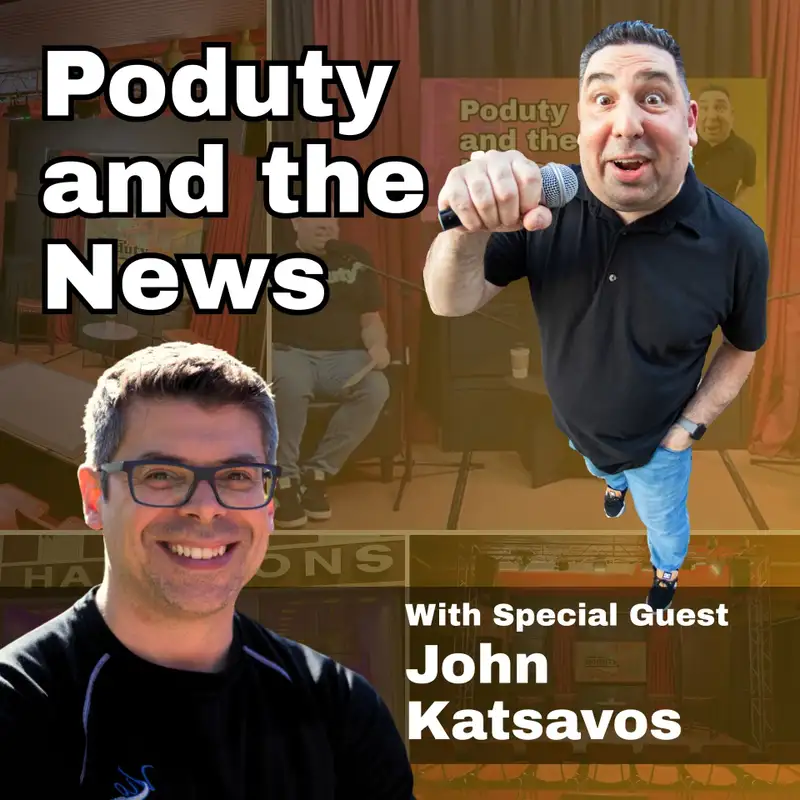
stage. And I have an amazing guest joining me today, John
Katsavos, Tech Forge Media, Podcast Business
Insider podcast. John, welcome to the show. Thank you for
having me, Jeff. So glad to have you here. I've been reading up
on your bio Tech Forge Media, and I even heard you had a
fitness podcast before all this. Kind of where you cut your teeth in the
podcasting industry. Yeah, it was called the Fitness Oracle, and
let's just say the Runway ran out before the
podcast could take off. Yeah, but a lot of great lessons
from there. You learned a lot of strategies, a lot of ways to position it.
And is that how you got into. To really helping other podcasters?
Yeah, you could say that. I was
running it for three years of 300, over 325
episodes, and most of those
episodes, and that journey was me bashing my head up against the wall
and trying to figure out what's going to work, what's not going to
work. So there was a lot of more error and little.
And a lot of trial, but a lot of error. But what
came out of it was the lessons that I learned
and I'm implementing now with not only podcasters, Business
Insider, but also an audio
podcast called Boots on the Ground, a text life, which is my day to day
life, and a couple of other episodes, a couple of
other podcasts. So a lot of hard
lessons, but very important
lessons to learn. And I'm trying to not help,
not get new podcasters
to fall into the same traps that I fell in for
three years. Yeah, there's tremendous opportunity to grow
your reach, expand your audience, make connections on a different
level that you can't do with a display ad or, you
know, a blog post. And podcasting is this great way to.
To connect what you do with. With people looking for you and your services
and your products. Yeah, 100%. 100%.
And people want to look for the podcast. Business Insider. Any
recommendations? You have a dedicated website or just go to the apps,
go to YouTube. Type in podcasters Business Insider.
I'm on itunes, Spotify and
Amazon. Amazon, Amazon
Audio. I don't know what they call it now. Yeah,
they keep changing the names and it's like, stop doing that.
It's a guessing game. Like, HBO Max is now Max. Now it's
HBO Max again. And then it's back to hbo.
Well, I'll have all those links for John in the show Notes. Make sure you
check out John, check out his podcast, see what he's working on, what he's building,
all those things over there, helping other business owners, helping other
podcasters. The podcaster Business Insider. The link
will be in the show Notes. And this is our Saturday morning version of the
show. We, we grab our coffee, we just sit down, we kind of slow down
for the week. We want to, you know, we're all busy during the week, working,
doing episodes. You're doing interviews during the week. But on
Saturday morning we can pour up a cup of coffee, sit down and
talk about six new live podcast stories about people doing
live podcasts around the world. And everybody who comes on the show
gets inducted into what we call the crew. So John is now part of
Poduty and the Crew while we have coffee with Poduty and the crew. And on
the website news.poduty.com, you'll see everybody
who's ever been on the show. And on Monday, John will appear on there, you'll
see the links for John, you'll see any episode he's ever been on. And so
this episode today at any future episode will all be linked there
for John so you can stay in contact with him. And it's just an easy,
nice little historical record of how the show's been growing and put together.
So check it out on the website. John, are you ready to
get into our stories? Let's do it. So here we go,
our first story today. We're going dry
January. What's going on with this one? Chance Clean Cider is
leaning up or is teaming up with Sober Boozers Club to record
a live podcast episode during the Dry January
2026, spotlighting how drinking culture is shifting,
not disappearing. Hosted by Ben Gibbs of Sober
Boozers Club and John Logue, founder of Chance,
the live event brings together leaders from low and no
alcohol space, including voices from Alcohol Change
uk, Lucky Saint Counterculture and Sober
Curious creators split into insight and
community driven segments, the show explores how brands, communities
and consumers are redefining social drinking, ending
with a live audience Q and A. The episode will be
recorded in a pub, underscoring the message that moderation
and mindful choices are now part of a mainstream
culture and not a fringe movement. And for me, this is a
news. This was a breaking news to me because I've been hearing a lot
about how the younger generations aren't going out and having a
nightlife like the Gen Xers, the boomers, and some of the
millennials did that. There's a whole new movement of just
being in the moment, just enjoying themselves without having to
rely on, you know, alcohol and partying. And there's even
dry bars popping up where, you know, people go in, they're just having
club sodas and lime or you know, specialty cocktails that are non
alcoholic. And it, it's a big movement and as we know,
dry January is a big thing that happens every January. And here's a,
here's a business leaning into all that. It's a current event,
it's a trend in mainstream that we're starting to see. And
they're hosting this event, they're bringing people together who, who think the same way. Like,
hey, we can go out and have fun without having to have
booze and drink and everything. We can have good entertaining
conversations without all that other stuff. And just to
see a pub and this community leaning together
to bring people together, I thought that was a pretty amazing experience.
And especially this time of year, tying it in with a lot of people trying
to celebrate Dry January after the holidays.
This is coming from an ex alcoholic.
I never really understood Dry January.
I understand what it's there for. It's to help under,
bring awareness to alcoholism, drinking and driving and all that stuff,
which I've done both. I've drove and
driven under the influence. Never got caught.
I don't do it, don't do it. People, don't do it. It's not good. Not
recommended. Not recommended.
I can understand why the younger generation does not want to
drink like the Gen Xers because I am, I am a Gen
Xer and I remember two dollar, two dollar drinks at the local,
at the local club. Tuesday Toonies we used to call
it. And you, with 10 bucks, you'd be just plastered,
just gone, just gone.
I like the idea. I really like that idea. I think that
is a really good idea and really good awareness. I
understand how expensive alcohol has become, especially here in Toronto
is ridiculously expensive. So I mean, I can understand
where the new generation is. Like, I'm not going to spend all that money just
to get hammered. It's not going to happen.
But also health wise, coming from an ex personal trainer who
used to be an alcoholic, it's not the best choice that
you can make. So I really like this idea where they're bringing more
awareness and the podcasting space has just blown, blown up. Especially
the, the, the live, the, the live podcasts.
It, it's just blown up like crazy.
So to marry the two is hugely
important to Me, and good for them. I give them all best
credit and all the best of luck because I really,
I'd really support. I'd really love to support these guys because it's, It's a, it's
an amazing project. Yeah. And this is. Seems different. This is a
different tone to, you know, just 10 years ago, just celebrating
Dry January was a thing you try to accomplish, but there's a
whole movement, I think, behind us that extends well beyond
Dry January, where people are living clean, healthy lives all year
long. And that's the trend. Not just, not just this one month.
Like you're saying, hey, it's a good start, but here's a bunch of people
who are embracing that year round. And to be able to bring those people together,
connect, maybe even share when you're struggling or, or, you know, hey, I,
you know, this is a crazy week. I just want to do something. Hey, here's
a bunch of people that can get together and just have a good time without
introducing any of that other. Other stuff. Yeah, I
totally agree with that, too. Like, it's, it's like I said, coming from
an ex alcoholic, it's. It's one of the hardest things that you can give up.
Next to smoking, which I also did,
it's the Greek in me. Booze and smokes. Are you.
But, yeah, I think it's. I think it's really important. But the one thing that
I wanted to let people out there struggling with
alcoholism especially is, like, don't just stop at January.
Try and keep going. And I think something like this
podcast where they teamed up with a dry bar is.
Is. It's, It's. It's important for them to, you know, become
part of that community, to help them through that struggle, through that journey for
them, because it's not an easy one. Not an easy one at all.
A lot of times you would be doing Dry January by yourself. You know, most,
maybe your friends didn't do it and they're trying to drag you back out, but
now there's so much more support for it. It's so much more
embraced. So, again, just a great opportunity
here. Way to plug in the current events. I think it's a great way to
tie your podcast into what society's doing and, you know, bring
that community together, bring them into your business, have a great night out, tell
stories, share stories, and, and, and just enjoy each other's company.
Well, to add to that point that you just said about your friends, I, I
remember. I think it was Dan Pena,
might have been Dan Pena, who said this quote, you are the
sum of your closest five friends. Yeah.
So if your five friends are going out drinking every night, guess what? You're going
to be the six man in. If your closest five friends
are, you know, being business owners and
responsible adults, well, guess what? You'll be. You'll be. You'll end up being that.
So maybe if you are looking to get out of,
you know, alcohol, drinking and all that stuff, maybe it's
time to find new friends. Yeah. Yeah. And if this
event isn't in and you don't live in this town, I think this was in
the uk, there's probably something happening in your town that's
somewhere near you. Go find out. Go out and find that community, whether it's a
podcast or just a group. Go out, hang out
like you can at our second story. This was submitted on our website
news.paduti.com we have a place to submit live
podcast news and this one is A Listening Party is bringing its
show to a live audience with a taping at Technica House
nyc. Blending comedy, music and communal listening
into a ticketed experience. Hosted by comedians Drew
Riley, Yasmin Ramos and Jacqueline Yueh,
the podcast hook is simple. They review iconic
albums while openly admitting they know nothing about music.
The live format lets audiences experience the unfiltered
reactions, cultural commentary and improvational humor
in real time, turning a familiar podcast
premise into a shared in room event scheduled for
just happened January 21st. The show highlights how
comedy podcasts are increasingly leaning into live tapings and
as experiential content where audience energy
becomes part of the product. And thanks again to Arielle
for submitting this in. If you have a live podcast coming up, let us
know. We'll review it here on Poduty and the News.
Here's an example of comedians doing something outside the
box and comedians love sharing the stage. They love
performing in front of people, they love doing improv, they love doing crowd work.
And here's a chance where they're going to set up a premise of playing a
song and then reacting to it without knowing anything about
music. It also works with comedians in the kitchen.
Whenever you see somebody cooking and they have no idea what's being made for them,
comedians can comment on it and tell stories about when they experience
that maybe that sandwich on the road somewhere. And you get to
have this other perspective, not from a professional critic but
but from these comedians making the audience laugh, you know, playing these
songs, goofing on each other, goofing on the songs and adding their
own Take maybe even a story about something they experienced while the song
was on. I've always been fascinated by
comedians. One of an old friend of mine is a very
popular Greek comedian in America and in Canada,
outside of Greece. When I see him
teaming up with his comedian friends, it's always a, it's always
the funniest thing in the world. Like the, the, the jabs that they give each
other. And I would like to
see more of that on Instagram from them because it,
because what I've been seeing on Instagram
lately is a lot of like stage
stuff and it's just too staged
for my liking. Diversify.
Yeah. Just make it a little bit more real, a little bit more, you know,
more personalized kind of thing. Like I love
comedians, don't get me wrong. I love who doesn't like a good laugh. Right.
And especially when it gets down and dirty. Because again,
Gen Xer we. I grew up with Andrew Dice Clay. I grew up
with all these really hardcore comedians like Eddie
Murphy when he was really Eddie Murphy.
There is just so much to, to say about
comedians. I, I love it. And I would love to see a comedian
do a live stream like Matt. Right?
Like Matt. Matt Rife. Do a live stream and just
do his, do his thing. Be the Matt Rife that we know and
we. That I care. That I love about, that I love about him would
be so amazing. Yeah. One thing podcasting has
shown me over the last 15 years is as much as I enjoy
comedy and stand up comedy, I love the
backstories, I love the road stories. I love hearing how
jokes came together so much more than the performances.
I listen to so many comedians podcasts because they
give you the behind the scenes stories. They tell you
about traveling on a road, traveling in a bus, going from town to town
and you get to hear this whole other perspective of what it actually
takes to get up on stage and perform in the
night after night, the grinding, the bombing, and it's
just something fascinating. So to be able to apply all that in a live experience
with some music, this sounds like a win win. And I hope to hear more
stories from them coming up in the future.
Let's keep it moving. We're going to go from music to sports. We've
got the Bobby Bones show recorded a live podcast episode
from Coaches Convention five at Almost Friday
Sporting Club in Nashville. Turning a fan heavy event into
an unscripted in the room experience. The episode captures
the raw reality of live podcasting. Spontaneous
conversations, imperfect audio when audience members skip the
mic and unpredictable moments that only happen when a show
leaves the studio. Members of Soar Losers Nation packed
the venue as hosts, shared stories, fielded audience
questions, and welcomed surprise guest pits to talk football
and life. It's a reminder that live podcasts trade polish
for authenticity, where energy, access and community
matter more than studio perfection.
This is super important, and you just said the most important
part at the end, that the community part is
the most important thing that podcasters are after.
We're not after likes. We're not at, well, subscriptions.
We're not after, you know, how many views did we get?
We're focused. Our main focus is the community,
without the community. And that's what I think a lot of
podcasts are outperforming the mainstream
media is because we are creating that community and doing. Doing this
live. It just. It just ties in that community so
beautifully, so perfectly. This is something we were talking about, you know, before the show
even started, is this is a perfect marriage of a sports
podcast at a sports club. They're go. They were at the almost Friday
sporting club, talking sports. Where do you think sports fans
hang out at sporting clubs, sporting bars. That's where they want to
be. That's where the action is when they're. The game isn't in town. Maybe it's
an away game. They all meet up at certain places, certain
restaurants, you know, places with giant TVs. And here
they are talking sports in an environment that they're comfortable with, with fans
who love doing the same thing. This is one of those perfect marriages
of. Of putting your entertainment in the place where your audience already
is. And I. I think Europe does
this beautifully. Like, if you look at the sports clubs in Europe,
that they don't follow players, they follow the club
there. I saw one quote recently on. In. I think it was Instagram or
something. I'm on Instagram a lot. Just swiping.
It's. The players come and go, but what stays is the club.
And the. The mentality
of the Europeans when it comes to their sports
clubs is insane. I don't
know if you guys are basketball fans. Not in Pittsburgh.
Not in Pittsburgh, no. Well, in Toronto,
there's. There's. There's a shift happening between hockey, basketball,
and soccer. Right now. There's a kind of a little bit of a shift.
Now we're leaning more towards the Toronto Raptors. But
if you see a Raptors game or a Sixers game,
and you compare that to a game in,
say, Greece, because I know Greece, like Olympiacos versus Panasonicos,
the two differences between those Two
games is night and day. You do not want to be
cheering for the wrong team. In Greece. You might
die. Where. Here
it's okay to root for the. For the wrong team. It's very
humbled. So I like
to see that kind of community come here in North America
where it's like. Like live and die your team. But I'm not
a big sports fan myself. I'm under
the idea that, you know what? Where's my millions to
support you? I'm dumping all this kind of money in.
Into you. Into you, into you. But this is coming from a Leafs fan, so
I'm very well aware of disappoint.
So. But it's nice to have that kind of feel like
me cheering for Libyakos in Karisaki Stadium rather
than going to Scotiabank arena and cheering for the.
For the. For the. For the Leafs. It's two very
different environments and two very different feels. American sports
have kind of become like a celebration and a party and the. The game
sometimes is secondary in America where everybody just listen for
the DJ or the sounds and the cheers and it
looks like what I see for European countries, you're there for your
team and that's the number one priority. Not. Not so much the
entertainment and the nachos. Yeah. And you know who creates
that? The community. The
community creates that for the team. The communities there
are much stronger than what they are here when it comes to sports, I'm just
talking about sports. And to see this
podcast trying to do this for their football team, I mean, that's
one step closer to where it's supposed to be, where the
community is building that hype for the club.
We saw it here in Toronto with Toronto FC back
in 20. I think it was 2016, 2017,
when other clubs from MLS were
looking at the fans and what they were doing for the
club. And the only reason why we won an
MLS championship was because the fans said that we're not. If
you keep bringing in players that are not going to perform,
we're not going to renew our season tickets because I was one of them.
So they brought in better, better players.
Our stadium erupted. It just. BMO Field
was just insane. And that was the community
of the fans that created that environment for the
club to succeed. And that's. And
the rest of MLS had taken. Taken over that. Which
I love. I love to see that. I mean, I'm not a big
Montreal fan because I'm from Toronto, but
I like to see Montreal and New York and
Philly and Miami have a huge,
amazing club fan experience so that when
you go to the games, the community of the club has created
an environment where you can enjoy the game.
Absolutely. And you mentioned the community is the one building it.
And this next story that we're moving into here, this podcast
is going to each of these cities and building a show around
the city. So this is really cool, kind of that concept you were just talking
about, but in reverse. TNH has announced the
Summer Sessions Live Podcast tour, sending hosts Jay
Walker and Sean Murphy on a multi city run across the US
this summer. Designed as a true live taping, not
a scripted stage show, the tour puts the duo alone on
stage with the audience fully integrated into each episode.
Produced by Whoa Ray and 1097 Group, the
tour emphasizes raw energy, city specific moments and
viral ready content. Each stop is structured to feel like
that city's episode, featuring audience participation,
rapid fire debates, story time segments and
unscripted moments built for both the room and digital
distribution. Alongside the tour, TNH
confirmed a new season of the TNH show airing this
summer on the iHeart podcast network, showcasing a
coordinated strategy that blends live touring, weekly audio
releases and social first content momentum.
This is something that after my own heart, you're taking your show
on the road, doing tours through cities. Everything
about this screams let's go, let's get some tickets.
This is actually pretty good. I like the idea behind it.
I think it's really cool. Good for them for coming up with
this idea. To be able to tailor
your show to the city, to that community.
Imagine the bond that that's going to build in each of those stops where
people now they really relate to the host that they're already listening
to and love. The hosts, they're going to go see them live and now they're
going to give them back an episode based on their hometown.
That's pretty big. It's going to be hard to overcome. You know, that type of
engagement that's powerful. And this is why mainstream media
is having a hard time right now. It's because of
men like this that are going out town to town and
really customize, really speaking to their audience
in that specific area, in that specific demographic.
And this is the power of podcasting and live
streaming is that you have the ability to do that
instead of saying, instead of having all these broad,
broad conversations with millions of
people, instead you're just having a conversation with just a few people
and you're really connecting with them. I think, I think this
is, this is amazing. I think it's powerful and I
Think this is a good
platform to copy? Maybe you're not ready for a
US Tour, but you probably have a bar or a restaurant or a
library with a media center in your hometown. That's a great place
to start. Yeah, if you have a theater like we built here, start there.
But you know, you can take your show out into the community. There's
probably very similar events to what you're talking about already happening.
Try to plug into those. That's the same thing that the TNH is doing.
They're plugging into their fans in their town. They have a much bigger base. But
you have people in your hometown that are probably interested in what you're
already talking about. Go out and find them and see if you can do a
live show. It'll change your whole perspective on podcasting and what
you think is possible. For a podcast. There was, there was a
really interesting. I'll call it an
experiment because I don't know if it was an experiment or not. At the
Podfest when I went to Podfest back in
2022. I don't know if you were, I don't know if you went to
PodFest. I don't know if you heard of PodFest. I haven't yet. That's on my
bucket list. Well, I went and they had a,
they had a, like a small section that was
just there for pop up
interviews, pop up podcasts, kind of.
And it was quite, quite fascinating. And it got me thinking that,
that one thing got me thinking. Why not go to trade
shows that are kind of tailored to what
you're doing, Put up a podcast booth there
and then invite the other, the other
people that are there to sell their products or introduce their products
to your booth and interview them. And on top of that,
interview the people that are coming to the trade show. Why are
they there? What are they doing? What are they looking for?
And it, like you said, like, it can build such a
community. Like if you're starting to think like your audience is out there,
like you just said, and it's like you just have to go out and
come up with ideas to do it.
Yeah, we are starting to see that bubble up a lot at conferences,
events. We're seeing, we're seeing people bring in
a lot of businesses like your training already have their
podcasts and they actually start, they're starting to take them to their booth and record
a show with customers in front of them. We're even seeing some of the
main entertainment on the main stage be a podcast.
Whereas 10 years ago it might Be a band in between keynote speaking or a
magician or a comedian. They're starting to put podcasters on the
stage. So you're, you're right in tune with that pulse, John. Like this is
something that's, that's happening more and more and businesses are starting to get
that traction and momentum and, and they're starting to take their podcasts on
the road to all these conferences that they're, they're already paying thousands and thousands of
dollars to attend. They might as well get some content out of it.
It's a, it's a, it's a great idea. And like, like podfest
was the one that actually planted that seed into me,
which was another podcasting conference. And
speaking of, look at what Pod PodFest is doing. They're doing these things called
Pod Tours. So during the year when the conference isn't
happening, they go to different cities and different stops and they're
doing small community gatherings to start to build that momentum
for the main conference. So, you know, Pod Fest, Pod
tours, these things that John's talking about, these are things that's happening right
now. You plug into them, see if you can make it happen. Let's keep it
moving. Speaking of making it happen, down with the boring
kicked off of 2026 with a live recorded episode broadcast
from Rockaway beach at Butlands in
Bognor Regis, turning a holiday camp into an
unexpected podcast venue. Recorded in front of a live
audience, the episode features Antony Scissormick
and Prima Queen in a loose, unfiltered conversation,
reflecting on the chaos of 2025, creative
momentum heading into the new year, and a surreal experience of
starting January backstage at a seaside resort.
The setting becomes part of the storytelling, adding texture, spontaneity,
and authenticity that wouldn't exist in a traditional studio.
The episode aired live on Dork Radio and will be
distributed across all major podcast platforms, reinforcing
how live recordings can fuel broadcast on demand
audio and app based ecosystems
simultaneously. This sounds like they're hitting the
cylinder on all heads, I think. Is that the right thing? They're hitting, they're
firing on all cylinders. That's what we're looking for. Personally,
this just seems a little bit too fluff for me.
I'm, I'm like more like raw, real and
you know, I'm just seeing like resorts and stuff
like that. It's like, really? Guys, like, come on. Like, I don't know what their
audience is. Like, I don't know what their audience is talking, but this would not
interest me at all. I would be more
interested in
their broadcasting, their on demand radio and their app based
ecosystems. I would love to see what they would talk about that
as again, like I'm coming like from an
it perspective. Like I, that's my heart, my heart
and my soul is it and automation
and all that stuff. But to be doing it from
a resort, just south seaside resort.
Come on, man. Like I'm a big
goofball. Like I, I like, I like my shows to be a party.
Like I do a Pittsburgh podcast meetup and we're just goofing around sharing
podcast stories and I do a trivia show that makes like
everything I do is kind of like a game show. Like this, this podcast is
almost like a game show where you come on down, you're the next contestant and
you know, we're talking about stories and hanging out. So I see both perspectives.
I do see and I, and I haven't, I'll be honest, in the past,
I haven't seen podcasting as a business thing, as a thing you
could do to grow customers. I always thought it was like a fun, you know,
be a goofball on, you know, almost like your own radio show,
but being silly. So I, I'm starting to see the full circle and I
just found out about audio dramas, if you're going to believe that. So there's a
whole world of podcasting and it's kind of like the wild west. You, you can
really build whatever you want to build and then there's going to be different flavors
for different people and different opportunities for different people. You'll find the thing
that, that fits you and, and that's the one that you'll go support and hang
out with. Well, that's what I love about podcasting and live streaming.
It's like it doesn't speak to everybody. Like I've said before, it speaks to
certain amount of people. Like, the only reason why I would watch
this is to get more information on the technology behind
it. I couldn't care less about the
frills behind it,
but the, the technology is what really drives
me. It's like, okay, how, what did you do with
this app? How did it improve your business? How did it improve the,
the productivity, the back end stuff for your business?
And I was the same as, I was the same as you. It's when with
the Fitness Oracle. I never really thought of the Fitness Oracle as a business
model until I ran out of money.
Well, I got bills to pay. So yeah, I,
I was living in Florida at the time. Like, I can't afford to Live in
Florida with, you know, not making any money.
So, I mean,
it's. For me, for me, it would be, I would be
more interested in seeing the,
the dorky side of it. Yes. Because I am a dork.
I am a nerd at heart. Big dork, Big nerd.
Especially when it comes to the. On with the audio apps and the app
based ecosystems and the broadcasting methods
that they use, that something like that would really interest somebody like
me. But I can, I can see the value in having a little bit
of entertainment with that. You want to see
how the sausage is made. You want to see, you know, how did they get
to this point? How did they set up the stage? What's the technology?
What are they running for? Sound and music and slides
and is there video interactive? And then they're recording that,
they're editing that as a finished product. Maybe it's a video that goes
on YouTube later on or in a private club or private membership community.
And then you get the audio version of the podcast released at a later date.
So the, the ability for them to build this ecosystem
and take all these little pieces out of it to create other pieces of content.
I think that's, that's kind of what you want to see. The. You want, you
do want to see how the sausage is made. Yes, yes.
But I also enjoy eating it.
Well, we're going back to sports. We got our final story today,
and you were talking Toronto. You got the Blue Jays, I got the Pittsburgh
Pirates. I don't think the Pirates haven't had a season over.500
in a while. It's been a while, but here's something happening at a minor
league baseball game. Minor League baseball took live podcasting
into the ballpark when the show before the show recorded a live
episode during a game at TD Bank Ballpark, home
of the Somerset Patriots. To celebrate the podcast
10th anniversary and 500th episode, the
Patriots hosted a full podcast theme night,
integrating live interviews in game activities and a
live podcast segment broadcast over the PA system
between games or between innings. Hosts Tyler
Maughan, Sam Dykstra and Benjamin Hill
weren't just recording content. They were embedded into the fan experience,
appearing on the game broadcast and interacting with fans throughout the
doubleheader. The event shows how live podcasting
can function as in venue programming, blending sports,
storytelling, sponsors and community into a single experience
that works for fans in the stadium and audiences
listening later. This one, I'd love to go get a beer with
you or go get a hot dog with you and go to the stadium
and watch A game and then hear a podcast in between games.
That would be awesome. Again,
this is what I was talking about with the last, with the last, with the
last part that we were talking about how the, how the fans
are creating the community to support and make it a fan experience
in, in the stadiums. This is amazing. Like,
I love seeing that. I wish I could
see more of it and it said in the games, but it would
be even better if you saw, if you had it in between innings or in
between periods or in between halves. You know,
instead of, you know, the traditional, having the, having the
reporter go to the locker room to get the interview, have
the, have the athlete come on the stage and have a chit chat about how
the game went and how they felt and, you know, what led up to it.
Really immerse the player in, into the fan's
life. Like, I hear hockey all the time
with all the cliches. When they get injured, upper body injury, lower body injury,
it's like, no, dude, like, tell me what the experience was
like. Well, how did you feel like when you did get hurt? When the, when
the trainer did tell you, you know what, you're going to be out for three
months. You know, what was the journey to, what was your journey to
when you came back from the, from it? Make me a part of
that experience. I know it's personal and all that, and I get it, but you
know what? I'm paying big bucks to watch you. You're also
getting paid millions of dollars to do something. Well, guess what there,
sunshine. Your privacy has gone a little bit out.
Yeah. And if you love sports, in this case, it was a doubleheader and they
broadcast in between game. They gave them the field in front of the crowd.
So think about things that you're talking about. What are
the events in your area and your industry? These two, three guys,
they do a baseball podcast. They love baseball and they got a
chance to perform their podcast on the field in
between a doubleheader with a crowd of people who also love
baseball, love the team that they're there to support that. That's the
best way to embed yourself into something that's already happening.
You're right in the middle of this game with these fans who
love the same thing that you talk about. There. There isn't a better way to
make a connection. Oh, it's. It's the best way. It's the best way.
Can you imagine if this was live too? Oh, like
now you're speaking, you're definitely speaking my language. Well, I
Mean you. Because you already have the attention of all the fans
at the stadium. Now you do it live. And people that are
watching it on YouTube or rumble or whatever
streaming platform that they're on are already tuned in.
Now you're reaching them as well.
So it's like you're. You're really embedding yourself. And this is
what. This is the beauty of technology. Technology has made this possible. Without
it, we'd be. This is why I love technology.
Yeah. When we talk about the theater space that I'm sitting
in right now, if you wanted to do this 20 years ago,
it would cost you hundreds of thousands of dollars to
figure out the streaming process, to figure out the camera work to do.
You can do something like this now for five, six thousand dollars.
The barrier to entry, because the technology has advanced so
rapidly. You can have a TV studio in your basement.
You can have the broadcast power of your local television
in 2026 that you couldn't have done 20, 30
years ago. So keep in mind what John's talking about. The technology brings
us all together, gives us a place to have a voice, to
elevate our voice into the public and to share these ideas and
thoughts with people and. And see if it resonates with people.
100%. 100%. Like, I don't have a very big
studio behind me. It's my basement apartment.
That's basically what it is. And I've.
I've never. I've never told people it's.
It costs a lot of money to get into podcasting
or live streaming. It costs a lot less than
5,000. But, I mean, if you want to do the. The studio. I've always
dreamt about having a studio myself. I just.
Right now, I'm in my basement apartment doing my podcasts.
When I do podcast training and I show people how to get started,
I always tell people, you already have everything you
need to build to start a podcast. You don't need to spend any more
dollars at this point. You have a way to record your voice. You probably have
a computer. There's free editing software. You
have enough to get started. You don't have to invest another penny to
just play around, try to figure things out, get started
with it. You don't have to do any of this. You can just
start to find your voice on a microphone and start to share your
thoughts in real time. As we all know, everybody's first episode isn't going to be
great anyway. You might as well start with your phone microphone or your computer
microphone just to get started Hear yourself. How can
you improve on that for episode two? And that learning
curve is part of the growth of your podcast and it's part of the
identity of your show that makes your show unique. But everybody's episodes
one through ten are a bit rough. Yes, they
are. Well, John, this has gone
so fast. We're at the end already. One last
time. People want to connect with you. Find more about the
podcaster, Business Insider and and Tech Forge Media.
What's, what's the best way again? Give us those websites and we'll
put those make sure everybody knows that they are in the show Notes I
the. Best way to find me is to just find me on YouTube.
Podcasters Business Insider
we are. I'm doing a special
series. I'm launching a special series today
on how to grow from 0 to
100 subscribers. Now, I've never been a big fan of
subscriber count. I'm just using that as
a measure to success and that
everything that I am doing is on is going exactly where
I need to go. So you can find me on YouTube,
LinkedIn and
YouTube and LinkedIn. Those are the only two platforms I'm focusing on because I believe
another thing I believe is in being hyper focused in the
platforms that will that are where your audience is not
being out there too far because
Voice in the woods is not heard by anybody.
That's a the tree falling down and no one's around to hear it.
Yeah. Did it make a sound? Don't let that be your
podcast. Follow John Check out the links in the show notes. We'll check them out
on YouTube and LinkedIn. It's a great strategy too, you know,
get good at one platform. A lot of times you hear people
saying you got to be everywhere all at once, all the time. But then you
don't become good at anything. If you can just become good at YouTube and just
become good at LinkedIn, there's enough of a community, enough of a foundation on
those two platforms to build something great. Then you can start to expand.
And I like that strategy, John. Thank you. And if
you like that strategy, we have a whole podcast theater here. We like to invite
people down, check out our website for upcoming events. We have all kinds of
podcasts coming up live on the stage in the next couple months.
P-O-D-U-T-Y poduty.com and we want to host your show
here. If you're in the area and you'd like to come through Pittsburgh and do
a live show. It's no contract, it's no minimum
ticket sales. There is no out of pocket expense for
you to do this. I will build you a landing page. I will build you
your tickets. I will help you facilitate the sales of those tickets. I will
record and produce the event for you. And at the end of the night I
not only give you the recording, I take no ownership over it, but
I also split the door with you. 50. 50. That's the only
time money exchanges hand. You can't even give me money if you want to. Let's
build your audience, build your ticket sales. You'll take home half the door
at the end of the night. Check it out. Poduty.com
P-O-D-U-T-Y.com and you can
check out our upcoming events. And if you really enjoyed this show, if you enjoyed
the conversation with John and I, please leave me a review.
News it's called Poduty and the News. On your favorite podcast app you can
find on the website at news.poduty.com and
John, that's the end of it. I'm gonna go ahead and play us out of
here. Thank you for joining me. We will see you on Tuesday.
What time is it?
Time is
it's
time for.
News. The only live
news podcast about podcasting from the
st.
The end the news the
only live news podcast about podcasting
from the stage.