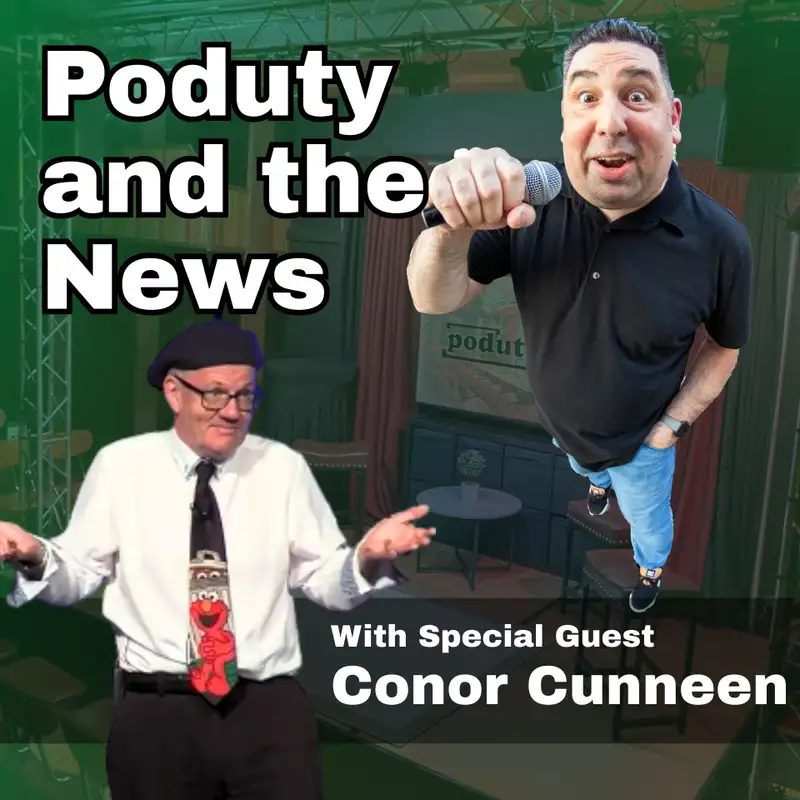
Hey everybody, welcome to the Poduty Live Podcast Theater. I'm your host, Jeff Ravella. I've
got an amazing guest joining me on Valentine's Day, Conor
Cunneen. Welcome to the show. Hey, delighted to be with you,
Jeff. Delighted to be with you, and happy Valentine's Day to you and
all of the people watching. Oh yes, thank you so much. This is
a live news show about live podcasting, recorded live. Conor and I are
going to discuss 6 stories about live podcasting I
only have one question for Conor. Do you know what time it is?
I do. And you know what, on my voicemail I say
it is 5 o'clock somewhere, and I think that's a good
way to approach the day.
What time is it?
Poduty and the News. Poduty and
the News. The only live news podcast about podcasting
from the stage.
Poduty
and the News. Poduty and the News.
The only live news podcast about podcasting from
the stage.
The only live news podcast about podcasting from the stage. And
those of you watching the show, you know that we play the theme song so
I can go from the backstage to the stage. It's the only way I can
do it when I'm here at the theater alone. I'm so glad to have
today's guest. We already wished each other Happy Valentine's Day. Conor,
welcome to the show. Delighted to be here. Actually, I love that
intro music. It's really kind of bright and poppy and
full of life and great energy, which is what your show is all about.
Anyway, so kudos to you. Well, what you didn't see is I
forgot my notes. I had to run to the stage 3 times to get up
here, so I'm a little bit winded right now. Uh, Conor,
the Irishman Speaks, that's kind of like your tagline. Irishman Speaks,
Conor Keneen. Tell me a little bit about that name. How did, how did you
become Irishman Speaks? Well, I developed this
fake accent and Brogue Jeff. And then I
said I would go with the Irishman Speaks kind of
nomenclature as well. But essentially what I do is I speak a
lot to associations and corporations to improve their people performance
and productivity with a smile. The Irish
experience, the Irish brogue is obviously part of my
branding. And after a couple of years of doing it, I've just been
just Conor Cunneen. I keep talking about having an appropriate
brand and brand name, and suddenly Irishman Speaks popped
up. I checked it, the website was available, etc. So
it's now Irishman Speaks, uh, Conor Cunneen. Irishman
Speaks, I love the name. I was thinking of all the backstories that could have
went into developing that name. Sometimes, you know, there's that chicken and the egg.
Maybe you came up with the idea, but obviously you are Irish, so
that part makes sense. But You know, he was the Irishman Speaks. Let's
listen to the Irishman Speaks. Dead right. I mean,
it's something I've worked really hard on. So all
over the interweb, we've got that branding,
Irishman Speaks, and it helps me to differentiate
myself in a business that is difficult to differentiate yourself in.
Yeah, sometimes with guests I spend, you know, 20, 30 minutes just
trying to find something on them. But because you have that branding
established, you came up 1,000 times right
away. You know, doing the research on you was super easy. That— you're right,
that little, little bit that comes before your name sometimes, or
whenever you do an appearance and you put in Irishman Speaks, I
mean, you really control that. You own that conversation, that keyword,
and it's a phenomenal strategy. Yeah. And you know, as you
reference that, I do say that my goal is to be all
over the web like a rash, um, because
you— it's, uh, it's important obviously for business booking, etc. So
I'm obviously creating a great rash all over the web at the
moment. I hope it's curable, you know, maybe it's
not like impetigo or MRSA or something. The itch
isn't too bad. And
that, what we're talking about here, just goofing around a little bit, having a good
time, Part of your strategy in approaching sales and
business is about that human side of it, about
bringing comedy and laughter and being, you know, being in the
moment and just enjoying each other's company.
And that's the way I think you say to build rapport and to
build trust is through laughter. Yeah, absolutely. I mean,
I speak to business audiences primarily and also
oncology and healthcare because I've had two bouts of cancer over the
the years. So good stories, well-researched. But
how do you connect better with your audiences? And one of the ways— and
neuroscience defines this well, Jeff— is that if you can
put a smile on your audience's face or on your prospect's face,
you're generating the dopamine and the little feel-good
chemicals in the brain that helps to build connections.
So in each of my presentations, and depending whether
it's business or whether it's just a pure motivational one, I do
make an effort to add that humor. Now, you mentioned a
word there that could be a death knell for me. I think I'm a funny
guy a lot of the time, but I am not a comedian. And
when I'm speaking to or pitching myself to event planners or to business
planners, I do not want to position myself as a comedian
because that is a different skill set which I I don't have them
funny, but comedians hard work and getting them laughing, laughing,
laughing all the time. But I can put a smile on people's face. I can
put a laugh in their face from time to time. But it's based on
reinforcing messages that I have.
So that's basically the kind of position that I go with. A good business
sense supported by humor to reinforce
the message. But one of the things that I've noticed when people were—
when I was watching your talks online is people are so bought
in, and you're doing these storylines where
they're laughing and you're telling stories, and the audiences, they're just
so invested through this element of storytelling and
humor for you to get your points across. And I think
that's really what you're touching on, is that humor really
makes you human. It really does.
There's no doubt about it. Neuroscience confirms this. Humor
builds connection. I actually refer to it as the, the Walt
effect, and you'll see how we know who the most famous
Walt in the world is. I can't necessarily reference the company,
but what humor does though is it builds warmth,
approachability, likability, and trust. W-A-L-T.
And if you as a presenter, as a podcaster,
can once or twice put smile on your audience's face,
you're going to connect better with them. And I know you can do it,
but people who think that I'm not funny, I'm
saying you don't have to be funny to be funny. Just capture the
humor that you see around you. If you were on a podcast last week
and someone made a funny comment that you laughed at, it's quite likely you
might be able to replay that at the next podcast you're doing.
Or you made a comment that someone laughed at, it's quite likely you can replay
that as well. So what I say is don't necessarily try and create
humor, just capture the humor that you see around you, which is
what most of the, the good professional comics do
essentially. But each of us can do it as well if we do it in
a deliberate, intentional way. Yeah, very
awesome. I will have all of Conor's links in the show notes.
Go ahead and go down, scroll down right now, click the links, go over, see
Irishman Speaks, Conor Keneen, are you ready for our
first story? Let's go, my brother. Let's go.
Well, we're going World Cup energy here. Live mic is ready. This
comes to us from KHOU. Men in Blazers is
bringing its live podcast to Houston ahead of the FIFA World
Cup. And this is exactly what I mean when I say podcasting is becoming
part of the main event. Roger Bennett is leaning— is teaming
up with the Houston World Cup host committee to do a show at
Rice University just 99 days before Kickoff with
guests like J.J. Watt and other Houston sports icons.
Think about that. A podcast is not just covering the World Cup. It is
helping kick off the celebration in one of the host cities.
This is what happens when a show builds a real brand, becomes a
part of the cultural moment, and not just commentary after
the fact. And we see a ton of sports podcasts
really attaching. And we've been using the word piggybacking to main events where
If there's something happening, those podcasts are showing up before, during,
and after that event to record live, to
interview some of the people involved in it, and just bring the community together
to watch the live show. This is one of the things we talk about, bringing
the community together and going where your community already is. I
don't think there's a better way to bridge, you know, your audience and your
content than to just go where they're at. So I completely
agree with that. I mean, Bennett has been able to create a kind of a
particular niche for himself, a guy from England
who is able to talk humorously about soccer.
And I think he's created a great audience on
that. Interestingly, J.J. Watt, who is one of his guests
there, obviously a football icon here in the United States. But
if I remember correctly, I think he's heavily involved and has
invested in Burnley, B-U-R-N-L-E-Y Soccer
Club. In the UK. I'm open to correction on that,
but I think that's the team that he's involved with. Yes,
I was wondering because, you know, the football, football, you know, the way Americans
call football and the rest of the world calls it football. But I was
thinking the same exact thing. He is a minority owner in
a football club in Ireland. Yeah, in
England. Yeah, in England. Yeah, he is. Yeah. Yeah.
Bennett has been able to capture a really good audience with
his programming. Good content, but actually
a bit like what I'm trying to do as well. And he also brings a
lot of humor to his presentations. He's a bit more over the
top. I try to make sure my humor is reinforcing a particular point, but
he's just a funny guy talking about a sport that he loves in
a way that connects well with people. Yeah, he's a Houston
icon. This event is happening in Houston. And
they're talking about something that he's a part owner in, he gets to get up
on stage and he's going to humanize that experience of owning a team,
working with the players, you know, all the things that are involved with
owning your own team that you don't even think about. He gets to tell those
inside stories and share his insights with the fans who are
showing up. Yeah, and that really is what the fans want.
I mean, they want to get those little nuggets that they wouldn't
normally get. And it's interesting, the number of US
football players and personalities that are now getting involved in
the English soccer scene. I mean, Tom Brady is an investor in Birmingham,
who are in the League One. Wrexham, the
TV series, you're familiar with that, but Ryan Reynolds and Rob
McElhenney are heavily involved in that. And they've been able to create a
huge audience by actually— what they do, Jeff, I think with
their— it's kind of the name of the show, it's Wrexham or whatever its
title is. But what they do is that don't concentrate so much on the
soccer aspect of it. They concentrate on the social aspect
of it and how the success of the football team has actually
impacted positively the whole Wrexham community. So it's a good
social documentary as much as a sports one.
And I think that's a kind of a secret for podcasters. Can you bring
a level of human empathy,
community to your podcast that will help you to connect even better
with your audience. Yeah, I love that, that connection, that
community, humanizing. There's that word again of,
you know, these are American actors and sports players who are buying into
sports that they may or may not have known their whole lives or
just gotten into later in life. And they're now purchasing
ownership stakes in it. And you're right, they're not telling,
you know, or they're not so much focused on the sports as much as everything
else around it that they can share and be there 24/7
instead of just during game time. Yeah, absolutely. And you know, it
doesn't always work out well because let me do something here.
I'm a big Manchester United fan. Okay. All right.
I bleed Man United red. They were taken over by the Glazers, which
is an American family, about 20 years ago, and they've sucked the life
out of Manchester United. They are absolutely
despised by every single United fan across the world. But they're an
example of an investors that came in
just to make money out of the club.
They're guys like Ryan Reynolds, Michael Henney, JJ
Watt, etc. I think they are actually involved because they love it. Hopefully
it'll be a good investment for them. But at the end of the day, it's
their love for the game and the club that has got them investing in it.
Very nice. And let's keep it moving. We're going to go to more investment.
The Culture On Stage just comes to us from NRF. Ulta
Beauty CEO Kesha Steelman joined the Retail Gets
Real podcast live from NRF 2026 in New
York City, and this is a great example of leadership happening in
public. Instead of a press release, she stepped onto a live
podcast stage to talk about culture, opportunity, and
how AI should enhance human connection, not replace
it. She shared her journey from the sales floor to the C-suite and
explained how Ulta builds performance through people
first. This is what live podcasting does at its best.
It humanizes leadership. It lets customers, employees, and
partners hear directly from the decision makers in a
real moment, not a polished ad. I used to talk
about 20 years ago, you'd have to subscribe to like a trade
publication. They would host an event, a
writer would cover that event, maybe do an interview, and then 6
months later that article would get released in that trade publication
and everybody involved in that industry would get to hear it. But now,
through these live events and through the speed at which podcasting can deliver
the news, you're getting these immersive events in almost
in real time. They may have this interview, have this Q&A,
this panel on stage, recorded as an episode of their podcast,
and release it to the public before many of the attendees
even get back to their homes. So this is something I love as far
as really showing what your company is about,
showing what your progress that you want to make over the next
year is going to be, and then delivering that information to people
almost in real time. I think what she is
showing is that she's totally aware of the various media
options that are out there to get her message across.
I don't know when was the last time you actually watched a television commercial. Because
what we do is we record everything and we just flick through the
television commercials. And the only time I watched television commercials in the
last 6 months, I'd say, was the Super Bowl,
and most of those just left me kind of, eh, anyway.
So you've got to find ways to be able to connect with your audience, and
obviously podcasting is one of those. I haven't
heard her particular podcast, but she's obviously a very accomplished
leader given where she's got, she's got to. So I'm sure she's able to get
her message across very well, and they will be able to target
the podcasts she goes on that are suitable for her audience.
So it's obviously a very sound media strategy by
Ulta, which is generally a very successful
business. Yeah, I actually pay extra. I mean, I'm in marketing. I've been in
marketing for 15, 20 years now, and I pay
extra on all my apps to not get commercials.
Little inside baseball. And you're right, people don't want to sit
through these curated, perfect crafted moments. They
want to see the real story. They want to hear from the real people who
are making it happen. And events like this are only growing in
popularity because people want to be there. They want to hear these
stories. Yeah, absolutely. No, I am intrigued as how
she might actually claim that AI should enhance human
connection, not replace it. I have yet to see any convincing
arguments that AI will improve human connection. I mean, I'm a big
AI fan. I think it's fascinating what's going on. But in terms of
building and enhancing human connection, I'm—
shall we say the jury is out on that one for me. Agreed.
We're still 4 or 5 years away before I think we'll start to see
meaningful customer service experiences. And then
maybe we'll start to see these other tasks happening. There's some other
things that just happened in the past couple of weeks, whether you've been following
OpenClaw, they've been turning agents
loose. So, we're going to see how that unfolds in the next month.
Was that a good idea or not a good idea? Yeah. Well, the
other thing that people talk about AI enhancing productivity, I'm involved
in a speaker mastermind group where we all get together.
And one of the guys, every single meeting we come on to, he comes
up with a new idea on AI, which is
happening every day. So, Actually, at the last meeting, I suggested— his name is Jim—
I said, I suggest that Jim should be banned from this meeting.
Because what he does is he comes on to the meeting, tells us the latest,
newest thing on AI. So for the next week, we spend our time looking
at the latest, newest thing on AI. And we just get the hang of it
until the next meeting where Jim comes on with the latest, newest thing on AI
again. He's a productivity destroyer, not a productivity
improver. Is what I think. One of the
things that we're seeing with AI is the thing that it's really good at
replacing is the top-level executives who are,
you know, reading reports, analyzing reports, analyzing spreadsheets.
AI seems to be doing that stuff really, really well, but those
top-level C-suite people are the ones making the decisions on whether to use
AI. So the AI may run into a roadblock
because C-suites aren't going to put themselves out of a job.
That is true. And I think honestly,
maybe the Elon Musks of this world, because I mean, I'm not a fan of
his, but the guy is obviously a genius and he can see 20 years into
the future. Maybe he has an idea what's going to happen in
10 years' time, or Sam Altman has. But it's—
I don't think we've got a clue what's going to happen even in the next
3 to the 6 months, the computers will take over
the world, Jeff. And I think the way to bring this back
into podcasting is there are things that you can do
if you understand the basics of what you want to do.
You can really tap into AI and build a superpower.
Conor was complimenting me on this show, all the research I
was doing, the theme song, and even some
of the editing and the distribution is done. I use AI. To run a
one-man show, to do this show 2 times a week. So things like
that, you know, I want to perform live, I want to bring this show to
the people, but I don't have a budget to hire a staff of 10. So
I'm able to tap into AI to build something that we can kind of make
a human experience between Conor and I and the audience. And we're
able to do something that I couldn't do 10 years ago. You know,
I'm able to tap into these tools to build something
bigger than myself. And I think that's where AI is really strong
at right now, is these small little tasks to help you build something
bigger or to really enhance your knowledge on something.
I think that is correct. But it's also based though on having the right
premise. And you said you were in marketing. My background is marketing as well. You
do understand the power of knowing your market and doing your research.
And what you have done, as I said previously, kudos to you, the research
you do on prep you do for the show, that is absolutely
critical for you. What is happening, and that is what podcasters need to
do, I think Larry King got away with just kind of not knowing anything about
the guests, but very few people can do that. What you're
doing is you know what you want to do, but you're using AI as the
tool to help you to do it. Yeah, I always
describe it as it's like having a superpower that you didn't know that you had
where you can multiply yourself and get so much
done efficiently because you have somebody who thinks like you, acts
like you, who's learned from you, you know, replicating what you can
do. Yeah, absolutely. So this is a terrible
segue, but speaking of replicating yourself, they're going on tour.
The History Class goes on tour. BBC Radio
4's You're Dead to Me is hitting the road for a full UK
live tour. And this is what long-term podcast success looks
like. This took 7 years. After 7 years of mixing history
and comedy, Greg Jenner is taking the show from the studio to
major theaters in London, Cardiff, Edinburgh, and Manchester.
This is not a small meetup. These are serious venues. What
stands out to me is that the format stays the same: expert
insight plus sharp humor. The difference is the audience is
now in the room. The shift— this is the shift we keep talking
about. When a podcast builds trust over time, live
touring becomes a natural next step, not a
risky experiment. And you know what, I was
reading that, it reminded me of a
little story that I was told when I was in school,
maybe 5th, 6th grade, I was probably 10 or
11 at the time, and it was about St. Patrick,
and St. Patrick was a
young kid in Wales or Scotland, I'm not sure which.
He was actually captured by roving bandits who
lived in Ireland and brought to Ireland for a number of years. And the
guy, he escaped, came back to Ireland then as a priest later on.
But the guy who brought him to Ireland was a guy who was known as
Niall of the Nine Hostages. Now, why do I
remember Niall of the Nine Hostages? The reason why I remember that St.
Patrick was brought to Ireland by Niall of the Nine Hostages is that Brother
Flaherty— I can still remember his name— the Christian brother told us that it
wasn't actually Niall of the Nine Hostages that brought him to Ireland, it was
Niall of the Nine Sausages. And we all thought, my God, that
is so funny. But 50 years
later, it's still sticking with me, that little message. And
I hadn't actually thought of that anecdote until
you were talking about this little concept here. And I said, wow. But
that's just an example of good, solid
messaging reinforced by a little bit of humor that
improves retention. Think about all those history lessons
you sat through in high school. They were dry, they were
fact-oriented, and the example you're giving,
you remember that because of the humor. And we're seeing people
who didn't like history during high school or college
falling in love with history podcasts because of the, the way they're
being told, the, the alliterations, the, the funny
aspects that they're tying in, even maybe sometimes the current events.
You see history repeating itself, and audiences in droves are
going towards these history podcasts. And, and this is proof that they're
doing a 4-city tour they're filling up theaters
just talking about history. You never would have dreamt about that while
sitting in high school history class. That is so true.
I'm a big history buff myself, I got to say, but I think where these
particular programs that connect well is, you mentioned the word that a lot of
history was dry, but if you can bring good
storytelling to the history, that's
what makes it memorable. You know, you don't mess around with the facts,
but you can actually convey your messaging via story rather
than line 1, line 2, line 3, etc. And again, it's about
building connection and empathy with the audience, which is critical
for everyone as a podcaster. It's
the best way to build connection, is applying
something that you're familiar with, which a lot of people are familiar with current events,
to these great stories throughout history, and you're telling
jokes, you're bringing those stories to life in a way that modern people understand,
and they're just falling in love with the storytelling, they're falling in love with the
host, the jokes, the way that the stories come together, and
it's probably something a lot of people who love this history podcast are
looking forward to every week, week after week. Yeah,
and I think the British are good at
what we call it dry humor or that kind of comedy
to get that message across as well. Another way to get your
message across is on Twitch. Twitch hits record. This comes to
us from the Times of India. Twitch CEO Dan Clancy
is launching the platform's first official podcast, Let's
Chat, and he's debuting it the only way Twitch knows how—
live. The first episode features NFL player and
Twitch streamer Cam Skadaboo.
And it will stream live on Twitch before rolling out to major—
Skitibo. Skitibo. And it will stream live on Twitch before rolling out to major podcast
platforms. That order matters. Live first,
replay second. This is a major platform stepping into
podcasting, but they are not abandoning what makes them strong. They
are leaning into real-time interaction and community. This is
the infinite seat theater that we talk about here at the Poduty Podcast
Theater. The audience isn't just listening, they are
participating. This is a great example of— here's a
platform, you know, Twitch is a huge live streaming platform. Live is what they do.
They do it better than anybody else. And the CEO is going
to do a recording, a live show on Twitch, and extract
that to be released as a podcast. It's another way
to bring that CEO role to the people and explain
the concepts, explain the direction that the company's moving in. And
I don't think there's a better way to, to get a one-on-one connection
than to have an interview or a podcast with the CEO. You know, the
first thing that struck me when I saw that story,
Jeff, was that the CEO, Dan Clancy, I thought
was a young Robert Plant I was looking at from Led Zeppelin
initially. But that then got me
thinking, can you imagine just going back 10,
15 years ago that the CEO of a large
organization would have long straggly hair, etc., be coming on in a t-shirt
that's half burnished or something like that. I
mean, what is happening with a lot of the
CEOs and leaders is that they are basically, I
think, trying to show more
genuine empathy with their
audience and being like the ordinary person who is watching or
listening to the show rather than kind of being a stiff white-collar,
shirt and tie, etc. The world has changed, and guys like
Clancy and others obviously being on Twitch fully appreciate that
podcasting and similar vehicles are important for
connecting with the audience. 15 years ago, you didn't know any
CEOs. You would— you never knew who ran the company, who did what.
But social media, videos, these conferences getting livestreamed
has really changed all that. Even product announcements have become a big event
for CEOs to get up on stage talk about the direction of the
company, really maybe boost shareholder value a little bit. That's probably,
you know, part of their momentum. But they are becoming the
face of the company where you didn't have that before. But now
people want to know who they're dealing with, who they're talking to, who's running the
ship. And the CEOs are becoming more and more the face of the
organization. Yeah, I mean, Steve Jobs is probably the first
famous CEO— he had a certain
personality. Jack Welch from GE was another famous CEO. He had
another personality, which I didn't think did much for
the business in general. He was just a cutthroat
guru expert. But in general, though, I think people
are beginning to understand that the CEO has got to have
communication skills. Leaders have got to have communication skills as well.
And if they're not able to look good in front of a camera
or on podcasts, I don't think you get to the top level
in organizations anymore. Yeah, I may never be a.
CEO. You look great, Jeff. Don't you worry, my man. You got good content and
you presented well and you do your research. They're critical, my
brother. Well, thank you. Thank you. You'll find me on stage. I'm going to invent
a company just so I can be the CEO. Well, a couple of
stories ago was a a podcast that took 7 years to have, uh, to
get on the road. This podcast is celebrating 10 years with
a live party. The Ask Mike Reinhold Show just
celebrated its 10th year anniversary, and they did it in the right way.
Not with a quiet post, not with a graphic on Instagram.
They hosted a live stream where fans could ask questions in real
time, announce new courses, offer discounts, and gave away
over $2,500 worth of products. This is what
I love about live podcasting. Milestones become
moments. Instead of saying thank you in a caption, they said it face to
face. And here's the bigger lesson: when you build community for
10 years, celebrating is not awkward, it is
earned. In the theater space here, we have people celebrating 1 year, 2
year, their season 1 kickoff. I've had shows on their first
episode have a party because they were recording their first episode live,
and Having some sort of milestone, some sort of reason to celebrate and bring people
together is one of the best things you can do. I can't tell you how
many times we've had like a season 1 wrap party where
there's full catering in here. We've had like full
American barbecue briskets and pulled pork and beans and corn,
and we've had full spreads where it's almost like a buffet, and
then they're going to perform their show. So having these milestones is
a great way to bring the community together and, and celebrate, you know, with
one another. There's no doubt about that, Jeff. I mean,
people want to be recognized, and if they're
on stage, I've been going for 10 years, they obviously want to create a
party there. One of the ways to do that is obviously have that 10-year party,
but also have some of their listeners and previous guests involved in
it as well. So you've got the sense of a community and
interaction going as well. Going for 10 years in this environment is pretty
good. Yeah, add in prizes, add in catering, I'm going to be there for.
Sure. As long as there's good Guinness there as well, which is not something that
is very well known here in the United States,
unfortunately. Oh, I love, I love me some Guinness. It's one of my favorite.
I hardly ever drink, but Guinness is like my go-to. I
just, there's something about it. I've never had real authentic Guinness. I
know it's completely different in Ireland, but whatever they serve in America is
pretty good. Not if you're used to the Irish. Stuff, I have
to say. Well, it's good for me,
but, uh, someday I'll have my life changed whenever I have a real Guinness in
Ireland. Like, get over there, man. You'll be made to feel very welcome. It's a
wonderfully friendly, hospitable country and
experience. I, I feel like I would never leave Ireland. Like, I would I would
just nestle in and they would have trouble getting rid of
me. We have one last story. I thought this would be a fun one to
finish out on, a little comedy, a little Lewis Black social
commentary. And he mentions in this performance, you know, he's not really
doing tours anymore. He's not really going on the road, but he loves doing
this Rantcast podcast. And this was an opportunity for him to still
get up on stage outside of the Tonight Show or
the The Jon Stewart Show, I forget which one the official name of it is,
and get on stage and perform his show in front of an audience without being
on tour. So I really love this story. Lewis Black just recorded the
first ever live version of the Rantcast at the Stand Comedy
Club in New York City, and it was sold out. Think
about that. He has done live stand-up for years, but this time the
goal was not just comedy. The goal was to record a podcast in front
of a real audience. He stepped out of his home studio and into the
packed room with a few hundred fans. That is the shift.
The podcast becomes the event, and once you sell out once,
you start to wonder how many more times can you do that
again? I mean, it's interesting that he's going down
that road. I don't know what happened to him, but he's obviously
either lost a lot of weight or he's not the same Louis Black that he
was a number of years ago, but he's obviously created
a brand and a persona where he rants, rants, rants the whole time.
And you've probably heard this, Jeff, but apparently
offstage he's the nicest, most calm guy in the world. He's just got a
stage persona there, but he comes across as the,
the ranter. I'd love to see what the reaction of the audience would be though
when he's ranting like that, because, um, I mean, Jimmy
Carr, who, the English comedian, He loves
to interact with the audience, but a lot of it is just kind of insult
comedy, which is really good, but you can feel the audience kind of
going, 'Oh, I'm afraid what he's going to say next,' kind of thing. And I
think Lewis Black might be the same when he's ranting like that
on, on stage. Do you kind of raise your hand, or if you start laughing
too much, is he going to pick you out, etc.? But it's interesting
that he's taken that concept and He's a guy
who obviously has been in the business for a long time
and knows how to stay connected with the audience. He has a great
way of delivering his frustration through
comedy. Something just really bothers him and irks him, and he's able
to just rant about it for 5, 6 minutes, and it keeps going, and
he keeps building on it, and new material all the time,
which is very impressive. And that's why you would go see a show like
this. You know that the only time you're gonna see that performance from Lewis
Black is in that moment. It's a once-in-a-lifetime
performance because he can't do that show again tomorrow. Once he
does those rants, people have already heard them. So he has to
completely reinvent himself for every episode, and a talent like
that, that's something you gotta see in the moment. I wonder, how is he able
to keep that going though for 50 minutes or 60 minutes? Just that
rant, rant, rant. Really interest me as
well, to see kind of rant a little bit, then going into more standard kind
of stand-up work, and then come back ranting again. Because I, I
gotta say, I think a 55-minute rant would not be something that would
appeal to, to me. The 3 or 4-minute rant is good.
The 34-minute rant, I'd be interested to see what,
how it works with the audience. He has to be
reading and researching all day long, every day, or he maybe even has
a team of writers that work with him now and help him put it all
together, but he still has to deliver it, he still has to know the material
and deliver it. It would be so impressive to do that every
week. Here's 50 new minutes of Lewis Black ranting.
Yeah, yeah, mind you, there's enough things messed up with the world that
you shouldn't have too much difficulty finding 50 minutes to rant about, in.
Fairness. Yeah, it's very easy with today's news. Cycle, so Isn't it
just? Yeah. Yeah. Well, Conor, I told you it goes so fast.
We're already at the end of the show. I can't tell you how much I've
enjoyed this conversation today. One last time, I'd like to turn the show
over. Plug, promote, talk about anything you'd like to talk about. The floor
is yours. Okay. Well, thank you for the time, Jeff. I do
appreciate it. The brand is Conor Cunneen, Irishman Speaks. My
mission is to improve people, performance, and productivity.
With a Smile. And I speak to
associations, organizations, healthcare, etc. And
the idea is that I will leave you with a smile on the face, with
a spring in the step, and memorable actionable takeaways to help you to keep
on keeping on and achieve whatever objectives you have got.
The promise is that you will not be bored, but you will leave with some
good content as well. So that's the Irishman Conor
Cunneen. Irishman Speaks. Awesome. I will have all those links
in the show notes. This has been so much fun. If you like kind of
what we're doing here, we're performing a live podcast live on the stage here in
the theater outside of Pittsburgh, Pennsylvania, and you may not have a
place like this in your hometown, but reach out to
bars, restaurants, libraries. There are places to perform
live podcasts and bring your community together. If that interests you at all, check
out our website poduty.com.
P-O-D-U-T-Y.com. You can also find more about me because I just
redid my website, jeffrevilla.com.
R-E-V-I-L-L-A. Check me out if you want to learn about me. A brand new website
just launched last night at like 10:30. I've been up all night working on a
new website. This has been Poduty and the News. And Conor, do
you remember what time it was? It is 5 o'clock
somewhere, my man. What time
is it? What time is
it? It's time for Poduty and the
News! Poduty and the
News, the only live news podcast
about podcasting from the state.
Poduty
and the News! Poduty and the News, the only live news Podcast
about podcasting from the stage.