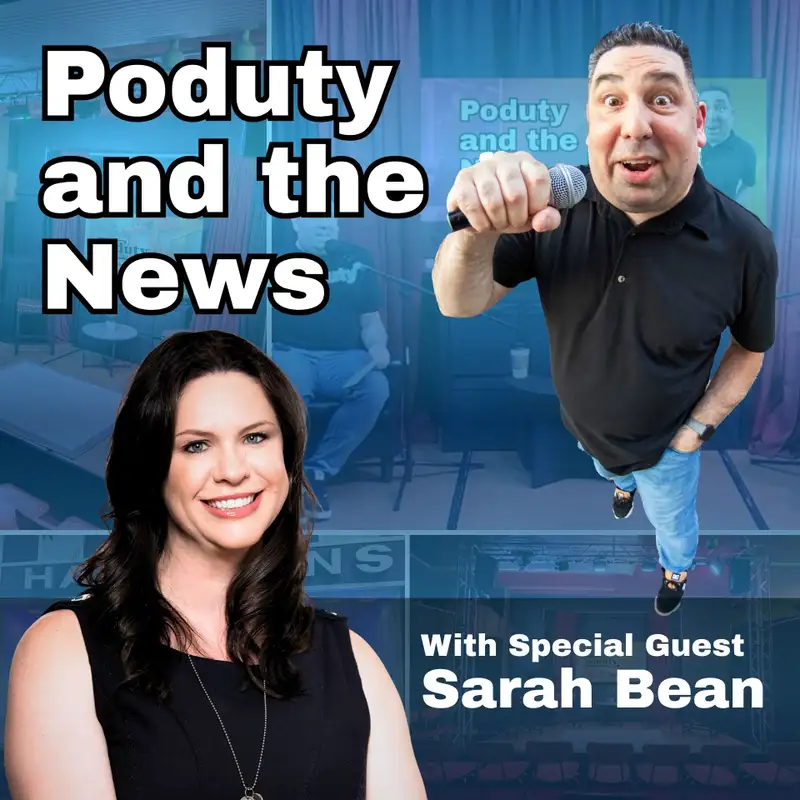
Oh, here we go, everybody. We are live at the Poduty Live Podcast Theater at
downtown Tarentum. I'm Jeff Revilla, your host for
Poduty and the News. We've got six great live stories heading your
way. Do you know what time it is? It's time
to jam out to that theme song. What time
is it?
What time is it?
Its time for
Poduty and the news. The
only live news podcast about podcasting
from the stage. The
only live news podcast about podcasting
from the stage.
Sarah, welcome to the show. Man, that theme
song just really just gets you in the mood. I need
to download that one and play it in the mornings. Well, I'll send it to
you. I do. It's kind of funny. It's like this high energy dance number
for a news show. So it cracks me up, the irony between
the two types of music. And we're having a lot of fun. We're talking about
live shows, live podcasting, and. And Sarah, you with Book Launchers,
you shared something with me before the show that was just amazing
that our guest last week, Amani, is a client of
yours and he was talking about the books that he published and the success that
he's been having. And he's one of your clients. He is.
We've been working with Imani for, oh my gosh, about eight years now
and have watched as he just built this
incredible career and all the work that he's done into the books and the
speaking, and it's been amazing to be on that journey with him.
Yeah, just, it was a great story, great to hear, and now we're going to
get it from the source from Book Launchers. Tell us a little about what
you're working on and what is Book Launchers. Yeah, absolutely. So
Book Launchers, we are a full service, self
publishing service provider. We work with nonfiction
authors to help them get their brand building business building book
out into the world. So as head of marketing and partnerships,
I work with all of our authors on their marketing strategy and I also work
with all of our great vendors and partners
to just continue to bring the latest in publishing and book
tools to our clients. So, yeah, there's Book
Launchers if people want to find more about it, connect with you.
What's the best way to get in touch with you and learn about Book Launchers?
Oh, absolutely. So definitely go to book launchers.com
to check out all of our services and you can find us at Book
Launchers on all social media channels. Definitely don't miss out on
our YouTube channel. Book launchers TV, we have Hunter
hundreds and hundreds of videos meant to help get your
book out into the world, building audiences and finding your
readers. Awesome. And as you know, anybody who comes on
the show, we have a crew page, Piduti. And the crew is
guests who have been on Padoodi in the news. And we have all the links,
all the bio information you can connect with Sarah right on that crew
page. So whenever the show comes out, go to news.poduty.com
find Sarah's profile. It'll be attached to this episode. But you all those
links, all those connection will be right there for you to make sure that you
can connect with Sarah, whether it's coming up after this episode or whenever
you're ready to launch your own book. Absolutely. I welcome that.
Please reach out to us at team@booklaunchers.com
if you have any questions about our services or how we work with
authors. Sarah, are you ready
for for our first story? Please, let's dive in. I'm
excited. Here we go. We have a book tour going on and we've
seen this a couple times where authors who maybe used to go on
morning radio shows or do interviews with local newspapers,
they're now taking their book on a road tour and they're doing
podcast tours. And this is a great example of getting out in front
of people and doing tours. And I know it's a lot of things that Sarah
will talk about here, but the Harvard Bookstore presented Mike Shore and
Joe Piznanski at the Brattle Theater for a
live discussion about their new book, Big Fan Two
Friends, 82,490 Miles and
the Wild Wonderful Sports we love. The conversation
featured sports writer Howard Bryant and tickets included
admission, plus a pre signed hard copy of the book.
Big Fan explores sports fandom and shared experiences through stories
involving everything from Wrestlemania and darts
to football, chess, pickleball and Taylor Swift
fandom. That is a lot to pack
into one live show. And, you know, it's great to learn that Mike Shore
has a new book out. Mike Shore, I don't know if you're familiar, was one
of the executives that was behind the Office on NBC
years ago. Great legendary comedy writer.
So really fun to see him doing a live event around his
book on all sorts of topics that I had no idea he was interested in.
Yeah, and a great way to really promote and get to the audience. A lot
of times we try to say go to where your audience already is. If you
don't know where to find them and you're an author, there's probably People
who like what you do at a bookstore. And so they're hitting all these bookstores
on the road, going town to town, connecting with local community people
and doing Q&As, doing small shows, small meet and
greets, and they're going where the audience is. And I think that's just a great
tip, especially for smaller podcasts. Absolutely. And I think,
you know, one of the key elements of what, you know, Mike Shore
did there is that he's partnering with the Harvard bookstore, which already
has a really big audience, already has a lot of
people that are just interested in different types of topics, interested in different types
of books. So partnering with a store like that is going to
automatically bring in people that maybe wouldn't have looked at the book
otherwise, which is great. But those live shows,
being able to go around and meet your audience exactly
where they live is a great way to get in front of new
readers. Yeah. Not only what a great bookstore, but the
credibility that comes with being at the Harvard bookstore,
putting that on your resume, on your website, as kind of building
that social graph of your appearances and where you've been and who you're connected
with, that's a pretty heavy hitter in the bookstore world.
Going to the Harvard bookstore. Oh, absolutely. That's one of the best,
you know, especially on the east coast, because they have just, they're so plugged
into the community and what their readers are actually looking for, what their
patrons are looking for. It's not going to be right for every single book,
every single podcast out there, but that is a great audience
for, for that one in particular.
Yeah, let's keep it moving because the same type of energy and almost in a
digital format as well. And this in person idea,
combining digital with in person events, as group communities,
as networking events within a community, and this comes to us from
the agent, efficiency and writer Thon Pham says the
rise of AI is rapidly changing the value of digital content and
live experiences. In his article, he explains how blog
posts, email campaigns, summaries and online educational content
can now be created at massive scale and a low cost
using AI tools. He contrasts that with in person
workshops, live sessions, which still require travel coordination,
facilitation and real time interaction. Pham argues that
workshops, live feedback and shared experiences are becoming
more valuable because they cannot easily be automated
or replicated. Absolutely. I
absolutely love this story and what's happening here
because one of the biggest things that wasn't mentioned in the story, but I think
is a big driver behind it, is trust. Right.
There's so Much content out there that is automated. Now from,
you know, what you see out on social media to blog posts, you know, all
sorts of things can be automated with the use of AI. And that's a great
thing. AI is an incredible tool to be able to use, but it cannot
replicate the trust that an end
user has to be able to build before they buy a book or listen to
a podcast or otherwise. And so in person
events, workshops, opportunities where an author
or a podcaster is able to look their ideal person in
the face and build that energy, build that
trust. That's where you see the magic happen. That's where you
really start to see audiences reacting to your content.
So I can absolutely see where AI is going to help you
automate those in person events are going to build the trust that you can't
replicate otherwise. Yeah. And as AI
grows and develops into whatever it's going to become,
the one reference it does make in this is that barrier to
entry. The cost of creating is becoming lower and lower
almost where content creation becomes commoditized, which
isn't a problem if you're creating something in your own
voice. And I think that's what's important about these in person events where
you're leading sessions, you're having discussions.
That's something that cannot be recreated with AI.
You have to be in the room to get that experience. You have to be
in the room to have that person to person connection, to
have those one on one chats. You can't get that with just
regurgitated AI content. And you're creating something
new that's never been in the world before. It's the first time ever it's been
presented is when you present it at your conference or your workshop.
That's something that they'll never put on stage as a, you know,
nobody wants to go see an AI speaker, right? I know,
I know. And think about it. Whenever you have sat in the audience of
someone maybe you haven't heard of before, but you know, maybe
you're on a conference or you're, you're at a live event and you hear someone
speak, speak and you connect to something that they have, have
reiterated from stage. How many times have you gone then and
bought their book or looked up their show or started following them on social
media, whereas in otherwise you made us, you might have skipped them all together.
If you just saw their name online, you know, there's nothing grabbing
there. But if you see them in person and you actually hear them
speak and feel that energy, you have something to connect with.
And there's so much more follow through from the audience when they hear you speak
live. Absolutely. And when we talk about live events, we
always hit on that. That you can't recreate that experience
from a downloaded MP3 file. Even with podcasting, you can
feel like you're in the room and part of that conversation, but you
don't ever have that connection that you would have if you were sitting right here
in front of me at the theater watching me talk with Sarah. Sarah's
answers, even she'd be up on the big screen here. You feel like
you're talking to both of us in real time. You can't get that just
passively listening to audio on your morning commute. You
being in the room makes it, it elevates it, makes it something
bigger than it will. Will be on just an MP3 file.
Absolutely. It just makes you part of that experience. I mean, I think people listen
to podcasts or they buy books because, you know, they need information,
they're taking in information. Whereas when you're in a live event, you're sitting
in that audience, you become part of really
changes the way you, you bring in any of that information.
So, yeah, I mean, I think this, this article really, you know, sort of
nailed that. And speaking of bringing in, Book Con
is bringing in a sold out show in New York City
for the first time in six years. The sold out event was at the
Javits Center. The convention featured live panels, book
signings, podcast tapings and fan events, including
a fantasy ball. Authors appearing throughout the weekend
included Veronica Roth, R.F. kwang,
Jody Picolt, Jasmine Guillory and
Riley Sager. One feature conversation brought together
author Rachel Reed and television creator Jacob
Tierney to discuss adapting heated rivalry and into a
television series and the process of translating the
story from page to screen.
I got to say I was so excited to talk about Book Con. I didn't
get to go. I wish that I had. I mean, from everyone
that I know that attended, it was an absolutely phenomenal event.
I think that the success of bookcon
from this year really shows how readers have shifted. I mean, Book Con
didn't happen for a while because, you know, people weren't really
sure that there were going to be an attendees. And now in this new
time that we have, people are coming back around to wanting books to
be a multi platform experience.
It's not enough just to read it anymore. They want to engage,
they want to connect with fellow readers. They want to learn the behind
the scenes, they want to get all the swag and all the different
editions of those books that they can, so that they can really,
really continue to experience the enjoyment, you know, to
experience what they did the first time they read it. And so it's interesting
that a lot of those authors that you mentioned are all from, you know, Veronica
Roth is, you know, obviously, you know, kind of fantasy,
Rachel Reed romance, you know, and a handful of those others.
It is a different experience between fiction and nonfiction.
But I know bookcon was very, very heavy on the fiction. And those
fan experiences are taking over. How many cities do you
know around the country that had heated rivalry
raves or, you know, club nights or whatever?
People want to take that experience from the page or the screen and they want
it in their real life. So this goes back to what we were talking about
with that last event. Again, that live experience feeling can't be replicated.
Yeah. And live events are back. Like you're mentioning. Book con hasn't happened in
six years because of, you know, things that have happened over the last six years.
But being back, people are craving
in person events. They're craving getting together with people who
have like, interests, who talk about the same things that they do, who, who
share passions and, you know, people who want to read and talk,
talk about books. Here's a whole place to do that. It's. It's a place for
authors, for fans of fiction to go and
hang out and share books and talk about things that they're. They're working on,
things that they're reading. And absolutely, you can't do that where else you
can't do that online. You have to be in person. And
events like this are just a great way to connect those fans. I mean, and
you think about it, I mean, part of the reason what happened six years ago,
Covid, right. We all got locked down. We all got put
into our isolated, isolated little bubbles with only zoom to connect
us. Now that the world has opened back up again, we're seeing live
events just take over because people want to experience things in the
real world. So I think what we're seeing is
a continued build, an increase in interest in these
fan events. And not just the fan events, but what you can build
around a book, Right. It's not just reading on the page
now. It is all the things that you can do with it.
And that's what, you know, is some of the most fun that I have in
my job is helping authors determine what are those things that they can build around
the book that are going to continue to keep their readers coming back again
and again. Yeah, and ironically, I really
think that this push for AI into everything
is really fueling this surge of in person events. Like
we've had, stores have been open, the states have been open for
four years after Covid, but it really didn't ramp up. But
in the last two years with AI into everything and you got to use
AI for this, your job. Once you use AI, use AI here, your phone
now has. You turn on the tv, it's got, you got to do an AI
search now. Like people are like, I just want to talk to
somebody. I want to be people. Yeah. And I really
think that this AI push is really putting people
back together again. It's pulling us together because we're just
craving, we're tired of doom scrolling at home all night
and, and just waiting for the phone to tell us what to do. We're like,
this is enough. I really think this is pushing that line to how
far can they take it? And I think this is why we're
seeing such a surge in in person events. I believe it. I mean, I
think too that AI, you know, when used appropriately
or used, you know, to help your business or aid what you're doing, it's
supposed to help you save time and energy. Right. It makes things that used to
take hours to do, it can shorten that down into minutes. Well, what
do you do with those extra minutes now that you have? You can go connect,
you can go out into the real, you can, you can do more things because
you weren't spending hours on the things that you used
to. So, you know, it's like, what do we do with our time? We go
out and we connect with the real world. Yeah. And I'm not shaming
AI. I was telling Sarah this is a one person show and
I'm reading, going through a thousand articles, I'm producing. Sarah
got nine pages of show notes. I
can't do that by myself. I work a full time job, I got a family
and you know, I'm supplementing some of the things that would take a
team of 10 people to put the show together. And, and that's okay because
it's the part of the show is the live element, the entertainment. Sarah and
I getting together and sharing these ideas with people who are watching and
listening. You know, that's, we're about the performance and
that's, that's something that's possible because of AI, we're able to
perform live. But you know, I'm not shaming it, but it's also,
it's also a reason why I Think we're seeing a big push towards live events.
Absolutely. Absolutely. I mean, you telling me about how you're combing through
thousands of potential news articles and headlines
to identify the best ones. I mean, without AI, that process would take
you so, so long. So I'm grateful because you picked
some great ones. Talk to talk with me about. Yeah. AI and a lot of.
A lot of keyword filtering in that. Yeah. Right.
Well, one of my favorite types of stories to show are ones
where it's from an industry I would never expect
had a podcast. And we filed this under industries. I never
expected to have a podcast. This comes from Aviation Week. And
Aviation Week recorded a live episode of its mro podcast
during MRO Americas 2026 in
Orlando. The panel featured editors and analysts discussing
highlights from the convention floor, including artificial intelligence,
workforce development, supply chain concerns, aircraft
maintenance trends, and geopolitical issues affecting aviation.
The live recording took place in front of attendees directly at the event
and was later distributed as a podcast content through
streaming platforms. Yeah, what I
really love about podcasts that do a live show
at a conference or something is. I mean, it gives them so much more flexibility.
Right. Podcasters can put together a show
in a live scenario where they're going to get guests that otherwise
would have probably been a nightmare to try and all schedule at the same time.
So they're able to do it at a conference where they're all present. Do it
at a live show where, again, a podcaster is going to be able to directly
interact with that audience in real time, get real questions,
understand what people are actually taking away from that content
that, you know, if you just record an episode and put it out, you don't
you. There's still a barrier between you and the audience.
So being able to do this in a live situation just
enables you to enrich the content. You're bringing so much more.
Yeah, and a benefit of performing live is you're going to get a recording,
and that recording can be repurposed throughout the year.
And if you're the conference owner, if you're running
MRO and you have all this great content you created at the one event,
you can start to use that to ramp up promotion for next year.
This is what you missed out. Don't miss out on this next year. Here's a
sneak peek of what you missed. And even the podcast, they're going to
release that content over weeks or months following the show.
So that one week at the conference, they spent three or four days.
They may have developed a quarter or two quarters worth of content
for the year. So think of that one stop
shop for going where the people are. Right. All your
aviation fans are at mro. You're going to connect with them and
then have content for six months. Absolutely. And
what I love about that as well is the. The people that guested
on it can also use that content. That's one of the things with authors
that I'm constantly talking with them about is when you're a guest on a podcast,
how can you then repurpose that information? That's content for
you, not just for the host, but for that guest. That guest can turn
that into blog content that you can use those videos, use those images,
and to be able to build further association between your name and that
topic. So, you know, in addition to the show
being able to, you know, bank great content they can use for months
for the guest, it just becomes, you know, more gold. Content gold for them
as well. Yeah, and I kind of referenced on earlier, and I feel
like I'm just quoting Jason Bernard of Calicube is, you know, building those
social profiles because we are in a. We're talking about AI again. We're in a
time where AI is hungry for information. It's
gathering everything it can. And when you do make these appearances,
whether you're on the stage at mro, whether you're at the Harvard Bookstore,
you need to start putting those somewhere where AI can find it and
associate that event with you. So you should have your own website.
If you're just say you're attending a conference and I'm
jeffrevilla.com, you can go to my site and see my appearances, see
what podcasts I've been on, what stages I've presented on.
That's all there. And it's associated with my domain, associated with
my name. So this podcast, I was at the MRO
conference, they should have their own site, their own landing page,
giving those signals of who they are in the industry, what are they doing
in the industry, who are they connected with, what connections do they
have? And all that starts to get picked up and sucked up. And Jason
Bernard called it like a child who's thirsty for knowledge. That's kind of what
AI is right now. It's gathering everything it possibly can
and learning everything it possibly can about you. Absolutely.
I'm so glad you brought that up because you know how it
starts to gather this, what they call information gain. Right.
AI is constantly looking for information gain by looking
for the current trends. What's happening now? What are people talking about
now they're not looking at a website from five years ago. They're looking at
websites that update consistently. The other
thing that is really valuable, both from, you know, either the
MRO show or for the Harvard Bookstore,
is that AI gives weight to peer
peer relations, meaning MRO is going to indicate that
any of the guests that were on that podcast have weight. MRO as
a peer industry conference or group
is going to have higher weight in the. I.
Excuse me, in the eyes of AI. Try and say that.
Eyes of AI. So,
Right, exactly. And so AI is looking to see, as
it is starting to determine whether or not you as an author or as
a podcaster are authority. They're going to look to see who are the
credible sources that are validating that person.
Meaning, okay, that person was, was at the Harvard Bookstore.
We know that that bookstore is one of the industry best and is well
respected. That speaker was at the MRO event. That
event is well respected within that industry. So it's giving weight
to where you have been. So you need to use it effectively
on your website, on your socials, in ways that are machine readable.
If you have all that content behind a paywall, something that the machine
can't grab onto, it's not going to do you any good. You have to have
it so that the LLMs can grab what they need to understand
who you are and what you talk about. Yeah,
I guess it won't matter behind a paywall whenever they crack all the
encryption. But,
but yeah, it has make things accessible, make your
appearances accessible. If, if you performed on
stage and it's not published somewhere online on your website
somewhere, then the AI will never know that. It'll never know what
happened in real life. So that's one of the reasons you want to document
and log these things, is so that its association
is, is with your name with these events. And AI
starts to pick all that up and, and put, pull these things together
and tell people, hey, okay, well this person knows what they're doing. They've been on,
you know, 15 stages and 23 events. This, this could be
a credible source. Exactly, exactly. And if you do
become a credible source, you could go to the KUT Festival.
Kut.org and I think this is in Austin.
That took place on May 1st and 2nd at the University of Texas
as a multi day celebration of ideas, music, media
and community. The event featured live conversations,
performances, author talks and family programming with
guests including Adrian Mishler, Shaky Graves,
Senator Cory Booker and representative Michael McCall.
The festival included both free and ticketed events along
with activities like the KUT Festival, Street Fair, Texas
Book Talks tent, and the KUT for Kids program.
Maybe it's K-U-T. I don't know if they say Cut for Kids,
but this was a great little festival that happened. I know there was some
logistics issues with it, but what a way to
bring the community together, people of Texas together, authors,
and put them on a stage and share some ideas on a college campus.
I mean, it really reminds me of what TED is and tedx. Right.
Those are ideas we're spreading. Those are events that are meant
to put people together to spread ideas and not
agendas. Right. TEDx is all about
spreading community ideas that we can all share
and unite in. And that's kind of what this event sounds
like, although on a much wider scale between the author events and
things that are for the family, sometimes those can be hard to blend. So
it is. I would love to have attended something like that.
I don't know all of the speakers that were there. Obviously, I'm familiar with Cory
Booker and some of the representatives. But what you also want
to look at is when you're doing events like this, who's going to
be in the audience and what are they going to gravitate towards the most?
What are the things? Is it parents bringing their kids out because they're hoping
there's a craft area? Is it, you know, college students
are coming out because they want to learn new ideas? Is it intellectuals,
Academics? You know, it sounds like a pretty wide variety of
attendees there. Yeah. And another reason I chose
this story was we're talking about all these events around the country in different
spots. But this isn't as big as some of the other events.
There's things that happen in your community, even locally. You may not have
a small theater space like we have here. You may not have the
Harvard Bookstore in your hometown. But there's other things
that are happening, and there's probably things that are associated
with what your passion is. If you're writing books on a certain topic,
there's probably an event somewhere in your community about that topic. If
you're a podcaster and you're doing, like I do, quirky
game shows when I'm not doing this show and, you know, there's
probably, maybe even I could fit into a sporting event somewhere as an opening
act to warm up the crowd or libraries love having content come
in. They. They have media spaces and stages, coffee
shops. There are places that are smaller, that aren't these
mainstream places that you can start taking your show out. You could
do a Meet and greet as an author just at your local coffee shop.
Oh, absolutely. And I think regardless of, you know,
no matter what your topic is, just like with podcasts, there is an association
or a group for everything. There is a podcast for everything.
There is a meetup group for everything. And so a lot of the
authors that I work with maybe haven't been on stages yet, haven't
done huge things to build their platform yet. And I always say start
local, start with. Who are the groups in your
area that might be interested in your topic? So, for example,
one of our authors was working on, you know, a book
that was all about, you know, sort of the origination of the. The
Constitution and what was actually meant there. And
so one of the things that we were sort of guiding them on was how
to connect with groups like the Daughters of the American Revolution who are
hugely interested in the historical fact, facts.
And so there's always a little bit of an angle in what you're talking about
and what groups in your area could be doing. Libraries,
coffee shops, all of those are going to be helpful. Farmers market,
surprisingly. Now, granted, I wouldn't go and hawk your, you know, business
development book at a. At a farmer's market, but if
your book has something to do with local information,
if it's a memoir, if it's something that can reach a general audience, that's a
great way to meet people. It's really about
identifying, okay, who's my target reader and what are the groups
that they're a part of? What are the events that they go to? Are they
going to libraries? Are they going to, you know, conferences? Are they
going to live events, and then determining how you can get in there. I
also encourage all authors network like crazy.
Go to some of these before you start pitching yourself as a speaker,
and really understand what that event organizer is looking for.
Building those relationships is going to pay off in spades.
Yeah, you never know who you're going to know, and you'll never know them if
you don't go and network. Exactly. It's like gold
mining. Not intentionally. It's just kind of
like a byproduct of making new connections and making friends.
It opens doors for you in ways that you're just not going to get
sitting at home emailing somebody or I don't know if people still pen a letter,
if you're going to pen a letter to somebody. But going to those network events,
shaking hands, even if there's only 15 people in the room, I
guarantee you one or two of those people will Become connections
that you can do something with down the road. We host monthly podcast
meetups. Sometimes we have 35, 40 people, and I don't make any
connections. Sometimes we have 15 people, and I make 10
meaningful connections. You never know
whenever you go somewhere who you're going to meet, who you're going to connect with,
and get out as much as you can. I know. I
mean, especially if you're an author, which can be a very lonely business. Right. It
can be very isolating. I know for podcasters, it can be the same because
you're spending so much time trying to develop that content.
Podcasters, you have a little bit of advantage if you're interviewing people. You get to
meet as many as possible. But with authors, it can
be a very isolated sort of
profession. And so I do encourage all of my authors. Continue
to make the relationships. Every time you do a podcast, keep in touch with that
host. You never know what that relationship
will lead to. It's important to continue to be open,
not go into it with, well, if I don't end up on their stage, I'm
never coming back to their event. Be open to the people
that you're going to meet and what might come your way. You'll be surprised at
the roads that'll lead you down. I love it. And our
last story here, I really. They're like, okay, well, what is
this? This is a WordPress plugin.
Try to say that one right? Yeah. When I read through book
launchers and what Sarah's working on and showing authors how to
bring books to market, how to build community, how to network, and
really take ownership over that process, I really love this
tool to fit into that model. And the reason
being, if you're already building your site on WordPress, maybe you're doing daily
blogs or updating your appearances. Well, now
you can also incorporate your podcast into your blog.
And it's all in one place, all on one site. So really, that
idea of taking ownership over the launch, taking ownership over the
control of your content, that's really why this just came out over the weekend.
And I was like, oh, this is a perfect little tool, little widget
to plug in if you want to build that ownership over your
content. And they just introduced us on the Jetpack
Podcast, a new tool that allows creators to publish
podcasts directly from their WordPress website. The
platform combines podcast hosting, blog publishing, and
newsletter distribution into a single system. Podcast
episodes can automatically appear on a creator's website,
email newsletter and podcast apps, including Apple Podcasts,
Spotify, Pocket Cast, YouTube, and Amazon Music
WordPress says the platform is designed to help creators maintain
ownership over their podcast feed, subscriber list, and
audience data. I love this. In
fact, when I saw this story, I immediately sent it to our digital marketing
specialist who helps build websites for all of our clients. Many of our clients who
do have podcasts, because they need to know that this is possible. I
liken this to when an author has direct
sales for their book right from their website. Right. It's not
just using one channel to distribute your content. It's that wide
distribution and being able to do things that
those other platforms might limit you with. So, again, going
along with the author analogy here,
you know, if an author sells their book through Amazon and that's the
only way they're reaching their reader, they are limited by
what that platform enables them to do. By
bringing it to their own website, being able to
directly sell to individuals from that website,
they can control the content better. They get better information about who's
listening, who's downloading, who's purchasing from them, and they're able to bring
them into a customer journey where you can upsell them and do other things with
them. I liken this exactly to what this, this new
podcasting tool will do. It's. It's going to
enable podcasters to do things that they were limited
by before, whether it's exclusive content or
it's being able to bring people into a mailing list that they never were able
to because, you know, they only had people listening through Apple podcasts
or Spotify or otherwise. So I think this is a
fantastic tool. I'm excited to see how it's going to work,
and I think it's going to give the right podcasters a lot of
freedom, you know, but it's all about how you use it.
I think there's going to be people that are implemented and then do nothing with
it. And, you know, unfortunately, that might be money left
on the table for them. So I think for the podcasters out there that have
that entrepreneurial, enterprise mindset, they're going to be able to really
do some cool stuff with this. Yeah, it's a tool, and if
you can tap into it and figure out the best way to utilize it
for your, your strategy, your goals, then
it's even better because it starts at $0. And I think there's a
paid tier that gives you a little more analytics. That's $8 a month. So
the price is cheaper than a lot of website hosting companies.
And you're hosting those files on your servers. It's your
RSS feed. Nobody can take that away from you. Yeah,
exactly. This is completely yours. And back in
the old days, before there really were podcasts, people used to handwrite their
RSS feeds, hand code it and, and update it, like, oh, here's
my file location and here's, here's the description about the
show so it can be done. And I think this was a nice little step
for, for most people to, to go to that next level
and still keep that DIY mindset, to still control
it on their own. Absolutely, absolutely. I mean, it's one of
the things that we advocate for constantly is not just building
your audience on social media, but building an email list that you
control and own and have access to.
I've seen it happen with authors where, you know, a month or two before
their launch, suddenly they have crossed some arbitrary line
they didn't know about and have lost all of their social media,
all their access to their audience. Well, if you have your
email list, if you own all of that information, then
you don't have to be worried. You don't have to be worried about being slowed
down when someone else makes those decisions. So I,
I love this tool. I'm excited to see what people do with it and I'm
excited for our team to start exploring. Yeah, it's your
feed. You own it, you want to put something into it.
Nothing's stopping you. If you want to move that you can, you have
complete control over, which is even more powerful than having
a host on your side is. You're the host,
you have complete ownership over that RSS feed. So it's something to
look into. If you want to be independent, check out this new Jetpack
plugin. Absolutely. And
Sarah, we did it. That was our last story.
This goes by so fast. I spend the
last minute, I turn the whole stage over to you and
for you to plug, promote, talk about anything you'd like.
Sarah, the floor is yours. Oh my
goodness. Well, thank you so much. It's been great talking about these
articles with you. It's been really fun to see
all of the latest things that are happening out there. If you are
interested in working on your non fiction
book and you are interested in self publishing, I do encourage you to check out
booklaunchers.com we have lots of content there that
is going to give you the tools that you need to be able to launch
a effectively. Not only that, we are looking at long term
authority growth. How do you go from just a person who has a
book to an authority that has an audience that is bringing in
constant opportunities for you. And so Book Launchers we
have been around for over eight years, worked with over 800
authors, including some guests from this show like Amani Roberts who
was on last week. And we help them with all
of that strategy while at the same time producing a top quality,
quality book. One that you could put on the shelf next to
any other, you know, traditionally published book out there and be
proud of what you have. In addition to working one on one with
authors, we also have Author Launch Kit. Author Launch Kit
is our marketing software for those of you that are marketing
books and have no idea where to go next. You're
spending time and money and everything feels scattered. Author Launch
Kit is built with Book Launchers expert expertise in
marketing in mind. We took all of our knowledge from working
with all of those 800 authors and turned it into an
easy to use software that cuts all
of the guesswork down in a fraction of the time.
So I highly encourage you. Check out authorlaunchkit.com
last I'm going to mention, we have a free virtual summit. We've
been talking about live events this whole time and how powerful they are. We
have our authority Business Blueprint Summit
coming up June 24th and 25th. It's completely free to
attend. You get a chance to talk to our team, listen to some
incredible authors and podcasters that are out there. They're going to be
explaining how to turn that book into lead
generating business. So if you're interested in checking out that
summit, go to booklaunchers.com summit
otherwise I think that's everything with Book Launchers. It's been a
pleasure being here chatting with you, Jeff, and all of these great
stories you put together. This was so much fun. This was
episode 70. We just started this last year
and I'm having more fun ever doing
this show, sharing the stage with experts in
the field like the knowledge that Sarah dropped today on live
events and self publishing and putting things on. Really.
I'm a big DIY guy so there's a lot of DIY
stuff in what Sarah talks about. And get out there,
take that ownership, take charge and make some great connections.
And then ask Sarah one last question. Do you remember what
time it was? Is it time for the theme song?
Because I want to dance my way out of here. What time is it?
The only live news podcast about podcasting
from the stage.