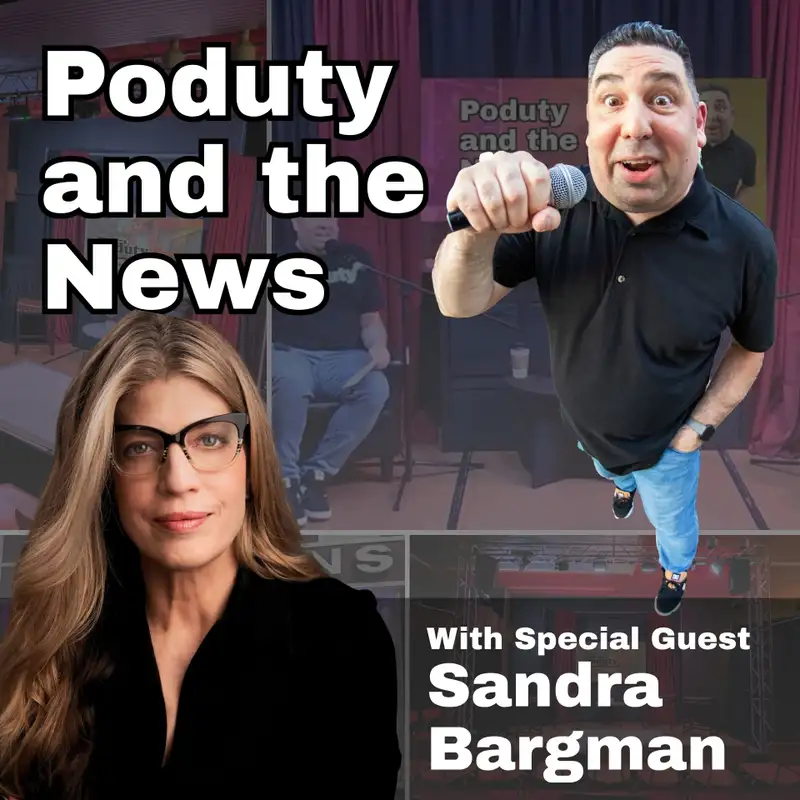
It's Tuesday, July 28th, 2026.
I'm Jeff Ravilla, your host of Poduty and the News. We're live at the Poduty
Live Podcast Theater at downtown Tarentum on Corbet Street. I've
got an amazing, incredible guest joining me today. I have
Sandra Bargman, the Edge of Everyday podcast host. Not only
that, author, singer, director, minister,
author, teacher, speaker, all the things. She's doing them all.
Sandra, I have just one question for you. Do you know what
time it is? I don't know, Jeff. It's time to party?
What time is it?
What time is
it?
It's time for Poduty
and the
News. The only live
Oh, the only live news podcast about podcasting from the stage.
Sandra, welcome to the show.
Oh, thank you, Jeff. It's a pleasure to be here and hello to your
listeners. I'm so glad to have you here. We're going through your
experience, all the expertise, the things that you've accomplished.
That list was so incredible at the beginning of the show and it ties in
so much to what a lot of podcasters are trying to do today. Build communities,
present, get in front of people, get in front of an audience,
be that force that makes the change in people's lives. You're doing
so much of that. Tell us a little bit about your podcast, a little bit
about your background. The podcast is The Edge of Every Day.
Yes. The Edge of Every Day is based on the
solo show that I created, and that's a poster from it if you're
watching and not just listening.
It's a solo show that I created at the
beginning of around 2014,
and I did it in New York
City and the surrounding areas for a few years. And I was
just about to dust it off and update
it with some new music when COVID hit. So I
turned it into a podcast,
exploring the same concepts that I
explored in the solo show. So but let me back
up just quickly to let everyone know I'm a lifelong
performer. I popped out of the womb as a singer and an actor and a
dancer, voice artist. Fast
forward midway through my life, I, I went to
seminary. So I'm a seminary-trained and ordained
interfaith minister. And I combined those 2
tracks into my own company called Sacred
Stages. And the first show that I
did under that umbrella was this Edge of Every Day.
And it was my way of exploring and teaching the
concepts, the spiritual concepts that I
am curious about and like to teach about, and utilizing
song and comedy. And I crafted it
like a ritual so I could—
people could plug into the show at any level that they wanted.
And so those same paradoxical
concepts That's why it's called The Edge of Every Day. We live in
very paradoxical times
and polarizing times. And that's what was live in
my life at the time and what I wanted to explore. And
so, you know, when it came time to turn it into a
podcast, I decided that I would
continue to explore those concepts. So people that come on to my
podcast, we talk about, you know, the rough edges of their life and where
they're, they're really dealing with change and where Paradox
and contradictions are showing up in their life and in their work.
Oh, amazing. And people want to find it, I'm sure you just search The Edge
of Every Day. Yeah, totally. It's on all the podcast platforms.
And the best way people want to connect with you, learn more about the speaking,
the ministry, and just make connections with you, do you have
a direct website that you like to take people to? I do. sandrabardsman.com. Yep.
And I have a YouTube channel, Sandra Bardsman, On the Edge of Every Day.
You make it so easy. I'll put all those links in the show notes. And
we have a special thing we do for each of our guests. It's called the
Crew Page. And once you've been on the show, you're part of Poduti and the
Crew on Poduti and the News, and you get your own dedicated landing
page with any show you've ever been on, plus all the links,
show notes, everything's connected to your appearance on the show. So, you know,
Sandra, I'd love to have you back on future episodes. Yeah. All those episodes will
be on that dedicated page where you can find all of Sandra's links. Wow. And
bio information. Love that, Jeff. That's great. Thank you.
Are you ready to get into our stories?
I'm ready to dive in. I love it. I can't wait to hear the
perspective and the experience and telling us what you think
about these next 6 stories. And Bramble Jam Podcast
Network is proving that niche podcasts can grow into sustainable
businesses. Co-founders Daniel Thompson and Brandon Gray
launched the network after creating Deck the Hallmark, a podcast
dedicated to reviewing Hallmark movies. Since then, Bramble Jam has
expanded to multiple shows serving highly engaged audiences.
The network recently reported a 25% increase in advertising
revenue after moving to Simplecast, and the founders say their
continued focus is on consistency and building loyal
communities. And that's really a page right out of my playbook. I
really believe that these in-person events, these
face-to-face with your community and getting in the weeds
and talking and seeing each other's faces, seeing
how the host reacts, seeing how the audience reacts. This is really the
next level of podcasting, and I'm so excited to see them
take it this far. Oh, totally. Well, for me,
it's like the best of doing live theater with podcasting.
I mean, it couldn't be a better melding of my
greatest loves. These one-on-one conversations that I have on my
podcast have changed my life immeasurably. And to go
and do it on a live stage where you can really— where the
audience becomes another member of the
conversation, and you can invite them in and they
really join in and
influence how the conversation goes with their reaction. It's
really communion. And you— the word that
you use, that you— that we're going to use over and over again,
community. The, the idea of that it's not about
content now, it's about connection and building
community. And I think since
COVID I think people have really more deeply
connected to the idea that building community
is so important. When we were isolated during
COVID the surge of connection to
building community, I noticed it everywhere.
I felt it internally myself. It's part of what propelled me
into even stepping into
creating a podcast myself. You
mentioned blending your 2 loves, theater and performing and getting
up on stage. And The one thing that podcasting live has
over anybody else, over musicians who go from
town to town and they play the same set of songs, comedians are
working on a routine, on an act, and they play that routine from town
to town. With podcasting, it's a
once-in-a-lifetime experience. Sandra and I can't take this show on
the road tomorrow and go to Cleveland and Cincinnati. You've already heard it. Right.
But when we do one show live, that's the only time in the
history of the world that that performance is going to happen. And that to me
is, I think, the most exciting part about the future of live podcasting.
Oh, totally. Well, and it's— I say
this all the time about what adds to
that aliveness is the fact that you're
constantly needing to learn about new things when
you're podcasting. You know, for me personally, the people
that I have on my podcast, I'm reading their book
or I'm reading about them. I'm reading about what they love to do,
what they do in the world, the work that they're finding
paradox in doing. And so it's this constant
curious learning curve that, yeah, it's
just really exciting. It's never the same experience. But I will
also say, Jeff, Having been a lifelong actor and
still doing it, yes, you're doing the same script.
However, each performance, while it may not look wildly
different on the outside, to the actors on stage, it does feel
pretty different depending on the night. Oh,
100%. And I know that there's little things that you try to do,
little things that you'll throw in here and there. And particularly when you've been
doing it for a long time and you need to spice it up.
Yeah, there's lots of little things that actors do on stage that the audience may
or may not catch on to right away. Right. But as far as
the whole body of work, the live podcast show
isn't something you can really take on tour and do from town to town.
And speaking of going from town to town and a little bit of the
tide turning on this next story, which I really love this one because usually
when you think of Comic-Con, you think of the the actors who are the, the
heroes of movies or the villains of movies doing these panels.
But the tide's turning a little bit, and the podcasts
who talk about their fandom and their love of these movies, they're
becoming the stars at Comic-Con. And we saw this recently at San
Diego Comic-Con, has long been known for celebrity appearances,
but this year's convention is giving podcasters a bigger spotlight.
Spotify's The Ringer brought shows including House of R
and the Midnight Boys to host live events, fan meet and
greets, and celebrity interviews throughout the convention. Warner
Bros. Television also recorded daily episodes of its podcast,
A Lot More, featuring casts and creators from its biggest franchise.
With more than 135,000 fans attending Comic-Con,
podcast hosts are increasingly becoming featured
personalities alongside the actors, filmmakers,
and studios? Oh, I love this so much. Well,
it's— hey, listen, because
we're moving away from that content version of podcasting more
into a more authentic voice, people are really—
they're connecting to the podcasters in deeper ways.
And podcasters are sharing more of who they are,
their own vulnerability, their own stories. And so we're getting
to know them a little more deeply. And of course,
so of course, they're going to become— we're going to choose our favorites and want
to, want to see them and become fans of them. And,
you know, look at where we're getting our news now,
more and more with our podcasters. I mean, we have our— we used to have
our favorite newscasters, and now we have our favorite podcasters.
You know, it's shifting, even the news is shifting to
podcasting. So yeah. Yeah, if you think about your
favorite movie franchise, maybe 18 months, 2 years,
3 years between movie, episode 1,
episode 2, episode 3, but a podcaster probably has
52 cracks at the bat a year. Between movies, you may
have listened to 104 episodes of a
podcast before the sequel comes out. So you're
gonna build a much better connection with that podcast host
than with— so they're kind of on this equal plane. Like, yes, you like the
actors, but you also like talking about this. And there's people who are
just as passionate as you are. They're also sharing their love and
their passion week after week. And you're showing up for them too, not
just the actors and directors and writers. It's kind of like this
community that you mentioned, we're going to talk a lot about. But this community,
this love of this whatever project you're working on, They're all coming
together, and they're sharing that passion.
Yeah. Well, it's great to hear their authentic voices, you know, their
lived experience with all of these— with these celebrities,
with these movies, their relationship with
it, rather than commenting on what it is, their experience
with it. And that really shifts it into
my attention into turning them into a celebrity. Why
I would personally become a fan of a podcaster.
Yeah, and not just thinking of entertainment, but if maybe you're an
accountant or a contractor or you're
into the music industry, you have passions with whatever
you invested your time, whatever you've built your expertise in,
there's probably events around the country that support what you're doing.
So don't just think, okay, I'm not an entertainment podcast.
Maybe you're a cooking podcast, maybe you're baking. Like
Procrastibaking is a great example of that where they're baking these
recipes and they're connecting with their audience and they're
going to trade shows, they're going to events where there's other
bakers, other people in the restaurant industry, and they're part of that
community now. Yeah, totally. So think about where you fit in and
try to go where your audience is. And maybe your
audience is in New Orleans and you're going, uh, this year for
the 2026 Essence Festival of Culture opened with a
live recording of Michelle Obama's podcast IMO
co-hosted with Keke Palmer. The conversation helped launch this
year's Ladies First theme celebrating the influence of Black women
throughout music, business, wellness, and live experiences.
Beyond concerts, the festival featured live conversations
immersive brand activations and community events throughout New
Orleans, demonstrating how podcasts continue to play
a prominent role in major cultural festivals. Oh my,
I watched a clip from this in preparation and I
just love that Michelle Obama, who, you know, I've seen
her with her brother on their podcast a number of times. They're, of
course, they're great storytellers. They're She's a great
comedian, just a natural comedian, very, very
secure in letting herself riff and be funny. And
so is her brother. But I really love this conversation with
Keke Palmer, whom I did not know.
I just love the intergenerational quality, how they were
just so naturally conversing and lifting
each other up and really setting a tone for women
of color, but for all women, of lifting each other
up, the vulnerability about their experience. You know,
it was— and again, that's the perfect
cocktail of why podcasting is getting
so popular, is you can share lived
experience, not just a performative
kind of conversation, performative kind of experience. You're
sharing lived experience. You know, these women who were
talking about ways that they had dealt with their families, etc.
So, you know, they're, they're speaking
with the listeners rather than at them. They're inviting them
into these conversations. I just thought it was so powerful.
And I can see how it would set the tone for all of these
events at something like that. Yeah, we're seeing so many of
these themed events like Ladies First. Well, That's probably
predominantly Michelle Obama's audience. Most likely,
it probably skews— And Kiki's too, yeah. Yeah, probably skews higher. So putting
an event together that really supports the audience, the
passions of the audience, and it's something that is really,
that's that community again, really. You're building that community and you're
supporting your audience who's also supporting you. And it's
like this symbiotic relationship now with media with the
hosts and their audience and their communities, you're bringing them
together and really supporting each other. Well, let's see if we
go on a 14-day tour. We're taking a
magician, an illusionist, and creator. Chris Ramsay is
taking his podcast, It's Probably Nothing, on the road in
2026 with a 14-city live tour. Each
performance is designed as a one-night-only experience featuring
mystery guests, audience stories, and live investigations
into unexplained topics that extend beyond the podcast.
Organizers say there will be no live streams or replays, making
each stop an exclusive event that can only
be experienced in person. I love
this. This is such a— well, this is like where we are in the world,
the multi-hyphenateness of where podcast is
going. It's like a little magic, a little
UFOs, a little audience participation.
What I really love that they're inviting audience members to come
on up on stage and share some stories. That's
awesome. And that shows a lot of trust and a lot of
vulnerability on the part of both the people on
stage and the audience members. But, and
speaking to like our first story in terms of
niches, I love this.
this mysterious niche that he's created. It's
fantastic. Magic and the
unseen other realms, just as great.
The one thing that I really took away from it is, you know, they're not
recording it. It's a once— that once-in-a-lifetime experience.
Yeah, it's, it's 100% FOMO. You're either there and
you're gonna see it, or you're not and you're— you'll have no idea what
happened. And yeah, And an event like this is kind of a reward for
those loyal followers, those loyal listeners who've been sticking with you from the
beginning. They're the ones who are going to want this
once-in-a-lifetime experience. If it comes to Pittsburgh, and I know
we have some Pittsburgh similarities here, I would want to go if I was
a fan. And that's the only way I'm going to get to catch that episode
is a unique Pittsburgh-based experience with audience members from
Pittsburgh. Yeah. Yeah, totally. How powerful was that? And
especially as a reward. Yeah, it's
like being in a salon. I just attended— I'm
tuning in for your listeners. I am from
Pittsburgh originally, but I live in New
York State now. I'm in Manhattan and also in the Catskill Mountains. And I
just attended an event in Kingston, New York
that was just like this. Pulling in this
interviews with audience members. They didn't call it
podcasting, but it was sort of this multimedia,
multi-way of engaging with the audience. There was
music, there was readings, there was audience stories.
So it was truly a one of a kind.
Recreating it all across the United States, but this
particular group of people who want this particular kind of
experience, are, are— you're just— you've got to go live.
You're never going to get it, uh, you're never going to be able to watch
it on TV or listen to it on a podcast. You've got to
be there live. There's a great company we've
covered a couple of times called 404 Media that's in
Manhattan that they do experiential shows. I know they're, they're celebrating their
3rd year and they're doing kind of what you're talking about. You might— it might
be in your area as well, but yeah, they're doing this, you know, Hey, we're
celebrating our 3 years. Yes, we have a podcast. We're gonna do a live
podcast, but it's not the reason why we're coming together. It's the
reward for everybody in the community sticking with us. Celebrating.
Celebrating 3 years. What an accomplishment. That's the
kind of bonus you can give as an independent producer. Imagine trying
to run this up the ladder through Hollywood like, oh, hey, we did this million-dollar
movie, but we also want to have a little get-together with our fans. Yeah. It's
gonna be hard. It's hard to get approved. But when you're the, you know, the
independent owner of your own media, you're creating it and you're in
charge, you own the asset, you can do these things. You can make that
happen. You can make it happen all day long.
Let's keep it going. We're going to talk about— speaking of making it happen,
here's one that made it happen, but it just does kind of talk
about the realities of going too big, maybe too
soon, and There's a lot of expenses involved in some of these events.
You can try to do these like I do, bootstrap, very cheap DIY.
I bought chairs from a Catholic school for $2 apiece to
fill up the theater. This person went all in on a
$38,000 event. Transparency
took center stage on a recent episode of The Lab
podcast as a host, Jay Clouse, and his wife, Mallory,
Shared a detailed breakdown of their 2nd annual in-person
community retreat. The episode covered everything from attendee
feedback and event planning to the financial realities of producing
a 2-day experience. The retreat generated just over
$30,000 in revenue while costing nearly $30,000—
$39,000 to produce, resulting in a— do the math—
$8,300 loss. The discussion also explored what worked,
what didn't, and how future events may evolve?
Wow. Well, I, as someone who has planned events,
certainly not on that scale.
Interestingly, I have created on my property in
the Catskill Mountains, I've reimagined my
1,000-square-foot garage and turned it into a
salon space. I mean, if
you just go down micro, micro, micro, micro, a
2-day event that I've produced in there,
even that small event, I've
never, I've never broken even, ever.
So I can really relate to if you chew
off more than— bite off more than you can chew, losing that
money and maybe not having it be such a
huge event. to resist the urge to make it so
bombastic, choose a few other things and maybe
focus in on them a little more sharply and make them a
little more successful, in which case maybe not lose that money.
But I also understand the urge to want to
hit all the— tick all the boxes and make it all happen like that.
Absolutely. Yeah, one of the things I tell people is you may
not have a theater space like this, you may not have, you know, an extra
salon room that you can build out. Exactly. But
around your town, around your city, there are, you know,
coffee shops, there are restaurants with back rooms. Yeah, plenty of spaces. There
are bowling alleys that have banquet rooms that they don't use it on a Tuesday
or Wednesday night. Even your local library might. A lot of libraries,
libraries are so underrated with the media centers. Sometimes they even
have auditoriums that get very underutilized.
They are looking— a lot of these businesses, these libraries,
they are looking for people to come through the front door. If you can make
some sort of arrangement like, hey, on Tuesday nights you're not using this banquet room.
If I can bring you 20 people, could we get a good rate on
the room and then we'll guarantee a certain amount of
food and drink or something? Yeah. You can pick up these spaces.
that are just remnant spaces that aren't being used at certain times of the day
or the week. And you can, you can make these arrangements to
do this on the cheap, on a shoestring budget, and pull off an
incredible event. Oh, completely. Absolutely.
Well, in my salon space, I have yet to do this, but it's certainly, um,
high on my priorities, is to begin to do live
podcasting from in with, uh, with an audience.
Because, you know, with a salon that I've— we've done in the past, we've
done house concerts and salons where we engage with the audience, we do
Q&A, and we get people coming in on certain topics, doing
music on certain topics, and engaging with the audience that way. So
it's, it's the same idea, again, very micro-sized,
but I have yet to do and want to do a
live podcast with, with an audience
Maybe not Q&A, obviously, but having them
there as part of that conversation. Well,
you're speaking my language. If you let me know when that's happening, I'll be one
of the first ones to get a ticket. Come on out. Yes.
Well, building on $39,000, this is probably,
I'm gonna guess, in the millions. This is a
new event space. There's a mall in Jersey, American Dream. And, uh,
the American Dream has expanded its live entertainment footprint
with the opening of 2 new event venues. The
60,000-square-foot event center officially opened on July 20th
and is designed to host conventions, trade shows, corporate events, and private
gatherings for up to 3,500 guests. On
July 25th, the new Dream Live Performing Arts Center begins
operation with Victory Fighting League's
VFL4, Havoc on the Hudson. The venue there is equipped to host
concerts, comedy shows, theater productions, live
podcasts, and other entertainment with professional
sound, lighting, and video production.
The scale is huge to me.
I mean, the community
building that's taking place in things that size is a little
mind-boggling for me. Keeping my
fingers crossed. I'm sure they've— if they're
bringing in conferences and such, that's a
really great way of building connection to that space.
But if they're doing live podcasting
combined in their conferences, they're going to just
continue to build their community that way. You said the
word mall. Did I miss, when
I was reading through about this, that they've reimagined a
mall? They've built these spaces where
a mall used to be? Because that would just be
fantastic, all of these skeletons of malls
around because people aren't doing shopping in the way that they used to be
doing it. I think American Dream is that mall in Jersey that
has the mountain with the ski slope in it. I
didn't— yeah, I missed that. I'm reading through it. Well, that's fabulous.
So they're reimagining these old spaces and turning them
into these great event spaces. That's fantastic. That's
the way to utilize these spaces. Yeah. And there was
2 versions of this. One was the larger convention center, which would
be great if there's a convention about something you're passionate about,
attend that, see if you can become part of it in future years. How do
I bring my podcast to the stage? How do I get up on stage and
be a speaker or presenter at a future
conference? But the other part of it was a smaller theater
space where, like, what we're doing here, maybe it's a 300 or
400 theater space theater. They're doing live shows, live
podcasts. And that was the part that caught my attention. Even this big giant
investment is still thinking future is podcasting,
future is live, future is community events. Future is live. Absolutely.
Future is communion. Communion and connection over
content and lived experience,
authentic voices versus these AI-generated
synthetic experiences that are becoming more and more
prevalent in all of our entertainment. So it's going to be
really important to, to create
events that really lift That
focus on humanity rather than AI generation.
Yeah, I am so bullish on that idea. I— that's all I can
think about is, you know, when AI becomes the commodity,
it's so easy to create, the rare thing becomes the
live performance. The rare thing is what has value.
Getting up on stage, making people laugh, making people smile,
cry, react, to have emotion. AI's never made
anybody cry. But if you tell a story and you connect
with somebody and you're meeting and they're seeing you face to face,
you can't recreate that in any other medium. I mean,
maybe movies can make you cry, but as a live performance
with real raw emotion and human connection, nothing
can really touch a live podcast performance.
As a lifelong performer, live performer, I couldn't
agree with you more. Well, Sandra,
this goes by so fast. I warned you it goes by.
Oh, we're already at the end, and I do
one thing— I turn the floor over to my guest
one last time. Plug, promote, talk about
anything you'd like. Sandra, the floor is yours.
Well, I briefly talked about my salon space. You can check that
out on my website The Plum at
TH2. And I encourage you to think
about the renaissance of salons in your own
area as a way of bringing people together in
community to discuss the topics that are important in
your communities. Yeah, you can
check out my website for any inspiration.
You— we talked about my podcast, The Edge of Every Day. You
can check that out on all the podcast platforms.
My niche— I have a wide spectrum of
voices that come on to my podcast. My niche,
it's not a niche per se in that I
talk about one topic. It's a niche in the sense
that with this wide spectrum of voices, I'm asking
all of them to speak about the rough edges, the
ways that they have— the work that they're doing has
transformed them, as well as their clients or
the people in their lives. So again, it's a wide
spectrum of voices and books and ways of
being in the world. You can check out
my YouTube channel, which has all
of my podcast episodes, over 120
episodes. It also has clips of
performances that I've been in.
There's a clip from when I worked
in Pittsburgh. Oh my God, I did Evita at the Byam Theatre.
That's on my website for you Pittsburghers who may be curious.
I'm also a wedding officiant. So in
addition to storytelling on stage and
in podcasting. I tell love stories and create
unique wedding ceremonies for couples that hire me.
And I will be returning to the cabaret
stage in New York in October doing a Blue
Wave cabaret show right before the
midterm elections. So
that's That's all of my news at the moment.
You are up to date.
The Edge of Every Day is the podcast. Check that out. Make sure you like
and subscribe. Follow along. sandrabargeman.com
is the website. We'll have all the links in the show notes. Sandra,
do you remember what time it was? It is
time to party, but I think we've been partying. Should we just
keep the partying going? Let's keep it going. I think that Poduty and
the News is all about celebrating life and podcasting.
What time is it?