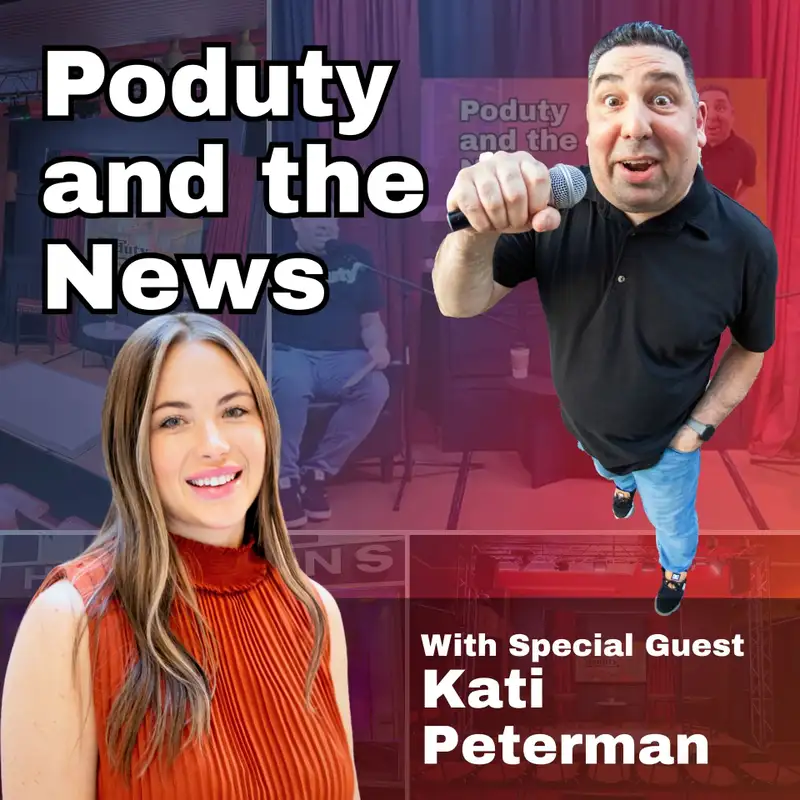
Hey, everybody. Welcome to Poduty and the News for Tuesday,
July 25, 2026. I've got a great guest joining me
today, Kati Peterman, your fractional executive.
Kati, I forgot to prep you on this, but I always ask my guests before
I play the theme song, do you know what time it is?
Time to party. It's time to party. What time is it?
What time is.
The only live news podcast about
podcasting from the st.
The only live news podcast about
podcasting from the stage.
Oh, it's the only live news podcast about podcasting from the stage. And
Kati Peterman is joining me today. Kati, from your
fractional executive, welcome to the show.
Thank you so much for having me. So excited to have you here.
Going through. We connected through a site called Podmatch
which puts podcasters and guests together and you've got a great bio,
a great experience, talking a lot about how do you go
to the next level, how do you build systems and structure and support for businesses.
And you've done a ton of work in the event space, which I think really
ties into what we're doing here with live podcasting, live shows
and showing people how do we build that structure, those
business guidelines to lead to success. I think it's a lot
of what you're building over at your fractional executive with. Tell us a
little bit about it. Yeah, thank you so much. And you know,
Podmatch is a great example that
it's very clear on the type of community that it's curated,
which allowed two individuals like us that probably never would
have met on the street or passing by, maybe we would have never went to
the same in person event. And now we're here, which is
great. So, yeah, I have an amazing team
of fractional executives. I have been in this space for a long time
and working with owners and founders, you know,
getting into businesses and exiting businesses. Myself, I
really saw a need for high level talent
to be placed, but without the
salaries and the long term commitment. A lot of people don't hire executives
because it comes with a very hefty payroll. But they are building
something so amazing and great and it needs to get out there. But
as you know, we can't do everything ourselves. And sometimes you just
need a seasonal or a part time, right. A
fractional short duration of a very high level,
a player to go and take your vision, your mission and your dream to get
it across the finish line. So I'm really
passionate about supporting people and getting their dream, their vision, their company
out there. And so we provide top talent to get things
across the finish line. Yeah. And that's so important, especially
in today's economy with businesses who want to scale fast, who
have big dreams, but maybe not those budgets at this time.
They're growing, they're seeing growth, but maybe they need that expert
set of eyes or another perspective of how to get that going.
And a lot of what you provide, those connections can help them get
over that finish line. Yeah, absolutely. And it's, you know, a
lot of people, even the bigger companies, you don't need some
full time executive. Like it's just sometimes it's just a waste of payroll.
So it's really like this is a model that works for everyone
even if you are on the bigger scale. And, and it's just
about accessibility and connections.
Awesome. And it's YourFRX.com I believe that's the
correct website. So go over, I'll put all the links in the show notes. You
can connect with Kati, connect with YourFRX.com, your fractional
executive. All those will be in the show notes. And we also have what's called
the crew. After today's episode, Kati gets inducted into
Paduti and the crew. And the crew is all the guests that have ever been
on the show, that all their links, every show that
they've been on, plus future shows all get added to this one special
page showing their expertise across many episodes
and all their social links and bios. So check out the crew page. Connect with
Kati. Connect with your fractional executive.
Yourfrx.com Kati, are
you ready for our stories? I'm ready. Our first story,
we're going to. Alena Rumyantseva,
curator, producer and strategic director at sifra, recently shared
her thoughts on what makes live virtual events successful.
Drawing from her experience producing global online art events and
community gatherings, she outlined five
create intimacy, curate the audience experience, build community
before the event starts, have a strong host who can guide the
room and end with intention. Elena argues that
virtual events work best when they are designed as experiences
rather than presentations. And that's a lot of what we talk about here is
coming into a show, having that structure built out, having
a plan in place on a live event, a live stream,
things don't always go as planned. There's things that happen, so you need to have
contingencies. And the best events that I think come off looking
flawless usually had the best plans, the best
contingency plans, the best vision of what the show could
be, and they plan for months to get to that level,
to be able to Pull off something so seamless, so
flawless. I agree. I liked her
speaking points and her bullet points. She talked about
having it be clear and the intimacy and building the connection.
I think whether it's live or in person or virtual,
we sign up for things. Right. And we've all been through this
where it's so helpful when you know
exactly what you are doing and what your role is, going into
something and then what you're going to get out of it and who your point
of contact is. So having that host, like she
said, having a point of contact, a designated host,
you know what their role is, you know how you're going to show up and
then curating that environment before you get to something.
Even having one or two familiar faces before
you go to an event or before you get into something
really helps with that connection and it really cements you to
whatever you're doing and locks it in. So I thought she made so many good
references on the intimacy and knowing exactly
who your host is, what the expectations are.
So that way you're engaged and you're actually
participating in whatever it is that you're going to.
Yeah, it really is all about that experience. And even as
simple things like the check in registration, getting your
badge. Some conferences start off with a nightmare system
where they didn't plan to get the people through the door and there's
two, three, four hour lines to get a badge and it's.
That's not starting off on the right foot. Those people just arrived in town,
they want to meet people that they've connected with in previous years,
other business counterparts. They don't want to stand in line for two, three hours. And
that's all part of that experience and play planning for these flawless
events, even even though some of these are, are virtual events,
you know, you still have, you still have to plan for that. How do people
register? How do people get into the rooms? What's the experience
like? Are they just sitting there waiting with a blank screen, sitting up? Or is
there some interactive, Is there a pre show, a host that's, that's warming up the
crowd and keeping them entertained. But when you plan for those things,
things will tend to go a lot smoother. The reviews
afterwards will be a lot better because you took the time to put
something together that was a great experience for the crowd.
Yeah, absolutely. I think just like you said, putting it together
and planning ahead, if you've put so much effort into
the event and everything beforehand, but you're not
reiterating that to the client and they're just like, oh, it's
fine. I can just show up five minutes before. It's okay if I'm a half
hour late, right? They need to know, like, do
they need to be early? Did they need to read through? Is there homework before?
What can they expect the first hour? Why should they show up on
time? Like, you're making this event for people to
join and to get into, and if
they don't know, hey, you're rewarded for being on time, or this is what you
have access to and it's not clear on what they're
they're doing, they lose the desire to show up and be
intentional. Yeah. That really takes us into our
next story. The first one was about planning for the guests. But
whenever you do have a plan, how do you roll that out internally? And I
think this really ties in a lot to your fractional executive
is how do you execute? How do you execute that internally?
And Speaking live from ATD 26 in Los Angeles,
Tanya Tucker Collins, head of talent and growth at Intersect,
discussed what separates programs that simply check a box
from those that create measurable impact. The conversation
focused on the importance of understanding organizational culture,
using data, effectively building strong stakeholder
relationships, and testing ideas through pilots and prototypes.
Tanya also explored how leaders can evaluate whether
an existing program should be maintained, improved, or
completely redesigned. Had the wrong slide up there, but we'll get, we'll fix all that
in post. Yeah, Tanya really did a great job
explaining, you know, that great ideas succeed when they're
designed around people instead of assumptions. And so when we're
talking about planning and going through all of that, you know,
this planning, I would say, is designed around who is showing
up and who's purchasing. So let's say you have a live
or a virtual event, right? Who's actually buying the
tickets? Like, don't just say, okay, we hit our
goal of ticket sales or we hit our registration
goal. You have to go so much deeper than that, right? You have to gather
the information of what is
the show rate? Do we have a male audience? Do we have a female audience?
That's very basic. But on top of that, do they own a
business? What are they looking for? What are their top three issues? What's something
we can solve today? And so that planning and
that curated experience goes in way before
even the show rate. Talking about these things internally, when you're
putting it together with your team and getting that buy in too, getting
buy in internally so that you can do all these other things that
Kati's talking about, you have to have the structure internally
to roll out those experiences for your guests. So
it's so important to get that organizational structure, getting buy in
from the different departments that are going to contribute. So we're kind of attacking
on these first two stories, both sides of the coin, like how do you make
a great experience and how do you turn that into a great experience
internally as well? A lot of people with that,
they'll just kind of take it as is and shoot at the hip and be
like, yeah, that was a good event. Or like, ah, we could have done better.
The buy in from your staff and from the audience
and from the entire experience all the way facilitated through
the buy in is created with data like either we hit our
benchmarks or we didn't. And either we got a good result and we got the
surveys we wanted, our show rate was dialed in.
That all can be structured around being very clear
on what data you need to hit. All of those things
and all these things we're talking about being clear, having set up goals,
being transparent and honest really ties into
the next story of how media has changed over the last years.
And at the New Media Summit, venture capitalists Mark
Andreessen, Ben Horowitz, Eric Torenberg
and Gabby Goldberg discussed how media communication and
influence have changed in the Internet era. The conversation
focused on the rise of creator led platforms, the decline
of traditional gatekeepers, and why founders are increasingly
building direct relationships with customers and audience through podcasts,
social media and personal brands. The panel also
explored the role of authenticity, storytelling and
public communication in modern business.
Authenticity, direct communication, storytelling,
really. With this one, I think the biggest takeaway is
the success and all these accolades, that's so great. But if
someone cannot literally see themselves somewhat
along your journey and where you've been and where you're going
and they can't say, okay, I can have that success too. I feel
connected to your journey. I see myself going from
here to here like you have. I took something from your
speech and I've implemented that in my life and now I'm set up
for success. If, if they can't feel that from
you and it's, it's not some. And I'm so,
you know, you don't have to file bankruptcy in order to be somebody one day.
Like the started from nothing and the big boom and the blow ups
and the, all this like, I think everyone's kind of over that where they're like,
okay, but I didn't do that and I'm here and I'm doing well and
life's not really hard. But I'd like to relate to that because I
still want to have success. So I think people sharing these personal
journeys and who they are as a person, that brand
is getting a lot more traction and becoming so much more popular
because people say, oh, I can relate to that. Let's keep it
moving. The host of the New York Times technology podcast Hard Fork
recently shared what goes into producing their annual live show.
This year's event brought roughly 700 attendees together in San
Francisco for interviews with technology leaders, including
Microsoft's CEO Satya Nadella.
Host Kevin Roos and Casey Newton discussed the differences between
recording in a studio and performing live, the importance of
creating memorable moments for ticket buyers, and how they prepare
for unexpected situations that can arise
during events. I think
we've all had so many unique experiences arise
during live events. Again, planning ahead, which I
think everyone has said and had that in common,
knowing what to prepare for, going through
option A, B, C, having a backup plan
that is what takes option B and option C and turns it into
a good moment. Still, maybe it's not the original outcome that
you wanted, but it's still a desired outcome because you had a
plan for it versus, like, oh, sorry, we don't have your name
badge, so guess you can't come versus hey, don't
worry. If you're a guest, just go over here, we'll get you set up. It's
going to be handwritten, but. But we'll have a printed one for you by lunch.
You know, that's what plan B looks like.
I love we talk so much about planning and contingencies and
getting the details right. Sometimes you can't plan what's
gonna happen. And a little side note about this story is they ran late
on starting the show and the CEO from
Microsoft didn't have time to wait. So they had to
decide they either had to start the show as is while people were still
checking in or lose their headliner. So, you know, those are
things that people have to deal with in real time. And, you know,
luckily they got the show off in time. They got their main headline
guest and they got to have the show that they wanted. So, you know,
there's things that are out of your control, but you have to learn how to
roll in the moment and make it happen. How do you get to the
finish line with what you got, with the, with the cards you were dealt.
Yeah. And creating a win, win experience. You know, they still got,
still got them out there, still got their original headliner. I'm
sure that the Headliner still wanted to have a great experience. They took their time
to also be there. So when we're making those shifts
in the moment, which can be very stressful, you
have to make sure that it's not self serving and you're still creating a Win
win environment for everyone involved.
Yeah, Win win environment is a great tie in for our last story,
which I just love this. This is a podcast studio, I believe,
in New York. And they had kind of like a
call for podcasters. They were like, hey, if you can present
a podcast, we're going to give you a one year
opportunity to build your show in our studio. And
they got a lot of media coverage out of this. They got
people submitting entries, creating podcasts, talking about
their studio. This was a great win win where you know, somebody's going
to get this fellowship for a year and that that
podcast studio is going to get all this news coverage. And Christine o', Donnell,
owner of Bright Sighted Media, appeared on local television
Albany, New York to announce the winner of her pitch your podcast
contest. Jesse o' Connell was named the winner for this
podcast, Mixtape Chronicles. The contest
provided aspiring podcasters an opportunity to pitch their show
concepts and gain visibility, while the live
reveal created excitement around the winning project and
the broader podcast community.
Contests and giveaways are such a
fantastic way for like double exposure,
free press media. You can make it fun
and really, it just, it can be super cost effective. We did a
book signing for someone at an event and they were
really excited about this particular
household name to have had an autographed book. And we did a
contest and said, hey, you know, basically just shoot
a recap of the event and tell us why you enjoyed it
and why you would like the book. Tag us. And we're going to be
picking one winner. We actually picked four. And so we
shipped four autographed books, which I think cost us less than $150.
Right. 7.99 for shipping. And man, the press
release and the social media coverage for that was
wild. Over. Over a book giveaway.
Yeah. And it's tremendous amount of goodwill for the studio. Who's going to give
away a year's worth of podcast recording, that's to
somebody local in the community. So people talk about those kind of things and
you just can't, you can't buy that kind of goodwill where you're helping a
local creator get something off the ground, something that they can
produce. And in this case, this. The person who won this had
already like put together a pitch deck, a media
kit, had some Sample episodes on Spotify,
all just around this contest idea. So it sparked
creativity all across the board and the audience is the one
who voted on it and they chose the person who really
came out at it, you know, full steam ahead. And those were
our stories for June. What is it,
23rd, 2026. Kati Peterman, your
fractional executive. One last thing
I do before I turn, before we play the theme
song one last time, is I turn the floor over to you. You can plug,
promote, talk about anything you'd want. Kati, the
floor is yours. Yeah. Everything that
you brought today and all the stories that we covered, I think it's
pretty clear, right? Connection, planning ahead,
creating a curated experience. The
team and I, we've hosted, you know, a ton of events. We've,
we've been inside some really large company and stages that many of you are
familiar with. And for those of you that have audiences and
connections and you're looking to say, hey, how can I create the best experience?
How can I make a memorable name for our company
and our staff and what we do, where people will talk about this event
or this pop up or my podcast for years to come.
We are so happy to connect with anyone and brainstorm and
give ideas and so we'd love to connect with you. And
I really appreciate these stories and how much thought goes into this. And I just
want to say thank you so much for having me. You're very
welcome. YourFRX.com. The links will be in the show
notes. Kati, do you remember what time it was?
It's party time. What time is it?
What time is it?
The only live news podcast about
podcasting from the stage.
How do the end of life
how do the end of news
the only live news podcast about
podcasting from the stage.