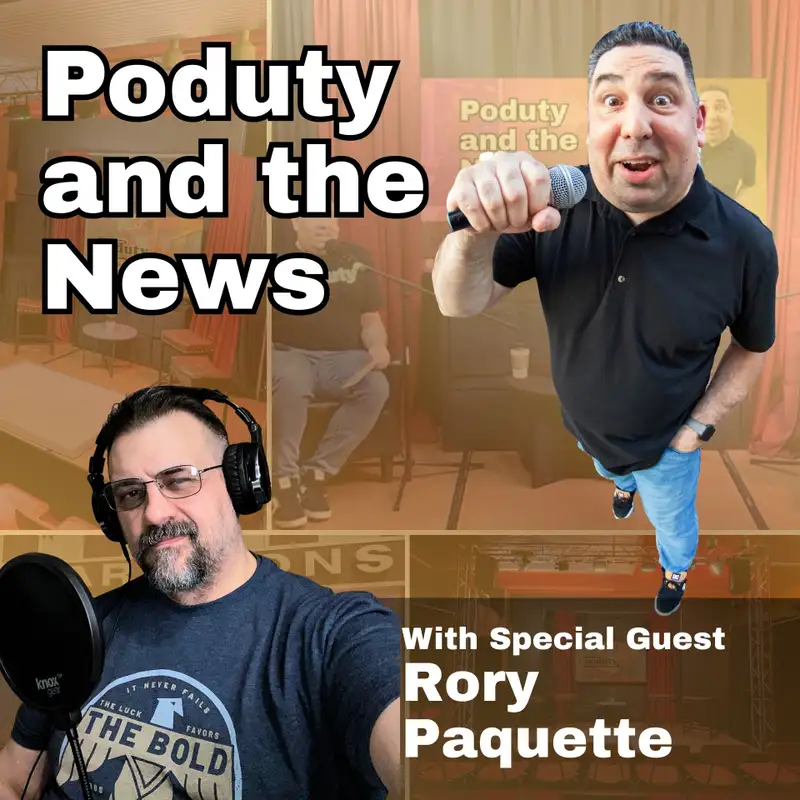
Hey everybody, we are live. It is Tuesday night, February 10th. I've got
Rory Paquette joining me at the Poduty Live Podcast Theater.
I am am on— I in Pittsburgh. Rory, where are you calling in from? I'm
coming from northern Indiana, brother. It's really cold up here, lots of snow.
We just had -15 yesterday and we had 55
today, so we had like a 70-degree swing. I'm
waiting for all the water pipes to break. Yeah, exactly. That's a hold my beer
moment, right? You know, where you can't have this temperature and the other one all
at the same time, but Yeah, yeah. So it's— we've had maintained really,
really cold up here. So good snow, lots of frozen stuff. Oh yeah, it's
been— it was brutal. The river has been frozen solid, and just in one
day we have like— it's all a series of navigable lakes
really, is what rivers are anymore. They're just locks and dams around here.
And so they were frozen solid Sunday night.
Today there's just like waterfalls of
icebergs going over the edge of the dams. It's pretty crazy.
That's That's Pittsburgh. Pittsburgh in the spring. There you go. Almost spring, I guess.
Well, I've got 6 stories coming your way about live podcasting.
Rory, I just have one question for you, which I didn't prep you for. I
usually prep my guests for— you're allowed to say whatever you want. Okay. I always
ask my guests, Rory, do you know what time it is? Uh,
it's time for our stories, I assume. That's perfect.
What time is it? Oh, oh.
It'S time for Poduty and
The News. Poduty and the News, the only live news podcast about
podcasting from the stage. Poduty and the
News. Poduty and the News. The only live news podcast about podcasting
from the stage. Oh,
the theme song's really just the sneaky way for me to get from the control
room to the stage. And Rory from THE Podcaster
Nation, welcome to the show. Thank you, brother. I appreciate
being here. Can't wait. Uh, so glad to have you here. We got 6 stories
coming your way. And this isn't the first time we met. I was actually— I
got to be a guest on your show. And I was looking back at the
dates. The episode came out June 2nd.
But 3 days prior to that, I tore my Achilles riding
a skateboard on Memorial Day. So I was
down and out. I was probably under severe
medication when the show came out, but not
when we recorded. It was a great episode. We had a great conversation.,
and I really enjoyed it. So tell people about the, THE Podcaster Nation.
Yeah, thanks, man. Uh, it was a great episode. I had a blast talking to
you. So when you said, hey, you know, come on this show, I was like,
okay, when? I'm there. It was wonderful. So, um, yeah,
Podcaster Nation is, uh, one of my 7 podcasts that I currently have up
and running, and, um, it's my second biggest one.
Podcaster Nation is for any podcaster out there, uh, to come on
and sort of give their, their story. It's a chance for them to get out
of the hosting chair, get into the guesting chair, and instead instead of having to,
you know, tell everybody else's story, you get to tell your own. And so your
audience gets to learn about you a little bit. But it's been a very
successful project so far, and we've built a great community around it. It's been a
lot of fun. I do like how it's THE
Podcaster Nation. It reminds me of like, like NFL football where they
introduce like THE Ohio State.
That's exactly right. And I wanted to do that on purpose. It's all capital letters
THE Podcaster Nation, because, you know, at the time there wasn't another one.
And in case there ever is another one, it won't be THE Podcaster
Nation. So that's like a lot of people just add like the number
1 to the end of their handle, but then you wonder, is that, is that
the original, or is that just the cop— that's the first copy of it? But
when you're The Podcaster Nation, nobody can doubt
that. That's right, man. Well, awesome. I'll put the links
to the show, even I'll put the links to the show that I was on
too. We'll give a couple links Back to the Podcaster Nation, so you can get
a flavor for the show. If you're familiar with me already, it might be a
great introduction. And then go in there. I think I was episode like
79-ish. There's a ton more episodes. I think
you're over 100, and you're nearing probably— what did I see,
130 on there? We're about 180 now, actually.
180. I'm way off. It's OK. We moved
to 5 days a week publishing. And now we're currently 7
days a week publishing. So, you know, it escalated in a
hurry after you and I did our episode. Is it all because of
us? I think that you were the cause, the causality
of all of it there, brother. I'm the cause of something, whether it's—
I don't know what that thing is, but I'm ready to get into the stories.
Are you ready to go? Oh, 100%. I can't wait. And
one of the ones the fans love the most are stories that I
can't pronounce. So this one happened in Amsterdam, and I
can't read the title. I had to have it translated to even get a description
here. But something interesting is happening in Amsterdam. There isn't a
soccer match anywhere on the schedule. Ajax supporters are
filling the streets around Liedseplein wearing
jerseys, singing songs, and showing up with the same energy
you'd expect on game day. But instead of heading to the stadium,
they're walking into Delamar Theater to see a live
taping of the Packshaw podcast. This isn't a one-off
experiment. The show has already sold out rooms like D. Mel
Quigg and D. Klein Comedy, and now
it's back at Delamar for a second time. What matters
here isn't Ajax or even the podcast itself. What
matters is that fans showed up on a night with no game because the
podcast became a place where the community gathers.
This is a— this is what smaller podcasters should pay attention to. You don't need
a massive audience. You need a group of people who care enough to leave their
house, wear the jersey, and show up together. That's the difference between
listeners and a real fan base. And that difference
changes everything. And one of the things that we talk about in this
theater is getting people out of their house,
getting people to come to a place to enjoy a night out.
Sharing like-minded thoughts, sharing comedy, sharing
stories together, and in a place where you can connect
one-on-one. And that's what we're seeing a lot with sports entertainment. We're
seeing these podcasts. They, they they go, do pregame shows, they
do postgame shows. Right now, every update you see about
podcasting in sports right now is going to be covering the big game that
happened yesterday. So podcasts are a great way
to bring community together. Whether it's sports related like this show
in Amsterdam where you're meeting the players and you're talking about the game you
love, or just whatever you're into, there are people like
you in your own neighborhood. You can connect with them. I love
that that is going on the way it is. I thought that was really cool
when I got to read that story. You know, right now we're all craving connection,
brother. I mean, we haven't recovered from 2020. You know, when
all of our connection got taken away, we all kind of went, wow, this is
life without connection. Now we're going, hey, How do we get our connection back?
And social media has, you know, kind of structured us in a way where we're
into niches and we're into groups and we have common, you know, interests.
So something like this where it's all the fans of a ball team, you know,
coming together, I think that's wonderful. And they're just getting together to sit there and
talk about it right on a podcast. I think it's beautiful. I mean, if you're
a fan of something and there's an event going on on an off night, there's
not a game, maybe it's, you know, in between traveling or the season's over
or our next story is going to be happening during the All-Star break,
what better way than to go to a pub or, you know, a local community
center, hanging out with fans of the same team that you all love,
meeting some of the players, maybe getting some autographs or, or tell them
about your favorite play that you saw them do. You just can't
recreate that with an MP3 file that gets downloaded once a week.
This this is, is a real life experience that you get. You can only
get by being there in the moment. I could not agree with you more.
I think it's fantastic that they're doing it. I think you're going to see a
lot more of this, and I think it's a great avenue for independent, independent
podcasters to start, you know, sort of taking, taking note of
in their subject matter, you know, when with stuff that they talk about,
wherever there are big events going on that they want to sort of piggyback on
or, you know, be in addition to, you know, where there's interest, you're
going to have participation and where there's participation and you've got success.
And they got a great one. Another sports podcast coming up, doing another live show.
This one actually is during the NBA All-Star Weekend.
Draymond Green is taking The Draymond Green Show out of the podcast
feed and into a real room. The show is going live in
Los Angeles from the Odyssey Sound Space, giving fans the chance
to be in the room for a conversation they won't hear
anywhere else. This isn't just about star power. It's about
timing, access, and experience. Draymond didn't add another
episode to the feed. He created a moment tied to NBA
All-Star Weekend and turned it into something exclusive. Smaller
podcasters should pay attention here. You don't need millions of listeners
to do this. You need a reason for people to show up, a
window of opportunity, and a clear promise that being there
live is different than listening later. This is how
podcasts stop being background noise and start
becoming events. I love it. And as long as nobody disagrees with
Draymond while they're in that room, I think they're probably safe.
He's a little volatile, you know, but, uh, but I think it's fantastic
again. And he's doing the same thing that soccer guys are in a lot of
ways, and that he's sort of piggybacking on this huge interest in the sport that
he's involved with and inviting everybody when you can't go see the game to come
in and talk about it., right? So you can still experience it. Piggyback— that's, that's
a word that we hear on this show a lot. And it's just thinking about—
there used to be a saying back in the early blogging days called
newsjacking. And newsjacking was a way to take a headline,
hurry up and write a blog post about it, and then try to get it
ranked in Google, in the search engines, really quick. And
if you think about that, how the world has turned, how social media has
changed the world, We're moving so fast with the information
that we're putting out that now those blog posts have
become these real-life events with podcasters. So we saw
one with the— I think the Carolina Panthers
quarterback did a pregame show from the parking
lot. We're seeing Draymond Green tie into NBA All-Star
Weekend. That piggyback technique that Rory's talking about,
that's something you can do in any industry. If there's something that somebody
is talking about that's related to what you do, see if you can
inject yourself into that conversation. Can you be part of that event?
Maybe the first year you just volunteer and then the next
year you get invited back to do something else. But, you know, find out where
these conversations are happening and put yourself in the middle of those
conversations. Absolutely. You know, and I think the volunteering part is,
is a pretty big deal, too. I mean, I'm all in favor of podcasters getting
paid for their work 100%. But if you're trying to break into something new, you
know, you offer it up. You know, you go out and you say, hey, I
want to do, I want to give before I get. And when you do stuff
like that, then people are very receptive. It's usually an open door and it's going
to be a great way to get get in, in there and get started. Being
part of the community, it really can open doors for you. You can make the
right connections and that's a choice that you want to make because you want to
get into that community and make those connections. But if somebody just wants to pay
you in exposure, that's a different conversation that you might want to have with
the organizer. But using, you know, using what you've already
built, the asset of your media that you've created,
to open doors to get into conferences, to get media passes
even. Sometimes that exchange is you might get free attendance to the
conference in exchange that the conference expects you to create content while
you're there. And that's a great exchange. Sometimes that can save you hundreds of
dollars just by getting that pass because you've built an
audience who cares about the same things that that conference is talking about.
Oh, 100%. And then let's not forget the fact that you are, like you said,
actually making content while you're there that you then get to repurpose and
use over and over in your you own, know, sort of exploits. So I mean,
you you can't, can't find that kind of great content, um, everywhere and on accident.
Sometimes you have to go out and you got to be purposeful about it. Use
what you built, open those doors, make those connections, and
soon you might be in Cork, Ireland on the main
stage This is Irish broadcaster Ryan Tooberty
is taking his podcast, The Bookshelf Live, onto one of
Cork's biggest stages, the Cork Opera House.
Tickets range from €35 to €40, and the
show is being billed as a one-night-only live experience where
the audience doesn't just listen, they participate. This
matters because it isn't a tour stop built around a flashy set or
heavy production. It's built around conversation,
storytelling, and access. The audience gets something they can't get from
the podcast feed, including the chance to ask questions live.
For smaller podcasters, this is an important reminder: you don't
need spectacle to justify ticket prices. You need
trust, a clear point of view, and a format that invites people into
the conversation. This show works because it treats the
podcast as a shared experience, and not just
content being consumed. And we talk
about these nights out for when you go to see a live podcast. And
in the theater space that I'm in right now, most of the time tickets are
$10. This one here he is— is a—
he's a major broadcaster in Ireland. He's very well known. He's like the
Johnny Carson of Ireland. And his tickets are $30.
They start at $30 or €30. To have a night
out, to experience this person that you've seen on TV 1,000
times, to sit in the same room while they interact
and, you know, with the audience, they take Q&A, they take questions from
the audience and comments and feedback. You get to see that all happen
in real time for $30. You're out,
you know, you have the worst night of your life, you're only out like, you
know, the cost of a nice dinner. It's not too bad.
Absolutely. I love this particular story. I mean, not all of them. This
is the one that I kind of kept coming back to because, you know, I
work with podcasters directly in a lot of ways. And one of the issues that
we have as podcasters is we never see our own value. You know, we are
programmed to think we have to do everything for free all the time, give it
all away, and, you know, sort of get walked on in the process. I'm a
big advocate for the fact that we should have value. This guy's charging a ticket
a ticket price, a good healthy ticket price to come be a part of this.
And as far as being a part of it, who doesn't want to be part
of a podcast? Who doesn't want to be a guest on a podcast, right?
It's a completely different avenue. It's a different type of media.
I try to explain to people it's different than comedy. It's different than
music. It's something that it only happens
once. Like we talk about comedians, they work on an act
and they take that act from town to town. Musicians play the same
15 songs in every town. But when you go to see
a live podcast, that show is only ever gonna happen
one time in front of that audience at that city with
that content. You can't take that show, do it tonight in Pittsburgh,
and then Rory and I can't go to Cleveland tomorrow and do these same 6
stories over again. It's done. And the fact that you can see
a once-in-a-lifetime performance for for just €30,
€40. To me, that's like the most impressive thing about live
podcasting. It's, it's, it's a unique experience. It can't
be repeated again. If you're there, you're there and you get get
to, you to witness something that will never happen again. I love the
way you said that. You know, you never get a second chance to have your
first conversation with somebody, and that's where you have all that discovery.
That's where you're both kind of legitimately and authentically wowed by
the questions that come out and the answers to them. And so, you know, when
you can have that, that just raw, real talk with somebody,
that first time you have it is the gold. And that's, that's why you can
only do it once, because our podcasting platform is
the most personal media in the world. A lot of
people listen to their podcast on their morning commute or while they're
working out. A lot of times it's passive listening. It's just on in the background
as, as a comforting agent. You get to hear that voice while you're you know,
doing the dishes, running the sweeper, cleaning up the house, maybe even studying.
And when you go to see that person live,
even though all those times you might have felt like you were sitting in the
room with that podcaster, you don't know what they look like or their facial
expressions or how they react. But when you see that come to
life right in front of you and you, you see that person in the
flesh, like, you're like, oh my goodness, I've listened to probably
500 hours of their podcast, and now I'm sitting in a room
with them. It really changes the way and your
perception of what you think a podcast can be and how a
podcast can impact you. You've had all those other hours
of experience or interaction, but you've never sat in
the room with that person and seen how the
sausage was made. 100%. And I mean, I'm sure I'm not alone
in that. I'm a guy who talks back to the podcast all the time when
I'm listening to it. You know, I'll make a comment on what they said or
I'll answer the question they ask, you know, because I feel like I'm in the
room with them, like you said. But how cool would it be to actually be
in the room and be able to answer that question and have them go, oh,
great answer, Rory. Hey, that's fantastic. Thanks for contributing. You know, that'd be really,
really cool instead of just, you know, yelling at the, you know, the MP3 all
day. Yeah. Yeah. I'd love to get a high five like, hey, Jeff, that was
a good one. Come up here. High five. You're not getting that from an
MP3 file. Right on. Well, you're also not
getting that if you— unless you're going to the Binance
Blockchain Week. This podcast wasn't recorded in a
studio or a home office. It was recorded at Binance Blockchain
Week, right in the middle of a major industry event.
The host used the moment to sit down with Elena
Afanasyeva, founder of and CEO of
BeInCrypto, to talk about branding, trust, and what happens
when platforms like Google changed the rules overnight.
The value here isn't the topic alone, it's the positioning. By
showing up where the conversation was already happening, the podcaster gained
access to a high-level voice and created content that instantly
carried authority. Conferences, festivals, and industry events
aren't just networking opportunities, they're content engines.
When you record live in those spaces, your podcast becomes part of the
moment instead of reacting to it later. That's how
smaller shows can punch above their weight. I love
that. It's a lot like, you know, when we used to listen to those, those
tracks growing up of, you know, the— it was the live version
of the Van Halen song versus, you know, the recorded version in the
studio. You know, the recorded version of the studio is great. It rocks. It's fantastic.
But you know that the live version, they're like crawling the walls and they're like
going across the floor upside down with the guitar on their head, you know, and
you can hear the people cheering and everything else. So, you know, doing it live
at a conference where you have just a different sound and a different feel and
there's just that energy that's in the air that you can actually capture into the
podcast. I, I just think I'm getting electric just thinking about it because I
just think that'd be fantastic to go through. Uh, yeah, I cite those—
when I grew up in the '80s and '90s and I had cassettes, and
when a live cassette came out, even though you've heard that band on the radio
for the last 6 months, but now their live album came out
with the same songs they've been touring with all year, there was something
electric, something special about that live recording,
hearing the crowd noise, the chanting, the clapping, the, the
oohs and the ahs. And you don't get that from the studio sound, but
you felt like you were in the moment. And, and I think that's something that
live podcasting is offering people is one,
as somebody up here on stage, I'm getting real-time feedback.
I'm going to find out real fast, am I funny? Is the crowd reacting
to this or are they just sitting on the phone? But from the crowd,
they're also getting immersed in that moment of how that
podcast is created. So it's really both sides of the coin
are getting something so unique and so special that just like Rory
says, it really captures those '80s like glam rock,
heavy metal live concert albums. I think
that's really what podcasting is doing today with, with these live
events, bringing people together and they're screaming, clapping, and
they're doing the oohs and ahs, you know, back and forth between the
stage and the audience. You're killing me, brother. I got like shivers going down
my spine right now thinking about that, just being at one of those events,
the electricity that you have from being at a concert. But you get it through
podcast, you get it through that. The other thing that I love about this is
that I'm always telling podcasters that there are no rules. So, you
know, if you want to go do a podcast, you know, in a room, if
you want to go do it out at some live event, if you want to
go out to a park and do it, You know, don't worry about what your
backdrop looks like. Don't worry about how your sound is. If you're doing a special
episode, go have fun, really enjoy yourself, and that's going
to transfer over. Your listeners are going to catch that. They're going to feel that
from you. I just think that encouraging us as
podcasters to go out and do these types of things— wonderful. Absolutely love
it. Yeah, I do this. I tell people the same thing. Get
out, try new things, expand what you think a podcast can be
or where you think a podcast has to be recorded. There are
enough editing tools now that can clean up so much of that
background noise. If you think you're getting drowned out, there are
tools, free tools even, that'll clean up your audio for
you. There's things that'll level your audio for you for free. There's, there's
so many things that we could show you. I'll just— you ask me like, hey,
I did show, I did it, I did a an episode in a park, but
all I can hear are dogs barking and then crickets. Well, there's ways to
eliminate all that background noise. So, you know, start to push the
limits. Start to figure out where can you record your podcast.
Can you go to a coffee shop or an ice cream parlor? Can you go
to a park or a stage or sit by a creek and even just
record your thoughts? All these things are now possible with
how portable our technology is. And, and this is a great example
of a crypto podcast going to a
crypto conference, recording with CEOs of
crypto companies. There's no better way to put yourself in the middle
and really piggyback off of that conference than to take your
conference— take your podcast to the exact conference that talks
about the things that you talk about on your podcast. Love it. Absolutely love
every minute of that. Every single thing you just said, man. I'm over here just
pulsating thinking about being in that room. So, uh, love it.
I should have warned you, I'm very bullish on live events.
I can see why, man. I can feel it. So yeah, 100%.
I love— I really do love this. And this next one, we're going to push
the boundaries a little bit. I started to include live streams as part of this,
not just live performances. And this one isn't necessarily a podcast,
but it's a live stream about something people love.
So I don't know if you can see a theme that's going on here tonight,
but This is the World of Warcraft. People love, love this game. And
on February 21st, World of Warcraft is hosting a massive
live community event in Toronto called Northern
Live, celebrating the launch of World of Warcraft
Midnight. The event is free to attend, livestreamed
globally, and packed with live programming that looks a lot like
podcasting, even though no one is calling it that. There are
live shows, competitions, creator segments,
interviews, and audience interaction happening in both the
room and online through Twitch. This is
important for smaller podcasts because it shows how content, community,
and live experiences are blending together. Blizzard, the
maker of World of Warcraft, isn't leading with episodes or
downloads. They're leading with participation. The takeaway is that
live content works best when it feels like an event not just a
recording. When people know something is happening at a specific
time with real interaction and shared energy, they
show up. That's the kind of thinking podcasters should be
borrowing right now. I
absolutely agree with you 100%. You know, whenever you're
doing any kind of livestream at all, it's just a different vibe. know, It's,
you I do a lot of livestreams, a lot of different groups that I'm a
part of, and we go live and it's at a certain time. People know I
need to show up. I want to be there. They get a chance to be
part of the conversation. They get a chance to interact, you know, with everybody else
who's enjoying it. So it's a community event and it's an
opportunity for everybody to just be active and part of of of
the, the, the production, you know. Yeah. If you're you're into— if in
Toronto, I'm in Tarentum. Tarentum Pennsylvania, but Toronto, Canada,
there were some general admission tickets. I think all the VIPs
were taken. But think of what's happening here.
This this is, is a video game release. That's putting together
a night like what we thought television was and what
podcasting is in a live environment. There's interviews and, and
conversations happening on stage, and they're live
streaming all that out to the world. It's basically a live podcast,
but they're— they are the media company, this Blizzard
Entertainment. They are creating this event. They're bringing in
fans, making it immersive in what they do and love. And
they're broadcasting that out to the world. They are
literally their own media company producing their
own content about the game that the people are there to play and
get at the release time.
That's the ultimate— for me, this is like the ultimate pinnacle of promotion
and bringing community together in this once-in-a-lifetime
immersive event. Yeah, 100%. I know a
buddy of mine who does this sort of thing with some smaller
Comic-Cons. You know, he has huge groups that he's part of
that follow him that are, you know, they talk about superheroes and they talk about
all the different movies that are out and the books and the graphic novels and
all that. And he'll go set up outside of a Comic-Con and catch people coming
and going and just get real reactions, you know, about questions and things like
that. That's the best way to get a hold of some of these folks. And
he has had some like you know, big name stars, just because they happen to
be walking by, they'll stop and talk for a minute. Whereas, you know, if you
would have tried to get, you know, Chris Hemsworth on his podcast, chances are you
would have gone through 18 layers of PR and finally got a no. So, you
know, it works out when you take the risk. Yeah, like TMZ at the LA
airport, you just ambush them when they get off the plane.
We don't recommend— the Poduty Live Podcast Theater does not recommend stalking celebrities.
Disclaimer real quick. Disclaimer.
Well, our last story tonight, it goes so fast, and
this one is one of those ones that's a button pusher. I, I I wanted—
love talking about podcasting, and I, I've really loosened up my
definition of a podcast, but I think this one might go too far.
And, and a lot of critics are saying the same thing, and there's a lot
of commentary in the podcast community about is this a podcast
or just cheap TV? And this I don't want to take anything away from Pete
Davidson. I think he's a great comedian, but I think
Netflix running with this as a podcast, let's find out if it's
problematic or not. And this story asks a question that feels
unavoidable in 2026. What exactly is considered
a podcast anymore? Pete Davidson has a new show on Netflix
that's being labeled a podcast, but it looks, feels, and
behaves a lot more like low-cost television.
It's a— it's shot cinematically, edited like a TV show, and
distributed exclusively on a closed platform.
The podcast label here isn't about format or distribution.
It's about cost control and convenience. That matters because
podcasting used to mean something specific. It meant audio
first, open distribution, and independence from traditional media
systems. Now the word is being stretched so far that it
risks meaning nothing at all. Smaller podcasters should pay attention,
not to copy this model, but to understand why the opportunity—
or, but to understand the opportunity. When big platforms blur the
definition, independent creators get clarity. A
podcast doesn't need celebrity cameras or streaming deals to
matter. What separates a podcast from cheap TV isn't production
value, it's ownership, access, and the relationship with the
audience. If podcasting becomes a label anyone
can slap on content, then independent podcasters
need to be clear about what they're actually building.
And I'd just like to disclaimer on this. Sometimes I let
ChatGPT write the teleprompter script for me, and it
really went on a rant on this one. I'm reading the—
I did— I may should have proofed this a little better, but, uh, it
really said everything I would have said, but it really went off on a tangent.
You know, I think we've been dealing with this for years, though. We started off,
you know, you and I have been around for a while. We started off with
audio podcasts, and an audio podcast was a podcast. A
video podcast was, you know, a YouTube channel, or it was
some other kind of thing, or it was vlogging, you know, when it first came
out. There's always been kind of a difference there.
Now the lines have been blurred to where, you know, hey, a YouTube channel can
still be a podcast. I think at this point, the way I look at
things, it's just strictly from my standpoint, is that
whether or not something's a podcast is more about the intention. I
think it's more about the intention, not only of the host but of the listener.
We build podcasts around community, around shared interest, and
around almost a sense of family. That's what podcasts are.
That's what successful podcasts are now. And I think that if we use
that as a guideline, I think we can kind of decide what's a podcast and
what's not. I'm not a big fan of Davidson, but I also
don't really think this comes anywhere near a podcast. I think they know
it's not a good production and they're trying to label it as something else so
they can get away with it. That's just my opinion. Yeah.
And that does fit the bill when you get these, these giant corporate deals
like, hey, how are we going to save this? Let's just call it a podcast.
It's not. So in that regard, that's a little insulting to
podcasters everywhere, but it's, it, It's also,
where are we pushing that definition? And it's a lot of things that you're
talking about. When I start to think about what is a podcast,
it has changed so much and evolved. And I've come to
mostly favor content that's produced by independent
creators. I don't care so much about the Netflixes and the now
Hulus in on podcasting, and HBO does podcasting for their
TV shows. I'm not so worried about that. But when it comes time
to judge who I'm gonna side with, no matter what
they create or how they create it or how they distribute it, if it's somebody
who's an independent creator who's out there, you know, pushing their own
limits, they're, they're doing new things, and they're,
they're in control of their destiny, they're in control of the
ownership of their media, that's who I'm gonna side with no matter
what they want to call a podcast. I, I'm just a big I
grew up skateboarding and punk rock, as a full disclaimer. So I'm a big
DIY independent guy. So my kind of line has
shifted from it doesn't have to just be an MP3 file distributed
by an RSS feed to an aggregator app. It can be something
more than that. As long as you're creating it and passionate about it,
I'll accept the boundaries that you want to call a podcast.
Totally agree. I actually think that we should be ranked differently as
well, kind of like they have different divisions in you
know, football in college, right? You know, you don't have like the big, you know,
1A guys going against the 4A college, you know, for the national championship.
Uh, I, I really think that, you know, all the guys with the corporate backing
and the corporate support and the $5,000 lighting per episode and, you know, the
national marketing budget, they're not really competing for number one
spot with, you know, people like us, you know, people who are out there really
trying to do independent work. So I agree with you completely. I think we're very
aligned and on that particular topic. Yeah, I'm sitting
under $90 of lights and it shows.
So yeah, I think what Netflix is doing here is
really pushing beyond what I can even accept as the
definition of a podcast. And I think the consensus for everybody who knows
anything about podcasting is like, hey Netflix, let's dial it back a
little bit. Completely, absolutely, 100%. With you.
Awesome. Roy, this was so much fun. I told you it
goes so fast. It's already 35 minutes into the show.
I got one last thing. I turn the floor over to you. I let you
plug, promote, talk about anything you'd like to talk about. Roy, the
floor is yours. Well, I appreciate that, man. for— Thanks thank you
for having me. This was a blast, a great conversation, and it's
always fun talking about this thing that we all love called podcasting. So thanks for
that. But, you know, I guess in terms of, you know, plugging and promoting,
I I just want to promote that, you know, I love this. I love what
I'm doing. And I'm a podcast coach. You know, I like to work one-on-one with
people to help them achieve their dreams, you know, of being able to do this
full-time. I'm one of the few guys out there that gets to do this as
a full-time living, and I don't have another job. This is it,
brother. So it's, it's big for me, but I want other people to be able
to achieve that as well. And, you know, there's ways to do that without just
following the same, you know, sort of checking the boxes that
everybody else wants you to check. I'm also really big as a
podcast advocate. And, you know, I'm sorry, but it is time for
podcasters everywhere to take the cuffs off and stop
trying to be like everybody else. Stop trying to be perfect. Stop editing yourself to
death and just go out there, have fun, throw it against the wall, see if
it'll stick and create something really cool, really original, because
that's how we started. And I think when we get back to that, we're going
to see so many more independent folks having success. So other
than that, anybody who wants to look me up, I have 7 podcasts now, 2
more coming up by the end of the month, and hopefully a 10th sometime in
mid-March. Look me up on Facebook. I'm an old guy, that's where I'm at,
@RoryPaquette on Facebook. You can reach me about anything.
Awesome, thank you so much. I'll put all those links in the show
notes. I, I try to tell people, for whatever reason, I still like
Facebook. I still check it regularly. I don't know why.
I'm holding on. Maybe it's the Gen X blood in me, but
I'll probably ride Facebook until the servers crumble. Right
on, until it dies. I got one last question for you. Do
you know what time it was? It was time for Poduty and the
News, bro. The only live news
podcast about podcasting from
the stage. Poduty and the News? Poduty
and the News?
The only live news podcast about
podcasting from the
stage.