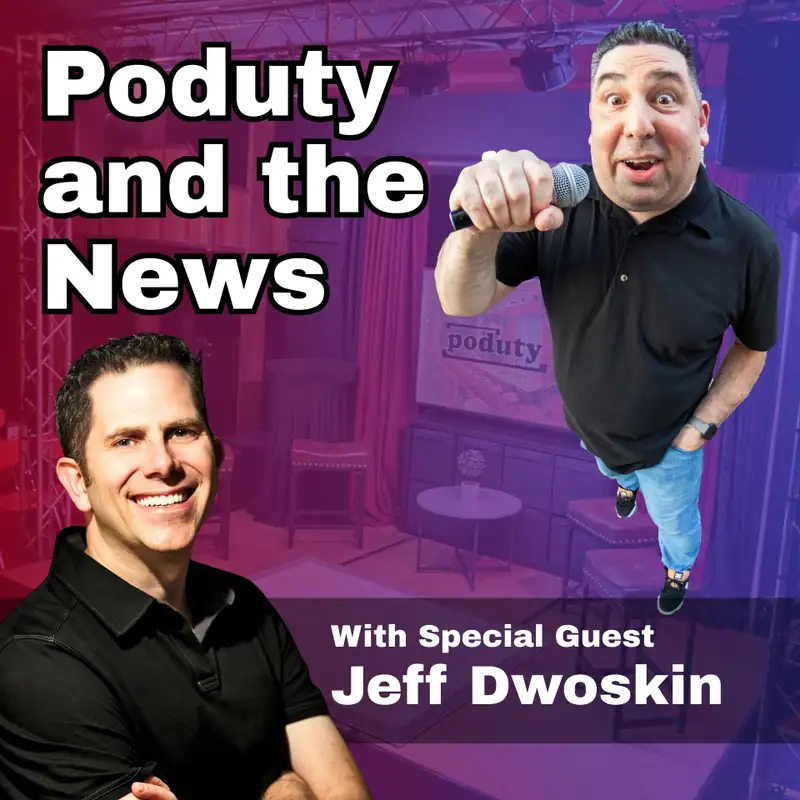
Hey everybody, it's a Tuesday night. I'm at the Harrison Theater on
Corbet Street, the Poduty Live Podcast Theater. Special guest Jeff
Dwaskin, #Roundup Classic Conversations.
I've got just one question for you, Jeff. You know what
time it is? Yeah, it's time we stop pretending we don't know what time it
is. What time is it?
Oh, it's time for Poduty and the News. Poduty and the News.
The only live news podcast about
podcasting from the state.
Poduty and the News.
Poduty and the News.
The only live news podcast about
podcasting from the state.
Oh, the only live news podcast about podcasting from the
stage. Jeff Dwoskin, welcome to the show. Hey, great to be here.
Way to create your own niche.
It's like, what can I be number one? Mine's the best, uh, mine's the number
one podcast of podcasts listened to
on Tuesdays between 3 and 4 PM.,
with only one earbud. So we were— Liam, no, if you go to
the Apple charts, that's— you'll see Classic Conversations is number—
always number one. I want to dominate somewhere. So the only live
news podcast about podcasting from the stage on Tuesday nights in
downtown Toronto, Pennsylvania. We can't be beat because there's
literally no other business open in this town tonight. Right now, I'm the only thing
with the lights on in the front. All right. Well, I'm excited to be on
the only, uh, live newscast about.
Podcasting. Maybe there's a reason why. It's a bucket. Hang on, give me a
second. What time is it? It's time to check something off my bucket list. That's
what time it is. Wow. It's like Stroh's is
America's only fire-brewed beer or wood-fired
beer. Maybe there's a reason for that, Stroh's. I was
just in Detroit this weekend outside the old
Stroh's ice cream building. It's now a brewery, but yeah,
so not too bad. I guess they're doing something right. We just don't understand
it. It's the only live news podcast talking about domestic
beer. The only live news podcast
about podcasting with Jeff and
Jeff. All the Jeffs. I was going to do one of those— everyone's betting
on things now, the prop bets and those markets where you can just
pick things. I was going to do a bet. Will both Jeffs have
brushed their teeth? I did just before because I knew you'd ask
me. I'm like, I'm brushing my teeth because I know Jeff is going to ask
me if I brush my teeth. I want to be able to
say yes in good conscience. Yeah, there we
go. There we go. And when we go back to your podcast, their Classic Conversations,
it is like, for me, I'm, I'm turning 50 this year, and
the guests that you're having on the show were
so influential in my childhood. And you're interviewing all these great
TV stars, movie stars from that time period when I was growing
up. And tell us a little bit about Classic Conversations. What can people expect when
they tune in? Um, well, that's exactly— you kind of
nailed, uh, what— now what it was— it hit the hammer on the head there,
uh, with the pocket. That's what it's— it is to me too. It's being able
to talk to people who I watched
on TV growing up. It's kind of
a thrill. I hope when people watch
or listen that, you know, it's kind of like
they have the same kind of passion that I do about the entertainment
and those people and those characters. And I'm just filling
in, talking to the guest on all of my guests,
on my listeners' behalf. That's what I kind of hope the vibe
is, you know, it's like I'm speaking for everyone and
then, and, uh, and making it happen type thing. Yeah, asking all the questions I
would have wanted to know, you know, 30, 40 years ago. Here you
are sitting down with them, going through some of those, you know, those
old-time production stories and the making of stories and some of the behind
the scenes stuff. It's, it's just tremendous conversation.
So I, my biggest thrill I've always said, like, people
ask, oh, I have people on The Love Boat— Gopher, Isaac, and Doc,
and, you know, Happy Days— Potsie, Ralph Malph, Mrs. C.
And then last December, I got the opportunity— The Love
Boat, uh, Isaac, Gopher, and Julie, um, Jill
Whelan— they all, uh, did— they're doing a Love
Boat— it's not really a rewatch, but they bring people on that guested
on The Love Boat, and they talk about their time on The Love Boat.. And
I, they reached out to me, somebody, their people reached out to me and they're
like, would you like to have all three on together? And I was
like, yeah. I mean, I was like, that's like a dream come
true. And, um, and when I was talking to Fred Grandy, Gopher, he, who
I had interviewed previously, he's like, and you can listen to
this. My, and my wife even says I'm not crazy. He's like, you know, Jeff,
when, after our interview, I, uh, you know, you kind of helped
spark this idea for this podcast. And I'm like, and
I got close at like, I interviewed Gopher
and then I end up inspiring or helping
to push forward an idea for a podcast on
a show I grew up watching and why I enjoyed being with them in the
first place. I mean, it's like, it was just a cool, it was a cool
moment. I played it for my wife because she normally, she would go, no, Jeff,
that's not what just happened. And, uh, but even she was like, oh my God,
that's so cool. Yeah, it's like, I— a lot of
times when I listen to the show, I think about those moments. Like,
could you imagine yourself, 1985, watching
Love Boat, and then 30 years later you're going to influence us, like
a spin-off podcast about it? Not that you would know what a podcast was
in 1985, but that you would have some sort of— even, even just to be
able to talk to those people back in 1985 was
so far removed from us. Celebrities were something
that were untouchable. You couldn't just walk in and talk to a
celebrity. And with technology today and what you're building, you're
able to have those conversations with things, with people we
thought were untouchable 30, 40 years ago. Yeah, I
mean, it's really kind of, it's wild and a little surreal. You can kind of
see in my background, I have all these 8x10s. So going to, and it goes
all the way around my office ever. And Going growing
up, I mean, in the last, you know, 10 or so years
specifically, like, uh, going to Comic-Cons has like been like my thing. So meeting
these people, so when I finally realized, oh, they'll talk
to me, it was, uh, it was quite— and then it's fun going to Comic-Cons
and meeting people in person that I had on the show.
So that's always kind of a thrill as well. So yeah, I
love it, love it. I'll put the link in the show
notes. Classic Conversations, Jeff Dwaszkin. You can see there's
at least— how. Many episodes are total? Uh, 411
as of right now. Wow. Yeah, 411 episodes of what we
were just talking about. Go back through and check the
archives there. It's really an incredible production. Yeah, when
I kind of look back on it, I'm like, I'm impressed
by myself. You know, I do it all myself, so it's like, you know. It's
pretty— it's a one-man show. It's a one-man theater. We got one-man show with
Jeff Dwaszka. Yeah, you're influenced by these actors
and actresses from the '80s and '90s, and I'm influenced
by our first story, which is donuts. Our first story tonight has
donuts, and that's maybe what caught my attention more than the ability to podcast
here. But this is called Donuts and Downloads from the St. Louis
Magazine, and Sweets by Sweetwater's in St. Louis is proof
that live podcasting does not have to start in a
fancy studio. It can start next to a donut counter.
Owner Byron Waters built more than a sweet shop. He created
a community hub with a rehearsal stage, event space,
and podcast room where kids can record their own
shows. That is powerful. Podcasting works best when it serves a
local community first. You build the room, you invite people in, you
give them a microphone, and suddenly you're not just selling
donuts you're building creators, building confidence, and building the
future of live podcasting from the ground up. And
this type of story is something that I, I relish in.
I love seeing these kind of grassroots moments where they're
putting something in. Maybe they don't know fully about podcast
studios and podcast recording, but they have some sort of interest, some sort of love,
and they also love donuts, and they put these two things together to support
the community. Let the kids come in after school, a safe place to hang out,
record a couple episodes, and, you know, go home with
a dozen. Yeah. Or baker's dozen.
Yeah. Yeah. The, uh, yeah. The interesting part of the story is where the, uh,
the owner's father was like, donuts, you're never gonna make it in donuts. You
gotta diversify. And so he, uh, he opened up that
podcast studio. So, which is smart. It's. Putting the
power of audio in the kids' hands is, uh, is a good idea. I
mean, Saturday Night Live, just a couple times now, Sabrina
Carpenter has, uh, parodied a,
um, snack talking, uh, podcast
by kids. And we've seen a couple of these, like, kind of, uh, like
Creator Studio slash something else. And more and more, they're, they're giving a place
for people to come in, and there is a stage here as well, so these
kids who are recording podcasts after school, there's an opportunity
maybe on the weekend or Saturday mornings when, you know, the most amount
of coffee and donuts are getting sold to possibly do a
live show in the venue while people are coming in and have some
sort of get-together, some sort of gathering, some sort of reason to bring the
community together. And you get this added benefit when you're teaching people how to be
on a microphone, how to record and
be comfortable. It's, it's also a lifelong skill that these kids will have, and now
they'll be able to perform that and give something back to the community
along.
With donuts. Uh, yes, yes, yes, yes. They'll, they'll be
able to, uh, start a business and charge us $200 an hour
to edit our podcasts, which we
make 17 cents on. But yes, I mean, economically it's got to make sense
for someone. So yeah. Yes, if you're out in St.
Louis in Sweets by Sweetwaters, check it out. It's an interesting
concept. It's not one I haven't seen one paired with donuts. I've seen
other like arts and libraries and, you know, authors. I've seen
them pair podcast studios together, but first time for everything. This
one has donuts. Donuts.
Let's go over to our second story tonight. We're going
lab coats and live mics. The Story Collider is
taking a podcast with about a million downloads a year and putting it
on a stage in Pasadena. Scientists,
comedians, firefighters, everyday people are sharing true stories about
when life goes off the rails. That is what live podcasting is
supposed to be like. It's not just information, it's
emotion, it's attention, it's laughter in a room full of strangers who
suddenly feel connected. When you take something that already works in the
headphones and bring it to a live audience, you raise the stakes,
you turn science into a story, And story is what
fills the seats. Welcome to Story Collider.
Another interesting concept. We've heard a lot about history
podcasts getting traction. Science podcasts are also
another big niche in podcasting that people are
flocking to. There are types of podcasts that people didn't care so much about in
high school. They didn't want to sit through a history lecture or a science
lecture, but as we're getting older and learning in different ways,
And these podcasters are telling us stories about things that
they're passionate about. People are starting to respond to that better than
just a general lecture in the classroom. It's a good
way to digest information. So, and you can listen to it
at 2 speeds, so you can take twice as much in, twice as much
learning and twice the speed.
So I'd rather argue about whether just because they're standing up saying the same thing,
if it's a live podcast. Well, if they record it
and distribute it. But what we are seeing is, as of— it's
so weird to see science and history
as forms of entertainment, you know. Yes, there's the History
Channel and Hamilton. Yeah, but these are things that weren't
really on people's radar 20 years ago. And, you know,
as we, you know, I don't know if we're getting away from books and reading
like I am, but entertainment as part
of education seems to be a route that more people are attracted to.
People who want to learn about science and history and, or just had that
little itch in the back of their, you know, in their back of their head,
I guess, they are now learning about the things that
they never really cared about because of the podcasts like
this. Yeah, it's a good medium to, you know, you can get a little creative
with it. And so it's, yeah, it's
I think it's great. I've been— there's a couple that I've been toying
with. I was like, I'm excited. But yeah, I think it's great. I
think sometimes those short form are really good, especially if you can just
nail one topic really quick. Yeah, we'll keep it moving right
along. We'll go to a story about AI.
Of course, we're going to AI. Everything this day and age
in 2026 is AI related, and AI takes the
stage And this comes to us from
TPBN. Dylan Patel from Semi Analysis
joined TPBN live at Cisco AI Summit to talk about the future
of AI, chips, power, and even data centers in
space. This conversation happened on a stage at a
real-world event. This is where big ideas belong. We
are still underestimating how fast AI is changing
everything. Including how creators produce content. But here's the
bigger lesson: the smartest voices in tech are not just publishing
episodes. They're showing up live, capturing the energy of the room,
and building authority in real time. In an AI-driven
world, the most valuable thing you can own is trust,
and trust is built faster when you see it live.
And so it's an AI summit conference. They're
recording AI-related podcasts all throughout the conference. So this is an
idea of getting your podcast in front of the audience where your audience
is showing up. I, I think it's one of the best strategies you
can do. No matter what you're interested in, what your podcast is
about, there's probably an event or an industry you could show up
at and piggyback, piggyback off of the people who are
already there. Yeah, absolutely, absolutely. So
this whole, this whole conversation, by the way, was created by
AI. So I, nothing I'm saying right now, I'm reading off teleprompter.
Every even saying I'm reading off teleprompter was written by AI and
I'm reading it now. Uh, right now it even.
Told me to go, uh, uh, the AI script I gave you said at, at
moment, uh, 17 minutes pause. And go, uh, uh,
that way, you know, it's real. Well, let's talk a little bit about
hashtag roundup. Are there any plans to implement some AI into
hashtag roundup? Uh, well, hashtag roundup is kind of retired a bit.
Stampede Social is, uh, is where it's at right now. The, uh, yeah, we
do have AI. It's a creator-based tool and we have
AI that can help you respond to comments,
uh, on Instagram using AI. And it can— you pick your tone
and theme and it can read your captions and give you suggestions on
how to respond to things in a very clever way.
Specifically like emojis, right?
And then you can do comment analysis
on your posts. You can do competitor analysis.
You can see what they're up to by analyzing their
comments. And then, yeah, so, you know, we integrate a lot of
AI, but sometimes
I think a lot of people look at, think of AI as, Oh, I just
need it to create a script for me, or I need it
to come up with ideas for me, things like
that. Like, and I've actually, that's not how I use AI
myself. I use AI to build tools that I can
use to make myself more productive. Yeah,
I apologize. I've known you for so long. No, no, I mean, it used to
be a competition. I wrote that thing ground up from memory on my paper, but
it, Stampede Social is what we're looking for. That's the correct name of the
company. I apologize for that. No, it's okay. You're okay.
Um, I, I, uh, yeah, so yeah,
I mean, AI I think is a big deal, but I think, uh, I mean,
if you want my two cents on AI is you have to become a master
of AI. And, and I don't mean a master of asking it for stuff that
you would then parrot. I mean, you have to become a master of being able
to create things and help it leverage you
do what you were already gonna do better and not be the
lead, but you're a copilot. But I built an entire, when we
talk about podcasting, and this is specifically great for
live news podcasts. Really, it's only
good for if you're a news podcast that's
live. But I created a whole tracking system, like how everything
I do, and then, and all the data I collect for gas and stuff like
that, I create an entire app on my thing, and it tells me
when the calendars are. I put the release dates. It, it reminds
me to do everything. And so I built it all with
AI. And so, you know, and they just run it.
So it's, um, it's, it's a great way to make— we're in a world right
now where if you can think of something, you can create it. So
if you have things that you're doing repeatedly, you can create those
apps. You don't have to rely on, oh, well, Notion does it this way, so
I have to do it that way. You can just build it however you
want it. Very nice. I usually tell people, if you're, if you're just getting into
AI, if your prompts aren't as long as the output, you're,
you're probably relying on AI too much. Like you're, you're, you're letting it create
too many things. You should have full thoughts and full
direction. And it should enhance what you're doing and make you better at what you're
doing, at least on the level I'm not using it for coding or anything. I'm
using it for creation and editing and
animating things. But I always say, like, your prompt, you should have
a really detailed, well-thought-out prompt before you take anything
out of AI.
Yeah, yeah, that's true. And then, you know, it's using
the same AI over and over again, you
know, and if it has memory like Claude or ChatGPT has memory,
it can start to— you can train it like, don't
use em dashes, do this, do that, you know, this is the type of
tone I like. So you can train it to know certain
things every time that you don't have to refeed it, you know. If it's, if
it's making you images, like I have a classic conversations GPT
that I built So I gave it all the colors that I use from, you
know, so I don't have to ever tell it that again. And then it just,
it can always just kind of do it that way. So yeah,
it's pretty cool. Pretty cool. It's amazing. The amazing thing about
AI is how fast we're all become addicted to it
and relying on it. That's, that's the crazy thing. So fast
and scary all at the same time. We'll keep it
going. Speaking of fast and scary. The 40-year-old
sweet spot. It comes to us from Inside Radio. For
years, advertisers chased the youngest podcast listeners, but the real
opportunity might be 35 to 44-year-olds. New data shows they
are more likely to remember ads and more likely to make a big
buying decision— insurance, home improvement, wireless,
even executive-level B2B decisions. And here's what jumped out to
me: that same 35 to 44 demo is who shows up
for live podcast events. They have careers, they have families, they
have money. If you're building a live podcast business, you're not just
building an audience, you're building access to the most valuable
buyers in podcasting. That changes the math. And you start
thinking about larger comedians and actors who have podcasts,
they're filling theaters and arenas now. But if you look at
that audience, it's 35 to 54-year-old you know,
couples a lot of times. It's, it's the same demographic
going to these. And that's something I noticed with selling tickets here for this theater.
We're only a 40-seat theater, but the people who
show up are 35 to 45 years old. I,
I'm like, like people that I would have grown up with are showing up and
to these live podcasting events. So that demographic may
have been overlooked, that, or not even one that you think of is
listening to podcasts, but This data from Inside
Radio says otherwise. Um, I always thought it was 40 to
44, so I don't, you know, my target audience
is 45 to 65. Well, you should be
doing live shows and selling tickets. I should, I should be, I should
be actually. Um, oh man. Um, yeah, no, that's good. I
mean, I wish I had stuff, more stuff to sell them,
I suppose. Well, you do Crossing the Streams. That's a live stream podcast.
Isn'T it? Um, yeah, we, we, uh, I haven't done it in a little bit,
but yeah, we did it for many years and then,
uh, everyone just, everyone kind of retired.
And so, uh, but yeah, I like doing live is, I
mean, it's, it's a lot of fun. I mean, it's like, because you
know, it's there's no editing. So it's like, you know,
you just go. And it's the thing
I learned I find most fascinating about live
shows versus edited ones is people
will accept different things from a live show than if they
were watching something that was prerecorded, edited, and then
put out, right? Like we could have a glitch right now and we could be
funny trying to figure out, and people would watch that because they would think it
was funny. But if we, if you were to put that on a
podcast, audio-only version, people would be like, why the hell did he not
edit this out? I don't need to hear this. Well, we'll keep, let's keep it
going right along. We're going, we're climbing towers.
We're going to climbing live on the Rich
Roll Podcast. Alex Honnold's first podcast after
free climbing, Taipei 101, happened live on the Rich
Roll Podcast, and more than 32,000 people have already watched
it. Think about that. A historic moment followed immediately by
a live stage conversation. That is powerful.
The tension of climbing carried straight into the energy of
the room. Live events let audiences process big moments together.
They feel the risk, they feel the relief, and they feel connected to the
person who just did something unbelievable. This is
why live podcasting is so important. It
turns interviewers into shared experiences, and shared experiences
are what
people remember. This type of event where they had this theater space, they pulled out
two chairs, and they just had a one-on-one interview in front of
a live audience right after this thing aired on
Netflix, right after just ascending the top of a
building. And you're— that person, Alex, is
still probably has adrenaline pumping through his veins, is still pumped
up from accomplishing this feat, the live show, probably got a nice check
from the live stream from Netflix, and now he can sit down,
take a minute, and tell the story of how it all came
together. There's something about, um, and you know, I
did stand-up comedy, so you know, there's interesting—
when you do it just your act or what would be considered like a
normal show where things are just going normal, people enjoy
it. They'll remember it. But when there's moments
that are clearly specifically unique to that moment
that, you know, may not happen again,
off-the-cuff comments, you know, the vibe and the energy that you're
describing with somebody just finishing something incredible that doesn't
happen very often. And that, I think that imprints
on somebody a lot differently. And I think it stays
with them forever. Those are the things, those are the stories people repeat. Oh my
God, you're not going to believe what I did, right? And, or what I heard
or what I saw or what I, where I was. And, you
know, that's, those are the, those are the cool things. That's like a live, you
know, when you go see like someone in concert or any kind of, any
kind of live experience, I think, uh, imprints a
little differently. One of the things I say about live podcasting, it's truly
a once-in-a-lifetime experience. You can only see that story be told
one time. They can't take that tomorrow and go to Cleveland and
do another set, another recording of the same podcast. Where a
little bit different than comedy where you're working on a routine, you're
trying to, you know, perfect 7, 15, half an hour. And
the music, the same way. You're gonna go to a town, play the same
15 songs, and then go to the next town and do that. But with, with
podcasting, like, you and I can't do this show again tomorrow, right? It's already been—
these 6 stories are spent. We're— no one's going to come and see us. I
don't know, I think we could dig in, I think, a lot here. We'll take
it on the road. But it's— but it is only going to happen
tonight, and that's it. It's the once-in-a-lifetime opportunity to see
a podcast recorded live, and it— most of the time it's not going
to happen again. And, and that's, I think, what makes live podcasting
so special. Yeah, I can concur. This will never happen again. No, I'm
just kidding. He's never coming back. No, this is it. No,
I'm kidding. Uh, I, I'm upset it took you this long to have me. Um,
no, I'm kidding. Uh, we're building hype. We're building hype. The—
no, I— you know, you're right. I mean, when you— anytime you
watch something, um, you have, uh, anytime you
have some unique kind of thing where,
you know, um, like when I go to like going to Comic-Cons and they have
like the panels, you know, like, and the people, you know, depending what questions
are asked or how things go,
um, it's, um, um, you know, you just, you know, like nobody's
gonna ever have that again, you know what I mean? They may answer the same
couple, some of the questions or stories, some of the stories may be the same,
but there's always some question that gets asked or something that
happens or, you know, that, you know, just kind of alters
it or makes it unique for that moment.
Yeah, and that's a great segue for our last story because it is— it's
at a comedy club, it's actors
and artists talking about artists on Artist on Artist. So this is
a show business but live. Artist on Artist on
Artist on Artist is taking their podcast live at Dynasty Typewriter
in Los Angeles And one— and this one checks all
the boxes. Big comedy names, audience suggestions,
industry gossip. And here's the key part. They're selling both
in-person tickets and a live stream. $25 to be in the
room, $20 to watch from anywhere. This is the future model
of podcasting. You monetize the stage and the stream at the same time.
You create urgency with a live show, but you do not cap your audience
at the door. This is what modern podcasting looks like
when creators treat it like show business.
Oh, business. And this is, this is a, this is a playbook, you know, page
right out of my playbook where I have a virtual stage. I have 40
chairs in front of me and we're surrounded by cameras that we
can broadcast this out like we're doing now. So you could watch this show if
you wanted to come see me on a Tuesday night, uh, hang out,
watch the show. You could watch it from your living room.
But this is where I think the model of podcasting is going to go, where
these types of events give you more access to local
people, virtual people, and you're sharing the story all in real time. You're
getting the recording and then releasing that as
your podcast. It's, uh, creating, uh, an
experience is amazing. It's just there's a lot of— I'm sure
there's a lot of overhead that goes into it,
right? I, uh, I, I wish it was an easier way to do it just
because I, I enjoy the flexibility. Or someone cancels, you know, in
the last second, you know, that kind of thing. It doesn't matter for me
with my podcast, but, you know, it's, it's one of
those things where, you know, hope people show up, you know, it's a
whole different energy, a whole different vibe. So, but yeah, I know it's,
it is great. It'd be cool to be able to do so if I had
the following, could do that once a month. I know somebody could do that. Pull
it in, you know, that'd be good. I'd like that. Let's
do that. That's a lot of fun. We're going to do this once a month.
Come back to the Jeff and Jeff, the only live news show
with two Jeffs. Two Jeffs talking about
live podcasting live at the Harrison Encore Podcast Theater.
This has been Poduty in the News. But before we go, I turn the
stage over to Jeff one last time. Plug, promote,
Talk about anything you'd like. Jeff, the floor
is yours. Poduty? You could— you, you call yourself— I thought
it was POD-duty, but I don't know if that— yeah. All
right, we're gonna— first we're gonna rebrand, and then—
oh, Classic Conversations, uh, jeffisfunny.com. That's
the easy URL for that podcast, uh,
website. You can get all the links there.
Stampede.social. If you're a creator and want to, uh,
help drive, uh, attribution automation on Instagram
and Facebook, check out stampede.social. Uh,
that's it. That's it. Yeah, back to Poduty.
Back to Poduty Live on the stage. There's the theater space that we're
talking about. It's— we got a whole place. We have HDMI access. You could
run any type of show that you want on on the stage.
There's no contract, no minimum ticket sales. I'll record it, sell the
tickets for you, and split the door with you 50/50 at the end of the
night. Check it out at poduty.com. P-O-D-U-T-Y
dot com. This has been Poduty in the News. Look for the
rebrand next week. What time.
Is it? It's time for
Poduty
and the News, Poduty and the News, the only live news podcast
about podcasting from
the
state. Poduty and the News, Poduty and the The
only live news podcast about podcasting
from the stage.