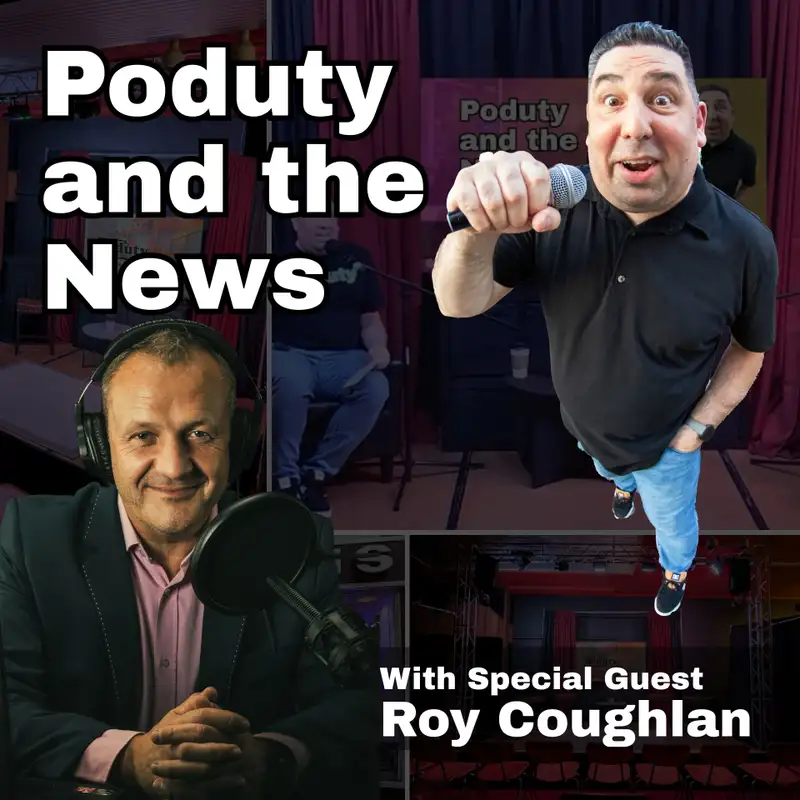
Hey, everybody. Welcome to the Poduty Live Podcast Theater. This is Poduty and the News.
I'm your host, Jeff Revilla. I've got a great guest. We're going to be talking
about six live stories about live podcasting. We're
doing it live from the stage. Roy Coughlan, do you know what time it
is? It's time to have people sit on the chairs.
What time is it?
What time is it?
Oh, it's time for Poduty and the News.
Poduty and the News.
The only live news
podcast about podcasting from the stage.
Poduty
and
the News. The only live
news podcast about podcasting from the
stage.
Oh, the only live news podcast about podcasting from the
stage. Roy Coughlan, the Podfather podcast coach,
officially welcome to the show. Thank you very much, Jeff, for
having me. So glad to have you here. We've had some conversations in the past.
I've been a guest on your show, had a great time, kind of continue that
conversation and seeing all the success that you've had in podcasting,
the amount of shows that you've launched that have had success, the. The coaching that
you're doing. Why don't you tell us a little bit about the Podfather and
some of your coaching services? So on
podcasting for eight years, I've got
eight podcasts at the moment. My coaching is kind of
helping people that want to start our existing
podcasters. I also help people do a podcast tour.
Maybe they're an author and want to do their business. And I've got a
school group as well, because I'm kind of conscious of different levels.
So the school group has courses that I professionally recorded
as well as all the episodes. I do a live Q A. And at the
end of the day, I want people to stay in the game. I want them
to get off the news, stop watching cnn, BBC, these channels,
and start listening to podcasters and enjoy the conversations,
whether they're doing it themselves. That's the best way to do
it. I mean, podcasting really is that connective medium where you get
that intimate experience, listening to somebody and sitting down in
your car ride or while you're working out or walking around the block.
You know, you're hearing those stories and you're getting that firsthand experience.
That's. It's. I think it's the best medium for connection.
No, absolutely. And the thing is, as well as sometimes, like, there's loads
of ways of listening to a podcast. I mean, if I'm cleaning the house or
earning, I'm listening to a podcast. I'm Going to the gym. I'm listening to podcasts.
I go for a walk, I'm listening to a podcast. I'm in the car, you
know, I dropped the child off. My child doesn't want to listen to a podcast.
But when I'm coming back, I'm listening to a podcast. I. And by doing
that, you're actually arming yourself with knowledge for when you're recording
yourself. Yeah. And plus, you're supporting smaller, independent
creators. You're supporting somebody who has maybe a home studio
or a small theater space or a business owner in your community
talking about their goods and services. That's who you're supporting.
You're supporting friends and neighbors and people with families who support things
in the community. So think about that just as a
core concept of who do you want to be around
in this world? Do you want to be with your friends and neighbors, or do
you want to have these giant corporate conglomerates that are
controlling a single narrative? That's up to you. But podcasting is
a great way to support smaller, local, independent creators
if people want to connect with you. I know. Podfather Me, I believe, is the
website. What's the best way if people wanted to get in touch with you? Roy,
I've got. Actually, it's my name, Roy Coughlan.
That's roycoughlan.com. all my
stuff are there. My aid podcast. I've got a virtual assistants business.
Everything is there. So, I mean, I kind of. I'm a serial entrepreneur,
so there could be something that's there now that I decide I don't like this
anymore and I move it out or something could be added. So
roycoughlan.com you'll find everything. All right, I'll put that link in the
show notes. There are. There's a lot of tabs across the top. You will find
something that interests you when you go to the site.
Are you ready to get into our stories? Absolutely.
We'll go to story number one. Oh, we're
going to the West Wing. Our first story. Today, the reunion
becomes the live event. This comes from the Happy Sad, Confused
podcast. Twenty years after the West Wing ended,
fans are still showing up. Martin Sheen and Dule Hill
reunited live at C2E2 on the Happy Sad, Confused
podcast. And it wasn't just a conversation. It was an event.
They shared stories, revisited iconic episodes, and reminded everyone
why the show still matters. This is what live podcasting looks
like when you tap into something people already care about.
You're not building from Scratch. You're activating an audience that's
been waiting for a reason to come back together. And one of
the things I really liked about the story is just showing podcasters that
if you have some interest in some sort of nostalgia,
you don't have to be Martin Sheen or Dulay Hill. You can just be a
fan of these shows and people show up. That's a reason
to put a podcast on. If you're passionate about a show or a
movie, and that's the topic of your show, people showed up
to come see this and talk about one of their favorite shows
and the thing as well as with a show. Like sometimes
people think that they have to be a specialist
to be the host. I've had one the crypto. And I'm
not. I'm basically asking all the questions and I
assume to be all beginners that would come in and it's experienced crypto people
because of my curiosity or actually liking the
questions that I'm doing. So you just don't think that you have to be a
specialist in the field to do a show as well.
Yeah, People come together around common interests and you
figure out what your interested in the most, what are you passionate
about? And we guarantee you there's people out there
who are also interested in the same things. You may not find them
exactly in your backyard, but around the world, people
will share your same interests and they'll want to hear your perspective on
it. Everybody brings a different perspective. There could be five or six
West Wing shows and each one, I guarantee you, is
different than the next. And like there's one I have
is the Polish one. And most people, they
teach a language, they spend an hour
and they do grammar and people yawn and get bored. And
what I wanted is, I wanted it fast, five, 10 minutes.
And talk about stuff that you need when you're in a foreign country.
Like if you go to the dentist, all the different things you need to do,
get your teeth filling, get something taken out. If you go to a car,
you know, get your tires done, all these different things. And
because I've done it in a way that gets you entertained and
engaged. It's got millions. It's like 4 million
combined between the audio and the video. Imagine an Irish guy teaching people
Polish. I'm. I'm the student and I have the teacher. But you can get
very creative. Don't think just because everybody's doing it that way you
can do something different. I mean, I, I did a picture for that show.
I set up a tripod and I took a picture, crappy picture,
and it was number one. It was ahead of duolingo, ahead of BBC
language, a bit ahead of a lot of things. I eventually, you know, kind of
done a professional thing, but so sometimes you might think
something's not going to take off, and it can, but you can get very creative
when you're doing something. Yeah. And that's a great example, you know,
not native to the country, teaching about the country. It's a great
way to help outsiders feel inclusive. And I really like that concept.
Well, let's go to story number two. This one's kind of
blending old media with new media. This comes to us from Podcast
News Daily. And radio isn't dying, it's evolving.
Ozen FM just launched Podcastbot
AI, a tool that turns live radio into on demand
podcasts automatically. It records broadcasts,
pulls out interviews, cleans up the audio, and publishes episodes
in minutes. This is a big shift. Broadcasters
aren't creating more content. They're getting more mileage of what they
already have. And it reinforces a key idea for
podcasters. Growth comes from distribution. The more
places your content lives, the more opportunities you have
to be discovered and monetized. There's a thing as well, like
when people see that, I hear a lot of times I'm not sure about yourself,
they think the market is saturated. There's over 4 million shows.
When you look at it there, There was over 4 million podcasts
in the last 30 days. It's less than 400,000.
That's active. That's not a saturated market. That's
tiny. So don't think that, hey, I've missed the boat on
this. That I. It's going to be too late. But that's brilliant. But what they're
doing there, I think is fantastic because there's even channels that I listen to, like
Red fmn. Yeah, you're trying to find stuff. But if I knew,
hey, this is converted onto a podcast. Now I can go in and when I
know there's a certain topic, I can go in and watch it. I would be
subscribing to radio stations from that.
Yeah, I could just think how many times, like, I wanted to listen to a
radio station in the morning. But maybe I had that dentist appointment you were talking
about earlier, or I had a doctor's appointment. I had to miss that one
segment. Well, now you don't have to worry about missing that
one segment. You waited all morning for through 20, you know,
two hours of commercials, and then you had to step out of your car.
Now that Episode could be recorded for you, cleaned up
and enhanced, and then you can catch it on your lunch break or on
your ride home, which I really love having that feature. That
was never an option before for traditional radio
to go back and listen. And now you have that opportunity to
rewind live radio. And the thing is, as well
is because a lot of people, when you create a show, they think,
I have to spend so much time putting it on iheartradio, I have to put
it on Spotify, Apple, when you have an RSS feed, because not everybody knows
that you get your unique kind of code. Once you set it up, you release
an episode. It just does its magic. I have things going to Amazon,
Pandora, everywhere. I don't even think about. I've even got
then my. My POD page that once it goes to
that, it's automatically releasing the episodes from that. So if I
have a graphic and everything that's going out to X, it's going on to LinkedIn.
You systemize everything. So sometimes people think, oh, this is going
to take too long. Like a couple of weeks ago, I got 22 episodes out.
And I. I'm sure, Jeff, that you've heard so many people go, oh, I don't
have time for one. It's not about that. It's just systemizing everything. And
when you systemize it, then it's not painful. And I know we've even been
discussing ourselves, like how you're going doing stuff. And that's the secret.
Because otherwise it becomes a chore and you want to have it, that it's a
passion and not a choreograph. Yeah. And I love this idea
of expanding reach. You think about local radio, it's only
broadcasting, what, 20, 30 miles around a city?
But through this ability to record and download, if you're
maybe homesick or you're traveling or you want to hear what
are they talking about in California or Istanbul? Now you
can download and extract and hear all these stations from around
the world whenever you want. Don't just tune in when it's live.
You can go back, rewind and hear morning segments from
New York or Florida or Cuba probably. I'm sure you can hear all
these different perspectives whenever you're available.
We'll go to story number three, keeping it moving. We're
going to the RSA conference. This is from a book to
a stage to authority, which I love this idea of.
You're creating one piece of content that lives on. In this example,
we're talking five years later and Nicole Perloth wrote
a Best selling book about cyber warfare back in 2021.
And five years later, she's still on stage talking about it at
major conferences like rsa. But now the story has
evolved. She's not just reporting on cyber, she's helping
shape where it's going to. This
is what smart creators do. One piece of content becomes a
platform. It turns into interviews, live events and
ongoing conversations. For podcasters, this is the play.
Your show is not just content, it's your entry point to
bigger rooms and bigger opportunities.
What you can do with the content that you have from interviews, you can use
AI to do it, but you can extract the
transcripts and then create a book from that. I mean,
with the books get you on stage and then obviously you can create
short content as well and post that everywhere. And like, we've
got a bit creative with the way we do it because a lot of times
the social media platforms don't want you to move from one platform to the
S. So what we do is we have either my website or some
of the clients that we use, we use a QR code. So when it's posted,
you're not putting the link because Facebook doesn't want you to, you know,
go to LinkedIn or they all want to keep you on that place.
So you can actually, you know, get a bit creative as well and have your
details in the short. So the shorts become from the podcast
and there's a lot that can be done. And the thing is, I. My best
episode on the polish one is episode number one. It just keeps
churning away and most of it's evergreen. And that's the
thing, like you've done it once and you put it out there and sometimes you
can re release it, you can reshare. Sometimes people think I share it once and
that's it, you can share it again. Two months later you can
reshare it. What I've done is I've actually started creating new
thumbnails based on the AI that I'm able to do. And it looks way better
before I put up a picture. I mean, it's like you could put up a
picture of me, nobody who cares about me. But if, if you put up a
picture that's a graphic that's connected with what we're talking about, that grabs
people's attention. And even if it was a picture of me and then three months
later you're putting up a graphic, you could actually get 10 times more people look
at it based on that. And then you can, you can analyze things as well
and Say what's working? And you get all
that immersed when you go to these conferences, too. So if you're
creating content and you're going to the places that are talking about,
like, the RSA conference, talking about cyber security, and
there's authors there, I think that that's very important for
podcasters to figure out that when you go to these
conferences now in 2026, whereas
we'll rewind, like 20 years ago, podcasters would sneak in with media passes. That
was kind of the play for podcasters. Go to a conference, get a media
pass, and go around and interview everybody to get content for your podcast. But
as podcasting has evolved, and this is where I think podcasters should really be
thinking, there are these conferences, there are these events
that you can plug into. Conferences are now using
podcasters as the entertainment for their
stage. And before, they used to have magicians and musicians
and comedians try to fill the time in between speaking
conference, speaking gigs. Now they're putting panels of
podcasters up on stage, and you're getting content from the
main stage, which boosts that credibility, which makes you
a thought leader in that industry. So, you know, how do you take your show
to where your audience already is and, you know, build all those
assets that Roy's talking about, like, how do you. How do you put all that
together? Here's a great strategy to do it all in one
place. And another thing that I've seen people do as well,
you know, if you're not going to be on the stage, you're just kind of
walking around trying to connect with people is they have the QR code on their
T shirt. And people, just out of curiosity, and. And if they know you, hey,
they'll probably check your socials and stuff like that, and they go, hey, I'd like
to be on your show. And with the, you know, the way technology's got before,
you couldn't really do that. But no, you can have a, you know, if you
go into a certain room, you can have a 10, 15 minute with, you know,
somebody that you would never get on your show. So it's well worth it, having
the gear, which is. Well, yeah,
the networking is unbelievable at a conference because you're going
to where everybody in your industry is already attending, you can make
those connections and even down the road, months down the road,
have guests booked just from that single appearance at that
conference. So use those QR codes, use those business cards, make
those connections to fill up your show for a couple months.
We'll go to story number four. I was telling
Roy about my situation here. And the reason I play the theme song
is so that I can run to the stage after I hit record.
So this studio here, they're doing something a little bit different now. There's a
significant investment to do what they're talking about here, but you don't need
a crew to go live. Like, it's just me in the theater by myself, and
Roy is virtually from Poland, and we're just hanging out doing a show.
But here is an example of somebody who built a home studio without
a crew. Everything's hands free once they go live. And this comes to us from
the pss Creative Media. If you've ever thought you
needed a full production crew to run a live podcast, you don't.
This setup uses Riverside and the Rodecaster video to
automate everything from camera switching to streaming. The
system listens to who's talking and cuts to the right camera in real
time. This means you can focus on the conversation, not
the tech. This is exactly how live podcasting grows.
When the barrier to entry drops, more creators can step on
stage, hit to go live, and start building an
audience. And there's so many
live streaming tools as well. I mean, I've done, We've used Streamyard, we do
live shows that I was doing for a couple of years.
And it. You get very comfortable doing it. You know,
it's, it's. Sometimes people think that they'd be nervous and everything. It's strange, but
it's just. You just get so used to it, it's okay. And
regarding kind of building your own kind of, say, home studio and everything,
like, when I moved to this place, it was just before the craziness happened in
2020, and I had a room picked out in the house. I said, oh, I'm
gonna have a great studio here and everything. And once the car started kind of
moving again, I was like, okay, this isn't good. So I'm kind of in the
middle of how. But I constantly evolve with lighting, with sound. I've used
Restream. So what happens is when you're in the space,
it's okay if you're making mistakes and you're learning, but what will happen is you
get the likes of Jeff coming on your show and he'd be telling you what
he's doing, you go, oh, that's good. He'll sell you some technology, some buttons.
You could do this. And if you keep learning the whole way, it's okay
that you're just starting something and you realize, okay, I got a Camera, like, if
you see behind me, that's a green screen. Normally I'm doing my stuff on zoom
and I can actually, I have like, my. My advertisement
as such on it. So when I'm. So you can just get as creative as
you want and as you say, like the cameras and there's
courses that you can do. You can go online and YouTube that will tell you
how to do things. So sometimes people think, I need to spend hundreds of
thousands to do this. You can do it on a shoestring budget. And
even if, like, you can get a ring light and then later get something else,
like an LED square, like, just keep developing. I mean, I see, like, even from
when we. You were on my show, like, what. The way that you' created that
studio. Like, I remember you telling me how you were getting the chairs and all
that. It's fantastic. You know, you've done it brilliantly and it looks
incredible. Yeah. People always ask me, like, well, how do you
get started? I'm like, you can get started with what you already have. I
guarantee you, you have enough equipment to start doing a live
stream now, to start recording a podcast now, you don't need
to start with a huge investment. You can start with what you already have.
And like Roy says, you don't need all that fancy equipment to
get started. You want to do it. I mean, I think getting
the systems that you mentioned, that's an important part of podcasting. How do you
repeat this week after week? But getting started and
developing a skill, learning how to be on a microphone, learning how
to entertain people, learning how to be in front of an audience, learning how
to host a guest, those things are skills you'll develop over time,
over 20, 50, 100 episodes. And as you do
that, guess what, Your podcasting skills also improve your
editing skills, improve your recording skills, improve
the whole show grows with you, especially on your first show, your first attempt,
Start small and grow from where you're already at. But
getting that momentum going, getting those systems in place, I think
just like Roy said, that's way more important than all the
tech that you need to use. You can. You can correct most things now with
AI and through free tools online, there's enough to fix
your sound. But just get started and get that momentum and
get. Get those systems down first. And what I would actually
recommend people do as well is go on a podcast tour and start,
because you'll start seeing other people's forms. You'll see how they're doing it.
Everyone is generous with how they do it. They'll tell you what they're doing.
And the other thing that's very important is you. When you're on the show, people
will ask you different questions, and then you realize you had a story
buried deep in your. Your mind, that it's like, oh, this is an
interesting story that you can then bring to your own show and make sure you
kind of develop it a bit. So there's a great advantage of doing a
tour as well. Yeah, you can learn so much. I even tell people how I
built this theater. So if you ever want to know, like, I'll. I'll tell you.
This thing was a shoestring budget. I put this all together to. You mentioned the
chairs. I bought chairs from a Catholic school that was closing,
and I made them an offer. I thought 100 chairs at $2
a chair would be great because these are like $40 chairs.
And they instantly accepted the offer. So I went in too high. I could have
even got them for a dollar. But it did go to charity, so I was
excited to be able to acquire the chairs and make a donation. But you
can do things on a shoestring budget. There's, trust me, in this
country, there's enough consumerism that somebody has already bought the things you need,
and they're probably willing to unload them dirt cheap. So, you know, think
secondhand. Don't think brand new right away. You'll build those skills
and build your tech stack as you get better and better at it. And
you don't need to be technical as well, because, like, say, with the mic, you
can get a mic, a decent enough mic for about 50 bucks, but maybe 100
to 200, and you can plug it, a USB, into your computer. You
don't need to be technical. A lot of people think I need to be really
technical. It is so easy to do. It's simple. You know,
50 bucks, you get a Logitech webcam, it's like 100
bucks and maybe a ring light for 20 bucks. And, you know, all
in. You're like around 150, and you can start a show
and you probably have half of that in your house already. Exactly.
Well, I love this next story. Very meta. This is a TV
show doing a show that's a live podcast
within the show. So, of course, I gravitated towards this
one. This is from the a&e YouTube channel for the Duck Dynasty
revival. And we're going to talk about when a live podcast becomes the
show. Very meta. Especially for what we're doing this morning. Roy
Live podcasting just made it onto reality tv. In
Duck the Revival, Sadie Robertson hosts her
first live podcast with Thomas Rhett. And of course,
things don't go as planned, but that's the point. The live element
creates tension, unpredictability, and moments you can't script.
This is where live podcasting wins. It's not just about the
conversation anymore. It's about the experience. When
things go off the rails, that's what people remember, and that's
what makes it worth showing up for. There's a whole
spontaneous element to this, and that's what I love about
podcasting. I grew up in the 80s and 90s. I grew up
skateboarding. I grew up punk rock. So like that
idea of chaos, but controlling the chaos and
not knowing what's around the corner or what the next adventure is,
that's part of performing live. You have no idea sometimes how the audience
will react. You have no idea if you're going to be a guest
on a show, what the next question's going to be or where the conversation is
going to meander to. And that's the beauty of live. It's. It's
the experience. And as long as you immerse yourself in it, you're going to have
a good time. And I think some people watch the
live shows because they want something to go wrong. They want someone's phone to
ring. They want to see how people react. They want somebody in the audience to
get aggravated and kind of throw a question. And by
doing that. And when it's live, it attracts more listeners.
Yeah, you have no idea. And sometimes it does go off the rails. And like
you saying, that is part of the show, and that's what people turn into. They
want to see that train wreck, and they want to see what happens when things
go off the rails and you just don't know. And that keeps you on the
edge of the seat. That keeps the show interesting. That keeps you moving along
to our last story. Already we're going
to 414 day. This comes to us from the
recombobulation area. The
recombobulation area isn't just hosting a live podcast.
They're attaching it to Milwaukee Day, a citywide
celebration. The event is free, packed with local voices,
and layered with incentives like subscription discounts and giveaways.
This is the play. Your live podcast should not exist in a vacuum.
It should plug into something people already care about. When you
combine community, timing, and shared reasons to gather,
the podcast becomes the centerpiece of the experience.
I think we kind of touched on this one. A couple times. But, you know,
this is. If you're in Milwaukee, you're doing a Milwaukee show,
and they're doing a celebration to celebrate Milwaukee. Guess where
your podcast should be? It should be in the heart of that celebration for your
city. And you should become the face. You should become part of that
entertainment, celebrating your love of Milwaukee. The local
sports, towns, restaurants, all the things that make Milwaukee unique
that you talk about, this is. This is where you belong.
It's a fantastic incentive. And even what you're doing, I mean, like, I
would love if there was something like that there, you know, because
it's. It's a totally new experience, and you're just. You're kind of testing
yourself as well, because you're going to studio. I mean, I. I went. And this
is something as well that I find with a lot of, say, podcasts. Some of
them are sh. I was extremely shy, and I kind of made a decision
kind of in my mid-40s to kind of join
Toastmasters and then join another club. I became. I
formed my own club, but I kind of transformed,
and I told myself, all right, I'm no longer this shy person, because I
told myself that's who I am. And I think a lot of people
might think, I can't do my face. I can't do this. I can't. It's like,
if you have a message that's going to make an impact in
the world, you know, there's a lot of craziness going on. If you can make
the world a better place, if you. You don't need to be getting a million
downloads. If you got one person that was listening, you've
just changed their life based on your knowledge, you should do that.
And I love these kind of live events and everything because, like,
I think people, when you've got the human touch, it's brilliant. Yeah. I
can, as I said earlier, enough, I'm at the gym or something listening to some,
but if I'm there, you're kind of touching into the
connection with humans as well when they're doing the live event. So I'm
hoping that this expands to every city in the world, because
it's a fantastic thing. Yeah. Even if you only
meet 10 people and you shake 10 hands and you get to share stories
with 10 people, that impact is exponentially
better than 100 downloads. A thousand downloads of your podcast,
you've made 10 new connections. They're gonna tell other people about it.
They're gonna be your biggest fans going forward because they have a connection
with you. On such a deeper level than just hearing you. When they
download your show once a week, they're gonna tune in every week. You may
even mention them like, oh, I met some great people at 414 day. You know,
I. Fun Bobby, you know, he was a great guy. I had a good time.
We talked about the scones from that Harvest Moon coffee shop down the street.
And you start tying all these stories and tying all these connections in,
you become the center of Milwaukee. People want to hang around with
you. You're the expert. You're the reason why they tune in.
You know where to get the best corned beef, where to get the. All my
references are food, apparently, but you are the face of
that city. When you develop something like this, this type of
concept, go there, support them, and be part of the community.
And that is gonna wrap it up for this padootie in the news.
I do one last thing. I turn the floor over to Roy
one last time. Plug, promote, talk about anything you'd like. Roy, the
floor is yours. Well, the first thing I'd like to say
is, if you're watching this, can you comment, give a
thumbs up? Because what Jeff is doing is fantastic. I've had him on my show
and I want more people to actually go to the theater, subscribe. So
please do that if you're on any of the platforms where it's released, you know,
five star, it's easy to do. And Apple as well give a review. So that
will help with me. Everything that I'm doing, all the
podcasts go to roycar.com I now have
called the podcast network. So what I'm trying to do is help the
small boy to do the sponsorship because a lot of these companies,
they're taking 90% of the money. So I'm putting something together
that they're kind of working with me. I'm talking to the sponsors and they can
dynamically place it. So if you're interested in that, let me know. And the
Podfather me. If you're interested in starting a podcast or you're an existing
podcaster, I've had incredible interviews, including with Jeff.
Every single person brings something good to the table, so be sure to check it
out. Thanks, Jeff. Awesome. Thank you so much. All
those links will be in the show notes. We'll have a special page dedicated to
Roy too, so we'll keep updates there. Any future shows, I'd love to have Roy
back on. Come on back anytime. You're always welcome.
But do you remember what time it is?
It's time for everybody to sit in your chairs and fill the audience.
What time is it?
What time is it?
It's time forPoduty and the News.
Poduty and the News.
The only live news podcast about
podcasting from the stage.
The only live news podcast about
podcasting from the stage.