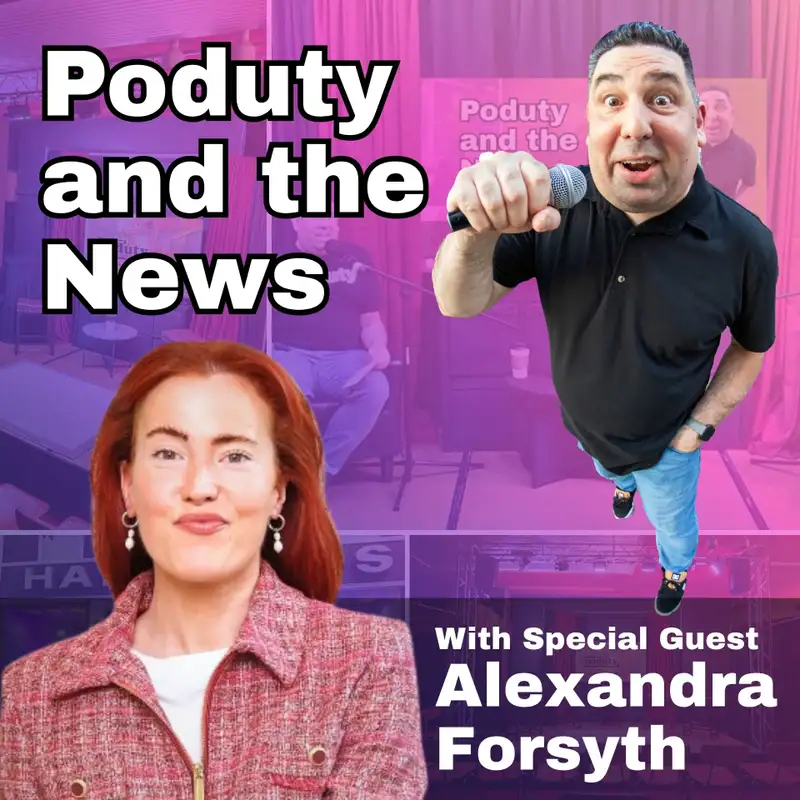
Hey everybody, welcome to Poduty and the News for Monday,
July 20th, 2026. We're recording a day early today. We have a very
special guest calling in from the future, about 5 hours
ahead of us today. We're gonna be dreaming big, talking human ROI.
Take a chance on me. It's Alexandra Forsyth.
Alexandra, you know what time it is? It's
human ROI time. What time is it?
What time is it?
Oh, oh, it's time for Poduty
and the News.
Poduty and
the News, the only live news
podcast about podcasting from the
state. Poduty and the News. Poduty
and the News, the only
live news
Oh, the only live news podcast about podcasting from the stage.
Alexandra, welcome to the show. Hello, it's lovely to be here.
So glad to have you here. We, we, uh, we actually featured you on
this show about 2 months ago, and I reached out, said, hey, we're gonna
have this, and We couldn't get a— trying to get a comment and your take
on it, but the next best thing happened is you were able to
book a time to get on this show. So now our first article
today, we're going to be talking about your article. So I'm really
excited to have you here. And we've been talking about— I mentioned dream big and
human ROI. And I know you're the host of the Take a Chance on Me
podcast— Take a Chance on You podcast. I'm not an ABBA— I'm singing an
ABBA song. We were watching
What's the musical with ABBA in it? I can't think of it.
Mamma Mia. We literally watched Mamma Mia last night. So
Take a Chance on Me. But the podcast, Take a Chance on You.
Alexandra, tell us a little bit about that show. So if I had a
dime for every time somebody said take a chance on me.
But I— yeah, so Take a Chance on You, I launched last year
around February time. And it was through human connection. So I
know we're going to talk a lot about that today. But originally, I went networking
when I moved to London. I moved to London for a corporate job,
so I wasn't necessarily lonely too much, but I did find that I needed
to meet people. So, I would go to networking events, I would introduce
myself, but then I'm quite empathetic, so I tend to
listen to other people's stories and resonate that way. And
people would just tell me about their challenges of, one, loneliness and
community and not having enough people around them or
resources. And I just thought to myself, I think it's time to create a
platform where people can come on and share their stories, and
then we offer strategies out to listeners. We talk about wellbeing a lot now,
so burnout, stress, anxiety, and resilience
plays a key part in Take a Chance on You. And the names in the
title for the guests, it's taking a chance on themselves to give
themselves time to self-reflect. I don't think we do it enough. And then
human ROI and dream big has naturally compounding
effect off the podcast. Yeah. Amazing. I've been combing through your
website. There's a lot of videos, a TEDx talk. There's
appearances that you've been on other podcasts. You have to check it out. It's your
name with a hyphen in the middle, right? Yes.
alexandra-foresythe.com. I'll have the
link in the show notes. And go ahead, check it out, connect with
Alexandra, learn more about the podcast, learn more about Dream Big and
Human ROI. Are you ready to get
into our stories? I am.
Our first story today is something you're
very familiar with. This is from Podcasting Today, and the podcast
industry is rapidly evolving beyond traditional audio and video
formats, with more creators embracing live events,
hybrid experiences, and deeper audience engagement. In an
opinion piece for Podcasting Today, podcast host and leadership
strategist Alexandra Forsythe argues that success is shifting
away from simply maximizing downloads and ad impressions
towards creating meaningful in-person experiences.
Alexandra believes podcasting offers a unique form of human ROI
that can't be measured through analytics alone. As creators
build stronger communities through live events, brand
partnerships, authentic conversations, as AI continues to
transform media marketing, Alexandra sees human connection becoming
one of podcasting's greatest competitive advantages and
definitely a page right out of our playbook. I read this article
and I said, this is the future. This is the direction we're hand— hand,
you know, moving towards. And yeah, I'm so glad that we connected and I want
to, I've been waiting to hear, uh, your full take on, on the piece that
you wrote. Yeah. So I think, I mean, recently I
attended Creator Fest, which is a 2-day event here in London talking
about the creator economy, not specifically podcasting. But the—
we talked about vanity metrics and we talked about likes, comments, and shares
just on social media, on posts. And it is getting to the point with
brands when they want to partner with creators, the same with podcasters,
they are starting to learn that you have to look beyond, like I said,
the downloads, the likes, comments, and shares, and
look at the podcast host or look at the creator and their story.
How did they get to where they got to? What type of person are they?
Can you curate a campaign together? That's what woman make
for the most effective partnership and longevity in
terms of your career as well in the future. And it's the same with podcasting.
I mean, for me, because the podcast started in person at
events, and naturally it snowballed from there, I've always said to
myself, I do see my podcast going
back to the people in person, so in real life. That's
always been the mission and the goal for me. For other people, it
isn't. They're happy enough to be in the studio, or they just want the audio
element and possibly not even the video. But again, And then I went to the
podcast show here in London in May, and a key
theme was video, video and audio combined.
So the landscape is just vastly evolving, and podcasting hasn't
really been around that long, a couple of decades now, I would
say. But it's shifting, and we too have to shift
with the times and tune into our audiences. I think it's doing
what's right for you as a host, but then also looking at your community and
your demographic. What do the listeners want? Mm-hmm. Yep,
people can download MP3 files all day long and listen to the audio,
listen passively, maybe a morning commute, on a morning run, or,
you know, just in the background at work. But when you're able to get in
front of people, when you're making eye contact, when you're, you know,
in act— you know, interacting in the moment, you know, seeing the
face of the host, how they react to a question from the audience, or,
you know, how their brain thinks in real time, When you're face-to-face,
that is a 10, 100-time multiplier
of a human connection being in the room where the
podcast is live or watching the livestream unfold.
You can't get that from those vanity metrics that you're talking about. Yeah, you could
upload a TikTok that maybe gets 10,000, 20,000 views,
but what's the retention on that? Do people remember your brand? Yeah.
Did it drive podcast Other numbers, other
metrics, did it have any value to it compared to the
value of being in front of people? Maybe an audience of 10 or
20 people might actually be worth 10,000 or
20,000 downloads with the amount of connections you'll make in that, even in
that little tiny room. It's so much more important to be with
people. Well, I gave a talk at the podcast show and
there were around 40 to 50 people in the room. Pretty
much each and every person talked about loneliness in their independent
journey towards creating their podcast. And I would never have known
that had I not have been in that room. So, just by, I mean, we
were building a community in real time together, going back and forth,
talking, because I've gone through loneliness with the podcast. It's, I
don't think we talk enough about the backend and production and what actually goes
into building a podcast. Jeff, I'm sure you feel the same.
You're just wearing multiple hats and it is really hard. And I think because we,
Like I said, because we don't talk about it all the time, when reality
strikes and you think, oh my God, I've got to do X, Y, and Z.
So, I also think it's time that we start doing that a little bit more
and actually talking about the journey. I'm all for successes,
but the challenges is where people
build trust. Yeah, there's nothing replaces
it. And I'm apparently, I built a theater space, right, to have live podcasts. I
love this. I'm very bullish on live events and human
connection. We had some great events over the weekend. We had a
music act come through on Friday. We had a history
story, a podcast come through about a gentleman in the Great
Depression who hitchhiked across the United States, all
48 continental states on 48 cents. And it
was just a tremendous experience. They made a documentary about this gentleman.
His son was here who wrote a book. So to be in the room, to
hear that history from 100 years ago being told
live on stage, they had video clips from
reenactments, and you can't get that from just an
MP3 file. But to be here, that history came alive,
and it became a new experience. It's a new form of entertainment,
live podcasting. Yeah. It really breaks boundaries. It
breaks that fourth wall that you hear about on television where
All of a sudden they start talking to the audience. Well, that's literally happening when
you go see a live podcast. It's an experience unlike anything else.
Yeah. And I don't know, I mean,
Twitch and Roblox, for example, this has come into conversation. They
used to be for just gaming, but actually we're starting to see a shift
within apps and live streaming, just turning on your camera and
starting to have a conversation with the audience. in real time, what's to stop you
doing that with podcasting? Because when you're recording in the studio, you could always
just turn your camera on and have a conversation with your audience.
I think it's— the boundaries are being blurred, but in the best way.
What we've come to know podcasting as is— it's evolving, as I
said at the beginning, and it will continue to. Yes,
and speaking of making that connection, how about celebrating 3 years of
Media With a live podcast, a livestream, and a
subscriber party, kind of bringing all these things that we're talking about together.
Independent journalism outlet 404 Media is celebrating its 3rd
anniversary by hosting a 2-day event centered around its
community of paying subscribers. On September 3rd, the team
will record a live episode of the 404 Media podcast
at WNYC's Green Space, featuring discussions about
the future of independent journalism, AI data center resistance,
and science reporting. The event will also be livestreamed for
remote supporters. The celebration continues the following evening
with an anniversary party at Threes Brewing in Brooklyn,
where subscribers receive free or discounted admission based on their
membership levels. The event highlights how live
experiences can strengthen subscriber relationships while creating additional
value beyond digital content.
This is something I'm just in love with. You're having a
3-year anniversary tour or anniversary, and you're having a
2-day event with your subscribers, with your fans, with the
people who are supporting you. They're watching the videos, they're reading the
articles, they're downloading the content, and
now it's like the celebration. It's a reward for being
a loyal member. You get to meet the staff, you get to
see the authors who are writing the articles, the
videographers who are creating the content, the podcasters making the podcast.
Now it's all in one room for one big celebration. I love
that. And again, it goes— I think there's 2 points. My first point is
what I said about production in the backend, not talking about it enough, not seeing
the people behind the camera. So often you see the host and so often you
see the guest, but how often do you see, as you say, the videographer, the
person who's doing the lighting, the sound, or editing? I think it just, it
shouldn't take away the magic, and I said this time and time again, it should
elevate your story and your brand even further,
because people don't just imagine Geoff the host, or
Alexandra the host, or the guests, they imagine everybody else behind
the scenes, and again, it builds this camaraderie amongst,
amongst the brand, amongst the company, essentially, behind the whole thing. And
then, my second point is, I love the use of VIP. I've
always said, everybody wants to feel like a VIP, especially
your community, They want to feel like the most important person in the room. And
I mean, I think I can still remember the first person that started
subscribing and following the podcast. So it's, yeah,
you just— serendipity. You just got to keep people on their toes.
Yeah, even keep them guessing by location. Our next story
takes them— the Philadelphia Phillies podcast, they're going—
oh, what happened here? But also, Jeff, back on that
story, just one second. Yeah, yeah. Isn't it interesting how they're talking about
data centers? It's quite a hard-hitting topic
to be talking about at the event. Oh, we did.
But the— yeah, part of— they are— this media
company is very driven on human-created
articles, human-created content, and they are resisting data
centers and they're resisting AI. Yeah. Which I thought was a
great tie-in with human ROI. This media company
really wants to make sure that you know who's creating the content,
who's behind the content, and that's part of what they're
doing and what they're celebrating. Yeah, yeah, it makes sense.
We'll keep it moving. We'll go— here's a remote appearance.
You would see these 20 years ago with radio stations doing remote appearances,
but Uh, this one here, this is a Philadelphia Phillies
baseball team podcast. They go— they went to Ocean City
Boardwalk, so they're just right on the boardwalk. If you're watching the video, you can
see all the, the people walking back and forth behind them. It's a
pretty great experience. As, as the Philadelphia Phillies return from the MLB
All-Star break, The Phillies Show is taking its podcast
directly to the fans. On July 17th, host
Todd Zalecki of MLB.com Jim Salisbury
of NBC Sports Philadelphia and former Phillies general
manager Ruben Amaro Jr. recorded a live episode from
Manco and Manco Pizza on the Ocean City, New
Jersey boardwalk. The event featured guests
Charlie Manuel, who managed the Phillies to their
2008 World Championship, and former Phillies manager and
player Larry Bowa. Fans could attend the live recording in
person or watch and listen later across the
show's podcasting and streaming platforms.
And here's one, you got a live experience. So if you're a sports
fan and you're, you know, you're thinking, okay, I need to get away,
Philadelphia to Ocean City, I don't believe is too far away. Maybe it's an
hour drive. But hey, you're going to get out for the weekend, go grab a
slice of pizza at this pizza shop. So You're going to support a local business,
have a live event, meet some legends of the sports
team, and have this great conversation celebrating
baseball, celebrating the All-Star Game that just happened, and
pulling all that together with the fans, the hosts, the TV
personalities. They're all there really just sharing
their love of baseball. They're— and they're going where their audience is, right?
If you're going to have a show, And you're going to go to the beach
where people who love baseball are hanging out, they're on vacation. Here's a little
bonus for your vacation. Come see a live podcast about
baseball and have a night that you just couldn't recreate
through just a digital download. I think it's just
appreciation as well. As you say, taking it to the people,
making it easy for people to show up as well, and the fan
experience. We just finished the World Cup. We've been
talking about it in my workspace today. Obviously,
congratulations to Spain. But you do really, I mean, you
look at the stadium and it's filled with 80,000 fans. All of these
people just absolutely adore sports. So it
means a lot. And yeah, we can never forget that, especially in sports. I think
sports, out of all industries, the fan experience is the most
important part of it. Yeah, and it's something that really
expands beyond the game. And that's something I think this podcast is capitalizing on is,
That fandom doesn't just live on game day. It's 7
days a week, 24 hours a day. All year round. Yeah. And if you can
have a live event with your fans, you know, at a pizza shop, getting
pizza and beer and talking sports, you know, what a better night out.
And I think it also humanizes the experience. And we
talk about human beings a lot. I think
sometimes, and it's no fault of anybody's really, but when you're
watching a game on TV or on your phone or on social media,
sometimes it can feel quite unattainable. I'm never going to get to see my
favorite player. I can just see them through the screen. But actually being able to
see them in front of you humanizes the experience. And also, of course, you get
to ask your questions that you've been dying to ask them and get the answers.
And yeah, I love the element of humanizing experiences because
we're all human beings, so we should be connecting together.
Yeah. Where else can you be a part of the show? You can't, you can't
go on TV. You know, you're not going to be a call-in host on, on
most television shows in, in 2026. So to be in the
room where they're having the show about the thing that you love and you're
participating and you're, you're asking questions of the host to these
legends of the game, it's just, it just takes that
experience to the next level. It, it really builds on that fandom
and makes a connection that's so much deeper than just listening passively
on a radio or Or downloading a podcast episode. And I
also think surroundings plays a big
part in your career success, etc., who you surround
yourself with. So to be with top achievers, say in sports,
it will naturally make you want to elevate yourself. If you have dreams to be
in a similar position, it will help you get there. So I think
that's also huge. Yeah, and also huge,
guess who else is leaning in on live events, live
programming, Podcasts, and they're kind of,
you know, you think Netflix, you think, okay, the algorithm is going to bring me
a show, it's going to figure out what I like and suggest more of that.
But Netflix is also realizing, hey, people that listen to podcasts, they're
invested a lot more. They're listening and staying on, on, on
app a lot longer. Live programming, people watch a lot
longer when there's live programming, and the cost to produce these aren't
as much as those you know, billion-dollar mega franchises.
They're able to produce this at a relatively, you know, uh,
inexpensive— quick— the— as subscriber growth begins to
slow, Netflix is expanding beyond on-demand entertainment by
investing in live programming, podcasts, and AI. According
to CNBC, the company is seeing increased watch time as it
experiments with new formats that encourage audiences to engage
in different ways. Live, live events and podcast-related content
are becoming part of Netflix's broader strategy to keep viewers
connected to the platform, while AI is being used to improve the user
experience and support content discovery. The
shift reflects a growing trend across the media industry as
platforms look for new ways to increase engagement
beyond just traditional streaming.
I'm not surprised, to be honest. I, if anything, I'm
more surprised that Netflix have taken so long. I thought they would have been
hot on this a little bit sooner, earlier in 2026, but I guess
it's better late than never. I think—
too many thoughts. I, one thing that I love about
podcasting is that now, say with Netflix, for example, moving
slightly into the TV show programming,
arena is that you don't necessarily have to stick to a script. So, with
podcasting, we've always said to ourselves, okay, season 1, season 2,
season 3, maybe 15 to 20 episodes, and then we take a
break and we come back and then we're on to the next season. I do
think it's a bit more free flow. At least, that's what I'm doing at the
minute. I'm just putting out episodes. I'm going with the flow.
I still do one per week and then some short mini clips, but I don't
necessarily think to myself, right, I've got to end this season and then move on
to the next. I think, again, some of the trends we're seeing is
Churning out content the way you want to, what suits you.
Yeah, and it's a great play. You know, people have been
subscribing for years now, 10+ years subscribing services, so
they're, they're reaching a maturity. So there's only 2 more ways.
You can either find new subscribers, you can increase the rates every month,
or, you know, or you can really increase satisfaction to reduce
cancellation. So What you're seeing, I think, part of Netflix's strategy is
if we engage more people and give them current events,
current things that are happening, that are streaming live,
podcasts with fresh content, those are sticky
things that keep subscribers around. What are they doing? They're making
real-time connections, right? They're building an audience of loyal people
who want fresh and current and up-to-date information.
they're going to find that on these streaming platforms. And I think also
authentic content, so it's real
stories, lived experiences, that I feel like that's what people are really
looking for, not just within podcasting but TV,
media, entertainment, the creative industry. So I think the
outside world can be so uncertain at times, we want
to be able to come into a community and feel like it's
It's where we want to be. Speaking of
uncertain times, how about going to an open
mic and they have a podcast show show up? Bullseye with Jesse
Thorne took an unconventional approach to live podcasting by
surprising attendees at an open mic night at Lyric
Hyperion Theater in LA with a live interview
featuring comedian and writer Guy Branum, created as a
reward for supporters of Maximum Fun during its annual
membership drive. The event blended comedy, music, and
podcasting into a single experience. The interview was
recorded before a live audience, later released as a podcast
episode, and published on YouTube, extending the event
well beyond the people who attended in person. And I
should say, before I say though they just crashed the open mic, they did
make arrangements ahead of time. But it was a surprise. to
the audience that, okay, we're here for open mic night and all of a sudden
a celebrity shows up to do a live podcast. You know, it was an added
bonus and it seemed to be a great night and the audience was all about
it. I kind of love that and I think
people don't know what they don't know. So if you show up and you're recording
a podcast, people will enjoy it. I
don't know, I think I remember the early days when I was recording
Take a Chance on You, and I would invite guests on, and they'd never been
on a podcast before. By the end, they wanted to do more public speaking
and be on further podcasts because they enjoyed the experience so much. People don't
know what they don't know unless you put it in front of them. So, it's
the same with the open mic. They've taken it there, and people
resonate, they follow along, and before you know it, you've got new people within
your community. So, I think, don't stop
trying, and don't stop looking for new ways to reach
people and new audiences. 'Cause you're never done. I
think with podcasting, with TV, with entertainment, with
media, you're never done. Yeah. And the
live experience, again, the, this new form of entertainment that's, that's becoming
more and more prevalent in, in different areas. We see it at
conferences a lot where 10 years ago it would be a
panelist of, of 4 people, probably selected by the
sponsor of the conference who was just trying to
implant like some of their executives to get on, get some stage
time. But we're seeing that get replaced by live
podcasts from people within the industry who are experts in the industry,
livestreaming the industry. And you're getting that here. Here's a comedian who's gone on,
had a tremendous acting career, has written some great things, going
back to the roots of a comedy club where probably tested out some of this
material and telling the story, telling the history of, I
started on this stage, And I've grown to be a major
player in Hollywood. And for the people in the audience, that's what they're hoping.
They're hoping to make these connections at open mic, follow the
career, and see how they grow, see how they
develop over time. And you're getting that full story in one night.
You know, what an add-on. I think it's great. And also,
if I think about live activations and what I'm trying to do with Take a
Chance on You, As you say, at conferences, the landscape's changing.
Live podcasting is becoming a thing, but also just the dynamics
of events is also shifting. People want more. So,
with panel discussions, with keynotes, people want more strategy, more
action. So, I think podcasting is a fantastic way to kind of
infiltrate into these spaces. At least that's what I'm trying to do,
and I seem to be the only one really doing it on the live event
space here. in London, so it'd be good to see more of it.
And we have one last story remaining, and then again, live.
Live is such a big part of what I believe the future podcast—
like Alexandra said, we hear so much about audio and video. Video is kind of
the focus right now, but I think both of us agree that
beyond video are these connections, are these live
events, it's getting in front of people and performing your show
and This was a tour that came up as kind of a review, a
look back. And since launching in 2020, Trash Taste has
grown from a long-form anime podcast into a global
creator brand by combining video, audio, live events,
and social media. Hosted by Joey the Anime
Man, Garrent Gigguk,
and Connor CDawgVA, the show expanded from
studio recordings into sold-out theater performances and
convention appearances where the audience participation
and live interaction became central to the experience. Rather than
simply recording the podcast on a stage, the hosts built
live shows around games, Q&A sessions, and
improvisation, creating memorable moments that continue to
influence future podcast episodes. Their approach demonstrates how
niche podcasts can evolve into multi-platform
entertainment brands built around community and
shared experience. I love that. I love
their names as well. But I agree,
I think audio, video, live events, it's very much merging together,
and it's just always finding ways to reach new
people. Yeah, taking the show on the road and just
performing and We'll talk more and more. And, you know,
I think we— I've done maybe 75, 80 shows of this podcast.
Every week I'm coming to you with 6 new stories about live podcasting. So
this is happening all around the world. And, and I, I believe—
I don't remember where they were from, but they've done tours through the
States, through Australia, through Europe. They've been around
the world taking their podcast, this media asset that they created
they've taken it on tour. They've taken it from town to town, city
to city, and they're performing versions of it live in front
of an audience. And, and that's really where I think the future of
podcasting is going, is these immersive experiences,
these real-time events face to face with people. They
can't be beat as far as a night out or a form of entertainment.
I, I just don't think there's anything better, especially When you compare
the value, you know, a live podcast might be
$25 to $50 compared to a
concert that might be $300 for a ticket. So,
you know, they're very affordable, they're very approachable for most
people to get out there and really participate in events
like this. And I also think book tours,
for example, more people going on the road talking about their writing, you
can merge that with a podcast. If you have a podcast, you're writing a
book, and you publish the book, You can merge them together,
and oh my God, what a fantastic experience that would be for your core
community, because they're not only getting to see the host, but they're getting to see
the writer, etc., etc. And so, you can really
expand your portfolio with your community.
I think it's just being open-minded. I think with podcasting now, it's just
remaining open-minded. Live events are the future. I think it's a lot to do with
feeling and emotion. People want to feel something,
and Human touch, connection. We said that
throughout. Can't be understated. Yeah.
And like you're mentioning, a couple of the events that we covered tonight talked about
recording that episode to have an asset for later release.
They would release it on video, they'd release it as a podcast. So a
book tour is a great example. You go around, go to different bookstores, do some
Q&A. Now you have a podcast, you have a video episode.
Yeah, absolutely. I think it's, yeah, like I said, people
just need to remain a little bit more open-minded. I think because
I also do a lot of public speaking, and I have done for years, so
podcasting wasn't my first rodeo in front of an audience. I've been
travelling, talking to different people, so podcasting was, to be honest,
naturally an extension of what I was already doing. But that's another prime
example. If you're doing public speaking, depending what industry, you can merge
the two together. It shouldn't, It shouldn't feel hard
to do any of these things. Live events shouldn't feel hard. It should feel
like a natural progression. Yeah,
and I hope we continue to stay in touch. I hope to continue following
more and hearing more opinion pieces about the future, which
is really, you know, I can't stress enough that
these face-to-face human connection, even livestream, you
know, in-person events, These are the future things that a
lot of independent creators, a lot of independent media companies,
that's what they're building towards. They know that the value is face-to-face
and they want to connect. And I just, I see this growing so much in
the next 3 to 5 years. Gosh, this time next year, I
think, what will we be saying in the summer of 2027? Who knows?
I can't wait. I can't wait to see you then. And the last thing we
do before we say goodbye is I'd like to turn the stage over to you
one last time, Alexandra. You can plug, promote, talk
about anything, anything you'd like. I'm
terrible at this. I'm terrible. I don't even do it on my own. I'm
awful, but okay. Okay. The floor is yours.
It's been an absolute pleasure to be here talking to Jeff about all things live
events. As I say, I'm the host of Take a Chance on You,
a UK-based podcast. I'm based in London, but we're
transatlantic. So we've had guests from the US, from different parts of
Europe, and I'd love to have you as part of this
community. You can find us on all social media channels. You can
follow on Spotify, Apple, and YouTube. You can listen to the audio, you can
watch the video. We are experimenting with live
activations, and I look forward to speaking to
many of you soon. Please don't hesitate, hesitate to get in touch, and thank you
very much. Well, thank you. Thank you. I got one
last question for you. Do you remember
what time it was? Human ROI time.